



Reya – Project Introduction and Potential Analysis (Perp DEX Based on ZK-Rollup on Ethereum)
2026/04/04 04:45:03
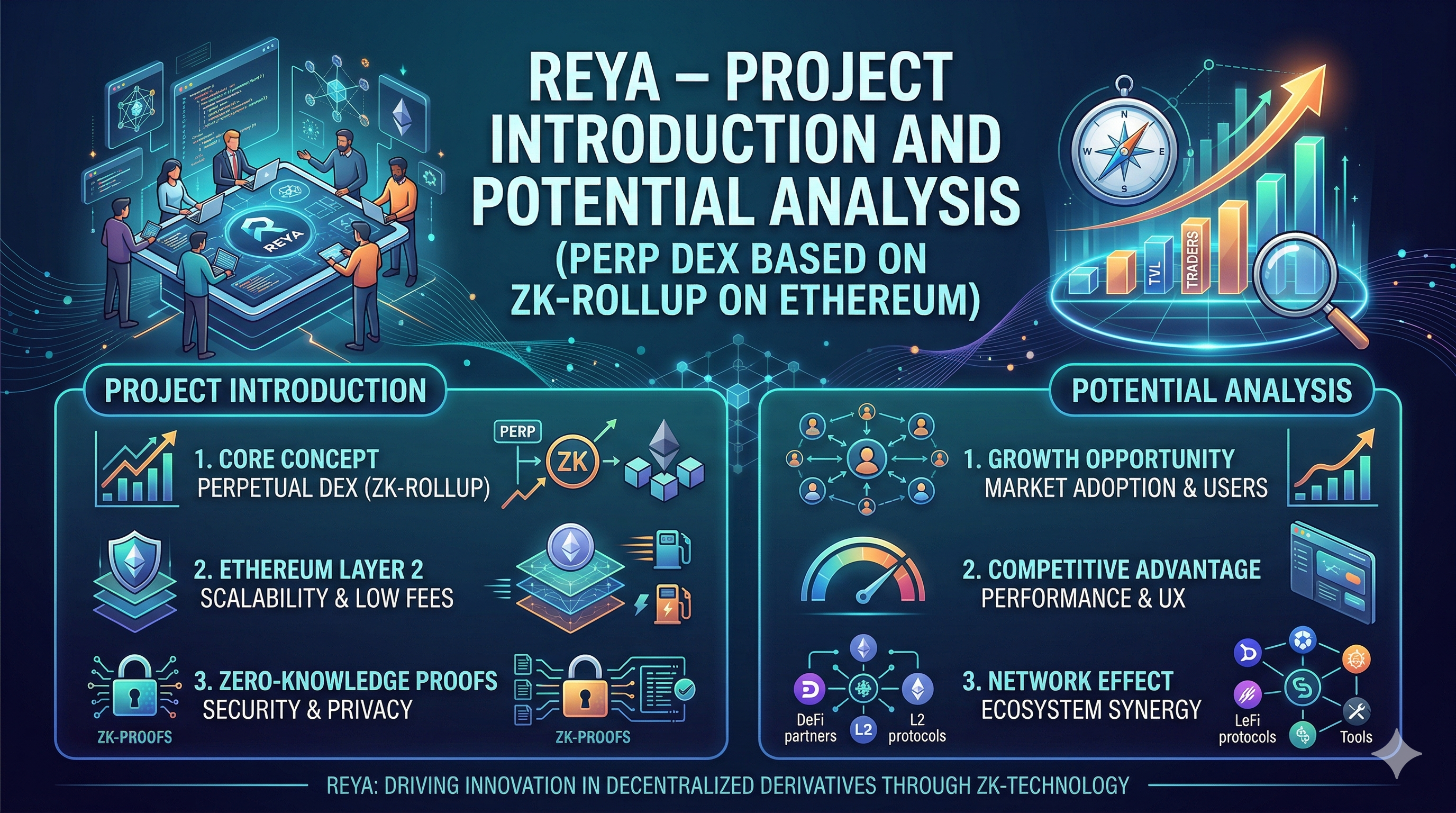
Reya introduces a more specialized approach to decentralized trading infrastructure, focusing on the specific demands of high-frequency derivatives markets instead of broad, general-purpose blockchain use. Through a combination of a performance-focused Layer 2 design, zero-knowledge technology, and its “based rollup” structure, the project aims to improve execution speed, trade efficiency, and capital utilization while still relying on Ethereum’s security foundation. Its development highlights a wider transition within DeFi, where platforms are increasingly engineered for specific financial functions rather than serving as one-size-fits-all systems.
A New Category of Trading Infrastructure Is Emerging
Decentralized finance has entered a phase where specialization is replacing general-purpose design. Early DeFi protocols were built on broad Layer 1 networks, which forced every application, from lending to trading, to compete for the same block space and execution resources. This model created bottlenecks, especially for derivatives trading, where latency and execution precision are critical. Reya enters this space not as just another decentralized exchange, but as a system designed entirely around trading performance. It operates as a trading-focused execution layer that aligns closely with how modern financial markets function.
The concept behind Reya reflects a growing realization: financial primitives such as perpetual futures require infrastructure tailored to their mechanics. Traditional blockchains struggle with order book systems due to latency and congestion. Reya’s approach restructures the architecture itself, prioritizing execution speed and deterministic ordering. This is not a minor upgrade; it represents a structural shift in how decentralized trading venues are built. According to Bitcoin.com, Reya introduces a specialized execution layer to address the mismatch between general-purpose blockchains and the needs of high-frequency markets. That framing positions Reya less as a product and more as a foundational layer for trading, which significantly expands its long-term relevance.
What Reya Actually Is: A Perpetual DEX Built as a ZK Rollup
Reya operates as a perpetual futures decentralized exchange built on a zero-knowledge rollup architecture anchored to Ethereum. It combines two roles into one system: a Layer 2 network and a trading platform. This dual identity allows it to control both execution and settlement, creating tighter integration between performance and security. Perpetual futures, or “perps,” are derivatives that allow traders to speculate on asset prices without expiry, making them one of the most active segments in crypto markets.
The technical backbone of Reya is its ZK-rollup design, where thousands of transactions are processed off-chain and then verified on Ethereum using cryptographic proofs. This approach significantly reduces computational overhead while maintaining verifiability. Reports indicate that Reya achieves sub-millisecond execution speeds while preserving Ethereum-level security guarantees. That combination is critical because it closes the performance gap between decentralized and centralized exchanges, which has historically limited DeFi adoption among professional traders.
Reya also integrates self-custody, allowing users to retain control of their funds while interacting with the exchange. This removes the counterparty risk associated with centralized platforms. The system supports multiple markets, including crypto assets and real-world assets, positioning it as a multi-asset derivatives venue rather than a niche trading tool.
The “Based Rollup” Design That Sets Reya Apart
At the center of Reya’s architecture is its “based rollup” model, a relatively new concept in blockchain scaling. Traditional rollups rely on centralized sequencers to order transactions, which introduces potential risks such as censorship or downtime. Reya eliminates this dependency by integrating sequencing directly with Ethereum’s validator ecosystem. This design removes a major single point of failure and aligns transaction ordering with the broader Ethereum consensus layer.
The implications of this approach are significant. Instead of relying on a single operator, Reya distributes responsibility across multiple participants, increasing resilience. It also introduces deterministic ordering, which is essential for financial markets where execution fairness matters. The system uses zero-knowledge proofs to validate batches of trades, ensuring that all transactions are processed correctly before being finalized on Ethereum.
Technical documentation highlights that this architecture allows Reya to deliver “TradFi-level speed” while maintaining decentralization. This is a notable claim because traditional finance systems operate on highly optimized infrastructure that has historically been difficult to replicate on-chain. By bridging that gap, Reya positions itself as a serious contender in the derivatives trading space, rather than just an experimental DeFi project.
Speed as a Core Competitive Weapon
Execution speed has long been one of the biggest weaknesses of decentralized exchanges. Traders operating on traditional DEXs often face delays, slippage, and unpredictable fees. Reya tackles this problem head-on by designing its system for ultra-low latency. Reports indicate execution speeds below one millisecond, with some claims reaching as low as 0.1 milliseconds.
This level of performance changes how traders interact with decentralized platforms. Strategies that were previously limited to centralized exchanges, such as high-frequency trading and advanced arbitrage, become feasible in a decentralized environment. It also improves user experience by reducing waiting times and increasing execution reliability.
The speed advantage is achieved through a combination of off-chain execution and efficient batching of transactions into ZK proofs. This reduces the computational load on Ethereum while maintaining security guarantees. The result is a system that feels closer to a traditional exchange interface, which is critical for onboarding professional traders.
Speed is not simply a technical feature; it is a strategic differentiator. In derivatives markets, milliseconds can determine profitability. By focusing on execution performance, Reya aligns itself with the needs of serious traders, which could drive sustained adoption.
Market Traction and Real Usage Data
Metrics provide a clearer picture of whether a protocol is gaining real traction. Data from DeFiLlama shows that Reya has processed over $114 billion in cumulative perpetual trading volume, with monthly volumes exceeding $11 billion. These figures place it among the more active decentralized derivatives platforms, indicating that its infrastructure is being used at scale.
The platform has also generated consistent fee revenue, with annualized figures reaching into the millions. While revenue alone does not determine long-term success, it reflects sustained user engagement. Trading volume, open interest, and liquidity are stronger indicators of a platform’s relevance in derivatives markets, and Reya shows meaningful activity across these metrics.
Growth in decentralized perpetual exchanges has accelerated in recent years, driven by demand for non-custodial trading solutions. Reya’s positioning within this trend suggests that it is benefiting from broader market dynamics rather than relying solely on hype. The data indicates that users are actively trading on the platform, which strengthens its credibility as a functioning exchange rather than a speculative project.
The Ecosystem of Perp DEXs
The perpetual DEX sector has become one of the most competitive areas in DeFi. Platforms are competing on multiple fronts, including speed, liquidity, incentives, and user experience. The success of earlier platforms demonstrated that there is strong demand for decentralized derivatives trading, but it also raised the bar for new entrants.
Industry analysis shows that competition has shifted from purely technical improvements to incentive design and ecosystem growth. This means that technology alone is no longer sufficient; platforms must also attract liquidity and maintain active trading communities. Reya enters this environment with a strong technical foundation, which gives it an edge in performance-driven use cases.
Its architecture allows it to compete not just with other DEXs, but also with centralized exchanges. That broader competitive scope is important because it expands its potential user base. If Reya can maintain its performance advantage while building liquidity, it could position itself as a hybrid alternative that combines the benefits of both models.
Execution Quality and Market Structure Design
Execution quality is often overlooked in casual discussions of trading platforms, yet it is one of the most important factors for professional users. Reya addresses this through deterministic ordering and FIFO (first-in, first-out) mechanisms, which reduce the likelihood of unfair trade execution. This design minimizes front-running and improves fairness across participants.
The platform also incorporates MEV resistance strategies, which aim to reduce the impact of malicious ordering practices. MEV, or maximal extractable value, has been a persistent issue in DeFi, where certain participants can exploit transaction ordering for profit. By addressing this at the architectural level, Reya enhances trust in its execution environment.
This focus on market structure aligns with how traditional exchanges operate, where fairness and transparency are critical. It also reflects a broader trend in DeFi toward improving execution quality rather than just increasing throughput. According to technical breakdowns, Reya’s system integrates these features directly into its rollup design, creating a more predictable trading environment.
The Role of Ethereum Security in Reya’s Design
Reya’s architecture remains deeply connected to Ethereum, which serves as its settlement layer. This connection provides access to one of the most secure and decentralized networks in the blockchain ecosystem. Transactions processed on Reya are ultimately verified and finalized on Ethereum, ensuring that the system inherits its security guarantees.
This approach allows Reya to balance performance and trust. Execution happens off-chain for speed, while settlement occurs on-chain for security. The use of zero-knowledge proofs ensures that all off-chain activity can be verified without exposing sensitive data.
Ethereum’s validator network plays a crucial role in maintaining the integrity of the system. By leveraging this infrastructure, Reya avoids the need to build its own security model from scratch. This significantly reduces risk while allowing the platform to focus on optimizing trading performance.
Capital Efficiency and Product Expansion
Reya is not limited to perpetual futures. Its roadmap includes support for spot trading, staking, and real-world assets, creating a more comprehensive trading environment. This expansion reflects a broader trend in DeFi toward integrated platforms that offer multiple financial products within a single ecosystem.
The platform also emphasizes capital efficiency through features such as unified margin accounts. This allows traders to use their capital more effectively across different positions, reducing the need to allocate funds separately for each trade. Capital efficiency is a key factor in derivatives markets, where leverage plays a central role.
Reya aims to create a “permissionless venue” where multiple asset classes can be traded seamlessly. This vision aligns with the idea of on-chain capital markets, where users can access a wide range of financial instruments without intermediaries.
Institutional Appeal and Market Direction
Reya’s design appears to target a more advanced segment of the market, including institutional and high-frequency traders. Its focus on execution speed, reliability, and capital efficiency aligns with the requirements of these users. This positioning could differentiate it from platforms that primarily cater to retail participants.
The integration of programmatic access and advanced trading tools further supports this direction. Professional traders often rely on automated strategies, which require stable and predictable execution environments. Reya’s architecture is built with these use cases in mind, suggesting a deliberate effort to attract sophisticated participants.
This shift toward institutional-grade infrastructure reflects a broader evolution in DeFi. As the market matures, platforms are increasingly designed to meet the standards of traditional finance while retaining the benefits of decentralization.
Challenges and Open Questions
Despite its strengths, Reya faces several challenges that could influence its long-term trajectory. Liquidity remains a critical factor, as even the most advanced technology cannot succeed without active market participation. Building and maintaining deep liquidity pools requires sustained incentives and user engagement.
The complexity of its architecture may also present barriers to understanding for less technical users. While the platform aims to simplify the user experience, the underlying system remains highly sophisticated. This could limit adoption among casual traders.
Decentralization is another area to watch. While the based rollup model reduces reliance on a single sequencer, the distribution of responsibilities across participants must be robust enough to prevent coordination risks. Data from L2BEAT suggests that some aspects of decentralization in Layer 2 systems are still growing.
Conclusion: Reya as a Signal of Where DeFi Is Headed
Reya shows a clear shift in decentralized finance toward purpose-built infrastructure. Its design prioritizes trading performance, execution quality, and capital efficiency, addressing the limitations that have historically held back decentralized exchanges. By combining ZK-rollup technology with a trading-specific architecture, it creates a system that feels closer to traditional financial platforms while maintaining the core principles of DeFi.
Its growth in trading volume and user activity suggests that there is demand for this type of infrastructure. Whether Reya can sustain this momentum will depend on its ability to attract liquidity, maintain performance, and continue evolving its product offering.
The broader implication is that DeFi is moving beyond experimentation into specialization. Platforms are no longer trying to do everything; they are focusing on doing one thing exceptionally well. Reya’s approach places it at the forefront of this trend, making it a project worth watching as the next phase of decentralized markets unfolds.
FAQs
-
What is Reya in simple terms?
Reya is a decentralized exchange focused on perpetual futures trading, built as a high-speed Layer 2 network on Ethereum.
-
What makes Reya different from other DEXs?
It uses a trading-specific ZK-rollup architecture designed for ultra-fast execution and better trading performance.
-
What can you trade on Reya?
Users can trade perpetual futures and potentially spot assets and real-world assets as the platform expands.
-
Is Reya fast compared to other platforms?
Yes, it achieves sub-millisecond execution speeds, which is significantly faster than most decentralized exchanges.
-
Why is Reya important in DeFi?
It represents a shift toward specialized infrastructure designed specifically for financial markets.
Disclaimer
This content is for informational purposes only and does not constitute investment advice. Cryptocurrency investments carry risk. Please do your own research (DYOR).