

KuCoin Ventures Weekly Report: Liquidity Reset and Industry Paradigm Shift — U.S. RWAs Pilot Mortgages, Miners Pivot to AI, and Capital Continues to Bet Heavily on Prediction Markets
2026/03/31 16:21:02

1. Weekly Market Highlights
Deeper RWA Adoption: Digital Assets Begin to Tentatively Enter the U.S. Housing Finance Market
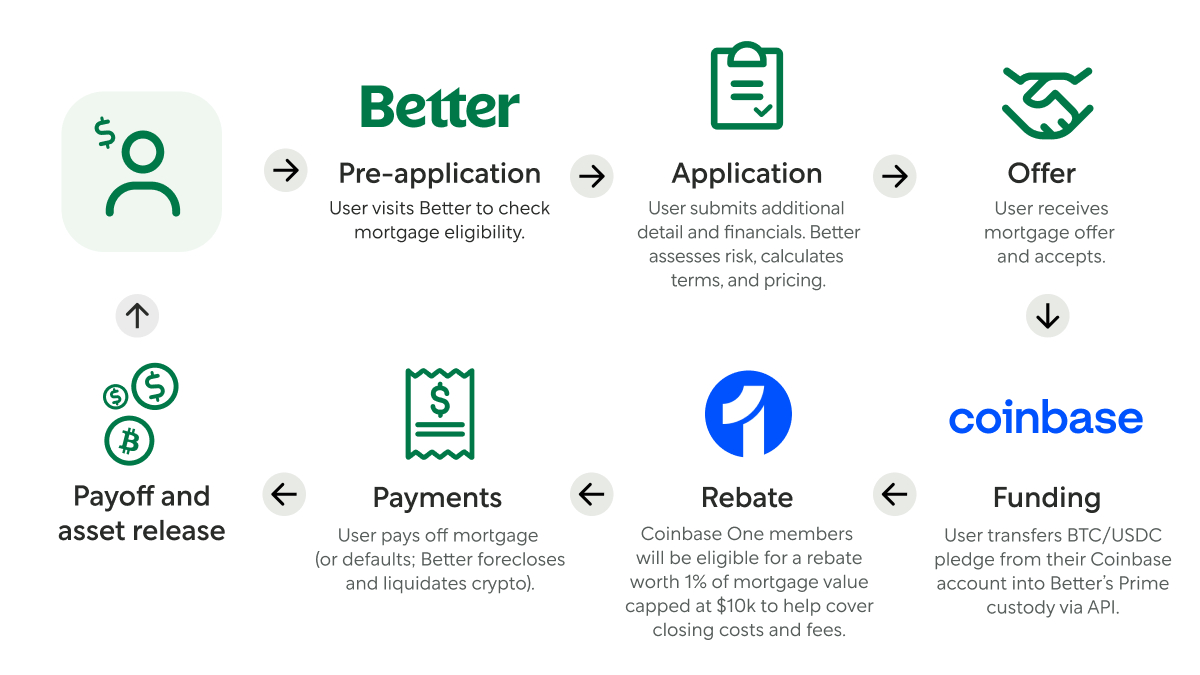
On March 26, Better and Coinbase launched a digital asset-backed home financing product. Eligible borrowers can pledge BTC or USDC, obtain a separate private financing loan from Better to cover the cash down payment gap, and simultaneously apply for a conforming mortgage that meets Fannie Mae standards. This allows homebuyers to complete a home purchase without selling their digital assets and potentially avoid triggering a taxable event through early liquidation. The most important development at the product level is not that “Bitcoin can now directly buy homes,” but that digital assets are, for the first time in a relatively standardized way, entering the mainstream U.S. housing finance process.
Data Source: https://www.businesswire.com/news/home/20260326569749/en/Better-and-Coinbase-Launch-the-First-Token-Backed-Conforming-Mortgage
Better is a U.S. online mortgage and home equity lending platform, and one of the few publicly listed AI-native housing finance companies, with cumulative funded volume exceeding $110 billion. For Better, this product serves two purposes: it opens access to a new customer segment of digital asset holders, and it provides a new conversion path for borrowers who may be short on cash for a down payment but are not lacking in assets, particularly in a high-price, high-rate environment. According to market research cited in Better’s official press release, around 52 million U.S. adults, or roughly 20% of the adult population, hold digital assets. At the same time, a 2025 Redfin survey showed that 12.7% of Gen Z and Millennial homebuyers had sold crypto assets to fund a down payment, compared with just 3.5% of Gen X and 0.5% of Baby Boomers. This suggests that digital assets have already started to function as a source of home purchase funding, though until now mostly through liquidation. Better × Coinbase is attempting to shift that step from “sell first” to “pledge first.”
Structurally, however, this does not mean that Fannie Mae has begun directly accepting Bitcoin or stablecoins as down payment assets or mortgage collateral. Under Fannie Mae’s current guidelines, virtual currency used for down payments, closing costs, or reserves must still be converted into U.S. dollars and verified before closing. What Better has introduced is an additional layer of down payment financing backed by digital assets, layered on top of a standard Fannie Mae-compliant mortgage. Fannie Mae is still guaranteeing the traditional conforming mortgage itself, while the digital assets sit in the financing layer outside the mortgage underwriting perimeter. This is also why Better emphasizes in its press release that the product remains a standard mortgage, comparable to other conforming mortgages, and can therefore benefit from rates significantly lower than those of traditional token-backed loans. Fannie Mae itself remains one of the most important pillars of the U.S. housing finance system, with its guaranty book reaching approximately $4.1 trillion by the end of 2025.
From a product design perspective, the structure is already fairly complete. The initial collateralization ratio is 250% for BTC and 125% for USDC, translating into down payment credit lines equal to roughly 40% and 80% of pledged collateral value, respectively. More importantly, the product does not require margin calls: BTC price volatility will not trigger additional collateral requirements, forced liquidation, or mortgage repricing. As long as the borrower remains current on payments, market price fluctuations alone do not trigger liquidation. Better may only liquidate the pledged digital assets after the borrower becomes 60 days delinquent. For USDC-backed borrowers, the product also allows users to continue earning rewards, partially offsetting mortgage costs. In addition, Coinbase One members who obtain either a token-backed mortgage product or a standard mortgage through Better are eligible for a rebate equal to 1% of the mortgage amount, capped at $10,000, which can be used toward closing costs and related transaction expenses.
Viewed in the broader evolution of RWA, the significance of this step is not that real estate itself is becoming further tokenized, but that digital assets are beginning to enter large-scale real-world credit distribution systems in a form that can be financed, underwritten, and liquidated. Until now, the market has been more familiar with the question of how real-world assets move on-chain; this time, the more relevant question is how on-chain wealth begins to enter real-world financial structures. In the near term, this type of product is better suited to a niche segment of borrowers who hold substantial digital assets but face cash constraints for a down payment, and is unlikely to become a mass-market mortgage solution anytime soon. But if application volume, approval rates, delinquency performance, and the “no margin call, liquidation only upon payment default” risk framework prove workable over time, its demonstration value could extend well beyond a single housing finance product. In that case, the role of digital assets in the U.S. mainstream financial system may continue to evolve from “tradable assets” toward “creditworthy collateral assets.”
2. Weekly Selected Market Signals
The Ebb of Crypto Narratives and Industrial Restructuring: Miners Pivot to AI, Heavy Bets on Prediction Markets and Compliance
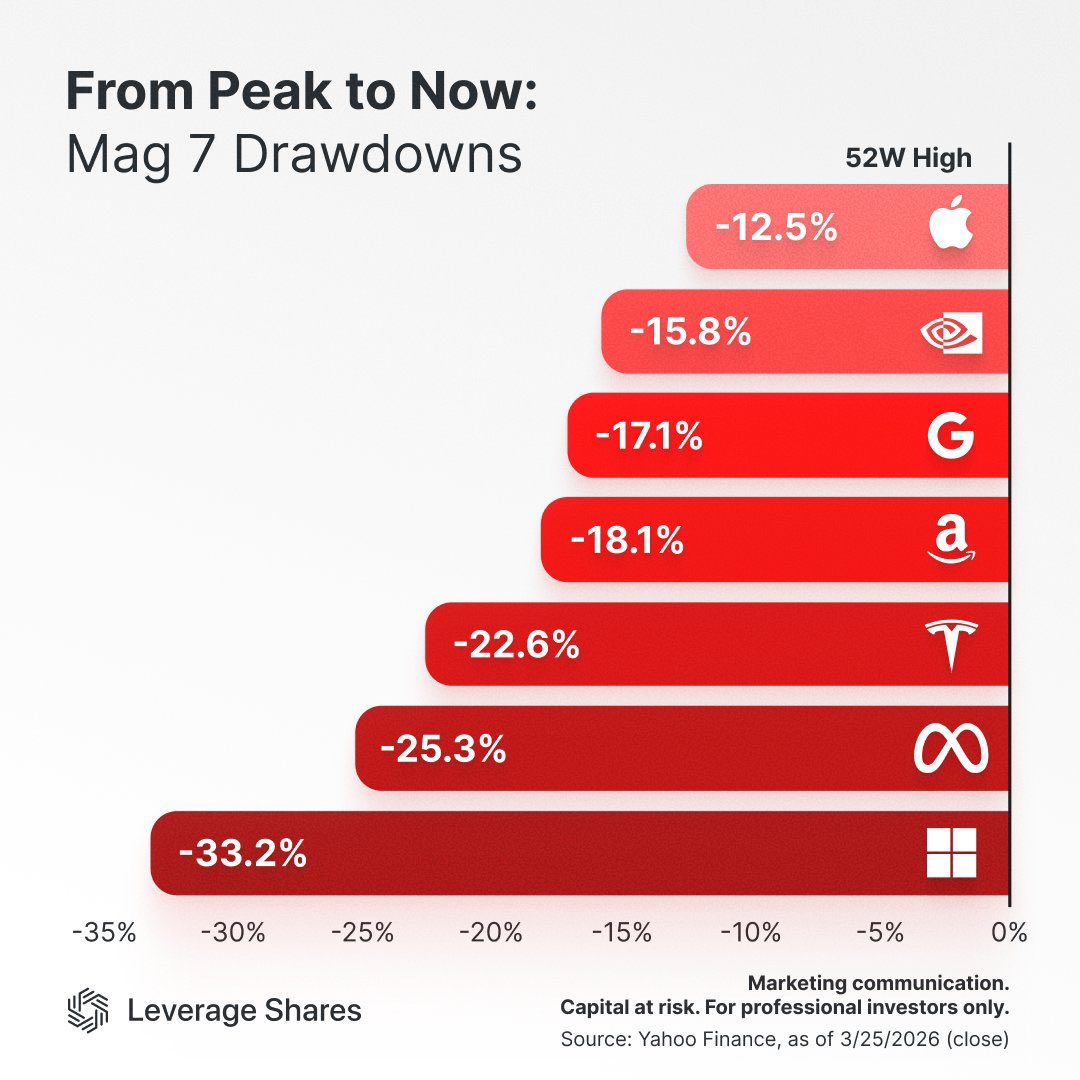
Affected by geopolitical tensions and profit-taking sentiment, the Nasdaq index suffered a massive market sell-off of up to $17 trillion, officially entering correction territory. Under this extreme risk-off sentiment, crypto concept stocks were not spared; Coinbase (COIN), MicroStrategy (MSTR), and major crypto miners (e.g., HIVE, BTDR) all experienced significant synchronized declines. This once again confirms that during times of macroeconomic liquidity tightening, crypto assets and their derivative stocks still carry the characteristics of extremely high-risk assets.
Meanwhile, the crypto infrastructure industry, led by mining companies, is undergoing a profound restructuring of its underlying business model. Given that current Bitcoin mining faces a paper loss of approximately $19,000 per coin, while the AI and High-Performance Computing (HPC) sectors offer lucrative profits, listed miners represented by TeraWulf and Core Scientific are accelerating their transition into data center operators. Data shows that listed miners have cumulatively sold over 15,000 BTC to allocate funds toward building AI infrastructure. This rational economic decision of "selling Bitcoin to fund AI" is generating sustained and significant structural selling pressure in the Bitcoin secondary market.
Even more concerning is the potential exhaustion of institutional purchasing power. The industry's corporate treasury leader, MicroStrategy (MSTR), after 13 consecutive weeks of massive Bitcoin accumulation, failed to post its customary weekend buy signal last week. This has sparked market concerns about the waning momentum of corporate treasury buying.
Data Source: https://www.sec.gov/Archives/edgar/data/2103612/000110465926029738/tm2534140-7_s1a.htm
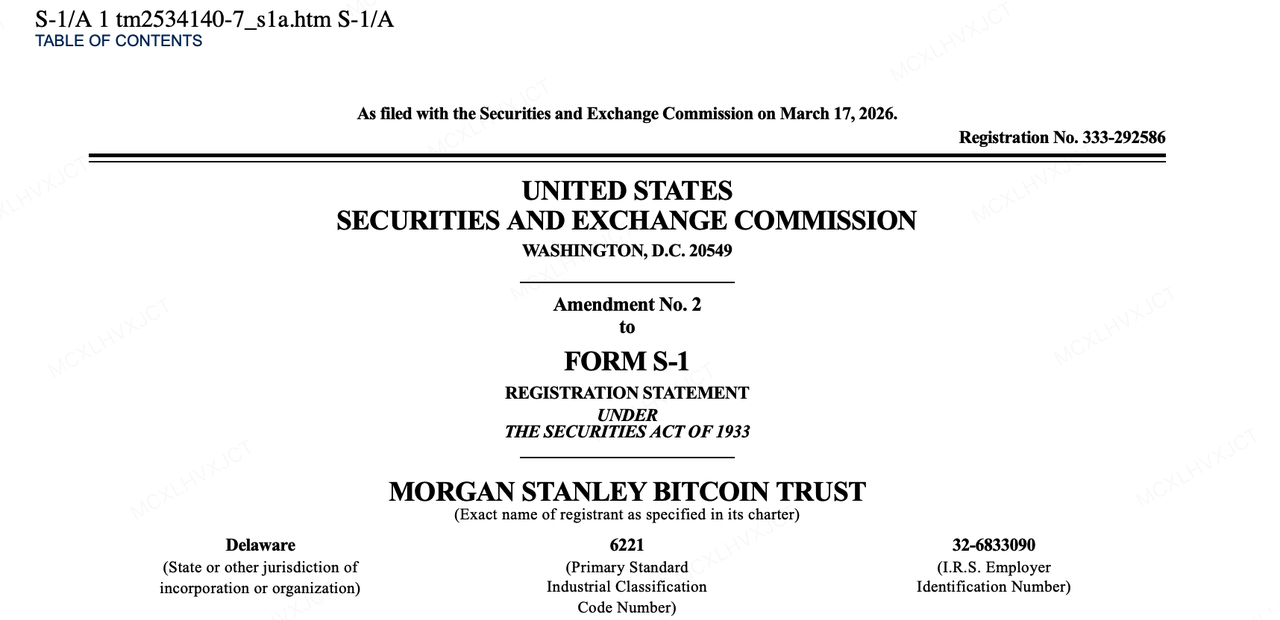
However, traditional finance continues its strategic entry. Morgan Stanley filed an amended S-1 form, joining the spot Bitcoin ETF battlefield with a more aggressive stance. They introduced a record-low fee of 0.14% (significantly lower than BlackRock IBIT's current 0.25%) in an attempt to seize market share. If it becomes the first spot Bitcoin ETF issued by a major bank, it implies that Wall Street's competition over mainstream crypto asset distribution channels is entering an even more brutal phase of consolidation.
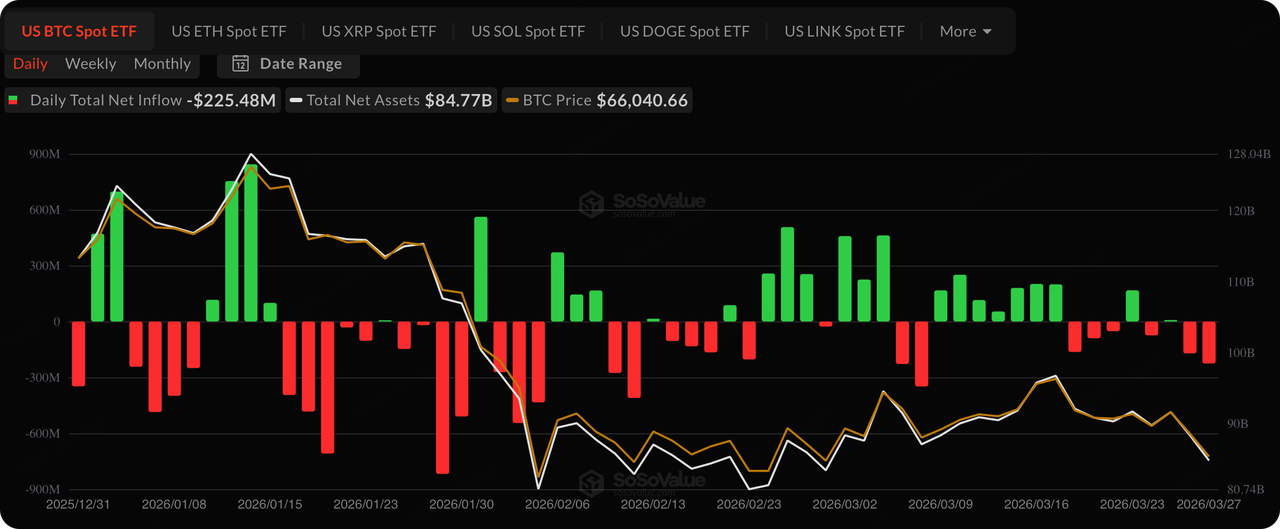
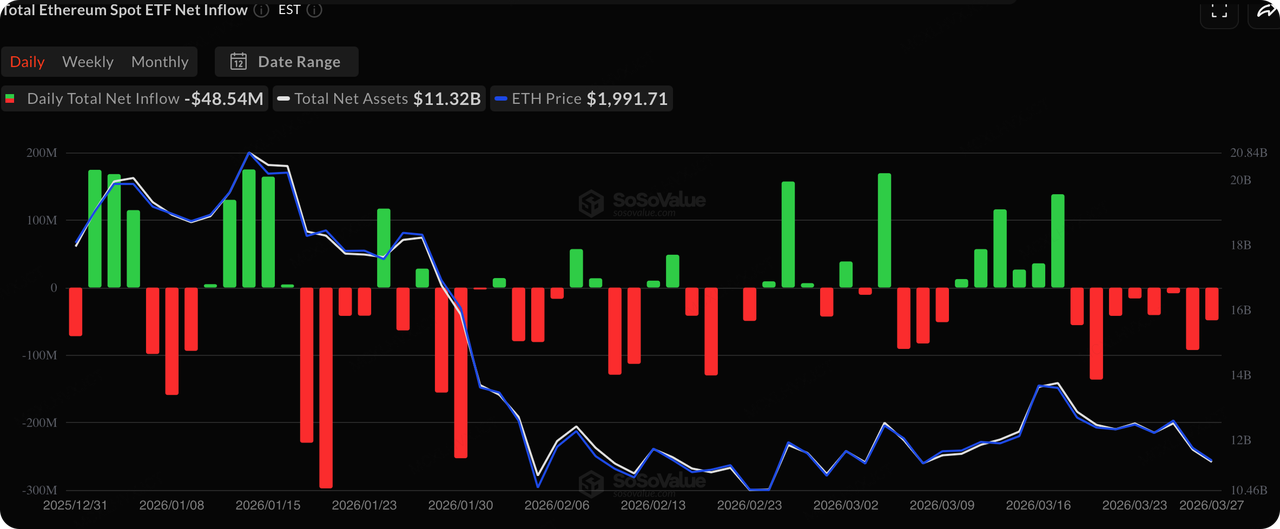
On the capital front, institutional willingness to allocate via ETF channels has also begun to marginally weaken. According to SoSoValue data, US spot BTC ETFs still recorded a net inflow of about $95.18 million last week, achieving a fourth consecutive week of net inflows. However, the latter half of the week saw a shift to net outflows for three consecutive days, indicating that the previous recovery was unstable. In contrast, ETH ETFs saw a net outflow of $59.94 million last week, ending a multi-week streak of net inflows. This reflects that against the backdrop of declining risk appetite and upward revisions in interest rate expectations, institutional exposure to ETH is contracting even earlier.
Data Source: SoSoValue
Spot ETFs are now experiencing large, consecutive net outflows as institutional funds opt for right-side risk aversion. Last week showed a trend of continuous net outflows, with single-day total net outflows reaching as high as $225 million. This caused the total net asset value of US spot BTC ETFs to drop to $84.77 billion, pressuring the BTC price down to the $66,000 range. ETH ETFs were not spared either, suffering continuous net outflows for 8 consecutive days.
Data Source: DeFillama
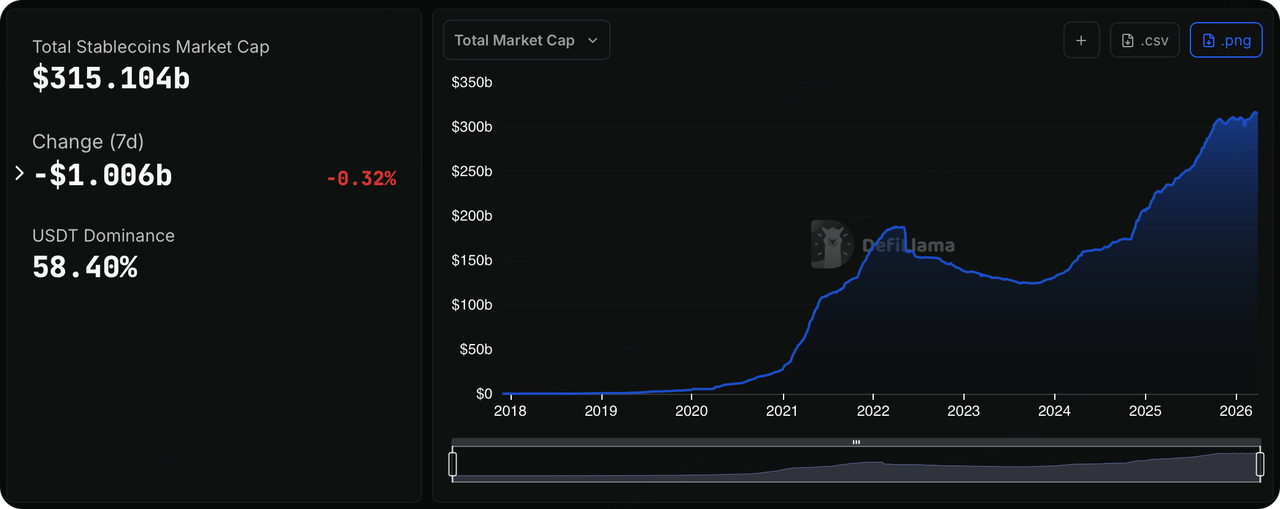
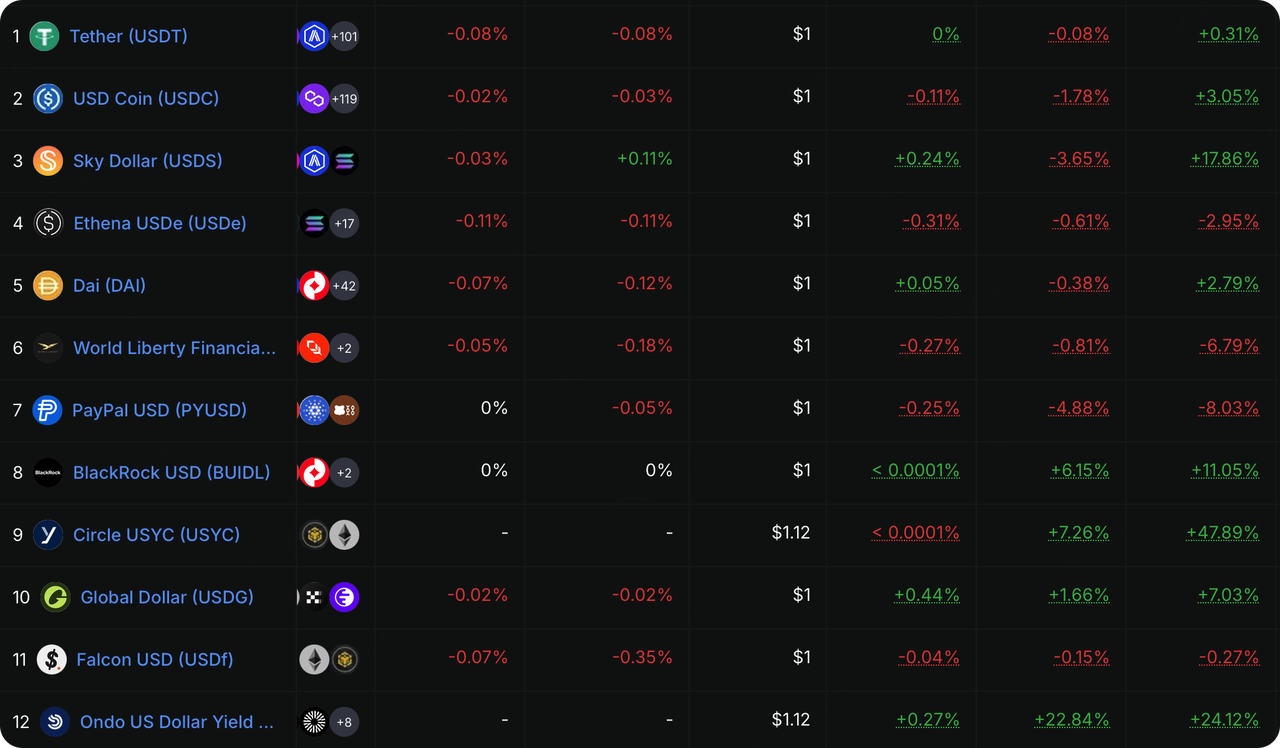
On-chain stablecoins continue to undergo structural shifts. Data from the past 7 days shows that traditional fiat-backed and over-collateralized stablecoins have generally faced net redemptions, with USDC down 1.78% and PYUSD down 4.88%. However, tokenized US Treasury infrastructure with RWA (Real World Asset) yield attributes surged against the market trend: BlackRock's BUIDL jumped 6.15% over 7 days, and Circle's USYC spiked by 7.26%. This confirms that amid the exhaustion of crypto-native yields (DeFi yields) and market panic, on-chain capital is rapidly flocking to risk-free interest-bearing assets like US Treasuries for safety.
Data Source: CME FedWatch Tool
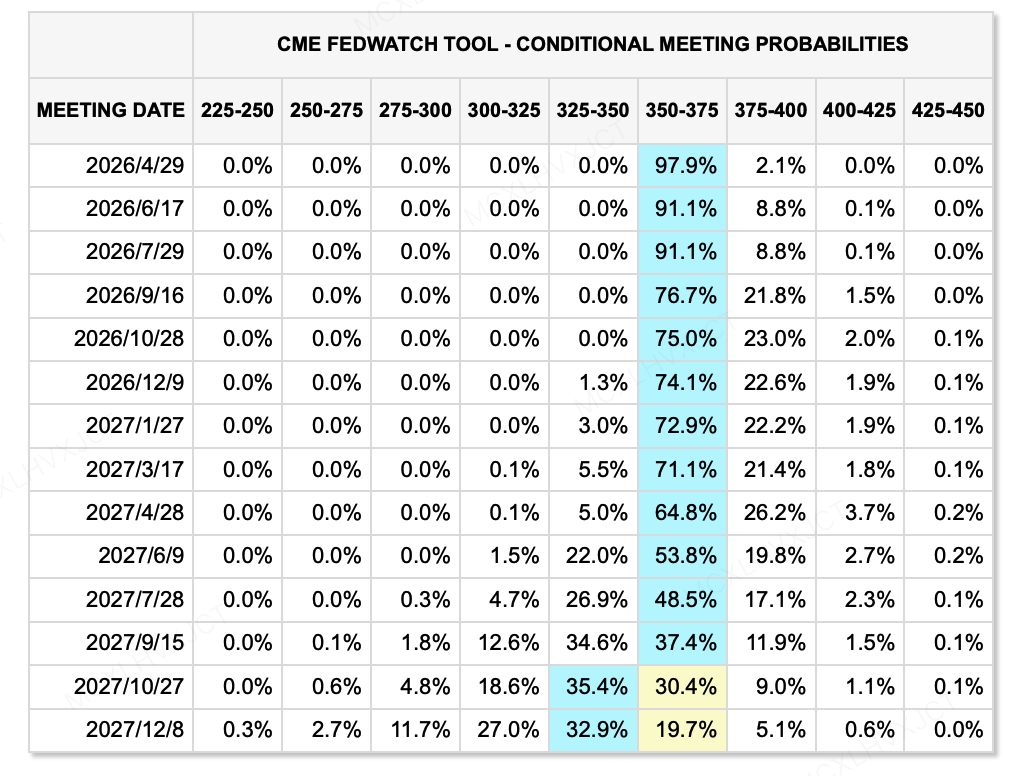
The macroeconomic liquidity environment is experiencing a new round of tightening expectations. According to the latest CME FedWatch Tool data, the market expects a 97.9% probability that the Federal Reserve will maintain interest rates at the 350-375 basis point range during its April 29, 2026 meeting. Furthermore, this "hold steady" expectation is highly likely to continue into the third quarter of 2026 (with probabilities of maintaining this rate in June and July both exceeding 91%). Combined with JPM's research report on the policy divergence of global central banks, the Fed's "Higher for Longer" stance continues to reshape the front end of the yield curve, directly suppressing the valuation ceilings of global high-risk assets, including cryptocurrencies. Whether for crypto or AI tech stocks, the market seems to need a deep reset to digest overextended leverage.
Major Events to Watch This Week:
Key focus areas for the market in the coming week:
-
Geopolitical Spillover Effects: Monitor whether geopolitical tensions in the Middle East will escalate further. Rising risk-aversion is a primary trigger for the recent cross-asset deleveraging, and its collateral suppression on the Nasdaq and highly volatile crypto assets must be closely tracked.
-
Intensive Release of Economic Data: Watch for the Consumer Confidence Index on March 31, ISM Manufacturing Index on April 1, Initial Jobless Claims on April 2, and the March Nonfarm Payrolls (NFP) report on April 3.
-
Central Bank Speeches: Officials from the Bank of Japan and FOMC voting members will deliver speeches this week. The market is keenly focused on their attitudes and forward guidance to gauge future liquidity expectations.
Primary Market Fundraising Observations:
Data Source:CryptoRank
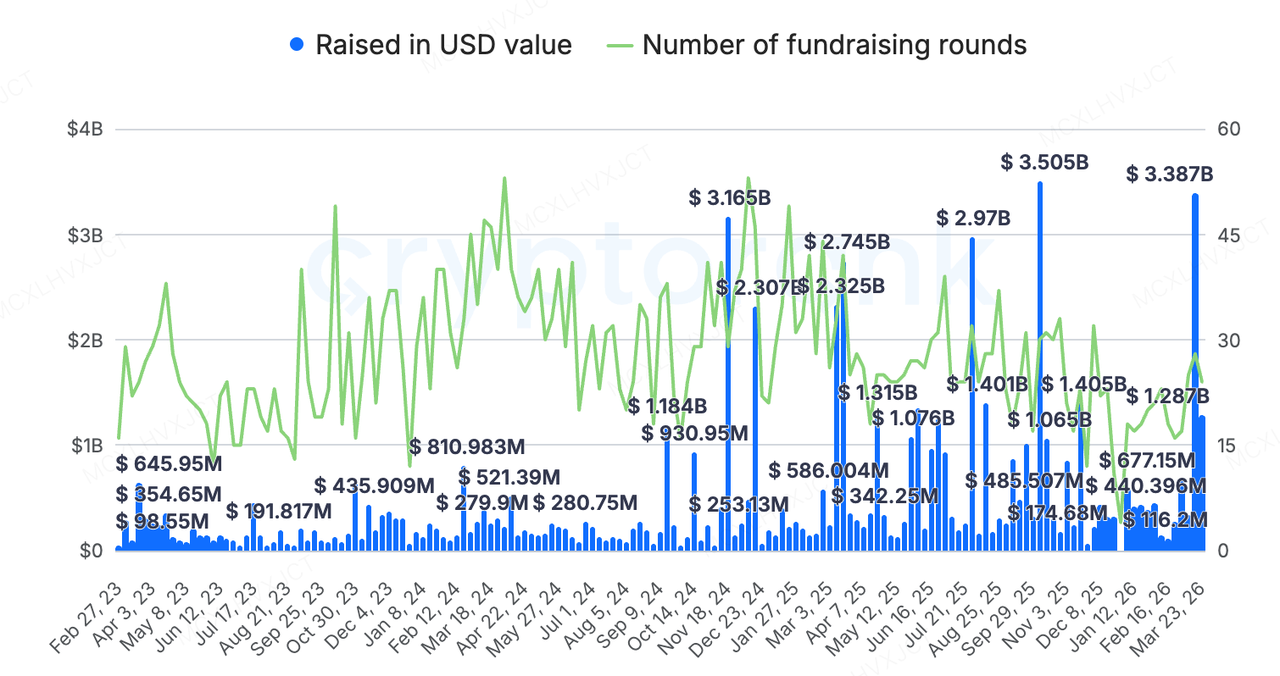
In the primary market, under CryptoRank's broader statistical scope, the total disclosed funding amount this week reached $1.29 billion across 24 capital events. While the market appears robust, fundraising remains heavily concentrated. Polymarket ($600 million) and Core Scientific ($500 million) alone accounted for 85% of the total. Furthermore, the successful fundraising by mining firm Core Scientific is aimed at expanding its data centers to develop its AI computing business—strictly speaking, this is not an expansion of the crypto industry or narrative.
Following the announcement of Kalshi's Series E, Intercontinental Exchange—the parent company of the New York Stock Exchange —announced last week that it has completed a $600 million investment in Polymarket. Additionally, ICE expects to spend up to $40 million purchasing Polymarket shares from existing shareholders. Combined with ICE's initial investment in October 2025, its total commitment to Polymarket has reached $1.6 billion. Prediction markets seem to have found a much sexier, long-term Product-Market Fit (PMF) and narrative. Wall Street is increasingly viewing them as highly strategic, novel event derivative markets and alternative data platforms.
Startale Labs announced the completion of a $63 million Series A funding round. As the primary developer of the Soneium L2 network, Startale Labs saw its valuation double compared to early 2024. Backed by a powerful lineup of investors, this round was led by Sony Innovation Fund, with participation from industrial and financial giants such as Samsung Next, UOB Venture, and SBI Holdings.
The core use of funds for this round includes:
-
Global Promotion: Pushing the "Startale Super App" integrated with the USDSC stablecoin to serve as a unified settlement layer for on-chain entertainment.
-
Ecosystem Expansion: Scaling the "Soneium Spark" incubation program, which has already onboarded over 250 gaming, music, and AI content dApps.
-
IP Tokenization: Developing "entertainment-native" tools to drive the tokenization of traditional entertainment and media intellectual properties.
-
Compliance & Settlement: Focusing on the advancement of the JPYSC stablecoin under a regulated framework to achieve 24/7 cross-border settlement in the APAC region. JPYSC is a Japanese Yen stablecoin aggressively promoted by Startale in partnership with Japanese financial giant SBI.
About KuCoin Ventures
KuCoin Ventures, is the leading investment arm of KuCoin Exchange, which is a leading global crypto platform built on trust, serving over 40 million users across 200+ countries and regions. Aiming to invest in the most disruptive crypto and blockchain projects of the Web 3.0 era, KuCoin Ventures supports crypto and Web 3.0 builders both financially and strategically with deep insights and global resources.
As a community-friendly and research-driven investor, KuCoin Ventures works closely with portfolio projects throughout the entire life cycle, with a focus on Web3.0 infrastructures, AI, Consumer App, DeFi and PayFi.
Disclaimer This general market information, possibly from third-party, commercial, or sponsored sources, is not legal, compliance, financial, or investment advice, an offer, solicitation, or guarantee. We make no express or implied representations or warranties regarding its accuracy, completeness, or reliability, and disclaim liability for any resulting losses. Investments/trading are risky; past performance doesn't guarantee future results. Users should research, judge prudently, and take full responsibility. Please consult professional legal, tax, or financial advisors if necessary.