

Fed Rate Hike 2026: Waller’s Hawkish Signals and the Impact on Crypto Markets
2026/07/18 12:00:00
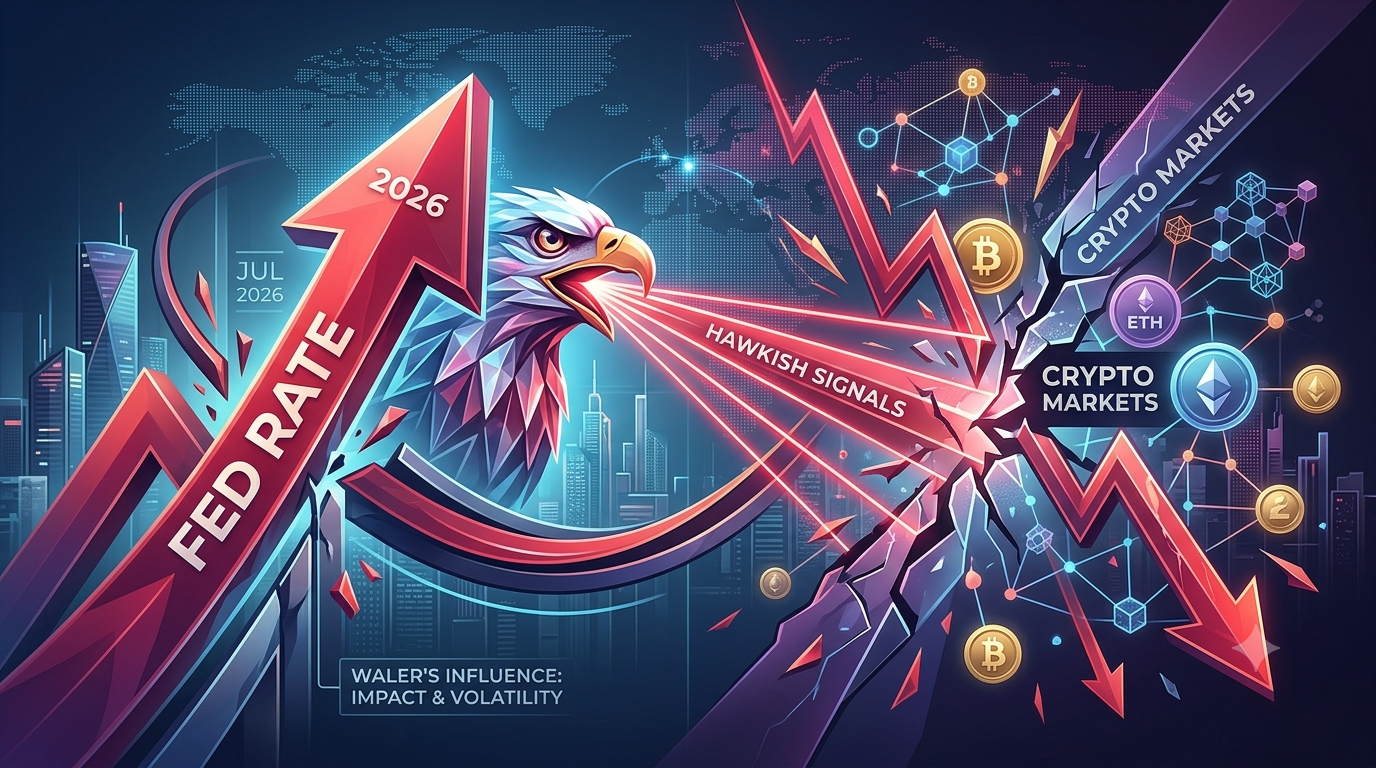
You might be obsessing over the latest layer-2 upgrade, tracking decentralized exchange volumes, or hunting for the next breakout meme coin. But let’s face the cold, hard truth: the ultimate market maker for the crypto ecosystem isn’t a whale wallet, an algorithmic market maker, or a prominent venture capitalist. It is the Federal Reserve.
Recently, Fed Governor Christopher Waller dropped a series of policy bombs at the New York Association for Business Economics (NYABE) that sent shockwaves through traditional finance and the digital asset space alike.
In the high-stakes arena of the 2026 crypto market, macroeconomics reigns supreme. The era of crypto trading in a vacuum is long gone; institutional adoption has permanently tethered Bitcoin, Ethereum, and the broader altcoin market to global liquidity taps. When the Fed hints at tightening those taps, the crypto market reacts violently. Waller’s latest remarks—spanning immediate rate hike warnings, a revolutionary revamp of the standard inflation target, and a logistical delay of the infamous "Dot Plot"—have redrawn the roadmap for the months ahead.
If you want to protect your portfolio and spot the next macro pivot before the crowd, you need to understand exactly what Waller signaled and how it will reshape crypto liquidity.
Waller’s Triple Bombshell: What Actually Happened?
To understand where the market is going, we must first look at the hard data driving the Fed’s anxiety. The economic backdrop of mid-2026 has caught many policymakers off guard. The core Personal Consumption Expenditures (PCE) price index—the Fed’s absolute favorite inflation gauge—crept back up to 3.4%, bouncing off the 3.0% level seen in late 2025.
Waller made it clear that this isn't just a temporary blip caused by isolated supply shocks or energy spikes. Instead, inflation is showing systemic, sticky characteristics across the broader service industry and tech sectors, fueled partly by massive capital expenditures flowing into artificial intelligence infrastructure.
Addressing this trend, Waller delivered three critical policy proposals that caught the market by surprise:
-
The Immediate Hike Threat: Waller explicitly warned that the Fed is standing at a critical crossroads. He noted that policymakers cannot simply stare at inflation and expect it to melt away under a stern gaze. If upcoming Consumer Price Index (CPI) and Producer Price Index (PPI) prints remain hot, he stated that the central bank will have no choice but to actively debate an immediate interest rate hike, shattering Wall Street's previous hopes for prolonged pauses.
-
The 1.5%–2.5% Target Band: In a major structural departure from decades of monetary tradition, Waller proposed abandoning the rigid, single-point 2.0% inflation target. Instead, he argued for a flexible 1.5% to 2.5% target range. According to Waller, trying to pin a dynamic global economy to an exact decimal point leads to blunt, knee-jerk policy errors. A band allows for natural economic volatility while keeping long-term expectations anchored.
-
The Dot Plot Delay: Finally, Waller attacked the logistics of the FOMC communications playbook. Currently, the "Dot Plot"—the collection of anonymous interest rate projections from individual Fed officials—is released simultaneously with the official policy statement. Waller proposed delaying the Dot Plot's release by exactly 24 hours. The goal? To let the market focus entirely on the actual policy decision and the Chair's press conference on day one, avoiding information overload and erratic, algorithmic hair-trigger liquidations.
Macro Liquidity 101: Why This Matters to Your Crypto Portfolio
Why should a crypto native care about structural Fed updates? The answer boils down to one word: Liquidity.
Cryptocurrencies are fundamentally high-beta liquidity sponges. When the global supply of fiat currency expands and interest rates are low, excess capital cascades down the risk curve, eventually flooding into Bitcoin, Ethereum, DeFi protocols, and highly speculative meme assets. Conversely, when the Fed signals a hawkish shift, that fluid dynamic reverses.
A potential rate hike increases the yields on "risk-free" traditional assets like US Treasuries. When institutional funds can lock in guaranteed, historically high yields on short-term government bonds, the hurdle rate for investing in volatile digital assets skyrockets. The capital allocation shift is swift and merciless: liquidity is siphoned out of risk assets and funneled back into the safety of the US Dollar.
This relationship is perfectly illustrated by the inverse correlation between the US Dollar Index (DXY) and Bitcoin (BTC). When Waller spoke, the DXY immediately caught a strong bid, putting immense downward pressure on crypto pairs.
Two Scenarios: How Bitcoin Will React to a 2026 Rate Hike
With Waller putting a potential rate hike back on the table for 2026, crypto market structure is preparing for a fork in the road. Depending on how the broader market interprets the macro data, Bitcoin's price action will likely follow one of two starkly contrasting paths.
Scenario A: The Bear Case – Liquidity Drain and High-Leverage Liquidation
In the immediate term, an actualized rate hike would be a harsh wake-up call for over-leveraged traders. The crypto derivatives market thrives on cheap capital and predictable volatility. If the Fed pulls the trigger on a hike, the cost of capital climbs, and funding rates across perpetual swap markets could turn painfully restrictive.
A sudden macro shock usually triggers a cascading liquidation event. As long positions are forcibly closed by automated risk engines, a wave of sell orders hits order books, crushing thin bids. In this environment, altcoins typically face severe corrections. Because altcoins sit further out on the risk spectrum and suffer from lower depth of liquidity compared to Bitcoin, they become the ultimate funding source for distressed traders trying to meet margin calls on their primary BTC and ETH positions.
Scenario B: The Bull Case – The "Hard Money" Narrative Ignited
Paradoxically, a hawkish pivot out of absolute necessity can act as a long-term catalyst for Bitcoin's core value proposition. If the Fed is forced to raise rates in 2026, it is an open admission that inflation is structural, aggressive, and highly resistant to standard monetary tools. It proves that fiat currency is undergoing a steady, unyielding degradation of purchasing power.
As traditional investors watch the purchasing power of cash erode despite higher nominal yields, the narrative of Bitcoin as a strictly finite, politically neutral, "hard money" alternative gains immense traction. Much like gold during the stagflationary periods of the late 1970s, Bitcoin could decouple from traditional equity correlations. In this scenario, institutional allocations shift toward BTC as a systemic hedge, allowing it to maintain an upward trajectory even as speculative, low-utility altcoins grind lower.
The Hidden Goldmine: Trading the "Dot Plot Delay" Volatility
While the headline rate hike warning captures the evening news, advanced crypto traders are quietly eyeing Waller’s proposal to delay the Dot Plot by 24 hours. If implemented, this procedural tweak creates a brand-new mechanical framework for trading FOMC weeks.
Historically, FOMC Wednesday is a meat grinder for crypto derivatives. At exactly 2:00 PM EST, the market receives the rate decision, the statement, and the Dot Plot all at once, followed by the press conference at 2:30 PM. This massive dump of unstructured data causes algorithms to fire contradictory orders, resulting in massive, multi-directional price spikes that wipe out both over-leveraged longs and shorts within minutes.
By pushing the Dot Plot to Thursday, the Fed would effectively create a 24-hour information vacuum.
On Wednesday, the market will trade purely on the immediate rate action and the tone of the press conference. If the Chair sounds moderately neutral, crypto markets might build a relief rally throughout the afternoon and night. However, the real reality check lands on Thursday morning when the individual macro projections are published.
This structural gap creates an excellent opportunity for sophisticated market participants:
-
Range Trading: Traders can exploit calmer, more predictable directional trends on Wednesday evening, knowing the ultimate data wild card is locked away for another day.
-
Volatility Straddles: Options traders can position themselves to harvest premium during a calmer Wednesday afternoon, while buying cheap options volatility that expires late Thursday to capture the delayed reaction to the Dot Plot.
-
Decentralized Liquidity Management: Automated market makers (AMMs) and liquidity providers on decentralized exchanges can adjust their fee tiers and concentration parameters more precisely, mitigating the risk of impermanent loss by breaking a single massive shock event into two manageable, distinct phases.
Playbook for Crypto Investors: How to Survive a Hawkish Fed
Navigating a hawkish macroeconomic regime requires a complete shift in mindset. You cannot deploy the same strategies in a tightening cycle that you use during periods of quantitative easing. Here is your tactical checklist for surviving and thriving under Waller’s projected framework:
-
Prioritize Stablecoin Yield Strategies over High-Beta Assets: When liquidity gets tight, chasing 50x returns on unproven micro-cap altcoins is a fast track to portfolio destruction. Instead, allocate a portion of your capital to reputable DeFi lending protocols or delta-neutral stablecoin yield strategies. Earning a reliable premium on stable capital allows you to preserve dry powder while outperforming inflation.
-
Identify and Map Crucial On-Chain Support Zones: Do not place random limit orders based on emotional biases. Study on-chain data metrics, such as the Short-Term Holder Realized Price and Whale Accumulation Clusters. These levels represent the actual aggregate cost basis of major market participants and serve as highly reliable macro backstops during panic drops.
-
Embrace the Discipline of Dollar-Cost Averaging (DCA): Trying to perfectly time the exact bottom of a market reacting to unpredictable Federal Reserve decisions is a losing game. By implementing an automated DCA schedule into blue-chip digital assets like Bitcoin and Ethereum, you entirely remove emotion from the equation, lowering your average entry price over time while letting macro volatility work in your favor.
Conclusion: Don’t Fight the Fed, Study It
Christopher Waller’s hawkish presentation serves as a stark reminder to the crypto community: the macro narrative is non-negotiable. While the prospect of a 2026 interest rate hike might seem intimidating to short-term bulls, it represents a mandatory evolutionary phase for the digital asset class.
The investors who make life-changing gains aren’t the ones blindly fighting the Federal Reserve or complaining about macroeconomic intervention. They are the ones who deeply analyze the central bank's playbook, anticipate the systemic shifts in fiat liquidity, and position their crypto portfolios accordingly. Keep your leverage low, watch the incoming inflation prints closely, and treat every macro-driven dip as an accumulation window for the next structural expansion.
Why is crypto so sensitive to the Fed if it is decentralized?
While blockchain networks are decentralized, the capital flowing into them is not. Institutional investors, hedge funds, and retail traders rely on fiat liquidity. When the Fed raises rates, it increases the cost of borrowing and makes "risk-free" assets like Treasury bonds more attractive, causing investors to pull capital out of highly volatile risk assets like crypto.
Will a 1.5%–2.5% inflation target band help or hurt Bitcoin long-term?
It is structurally bullish. Transitioning to an inflation range is a tacit admission by the Fed that keeping inflation locked at exactly 2% is no longer realistic. This expectation of permanently higher baseline inflation strengthens the long-term investment case for Bitcoin as a scarce, programmatic hedge against fiat debasement.
How should I manage leverage during major Fed speeches?
De-risk immediately. High-frequency trading algorithms scan Fed speeches in real-time for hawkish keywords, triggering sudden, aggressive liquidation cascades to flush out leveraged positions. During high-impact macro weeks, the safest strategy is to lower your leverage below 2x or hold spot positions exclusively to avoid sudden market liquidations.
Disclaimer: This content is for informational purposes only and does not constitute investment advice. Cryptocurrency investments carry risk. Please do your own research (DYOR).