

BOK Hikes Interest Rates for First Time Since 2023, Raising Base Rate to 2.75%
2026/07/25 08:07:00
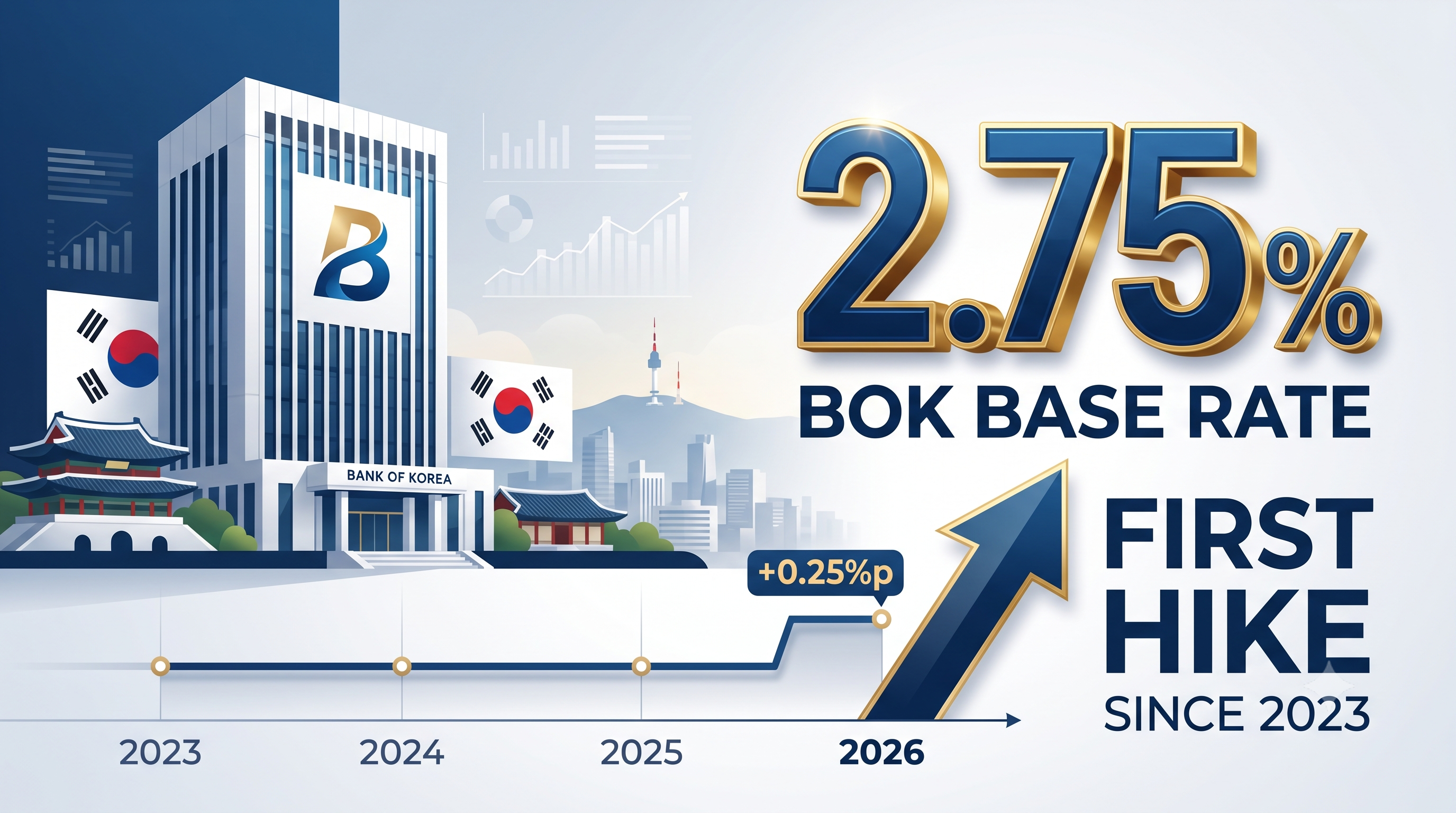
The Bank of Korea’s July 16 monetary policy decision shifted South Korea back toward monetary tightening after policymakers raised the base rate by 25 basis points from 2.50% to 2.75% on July 16, 2026. The unanimous decision was the central bank’s first interest rate increase since January 2023 and reflected a major change in the country’s economic environment. Inflation remained above the BOK’s 2% target, the Korean won was still weak against the US dollar, household borrowing continued to grow and property prices accelerated in Seoul and surrounding areas.
Unlike the previous tightening cycle, the latest BOK rate hike arrived during a period of exceptional export growth. Strong global demand for artificial intelligence infrastructure pushed South Korean semiconductor shipments to record levels, strengthening business investment and improving the country’s economic outlook. The BOK indicated that additional rate increases could follow, making the future path of monetary policy important for Korean households, mortgage borrowers, property investors, companies and financial markets. The decision also has potential implications for the Korean won, KOSPI stocks and South Korea’s active crypto market.
BOK Raises Base Rate to 2.75% in First Interest Rate Hike Since 2023
The Bank of Korea raised its base rate by 25 basis points from 2.50% to 2.75% on July 16, 2026, delivering its first increase since January 2023. All seven Monetary Policy Board members supported the decision as strong semiconductor exports, rising business investment and improving consumer spending strengthened South Korea’s economy. Persistent inflation above the BOK’s 2% target, a weak Korean won, growing household debt and rising property prices also increased the need for tighter monetary policy. The weaker won made imported fuel and raw materials more expensive, while higher energy, transportation and production costs continued to affect consumer prices.
The rate had previously reached 3.50% in January 2023 before four cuts between October 2024 and May 2025 lowered it to 2.50%, where it remained for eight consecutive meetings. At the May 28, 2026 meeting, two board members already supported a hike, and stronger growth and financial-stability risks produced a unanimous decision in July. The BOK also raised the Bank Intermediated Lending Support Facility rate from 1.00% to 1.25% and indicated that further increases may be necessary. Future decisions will depend on inflation, economic growth, the won-dollar exchange rate, household borrowing and housing prices, meaning the move to 2.75% could mark the beginning of a broader tightening cycle if semiconductor-led growth continues spreading into wages, investment and domestic demand.
Why the Bank of Korea Raised Interest Rates in 2026
The Bank of Korea’s decision to raise interest rates reflected more than a temporary increase in consumer prices. Strong export-led growth, a weak Korean won, rising household debt and renewed pressure in the Seoul housing market meant that inflation, economic activity and financial stability were all supporting tighter monetary policy.
South Korea Inflation Remains Above the BOK’s 2% Target
Persistent inflation was one of the main reasons the Bank of Korea decided that tighter monetary policy was necessary in 2026. South Korea’s official June 2026 consumer price data showed that annual inflation accelerated to 3.2%, reaching its highest level since December 2023 and remaining substantially above the BOK’s 2% target. Core inflation, which excludes food and energy, held at 2.5%, showing that price pressure was not limited to volatile petroleum and agricultural products. Higher energy costs, rising prices for agricultural, livestock and fisheries products and the delayed pass-through of transportation and production expenses continued to affect consumers. Inflation for frequently purchased necessities remained in the mid-3% range, creating a noticeable burden on household budgets.
The central bank was also concerned that stronger wages, improving consumption and higher corporate income could allow inflation to spread more broadly into services and domestic business pricing. Supply-driven inflation can sometimes ease without higher interest rates once oil, food or transportation costs decline. The BOK’s concern was that South Korea was beginning to experience both supply pressure and stronger domestic demand. Even if global oil prices continued to fall, earlier cost increases and improving income conditions could keep consumer inflation above target for a considerable period. Short-term inflation expectations among households also remained in the upper-2% range, increasing the risk that businesses and workers would begin incorporating higher prices into wage demands and pricing decisions.
AI Semiconductor Export Growth Gives the BOK Room to Tighten
South Korea’s stronger economic performance reduced the risk that a moderate interest-rate increase would immediately disrupt the wider recovery. The economy expanded by 1.8% quarter on quarter during the first quarter of 2026, while exports and business investment benefited from exceptional international demand for semiconductors used in artificial intelligence systems, cloud computing and data centers. The government’s June 2026 export and import figures showed exports reaching a record $102.25 billion, representing a 70.9% annual increase, while semiconductor shipments climbed 199.5% to $44.82 billion. The performance made South Korea one of only a small number of countries to exceed $100 billion in monthly exports.
Higher chip prices and export volumes increased corporate profits and encouraged additional spending on factories, research and production equipment. These gains were expected to support domestic demand through higher wages, employee bonuses, tax revenue and investment. The BOK consequently expected 2026 economic growth to considerably exceed its previous 2.6% projection, while the Korean government separately raised its annual growth forecast to 3.0%. The government also projected a record current-account surplus of $290 billion, supported by the semiconductor industry and strong first-half export performance. The improvement gave policymakers greater room to prioritize price stability. Raising rates during weak growth could deepen unemployment and reduce investment, but South Korea’s export boom provided a financial cushion. The labor market nevertheless remained uneven, with service-sector employment improving while jobs in manufacturing and other important industries continued to face pressure. The BOK therefore had to tighten carefully enough to control inflation without placing unnecessary strain on construction, smaller businesses and households outside the semiconductor-led recovery.
Weak Korean Won, Household Debt and Seoul Housing Prices Increase Risks
Currency and financial-stability concerns also strengthened the case for the BOK interest rate hike. The won-dollar exchange rate had moved into the mid-KRW 1,500 range before recovering toward the upper-KRW 1,400 range, leaving South Korea exposed to higher costs for imported oil, gas, food and industrial materials. Prolonged currency weakness can increase business expenses and eventually raise consumer prices even when international commodity prices stabilize. Higher interest rates cannot determine the won’s direction on their own, but they can improve the relative return available on won-denominated assets and reduce part of the pressure created by the interest-rate gap with the United States.
Household loans across the financial sector were increasing by approximately KRW 8–9 trillion per month as housing-related borrowing remained strong and other forms of credit expanded. Property-price growth accelerated in Seoul and important areas of Gyeonggi Province, supported by limited housing supply in preferred locations, improving household income and expectations that values would continue rising. Maintaining lower borrowing costs during a period of stronger wages, rising asset prices and high demand for housing could have encouraged households to take on additional debt.
The BOK therefore faced simultaneous risks from inflation, currency weakness, household leverage and the housing market. These factors made a rate increase more appropriate despite the added burden on variable-rate borrowers, smaller companies and weaker parts of the economy. Waiting too long could have allowed inflation expectations and financial imbalances to become more difficult and expensive to control.
BOK Rate Hike Impact on the Korean Won, Housing, Stocks and Crypto Markets
The move to a 2.75% base rate changes the financial environment for Korean households, businesses and investors even if commercial borrowing costs do not rise immediately by the same amount. Its eventual impact will depend on how banks adjust lending and deposit rates, whether the won strengthens, how property buyers respond to reduced affordability and whether global investors continue reducing exposure to Korean technology shares.
Korean Won and Bond Market Outlook After the BOK Rate Hike
A higher Bank of Korea base rate can support the Korean won by increasing the return available on won-denominated deposits and fixed-income assets. It also narrows part of the interest-rate gap between South Korea and the United States, potentially making Korean bonds more attractive to international investors. The won closed near KRW 1,480.4 per dollar on July 16, but its next direction will not depend on Korean monetary policy alone. Federal Reserve decisions, US Treasury yields, international energy prices, foreign investment flows and Korean institutions’ purchases of overseas assets will remain important.
If the BOK continues tightening while US rates remain unchanged, the won could receive additional support and imported inflation could gradually ease. If the dollar strengthens globally or geopolitical risks increase, however, the Korean currency could remain weak despite higher domestic rates. The relationship is therefore conditional rather than automatic. A stronger won would reduce the local cost of imported energy and raw materials, but it could also lower the converted value of overseas revenue earned by Korean exporters.
South Korea’s three-year government bond yield was approximately 3.85% following the decision, while the three-month KORIBOR stood near 3.02%. The relatively limited initial reaction showed that investors had largely anticipated the July increase. Future bond-market movements will depend more heavily on how many additional hikes investors expect and whether the BOK’s eventual peak rate is closer to 3.00%, 3.25% or a higher level.
Higher Mortgage Costs Could Slow the Seoul Housing Market
The BOK rate hike could gradually increase financing costs for homebuyers, particularly borrowers using variable-rate mortgages or loans linked to market benchmarks such as COFIX. Banks are not required to raise every mortgage rate by exactly 25 basis points because the eventual adjustment depends on deposit costs, bond yields, competition, borrower risk and the terms of each loan. Existing fixed-rate mortgage payments should generally remain unchanged until the fixed period expires, while variable-rate borrowers may experience higher payments when their contracts reset.
More expensive financing can reduce the maximum mortgage households can afford, weaken investment demand and slow transaction activity before it produces a visible decline in property prices. The effect may be strongest among highly leveraged buyers and owners of multiple properties, while homes in supply-constrained areas of Seoul could remain supported by limited availability and long-term demand. Higher rates could therefore cool the housing market without necessarily producing an immediate or uniform decline across every city and property type.
The policy change creates a more difficult adjustment for households that borrowed when further rate cuts appeared likely. Refinancing could become more expensive, and borrowers with high debt-service ratios may need to reduce discretionary spending to meet larger monthly payments. Banks could earn more interest from some loans, but an extended tightening cycle would also increase the risk of missed payments and delinquencies among vulnerable borrowers. The housing impact should consequently be evaluated through mortgage approvals, COFIX movements, Seoul apartment transactions, auction activity and household debt-service data rather than property prices alone.
KOSPI Volatility Could Encourage Stock Market Sector Rotation
The KOSPI declined by more than 6% on July 16 as Samsung Electronics, SK Hynix and other major technology shares experienced heavy selling. The BOK rate hike contributed to tighter domestic financial conditions, but it was not the only cause of the decline. The rate increase had been widely anticipated, while concerns about AI-sector valuations, foreign investor outflows, leveraged exchange-traded products and profit-taking in semiconductor stocks also affected sentiment. Describing the entire stock-market decline as a direct reaction to the BOK would therefore overstate the central bank’s role.
Higher interest rates can still influence Korean equities by increasing the discount rate used to value future corporate earnings. High-growth companies with expensive valuations are often more sensitive because a larger share of their expected profits lies further in the future. Property developers, construction businesses, retailers and highly indebted companies may also face pressure from weaker demand and higher refinancing costs. Companies holding significant cash could benefit from better returns on deposits and short-term investments.
Banks and insurers may gain from improved investment yields or wider lending margins, although those benefits can be reduced if credit quality deteriorates. Exporters face a more complicated outcome because a stronger won can lower the converted value of foreign revenue, while a weak won can support overseas earnings but increase imported production costs. The BOK rate hike could therefore encourage sector rotation rather than creating the same outcome for every Korean stock. Investors should also recognize that cryptocurrency and traditional financial markets operate differently, so a decline in the KOSPI does not guarantee an identical or simultaneous move in digital assets.
Bitcoin and South Korea Crypto Market Impact
The BOK rate hike affects Bitcoin and the South Korea crypto market indirectly through liquidity, currency conversion and investor risk appetite. Higher deposit and bond yields can make traditional won-denominated assets more competitive with cryptocurrencies, potentially reducing some demand for speculative investments. More expensive credit can also discourage traders from borrowing money to purchase digital assets, while sudden changes in currencies, equities and bond yields can increase volatility for leveraged crypto positions. The effect is likely to be more visible in Korean trading activity and KRW-denominated prices than in Bitcoin’s global supply or network fundamentals.
Changes in the Korean won can alter the local Bitcoin price even when BTC remains stable in US dollar terms. If the won strengthens while the international Bitcoin price is unchanged, the converted BTC price in won can decline. If the won weakens, the KRW value of Bitcoin can rise without an equivalent increase in its global dollar price. The rate decision may also influence the Korean Bitcoin premium, although that premium depends on domestic demand, exchange liquidity, capital-movement restrictions and differences between Korean and international order books. Comparing Bitcoin price movement across previous market cycles can provide useful historical context, but past performance cannot establish how BTC will respond to the latest BOK decision.
The BOK does not control Bitcoin, and its interest-rate decision does not directly change South Korea’s crypto regulations, token supply or blockchain activity. Global crypto performance will continue to respond more strongly to Federal Reserve policy, dollar liquidity, institutional fund flows, geopolitical developments and crypto-specific events. Investors evaluating the BOK rate hike’s crypto impact should therefore monitor the won-dollar exchange rate, KRW trading volumes, the Korean Bitcoin premium, domestic leverage and the difference between BTC/KRW and BTC/USD performance. They can also compare South Korean trading conditions with live crypto market prices and broader market trends to distinguish a local currency effect from a global change in digital-asset valuations.
Overall, the July rate hike represents a meaningful shift in South Korea’s monetary environment, but its full consequences will emerge gradually. The next stage will depend on whether inflation continues to exceed target, whether the semiconductor boom supports domestic demand and whether higher borrowing costs slow household debt and property prices. The BOK’s future decisions will determine whether the move to 2.75% becomes a limited adjustment or the beginning of a longer tightening cycle with broader consequences for the won, housing, equities and digital assets.
Conclusion
The Bank of Korea’s decision to raise the base rate to 2.75% marks an important shift in South Korea’s monetary policy as officials respond to persistent inflation, a weaker Korean won, rising household debt and renewed pressure in the Seoul housing market. Strong semiconductor exports and improving economic growth gave the BOK more room to tighten policy, but higher borrowing costs may also create fresh challenges for households, property buyers and businesses. The BOK rate hike could support the won and improve returns in the bond market while limiting housing demand and increasing volatility across the KOSPI and South Korea’s crypto market. However, the longer-term impact will depend on inflation trends, export momentum, global interest-rate decisions and the stability of domestic financial markets. Investors and consumers should therefore monitor future BOK policy meetings closely, as any additional interest-rate hikes or a prolonged period with the base rate held at 2.75% could significantly influence mortgage costs, stock valuations, Bitcoin trading activity and South Korea’s overall economic outlook.
Frequently Asked Questions (FAQs)
Does a 2.75% BOK Base Rate Mean Consumers Will Pay 2.75% on Loans?
No. The BOK base rate is a benchmark that influences market funding costs, but banks set their own mortgage, credit-card and business-loan rates. A borrower’s actual rate may be considerably higher because it also includes the bank’s funding costs, operating margin, credit-risk premium and any discounts applied to the account.
How Quickly Will the BOK Rate Hike Affect Existing Mortgages?
The timing depends on the mortgage contract. Variable-rate loans may be repriced on their next adjustment date using benchmarks such as COFIX, the certificate-of-deposit rate or another reference rate, while fixed-rate mortgages normally remain unchanged until refinancing or the end of the fixed period. Borrowers should check both the benchmark and the reset schedule stated in their loan documents.
Will South Korean Savings and Deposit Rates Increase After the Rate Hike?
Deposit rates may rise as banks compete for customer funds, although the increase is not always equal to the BOK’s 0.25-percentage-point move. Consumers should compare the effective annual yield, required holding period, early-withdrawal penalties and tax treatment instead of selecting an account based only on its advertised maximum rate.
Could the Bank of Korea Cut Interest Rates Again Later in 2026?
A future rate cut remains possible, but it would depend on incoming economic data rather than a fixed timetable. A sustained decline in inflation, slower growth, weaker employment or reduced pressure on the won and housing market could create room for easing, while persistent price increases and financial-stability risks could keep the base rate at 2.75% or lead to further tightening.
What Should Variable-Rate Borrowers Do After the BOK Rate Increase?
Borrowers should calculate how their monthly payments would change under several higher-rate scenarios, confirm the next repricing date and compare refinancing costs before changing products. Extending a loan term may reduce the monthly payment but can increase total interest expenses, so fees, penalties and lifetime borrowing costs should be considered together.
Disclaimer: This article is for informational purposes only and does not constitute financial or investment advice. Market conditions can change rapidly, so readers should conduct independent research before making financial decisions.