

AI Stocks Now 45% of S&P 500: Is a US Stock Market Crash Coming in 2026?
2026/05/13 15:21:02
Introduction
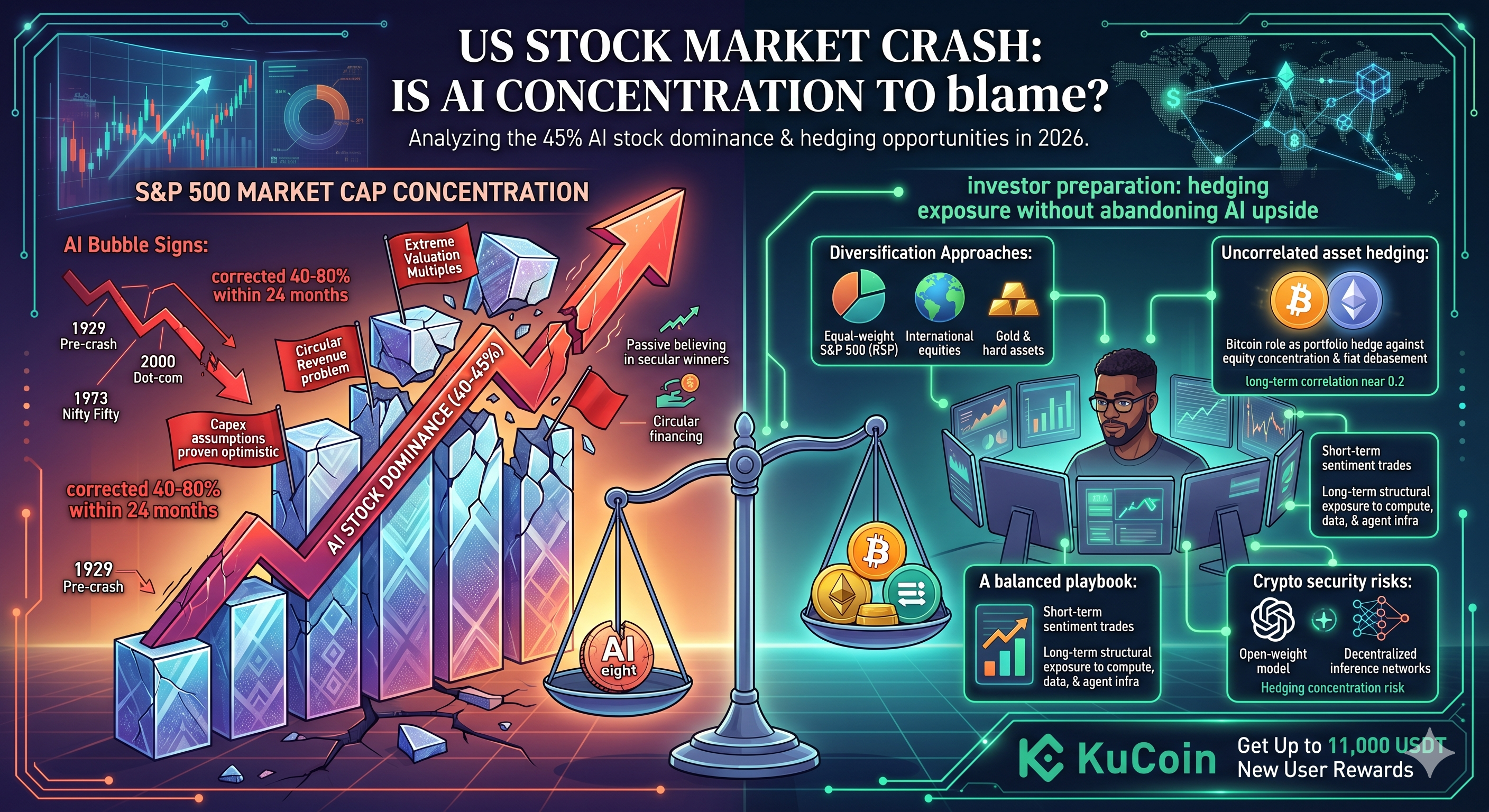
The top 10 AI-linked stocks now account for roughly 40-45% of the S&P 500's total market capitalization — the highest single-sector concentration since the 1929 pre-crash peak, according to Deutsche Bank research published in April 2026. This level of concentration raises a critical question: when will the US stock market crash, and how should investors prepare?
The honest answer: nobody can time a crash precisely, but the structural risks are measurable. Historical concentration episodes — 1929, 1973 Nifty Fifty, and 2000 dot-com — all corrected 40-80% within 24 months of peaking. Today's AI-driven market shows similar warning signs: extreme valuation multiples, circular revenue arrangements between Nvidia, OpenAI, and hyperscalers, and passive flows amplifying the top names.
This article breaks down the concentration data, the crash triggers analysts are watching, and what investors can do to hedge exposure without abandoning AI upside entirely.
How Concentrated Is the S&P 500 in AI Stocks Right Now?
AI-exposed mega-caps represent approximately 40-45% of S&P 500 market cap as of April 2026, according to Goldman Sachs and Deutsche Bank concentration reports. Nvidia alone crossed 8% index weight in Q1 2026, followed by Microsoft, Apple, Alphabet, Amazon, Meta, Broadcom, and Tesla — the so-called "AI Eight."
This concentration exceeds the dot-com peak of 2000, when the top 10 stocks represented roughly 27% of the index. It also surpasses the 1973 Nifty Fifty era and approaches the 1929 pre-Depression high.
Why Concentration Has Accelerated
Three forces drove the surge:
-
Passive flows. Every dollar entering an S&P 500 index fund allocates proportionally to mega-caps, creating a reflexive loop. According to ICI data from March 2026, passive funds now hold over 54% of US equity AUM.
-
AI capex boom. Hyperscaler capital expenditure reached an estimated $410 billion in 2025 and is projected at $520 billion for 2026, per Morgan Stanley estimates published in April 2026 — most of it flowing to Nvidia and a handful of suppliers.
-
Earnings dominance. The AI Eight contributed nearly 60% of S&P 500 earnings growth in 2025, according to FactSet's Q1 2026 earnings tracker.
The result: the index is no longer diversified in any meaningful sense. It is an AI infrastructure bet wearing a 500-stock costume.
Is the AI Boom a Bubble or Sustainable Growth?
It is partially both — and that nuance matters. The underlying AI demand is real, but valuations have detached from realistic cash flow trajectories for several names.
Nvidia trades at roughly 38x forward earnings as of early May 2026, according to Bloomberg consensus data. That is high but not absurd given growth. The concern lies elsewhere: software and AI-adjacent names trading at 25-40x sales, with margin assumptions that require AI monetization to scale faster than any prior software cycle.
The Circular Revenue Problem
The most-cited red flag is circular financing. OpenAI commits hundreds of billions to Oracle and Microsoft for compute; those hyperscalers buy chips from Nvidia; Nvidia invests equity back into OpenAI and other AI labs that then spend on more compute. Bain & Company analysts flagged in an April 2026 note that an estimated $1.4 trillion in announced AI infrastructure commitments through 2030 depends on AI revenue that has not yet materialized.
If end-customer AI revenue disappoints — meaning enterprises and consumers do not pay enough to justify the capex — the loop unwinds quickly.
What History Suggests
The 2000 dot-com crash erased 78% of Nasdaq value over 30 months. The 1973-74 Nifty Fifty collapse cut the leaders by 60-90%. Both episodes shared today's traits: narrow leadership, passive belief in secular winners, and capex assumptions that proved optimistic. None crashed because the underlying technology failed — they crashed because prices ran ahead of cash flows.
When Will the US Stock Market Crash?
No one knows the date, but the most-watched trigger conditions are narrowing. Bank of America's April 2026 Global Fund Manager Survey listed "long Magnificent 7" as the most crowded trade for the 23rd consecutive month, and 54% of surveyed managers now call AI stocks a bubble — up from 38% in late 2025.
Three Triggers Analysts Are Watching
-
A hyperscaler capex cut. If Microsoft, Meta, Google, or Amazon trims 2026 or 2027 AI capex guidance, Nvidia's revenue trajectory resets immediately. Morgan Stanley estimates a 15% capex cut would compress Nvidia's forward earnings by roughly 22%.
-
An AI revenue disappointment. OpenAI is reportedly targeting $125 billion in revenue by 2029, according to reporting from The Information in March 2026. Missing that ramp materially would force a re-rating across the AI stack.
-
A liquidity shock. Rising real yields, a credit event, or yen-carry-style unwind could force forced selling of crowded longs. The August 2024 yen unwind previewed how quickly concentrated positioning corrects.
Crash Timing Estimates
Most sell-side strategists publishing in Q2 2026 — including JPMorgan's Marko Kolanovic successor team and Société Générale's Albert Edwards — place elevated correction probability in the 12-18 month window, contingent on capex guidance through 2026 earnings season. None forecast an imminent crash; all flag asymmetric downside risk.
What Would an AI-Led Market Crash Look Like?
An AI-led correction would likely cut the S&P 500 by 30-50% from peak, with AI mega-caps falling 50-75%. That is the historical template from 2000 and 1973.
The mechanics would unfold in stages:
-
Stage 1 — Guidance shock. A single hyperscaler cuts capex or an AI lab misses revenue. Nvidia and suppliers gap down 15-25% in days.
-
Stage 2 — Passive unwind. Index outflows force proportional selling of mega-caps, dragging the broader market 10-20%.
-
Stage 3 — Margin and credit stress. Leveraged AI bets — private credit to neoclouds, retail options — unwind. Volatility spikes, correlations rise to 1.
-
Stage 4 — Capitulation and rotation. Equal-weight indices, value, international, and select hard assets outperform as capital rotates out of AI concentration.
Spillover to Other Assets
A crash would not stay contained. Private AI valuations would reset 50-80%. Commercial real estate tied to data center buildouts would face stress. And crypto — particularly BTC and ETH — typically correlates with risk-off Nasdaq moves in the first 30-60 days before decoupling, based on the pattern observed during the March 2020 and 2022 drawdowns.
How Can Investors Hedge AI Concentration Risk?
Diversify away from cap-weighted exposure and add uncorrelated assets — that is the consensus risk management answer.
Practical Hedging Approaches
|
Strategy
|
What It Does
|
Trade-Off
|
|
Equal-weight S&P 500 (RSP)
|
Removes mega-cap concentration
|
Underperforms in AI rallies
|
|
International equities
|
Adds geographic diversification
|
Currency and political risk
|
|
Gold and hard assets
|
Hedges monetary debasement
|
No yield
|
|
Bitcoin and select crypto
|
Uncorrelated long-term, scarce supply
|
Short-term risk-on correlation
|
|
Cash and short Treasuries
|
Dry powder for crash buying
|
Opportunity cost during rallies
|
Why Bitcoin Enters the Conversation
Bitcoin's role as a portfolio hedge has strengthened as institutional adoption deepened through 2025 and early 2026. According to BlackRock's April 2026 institutional survey, 38% of surveyed family offices now allocate 1-5% to BTC specifically as a hedge against equity concentration and fiat debasement. Bitcoin does not eliminate drawdown risk in a panic, but its long-term correlation with the S&P 500 sits near 0.2, lower than gold in many windows.
Ethereum, by contrast, behaves more like a high-beta tech proxy in the short term but offers exposure to a different growth narrative — onchain finance and tokenization — that is not dependent on AI capex.
Should You Trade BTC, ETH, and Hedging Assets on KuCoin?
KuCoin offers a practical venue for investors looking to diversify away from US equity AI concentration without abandoning growth exposure. With over 41 million registered users globally as of Q1 2026 and access to more than 900 digital assets, KuCoin provides spot, futures, and earn products across BTC, ETH, stablecoins, and emerging tokens that can complement a traditional equity portfolio.
For investors hedging AI concentration risk, three KuCoin use cases stand out. First, accumulate BTC or ETH on a recurring schedule using spot DCA to build an uncorrelated position over time. Second, use stablecoin earn products to park dry powder while maintaining yield — useful if you are reducing equity exposure ahead of a potential correction. Third, crypto hedges can offset short-term portfolio volatility for advanced users.
KuCoin's deep liquidity, competitive fees, and 24/7 access make it suitable for both long-term hedgers and active traders. Sign up, complete verification, and you can begin diversifying within minutes. New users can now register at KuCoin and Get Up to 11,000 USDT in New User Rewards.

Conclusion
The 45% AI concentration in the S&P 500 is not a forecast of an imminent crash — it is a measurement of risk asymmetry. Historical concentration episodes in 1929, 1973, and 2000 all corrected severely, and today's setup combines record valuations with circular revenue arrangements and passive flow reflexivity. The triggers most likely to start a correction are a hyperscaler capex cut, an AI revenue miss, or a broader liquidity shock — none of which can be timed precisely.
What investors can control is exposure. Equal-weight strategies, international diversification, hard assets, and selective crypto allocation all reduce dependence on a handful of AI mega-caps continuing to deliver. Bitcoin in particular has emerged as a structural hedge against both equity concentration and fiat debasement, with growing institutional adoption supporting that thesis.
A crash may not come in 2026. It may not come in 2027. But concentration this extreme has never resolved without a meaningful repricing. Preparing now — through diversification rather than panic — is the rational response to a market where 10 stocks decide the fate of 500.
FAQs
1. What percentage of the S&P 500 is AI stocks in 2026?
AI-exposed mega-caps represent approximately 40-45% of S&P 500 market cap as of April 2026, with Nvidia alone above 8% index weight, according to Deutsche Bank and Goldman Sachs concentration data.
2. Is the AI bubble bigger than the dot-com bubble?
By concentration, yes — the top 10 stocks today exceed the 27% peak weight from March 2000. By valuation multiples, no — current AI leaders trade at lower price-to-sales ratios than peak dot-com names like Cisco, which hit 30x sales in 2000.
3. What sectors would outperform if AI stocks crash?
Historically, equal-weight indices, value stocks, international equities, energy, healthcare, and consumer staples outperform during mega-cap unwinds. Gold and Bitcoin have also outperformed during select equity drawdowns since 2020.
4. How long do market crashes typically last?
Bear markets average 13 months from peak to trough since 1945, with declines averaging 36%, according to S&P Dow Jones Indices data. Concentration-driven crashes — 1929, 1973, 2000 — lasted longer, between 21 and 33 months to bottom.
5. Can I short AI stocks to hedge my portfolio?
Yes, through inverse ETFs, put options, or direct futures, but shorting concentrated mega-caps has been costly throughout 2023-2025 due to persistent uptrends. Most risk managers recommend diversification and put-spread hedges rather than outright shorts, given asymmetric short-squeeze risk.