

Which Cryptocurrency ETFs Are Most Likely to Be Approved by the US SEC in 2026?
2026/03/31 17:00:00
What comes after Bitcoin and Ethereum spot ETFs?
That is now one of the biggest questions in digital assets. In 2026, the conversation is no longer about whether altcoin ETFs are possible at all. It is about which funds have made enough regulatory and exchange progress to look genuinely close to approval or launch. The SEC’s September 2025 move to adopt generic listing standards for qualifying commodity-based trust shares, including digital assets, changed the approval landscape in a meaningful way.
By the end of this article, you will have a clearer view of the crypto ETF landscape, the leading candidates, the reasons they stand out, and the main risks that still matter. This is market analysis for informational purposes only, not investment advice.
Hook
What if the biggest crypto ETF story in 2026 is not Bitcoin at all, but which altcoin fund gets across the regulatory finish line next?
Overview
This article explains:
-
why 2026 looks different from earlier crypto ETF cycles,
-
which cryptocurrency ETFs appear most likely to be approved by the US SEC in 2026
-
how SEC rule changes reshaped the path forward,
-
why Solana, Litecoin, XRP, and Dogecoin stand out,
-
and which risks could still delay progress.
Thesis
The article explains why Solana, Litecoin, XRP, and Dogecoin are the most likely approval candidates. because they show the clearest mix of issuer commitment, filing progress, and exchange readiness under the SEC’s post-2025 framework.
Introduction to Cryptocurrency ETFs
What Cryptocurrency ETFs Mean in the 2026 Market
A cryptocurrency ETF gives investors exposure to digital assets through a standard brokerage account instead of direct coin ownership. That means investors can access crypto price exposure without managing wallets, private keys, or on-chain custody.
This structure is already familiar because spot Bitcoin ETFs and Ethereum-related products helped normalize crypto exposure inside traditional financial markets. What makes 2026 different is the regulatory setup. In September 2025, the SEC approved generic listing standards that allow qualifying spot commodity-based trust shares, including digital-asset products, to be listed without a separate proposed rule change for each fund.
That matters because it lowers one of the biggest procedural hurdles that slowed earlier crypto ETF approvals. It does not mean every product is automatically cleared, but it does create a more workable path for funds that meet the required standards. As a result, the best-positioned ETFs in 2026 are likely to be the ones that can show:
-
a structure that fits SEC listing requirements,
-
reliable custody and operational arrangements,
-
strong exchange readiness,
-
and a credible path from filing to launch.
Impact of SEC Listing Standards on Cryptocurrency ETFs
How SEC Approval Trends Are Shaping Markets, Trading, and Access
The SEC’s 2025 decision changed more than the paperwork. It also changed how the market reads crypto ETF momentum.
For years, the story was framed as a simple yes-or-no approval question. In 2026, the process is more layered. Some products may move toward launch through a sequence of milestones that include registration effectiveness, exchange listing mechanics, custody arrangements, operational readiness, and final trading preparation.
That shift affects the market in several ways:
-
More competition among issuers: once the regulatory lane becomes more usable, firms compete on structure, fees, custody, and timing.
-
A different measure of progress: analysts now watch late-stage amendments, certifications, and registration updates, not only headline SEC commentary.
-
Broader access: once a crypto product trades as an ETF, it becomes easier to access through brokerage platforms and other familiar investment channels.
The filing trail shows how this works in practice. VanEck filed a post-effective amendment for its Solana ETF on December 12, 2025, which usually indicates a product has moved well beyond the rough-concept stage.
Litecoin offers another clear example. The SEC published Nasdaq’s proposed rule change for the CoinShares XRP ETF in February 2025 and also published the formal rulemaking process for the Canary Litecoin ETF in 2025, showing that these were live regulatory matters rather than just market rumor.
Dogecoin is the most surprising case. NYSE Arca certified its approval for listing and registration of the Bitwise Dogecoin ETF on November 25, 2025, a strong sign of exchange-level progress.
So the better question in 2026 is not simply which crypto ETF gets “approved” first. It is which products have the strongest filing history, the most advanced regulatory posture, and the clearest operational route to market.
Cryptocurrency ETFs Most Likely to Be Approved by the US SEC in 2026
The leading candidates are not strong for exactly the same reasons. Each stands out differently. Together, though, they form the clearest top tier.
-
Solana ETFs
Solana looks like the strongest next-wave altcoin ETF candidate.
Its biggest advantage is visible late-stage filing activity. VanEck’s December 2025 post-effective amendment is a stronger signal than a plain initial filing because it suggests the product had moved deeper into the registration process.
Solana also benefits from:
-
strong brand recognition,
-
high trading activity,
-
significant issuer interest,
-
and clear commercial appeal for ETF sponsors.
These factors do not determine SEC treatment on their own, but they help explain why Solana remains near the top of the list.
-
Litecoin ETFs
Litecoin’s edge is simplicity.
Compared with more complex blockchain ecosystems, Litecoin is easier to understand and structure in ETF form. Canary’s own ETF page lists the Canary Litecoin ETF (LTCC) with an inception date of October 27, 2025, showing that Litecoin exposure had already progressed well beyond the purely speculative stage.
Why Litecoin stays near the top:
-
a relatively simple market identity,
-
a long trading history,
-
a cleaner public filing trail,
-
and visible product progress in the ETF market.
-
XRP ETFs
XRP remains one of the most watched names in the crypto ETF space.
Its advantage is persistence. Even through years of legal and regulatory controversy, issuers kept pushing forward. The SEC archive includes a CoinShares XRP ETF registration statement, and Nasdaq filed a proposed rule change to list and trade shares of the CoinShares XRP ETF in February 2025. That gives XRP a real regulatory paper trail, not just speculative buzz.
What keeps XRP in the top group:
-
strong market recognition,
-
continued issuer interest,
-
deep investor attention,
-
and a formal SEC filing history.
-
Dogecoin ETFs
Dogecoin may be the most unexpected name here, but its progress is real.
NYSE Arca’s certification for the Bitwise Dogecoin ETF is concrete evidence that a Dogecoin-linked ETF advanced into serious exchange approval mechanics. That is more than social-media excitement or industry chatter.
Why Dogecoin deserves attention:
-
meaningful exchange-level progress,
-
backing from a recognized issuer,
-
stronger regulatory traction than many expected,
-
and proof that it is more than a novelty concept.
Why These Four Lead the 2026 ETF Race
Across Solana, Litecoin, XRP, and Dogecoin, the pattern is consistent:
-
stronger filing visibility,
-
credible issuer involvement,
-
more advanced exchange or registration progress,
-
and better positioning under the SEC’s updated framework.
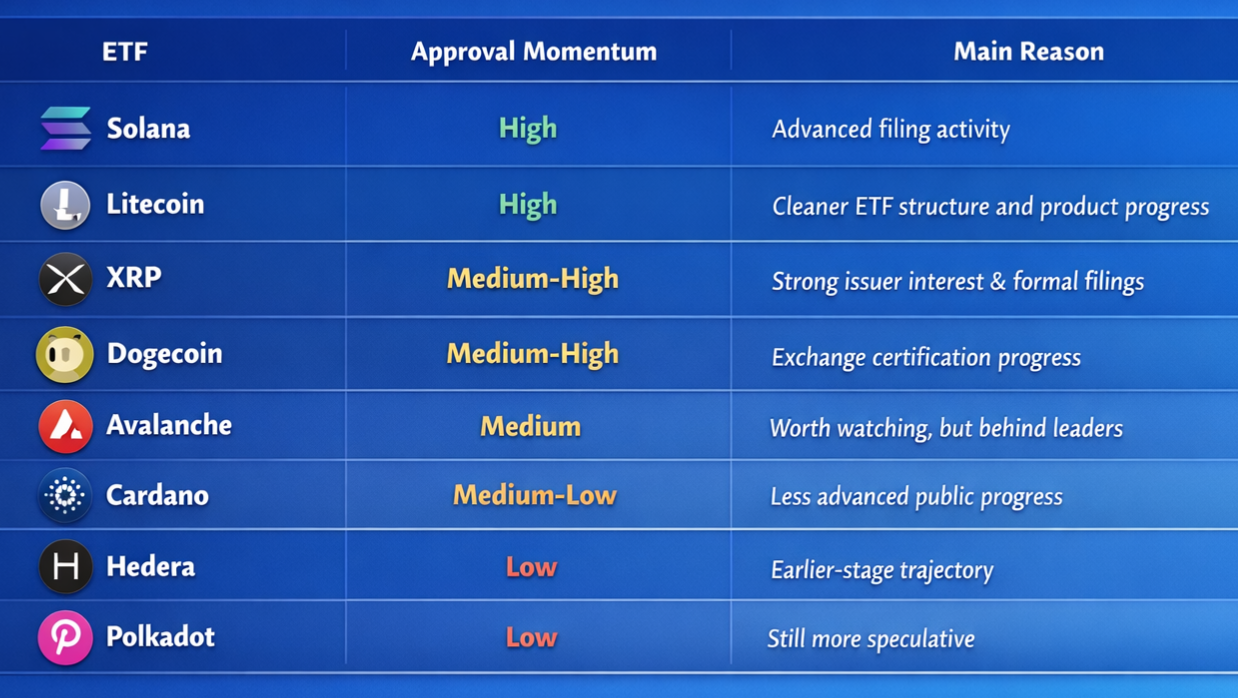
A reasonable 2026 ranking looks like this:
-
Solana ETFs
-
Litecoin ETFs
-
XRP ETFs
-
Dogecoin ETFs
A step behind them are names like Avalanche, Cardano, Hedera, and Polkadot, but this article’s strongest public-record evidence supports the top four most clearly.
Cryptocurrency ETFs Closest to SEC Approval in 2026
Challenges and Considerations
Key Risks Facing Cryptocurrency ETF Approval in 2026
Even with stronger momentum, the approval path is still not frictionless.
-
Listing standards do not guarantee approval
The SEC’s updated framework does not automatically clear every crypto ETF. Funds still need to meet the listing standards, structure requirements, and exchange criteria. Products outside those parameters may still require additional review.
-
Not every crypto asset fits the same regulatory profile
Digital assets do not all look the same from a regulatory standpoint. Some have cleaner market histories or easier commodity-style narratives. Others bring extra complexity around market structure, surveillance, or legal treatment.
-
Progress does not always mean immediate launch
A product can look close and still face delays tied to:
-
registration effectiveness,
-
custody arrangements,
-
market-making setup,
-
fee structure,
-
exchange operations,
-
and final launch readiness.
That is why a strong filing or certification should not automatically be read as immediate market access.
-
Headlines can overstate where a product stands
Crypto coverage often uses “approved” too loosely. A filing amendment, exchange certification, or registration update can be meaningful progress without meaning the whole process is complete. Readers should separate advanced progress from fully launched access.
-
ETFs do not remove crypto volatility
Even if more funds reach the market, the underlying assets can still remain highly volatile. An ETF changes access, not the nature of crypto price risk.
What to watch next
The most practical way to follow this story is to:
-
watch official SEC filings,
-
follow exchange-level notices,
-
avoid treating rumors as regulatory fact,
-
and pay attention to product structure, not just market excitement.
Conclusion
The cryptocurrency ETFs that look closest to SEC approval or market launch in 2026 are Solana, Litecoin, XRP, and Dogecoin.
Solana stands out for its late-stage filing activity. Litecoin benefits from a cleaner and more visible ETF path. XRP remains a serious contender because of sustained issuer interest and a formal SEC filing trail. Dogecoin has made more concrete exchange progress than many expected.
The broader takeaway is simple: the SEC 2025 rule changes made the next wave of crypto ETFs more realistic by reducing the old case-by-case bottleneck for qualifying products. That does not make outcomes automatic, but it does make 2026 a far more credible year for expanded crypto ETF access.
Call to Action
Explore more market insights, analysis, and educational content on KuCoin to make smarter decisions in a fast-moving digital asset landscape.
Frequently Asked Questions
Which cryptocurrency ETF is most likely to be approved in 2026?
Based on current public filings and regulatory progress, Solana ETFs appear to be among the strongest candidates heading into 2026.
Why are more crypto ETFs possible now than before?
Because the SEC approved generic listing standards for commodity-based trust shares, including digital assets, in September 2025, reducing the need for a separate rule filing for every qualifying product.
Is Litecoin a serious ETF candidate?
Yes. The Canary Litecoin ETF moved through formal SEC review, and Canary’s product page shows LTCC with a 2025 inception date.
Does Dogecoin really have a realistic ETF path?
Yes. NYSE Arca certified approval for the listing and registration of the Bitwise Dogecoin ETF, which is a meaningful sign of exchange progress.
Is XRP still in the running for ETF approval?
Yes. XRP remains one of the most discussed altcoin ETF candidates because of ongoing issuer interest and the broader regulatory framework now available for qualifying products.
Does SEC approval mean an ETF starts trading immediately?
Not always. In 2026, progress may involve multiple stages such as registration effectiveness, exchange readiness, custody arrangements, and launch timing.
Are Avalanche, Cardano, Hedera, and Polkadot still possible ETF candidates?
Yes, they are still worth watching, but they currently look less advanced than Solana, Litecoin, XRP, and Dogecoin based on the sources reviewed here.
Disclaimer: The information provided on this page may originate from third-party sources and does not necessarily represent the views or opinions of KuCoin. This content is intended solely for general informational purposes and should not be considered as financial, investment, or professional advice. KuCoin does not guarantee the accuracy, completeness, or reliability of the information, and is not responsible for any errors, omissions, or outcomes resulting from its use. Investing in digital assets carries inherent risks. Please carefully evaluate your risk tolerance and financial situation before making any investment decisions. For further details, please consult our Terms of Use and Risk Disclosure