

US 30-Year Treasury Yields Hit 2007 High as Iran Conflict and Trump Military Risks Escalate
2026/05/21 16:39:02
Thesis Statement
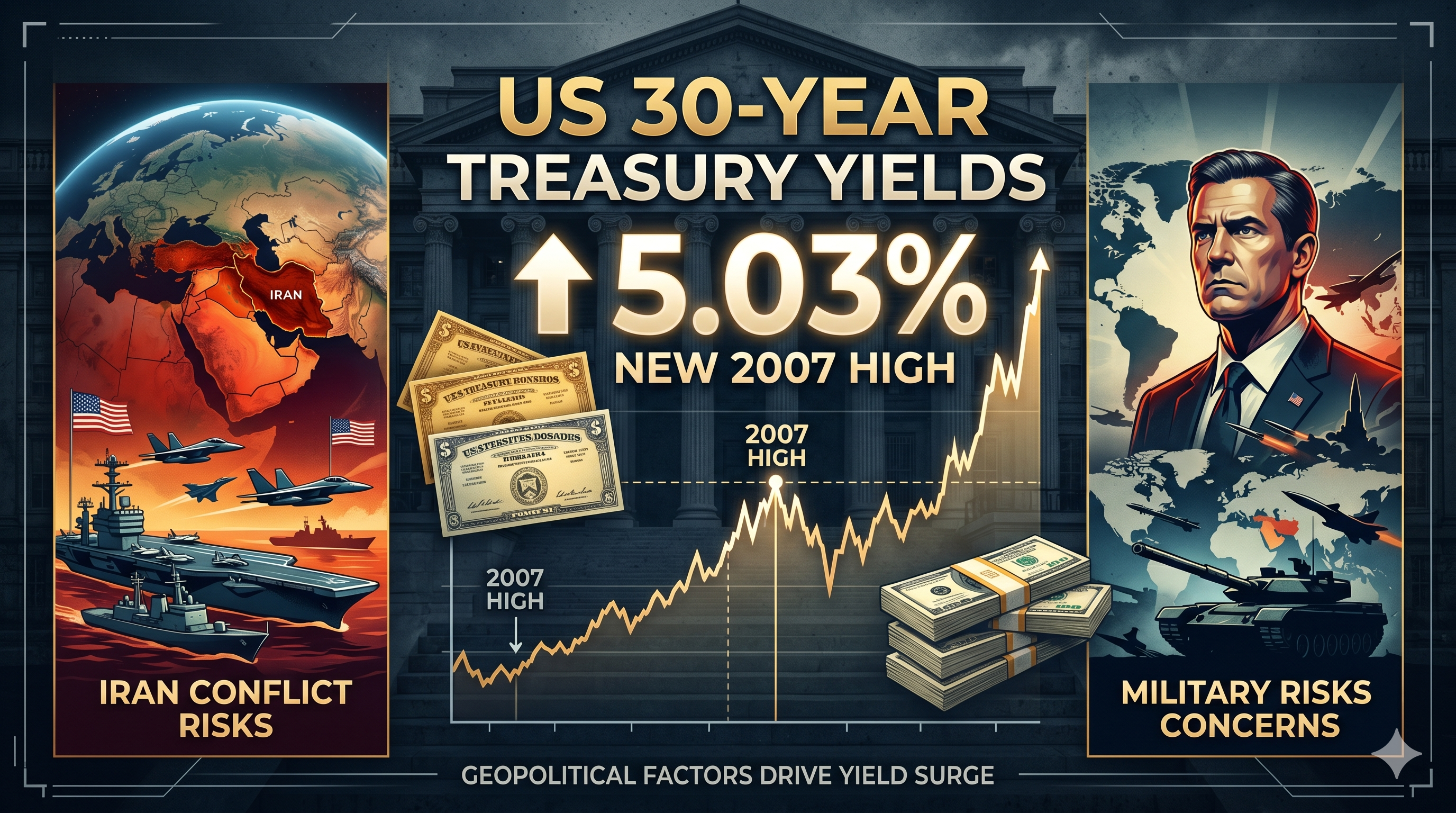
The US 30-year Treasury yield climbed sharply in mid-May 2026, briefly touching 5.20% and marking the highest level since before the global financial crisis. This move reflected a broad sell-off in long-dated government bonds as investors repriced risks around persistent inflation, geopolitical disruptions in energy markets, and the long-term fiscal implications of elevated defense outlays. The surge occurred against a backdrop of ongoing uncertainty from the US-Iran conflict that began in late February 2026, which disrupted oil flows through the Strait of Hormuz and pushed energy prices higher for extended periods.
Rising long-term Treasury yields signal market recognition of intertwined geopolitical energy shocks and structural fiscal pressures from higher military commitments, with implications for borrowing costs, investment allocation, and economic growth trajectories in the years ahead.
💡 Tips: New to crypto? KuCoin's Knowledge Base has everything you need to get started.
How the Iran Conflict Reshaped Energy Markets and Inflation Expectations
The 2026 Iran conflict, which escalated with joint US-Israeli operations in late February, quickly affected global energy supply chains. Iranian actions, including threats and disruptions around the Strait of Hormuz, led to significant reductions in shipping traffic and contributed to sharp increases in Brent crude prices, which at times exceeded $100 per barrel and sustained elevated levels into subsequent months. These developments reinforced inflation concerns among bond investors, who pushed yields higher as they anticipated stickier price pressures feeding into broader consumer and producer costs. Oil price volatility stemming from the conflict added a risk premium, complicating central bank policy paths, as markets adjusted expectations for the duration of elevated energy costs. Analysis from various economic assessments indicated that even partial or temporary disruptions could lift US headline inflation by notable amounts over 2026, directly influencing the pricing of long-duration fixed-income assets.
Longer-term Treasury securities proved particularly sensitive because their pricing incorporates decades of expected inflation and real growth dynamics. The conflict showed vulnerabilities in global energy infrastructure, prompting investors to demand higher compensation for holding bonds vulnerable to renewed supply shocks. Data from the period showed correlated movements between oil benchmarks and yield increases, with the 30-year yield advancing alongside energy market repricing. This dynamic differed from shorter-term rates, which remained more anchored by near-term policy expectations, underscoring the term premium expansion in the long end of the curve. Practical effects appeared in related sectors, where higher input costs from energy translated into broader pricing power concerns across industries reliant on transportation and manufacturing.
Bond Market Reaction to Geopolitical Risk Premiums in Long-Dated Debt
Investor selling in the Treasury market intensified as geopolitical developments layered additional uncertainty onto already elevated yield levels. The 30-year yield's advance to multi-year highs reflected not only immediate inflation fears but also a reassessment of the compensation required for holding long-duration paper amid potential repeated disruptions. Global bond markets experienced parallel pressure, with yields rising in other major economies as risk sentiment shifted. Market participants noted changes in buyer behavior, with traditional long-term holders showing caution while shorter-horizon traders influenced pricing dynamics. This environment contributed to increased volatility in the long end, where small shifts in inflation outlooks or risk perceptions produced outsized price movements.
Reports showed that yields on the 30-year moved in tandem with oil price swings and assessments of conflict duration, illustrating how external shocks transmit rapidly into sovereign debt pricing. The episode served as a reminder of the bond market's role as a barometer for accumulated risks that shorter-term indicators might overlook. Further analysis revealed that foreign official buying, often a stabilizing force in Treasuries, moderated during periods of heightened uncertainty, as central banks reassessed allocations amid their own domestic inflation challenges. Primary dealers reported thinner order books for long-bond auctions, forcing yields higher to attract sufficient demand. Volatility metrics, such as the MOVE index, spiked alongside these moves, reflecting the market's sensitivity to news flow from the Middle East.
Institutional investors conducting liability-driven investing recalibrated models to incorporate higher baseline inflation assumptions, reducing appetite for duration at previous yield levels. This behavioral shift extended beyond pure rate hedging, incorporating explicit geopolitical risk overlays that many portfolios had previously treated as transient. Market depth in the 30-year sector showed periodic liquidity strains, particularly during intraday spikes tied to conflict updates, prompting some participants to rely more heavily on futures for positioning. The broadening of the sell-off to include other developed market long bonds suggested a global reassessment rather than US-specific factors, though the dollar's reserve status amplified domestic yield impacts through currency channels. Credit spread movements in corporate bonds also widened modestly in sympathy, indicating spillover to private borrowing conditions.
Trump Administration Defense Spending Plans and Their Fiscal Footprint
President Trump's push for significantly higher defense budgets, including proposals approaching $1.5 trillion for fiscal year 2027, added another dimension to yield pressures. These plans represented substantial increases from prior levels, focusing on capabilities expansion, force size adjustments, and major initiatives such as the Golden Dome missile defense system. Such commitments, set against the backdrop of ongoing international engagements, signaled to markets a period of structurally higher government borrowing needs in the security domain. Defense spending at these proposed scales would contribute to overall fiscal outlays, interacting with existing deficit trajectories. Investors factored in the potential for sustained issuance of Treasury securities to finance these priorities, which influenced demand for longer maturities.
The combination of elevated spending plans and existing debt dynamics reinforced the view that term premiums might remain elevated or face periodic upward pressure as markets digest the multi-year outlook. The $1.5 trillion request, representing roughly a 44% increase, encompasses substantial investments in the defense industrial base, shipbuilding programs targeting dozens of new vessels, munitions stockpiling, and personnel pay raises. This scale of expansion aims to address perceived readiness gaps and enhance deterrence across multiple theaters, but it also implies continued large-scale Treasury issuance even as the conflict adds direct operational costs estimated in the tens of billions already. Budget documents highlight efforts to rebuild supply chains and expand production capacity for advanced systems, which require multi-year funding commitments that markets price into long-term debt expectations.
Analysts projecting debt-to-GDP direction incorporated these figures alongside interest servicing costs that rise mechanically with higher yields, creating a potential self-reinforcing dynamic. While some offsets through efficiency measures or tariff revenues were discussed, the net effect pointed toward larger primary deficits over the medium term. Portfolio managers specializing in rate strategy noted that defense-heavy fiscal packages historically correlate with steeper yield curves, as spending multipliers and supply-side effects play out unevenly. The timing overlapped with the energy shock, amplifying perceptions of dual pressures on the federal balance sheet from both revenue-eroding inflation and expenditure-increasing commitments. This fiscal outlook encouraged investors to scrutinize auction results more closely for signs of absorption capacity at current yield levels.
Interaction Between Energy Shocks and Federal Borrowing Requirements
The Iran-related energy price increases occurred while federal deficit projections for fiscal year 2026 already pointed toward the $2 trillion range, amplifying concerns over debt servicing costs. Higher oil prices fed into inflation readings, which in turn affected nominal yield requirements as investors sought protection against erosion of purchasing power. According to recent Treasury and CBO assessments, the fiscal year 2026 deficit is projected to be near $1.9–2.0 trillion, up from prior years, even as revenues have shown some growth from economic activity.
This interplay created a feedback loop where external shocks raised immediate borrowing costs while longer-term fiscal plans added to supply considerations in the Treasury market. Analysis of recent monthly statements showed deficits remaining substantial even with revenue growth, setting the stage for continued net issuance across various maturities.
The long end of the curve absorbed much of this repricing, as it is most exposed to cumulative effects over time, including persistent higher interest expenses that could add tens of billions annually to federal outlays. With Brent crude sustaining levels above $100–110 per barrel at points due to Strait of Hormuz disruptions, the pass-through to core inflation measures heightened the sensitivity of long-duration bonds. Investors demanded higher term premiums to compensate for the combined risks of elevated energy-driven inflation and sustained Treasury supply needed to finance both baseline operations and incremental defense-related expenditures. This dynamic contributed to the 30-year yield's push toward 5.2%, as market participants repriced the trajectory of real yields and breakeven inflation rates amid these overlapping pressures. Primary dealer surveys and auction results during the period reflected cautious demand at the long end, further reinforcing the upward bias in yields.
Historical Context of 30-Year Yields Reaching Pre-Crisis Peaks
Reaching levels last seen consistently in July 2007 placed current yields in rare territory, evoking comparisons to periods preceding major economic adjustments. The 30-year Treasury yield climbed to 5.18–5.20% in mid-May 2026, marking its highest print in nearly 19 years. This move represented a significant departure from the lower-yield environment that characterized much of the post-crisis decade, when yields often lingered below 3% for extended stretches amid quantitative easing and subdued inflation. This move carried implications for asset allocation across portfolios, as higher discount rates affected valuations in equities, real estate, and other rate-sensitive areas. Growth-oriented technology and high-valuation stocks faced downward pressure from elevated discount factors applied to future cash flows, while real estate investment trusts and commercial property deals encountered higher capitalization rates.
Market observers tracked the 30-year as a key indicator of long-horizon risk perceptions, particularly regarding the sustainability of fiscal paths amid external volatility. The yield advance unfolded gradually through the spring but accelerated sharply with news flow around conflict developments in the Middle East and updates on defense budget proposals. Auction demand for new 30-year bonds showed signs of caution, with bid-to-cover ratios occasionally softening and foreign participation remaining selective. This dynamic prompted portfolio managers to reassess duration exposure and hedge strategies, contributing to broader volatility in fixed-income markets. The repricing also highlighted changing correlations between Treasuries and other asset classes, reducing their traditional safe-haven characteristics during simultaneous inflation and geopolitical stress.
Implications for Mortgage Rates and Housing Market Dynamics
Elevated 30-year Treasury yields were transmitted directly into mortgage pricing, with 30-year fixed rates facing upward pressure that affected affordability calculations for prospective buyers. As the 30-year Treasury yield approached 5.20% in mid-May 2026, average 30-year fixed mortgage rates climbed into the 6.36%–6.56% range, according to Mortgage Bankers Association and Freddie Mac data. This dynamic compounded challenges in the housing sector, where higher borrowing costs influenced demand and transaction volumes. Lenders and borrowers navigated an environment where benchmark rates reflected both inflation hedging and substantial Treasury supply considerations. Practical examples from the period showed mortgage rates adjusting in response to Treasury movements, with ripple effects on home financing decisions.
A 50-basis-point increase in mortgage rates added roughly $150–$200 to monthly payments on a $400,000 loan, pushing many buyers toward smaller homes, longer commutes, or delayed purchases. Potential buyers encountered higher monthly costs, which in some cases delayed or altered purchase plans, particularly for first-time buyers and those in higher-price markets. Existing homeowners with low-rate mortgages from earlier years showed strong reluctance to sell, contributing to low inventory and further price stickiness in many regions. The housing market's sensitivity to long-term rates highlighted broader transmission channels from sovereign debt pricing to real economy outcomes, including slower home sales, moderated price appreciation, and reduced refinancing activity that limited consumer spending power.
Corporate Borrowing Costs and Capital Investment Decisions
Higher Treasury yields served as a reference point for corporate debt issuance, pushing borrowing costs upward across the credit spectra. As the 30-year yield rose toward 5.20% in mid-May 2026, investment-grade corporate bond yields climbed in tandem, with many new issues pricing at spreads that reflected both the higher risk-free benchmark and modestly wider credit spreads. Companies planning long-term investments or refinancings faced elevated hurdle rates, potentially leading to more selective capital allocation. Sectors with heavy financing needs, including those exposed to energy costs such as airlines, logistics, and manufacturing, experienced compounded effects from both higher interest expenses and elevated input costs.
This environment encouraged greater scrutiny of project returns, with some firms adjusting expansion timelines, scaling back capital expenditure budgets, or seeking alternative funding structures such as private credit or equity raises. Investment-grade issuers reported higher all-in borrowing costs, prompting CFOs to prioritize debt maturity extensions over new leverage. The yield environment underscored the interconnectedness between government debt markets and private sector financing conditions, where sovereign benchmarks influence the cost of capital economy-wide. This transmission mechanism affected everything from merger and acquisition financing to green energy project funding, ultimately shaping corporate investment decisions and economic growth momentum in the second half of 2026.
Global Spillovers from US Long-Term Yield Movements
International bond markets registered similar pressures, with yields in Europe and Asia advancing amid shared inflation concerns and risk repricing. German 10-year Bund yields rose above 2.8%, while Japanese Government Bond yields climbed to multi-year highs as markets priced in imported energy inflation. Foreign investors in US Treasuries weighed currency movements, policy divergence, and geopolitical factors in their allocation choices. The dollar's role as a reserve currency amplified the global reach of US yield developments, strengthening the USD against several major currencies. Central banks and sovereign wealth funds monitored these shifts closely, as changes in US rates influenced capital flows and exchange rate dynamics worldwide.
Several Asian central banks adjusted their FX intervention strategies to counter excessive dollar strength. Emerging markets faced additional considerations around imported inflation from energy prices and potential tightening in financial conditions, with countries like India, Brazil, and South Africa seeing higher local bond yields and currency volatility. Portfolio managers at global institutions reduced duration exposure in some developed markets while increasing allocations to inflation-linked securities. The episode illustrated the central position of US Treasuries in global portfolio construction and risk management, serving as the benchmark that ripples across asset classes and geographies.
Federal Reserve Policy Considerations in a Higher-Yield Ecosystem
The yield surge occurred as the Federal Reserve balanced inflation data influenced by energy costs against growth indicators. Policymakers faced a complex environment where external shocks from the Iran conflict complicated the calibration of short-term rates relative to long-term market pricing. With the federal funds rate held steady in the 3.50–3.75% target range in recent meetings, communications emphasized data dependence, with close attention to both headline and underlying price measures. FOMC statements noted that inflation remained elevated, partly reflecting higher global energy prices stemming from disruptions in the Strait of Hormuz. Markets adjusted expectations for the policy path, incorporating the possibility of responses tailored to evolving inflation risks, including the potential for fewer rate cuts or even hikes if price pressures proved more persistent.
The divergence between short and long rates highlighted differing pressures across the maturity spectrum, with the long end more reflective of structural and geopolitical factors such as sustained defense spending and energy market volatility. This setup tested the central bank's ability to anchor expectations amid multiple headwinds. Several participants highlighted the challenge of distinguishing temporary supply shocks from more entrenched inflationary dynamics, leading to cautious language in post-meeting projections. Market-implied probabilities shifted toward a more hawkish stance through late 2026, with some pricing in limited easing or even tightening risks depending on incoming CPI and PCE readings.
Pension Funds, Insurers, and Long-Duration Asset Strategies
Institutional investors with long-term liabilities, such as pension plans and insurance companies, were confronted with higher discount rates that affected present value calculations of future obligations. The rise in 30-year Treasury yields to around 5.20% in May 2026 significantly increased discount rates used in actuarial valuations, reducing the reported present value of liabilities for many defined-benefit pension plans and improving their funded status on paper. While elevated yields offered potential income opportunities for reinvestment and new allocations, the volatility and underlying drivers, geopolitical energy shocks, and elevated defense spending prompted portfolio reviews focused on duration matching and risk buffers.
Some entities explored opportunities in the higher-yield environment by extending duration selectively or increasing allocations to long-dated Treasuries and corporate bonds to lock in attractive rates for matching long-term payouts.
Others maintained caution regarding further upside in rates or renewed volatility, opting instead to build cash reserves or add inflation-protected securities. This recalibration influenced demand patterns in the Treasury market and extended to other fixed income categories, including investment-grade corporates and municipal bonds. Major pension funds and insurers adjusted their strategic asset allocation models to incorporate higher neutral yield assumptions over the coming decade. The developments reinforced the importance of scenario planning around inflation persistence and fiscal trajectories, with many institutions now running stress tests that model prolonged 4.5–5.5% yield ranges combined with oil price shocks.
Evolving Debt Management and Market Liquidity Considerations
Increased Treasury issuance to meet fiscal needs required careful coordination to maintain market functioning. Treasury Department strategies focused on meeting demand across maturities while monitoring auction results and investor participation. Liquidity in the secondary market for long bonds remained a point of attention amid volatility episodes. These operational aspects influenced pricing dynamics and investor confidence. Smooth absorption of supply represented a key variable in containing undue yield volatility, with implications for overall financial stability. Ongoing dialogue between debt managers, the Federal Reserve, and market participants helped navigate the environment shaped by both cyclical and structural factors.
At the same time, analysts closely watched foreign demand from major institutional buyers, including sovereign wealth funds, pension managers, and central banks, whose participation often affects longer-term borrowing costs. Shifts in expectations around inflation, economic growth, and future interest rate policy also played an important role in shaping investor appetite for Treasury securities. Market participants evaluated each auction not only for immediate pricing outcomes but also for broader signals regarding confidence in U.S. government debt markets and the resilience of financial conditions during periods of heightened uncertainty.
FAQ
How exactly did disruptions from the 2026 Iran conflict contribute to higher US Treasury yields?
The conflict led to reduced oil shipping through critical chokepoints, driving energy prices upward and feeding into inflation measures. Bond investors responded by selling longer-dated securities to demand greater compensation for inflation and uncertainty risks, pushing the 30-year yield to levels near 5.20%. This effect, compounded with other fiscal considerations, creates sustained pressure on long-term rates.
What role do proposed increases in US defense spending play in current bond market dynamics?
Plans for substantially higher military budgets, such as those targeting $1.5 trillion for fiscal 2027, signal larger future borrowing needs. Markets incorporate these expectations into long-term yield pricing, contributing to term premium expansion as investors assess the trajectory of debt supply and associated risks.
Why are 30-year Treasury yields more sensitive to these developments than shorter maturities?
Longer-duration bonds carry greater exposure to cumulative inflation, growth, and policy risks over extended periods. Geopolitical shocks and fiscal outlooks affect distant cash flow discounting more profoundly, leading to sharper price adjustments in the long end compared to front-end rates anchored by nearer-term expectations.
How might sustained higher yields affect everyday consumers and businesses?
Elevated Treasury rates influence mortgage pricing, corporate loans, and other credit costs, potentially slowing housing activity, business expansion, and consumer borrowing. Energy cost pressures from related events further compound expense burdens across households and operations.
What indicators should investors monitor for potential changes in this yield environment?
Key signals include oil price trends and conflict resolution progress, monthly deficit and debt issuance data, inflation reports, and Federal Reserve communications. Shifts in these areas can influence the balance of risks affecting long-term rate expectations.
Are there opportunities arising from the current higher yield levels for certain investor types?
Institutional holders with long liabilities may find improved income potential and better matching characteristics, while diversified portfolios can use higher rates for tactical allocation or as a hedge component. Success depends on individual risk tolerance, time horizon, and thorough assessment of ongoing volatility drivers.
Disclaimer: This content is for informational purposes only and does not constitute investment advice. Cryptocurrency investments carry risk. Please do your own research (DYOR).