

Crypto Markets Paint the Town Green: Solana and Ether Rally Behind Bitcoin’s $60K Comeback
2026/07/06 16:32:00
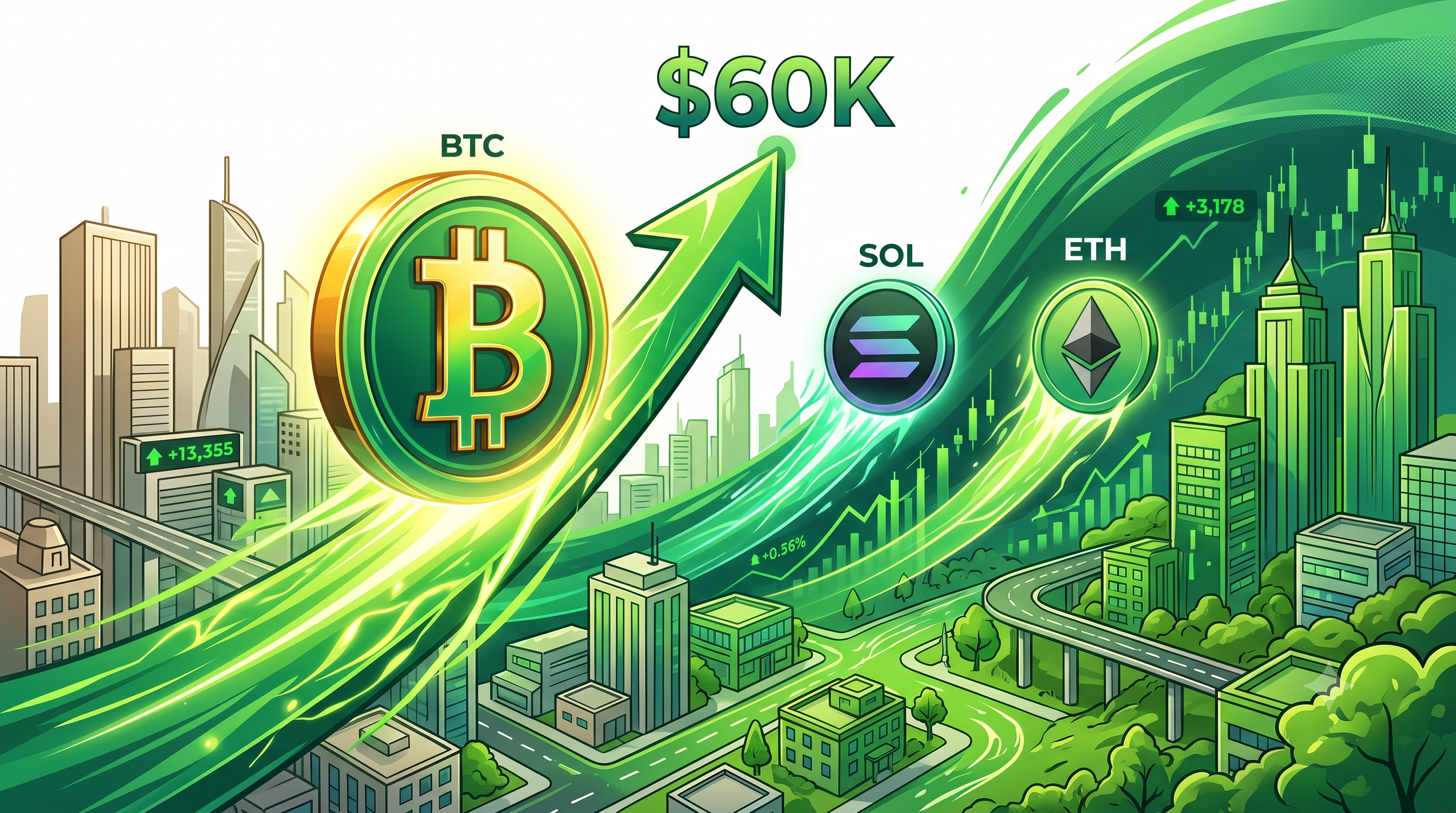
Crypto markets turned green again after Bitcoin reclaimed the $60,000 level, giving traders a stronger short-term confidence signal after several sessions of weak sentiment and macro uncertainty. The latest market quote available on July 3 showed Bitcoin trading near $61,320, with an intraday range between roughly $60,043 and $62,056, meaning BTC was still holding above the key psychological level after the initial rebound. Ether was trading near $1700, while Solana was around $77.97, keeping both major altcoins in focus as investors watched whether Bitcoin’s recovery could turn into a broader crypto-market rebound.
The rally followed comments from Federal Reserve Chair Kevin Warsh, who said inflation risks had come down while still reaffirming the Fed’s commitment to its 2% inflation target. That balance gave risk assets some breathing room without turning the Fed’s message fully dovish. CoinDesk reported that Bitcoin climbed back above $60,000 for the first time in more than a week after Warsh’s remarks, while Solana led major tokens with about a 16% weekly gain and a semiconductor selloff in Asia weakened the AI trade that had been pulling capital away from crypto during the quarter. The move was therefore not only a crypto-specific bounce; it was also part of a wider macro repricing around inflation expectations, Fed policy, and risk appetite.
Crypto Markets Paint the Town Green as Bitcoin Reclaims $60K
Bitcoin’s return above $60,000 mattered because it changed the tone of the market from defensive caution to cautious optimism. In crypto, major round numbers often become psychological battle lines, especially when traders are already nervous about macro policy, liquidity, and weak momentum. When Bitcoin trades below a level like $60K for several sessions, bearish positioning can build, spot buyers may hesitate, and altcoin traders often reduce exposure because they expect higher-beta assets to fall harder if BTC breaks lower. Once Bitcoin reclaimed that level and stayed above it, traders had a clearer reason to re-enter major crypto assets instead of staying fully defensive. This is why investors watching Bitcoin price movement across market cycles are now focused less on the first bounce and more on whether BTC can build a stable base above $60K.
Bitcoin’s $60K Reclaim Resets Short-Term Market Psychology
The $60,000 reclaim carried extra weight because Bitcoin had recently been trading under visible pressure. Reuters reported that BTC rebounded by 2.44% to around $60,096 after dipping to its lowest level since September 2024, while the latest quote showed Bitcoin still above $61,000. That sequence matters because it shows the move was not simply a calm continuation of an uptrend. It was a recovery from a stressed market, where sellers had been testing lower levels and traders were watching whether Bitcoin would lose another major support zone. When BTC recovers from that type of pressure and retakes a key psychological level, it can force short sellers to reduce risk, encourage dip buyers to return, and improve confidence across the broader crypto market.
The next issue is whether Bitcoin can turn $60K into support rather than treating it as a temporary recovery line. A clean hold above this level would suggest buyers are willing to defend the reclaim and that the market may have moved beyond immediate panic. That would give traders more confidence to watch higher resistance areas and could support stronger participation from Ether, Solana, and other large-cap altcoins. However, if Bitcoin quickly falls back below $60,000, the rally may be viewed as a short-covering move or macro-driven relief bounce rather than a durable shift in demand. For now, Bitcoin has changed the short-term conversation, but it still needs follow-through before the market can call the recovery stable.
Warsh’s Inflation Comments Give Risk Assets Breathing Room
The macro trigger behind the rebound was Warsh’s softer language on inflation risks. Reuters reported that Warsh reaffirmed the Fed’s 2% inflation target, refused to give clear forward guidance, and signaled that he would not tolerate inflation above target, even as markets focused on his comment that inflation expectations and risks had eased. For crypto, that combination is important because Bitcoin and altcoins remain highly sensitive to interest-rate expectations, dollar strength, liquidity conditions, and investor appetite for volatile assets. The Fed did not promise easier policy, but the tone was soft enough for traders to reduce some near-term fear around aggressive tightening.
The Federal Reserve’s official monetary-policy framework states that the FOMC views 2% inflation over the longer run as most consistent with its price-stability mandate. That helps explain why Warsh’s remarks were interpreted carefully. Markets welcomed softer inflation-risk language, but the Fed’s commitment to its target means policy risk has not disappeared. Any fresh inflation surprise, stronger dollar move, or hawkish Fed communication could pressure Bitcoin again. The current rebound is therefore better understood as a macro relief rally with improving sentiment, not a confirmed all-clear signal from the Fed.
The Debasement Trade Returns to the Market Conversation
MarketWatch connected Warsh’s remarks to a brief revival of the “debasement trade,” a theme linked to demand for hard assets such as gold and Bitcoin when investors become concerned about currency weakness, fiscal pressure, or long-term inflation risk. The report said gold rose after Warsh’s comments, Bitcoin also gained, and the Treasury yield curve steepened, showing that traders were reacting to a broader macro repricing rather than only crypto-specific news. That matters because Bitcoin often performs best as a macro asset when investors are debating inflation, central-bank credibility, the dollar, and long-term store-of-value narratives.
The latest move does not prove that the debasement trade is fully back, but it shows how quickly Bitcoin can re-enter that conversation when inflation expectations soften or policy uncertainty shifts. This gives the $60K comeback more meaning than a normal daily bounce. Bitcoin was not only reacting to token-level momentum; it was moving alongside a broader reassessment of hard assets, rates, and inflation risk. For traders, this means the next phase depends on more than chart levels. U.S. jobs data, inflation readings, Fed speeches, dollar strength, and Treasury yields could all influence whether BTC holds above $60,000 or loses momentum again.
Solana and Ether Rally as Altcoin Momentum Returns
Bitcoin led the rebound, but the altcoin reaction made the move more important. Solana and Ether matter because they represent two different sides of crypto risk appetite. Ether is tied to smart contracts, DeFi, staking, stablecoin settlement, tokenized assets, and layer-2 infrastructure, while Solana is often treated as a faster-moving, higher-beta asset connected to retail trading, meme coins, high-throughput blockchain activity, and stronger speculative momentum. When both ETH and SOL move higher after Bitcoin stabilizes, it suggests traders are not only buying BTC defensively but also testing whether broader crypto momentum can return.
Solana Leads Major Tokens as Traders Rotate Into Higher-Beta Crypto
Solana stood out as one of the strongest major tokens in the rebound. CoinDesk reported that SOL gained about 16% over the week, while the latest quote showed Solana trading near $77.97 on July 3. That strength matters because Solana often behaves like a high-beta crypto asset: it can fall quickly when sentiment weakens, but it can also rebound faster when traders regain confidence. A strong Solana move after Bitcoin reclaims a major level suggests that some investors are willing to take more risk again, especially in assets that can deliver larger percentage moves during relief rallies. Solana’s performance also shows that the rebound was not limited to Bitcoin alone. If traders were only seeking safety inside crypto, BTC would likely lead while higher-volatility assets remained weak. Instead, SOL’s outperformance suggests that some capital rotated back into riskier crypto segments once Bitcoin stabilized. That does not automatically confirm a new altcoin season, because a true altcoin cycle requires broader participation across multiple sectors. Still, Solana price action and market performance gives the market an important signal: risk appetite has improved enough for traders to look beyond Bitcoin and seek stronger upside in large-cap altcoins.
Ether Rebounds as Smart Contract Sentiment Improves
Ether’s rebound was less aggressive than Solana’s, but it remained important for market structure. CoinDesk reported that ETH traded near $1,630 during the rally, while the latest quote showed Ether around $1700 on July 3. ETH’s participation matters because Ethereum remains one of the largest liquidity centers in crypto and supports major areas such as DeFi, stablecoin activity, staking, layer-2 networks, tokenized asset experiments, and institutional blockchain infrastructure. When Ether joins a Bitcoin-led recovery, the market looks healthier than it would if only BTC were moving higher.
At the same time, Ether still needs stronger follow-through before traders can describe the move as an Ethereum-led recovery. The latest price action looks more like ETH participating in a wider risk reset than leading the market by itself. That distinction matters because Ethereum sentiment has been uneven in parts of the recent cycle, especially as Bitcoin-specific narratives and faster-moving layer-1 assets have captured more attention. For Ether to become a stronger leader, traders would likely need to see better volume, stronger DeFi activity, healthier layer-2 sentiment, and a cleaner technical move above nearby resistance zones. In that context, Ethereum staking and network participation remain important parts of the broader Ethereum ecosystem story, even if short-term ETH price action is still being shaped mainly by Bitcoin and macro conditions.
Altcoin Breadth Still Needs Confirmation
The moves in Solana and Ether improved market sentiment, but a durable altcoin recovery needs wider confirmation. In the early stage of a rebound, liquidity usually returns first to Bitcoin and the largest altcoins because these assets are easier to trade, more liquid, and less risky than smaller tokens. After that, traders watch whether gains spread into mid-cap assets, DeFi tokens, layer-2 projects, AI-related crypto assets, gaming tokens, and meme coins. If BTC, ETH, and SOL are the only meaningful movers while the rest of the market remains weak, the rally may stay narrow and fragile rather than becoming a broad recovery.
A healthier altcoin rebound would likely show stronger spot volume, improving derivatives positioning, and more balanced participation across crypto sectors. Solana’s outperformance is encouraging because it shows traders are willing to take more risk, while Ether’s recovery supports confidence in smart contract infrastructure. However, the market still needs time to prove that buyers are adding fresh exposure rather than simply closing shorts or chasing a quick bounce. If broader altcoin sectors begin to participate while Bitcoin holds above $60K, the rally would look more durable. If breadth remains weak, traders may treat the move as a temporary large-cap recovery.
What Bitcoin’s $60K Comeback Means for Traders Next
Bitcoin’s comeback above $60,000 gives traders a clearer short-term roadmap, but it does not remove the risks facing the market. The latest data shows BTC trading near $61,336, with an intraday high around $62,056 and an intraday low near $60,043, meaning the market is still holding above the key support zone after the first rebound. That is constructive, but traders still need confirmation from price action, altcoin breadth, macro data, and liquidity conditions before treating this move as a stronger recovery rather than a relief bounce.
-
Bitcoin Must Defend $60K to Confirm the Recovery: The first and most important test is whether Bitcoin can hold the $60,000 area as support. A move above a major round number can improve sentiment quickly, but real confirmation comes when buyers defend that level after the first wave of excitement fades. With BTC still trading above $61,000, the market has moved from panic recovery into a support-building phase. If Bitcoin continues to stay above $60K, traders may become more comfortable watching higher resistance zones near the recent intraday high around $62,056, while altcoins such as Ether and Solana may get more room to extend their rebounds. If BTC drops back below $60,000, however, the market may treat the rally as temporary short covering rather than a durable shift in demand.
-
Altcoin Momentum Needs Broader Market Participation: Solana and Ether helped strengthen the rebound, but traders should watch whether the rally spreads beyond the largest and most liquid assets. CoinDesk reported that Solana led major tokens with roughly a 4% daily gain and about a 16% weekly rise after Bitcoin reclaimed $60,000, while Ether also moved higher with the broader market. Latest market data shows SOL near $77.97 and ETH near $1700, keeping both assets close to the levels that mattered during the first wave of the rebound. A stronger recovery would likely require more than BTC, ETH, and SOL moving together; traders would want to see participation from DeFi tokens, layer-2 assets, infrastructure names, meme coins, and other high-beta sectors. Without that wider breadth, the market may still be vulnerable to a quick reversal if Bitcoin loses momentum.
-
Fed Policy and Jobs Data Remain Critical for Crypto Sentiment: Bitcoin’s $60K comeback was closely tied to macro expectations, not only crypto-native demand. Warsh’s comments helped risk assets because he said inflation expectations and risks had eased, even while reaffirming the Fed’s 2% inflation target and avoiding clear forward guidance. That gave traders some breathing room, but it did not remove uncertainty around interest rates. The U.S. Bureau of Labor Statistics employment report also remains important because labor-market data can shape expectations for Fed policy, Treasury yields, dollar strength, and risk appetite. For crypto traders, the next phase depends heavily on whether incoming data supports a softer Fed path or brings back fears of sticky inflation, stronger yields, and a stronger dollar.
-
Dollar Strength and Liquidity Conditions Could Decide Follow-Through: Bitcoin often reacts strongly to the dollar, Treasury yields, and liquidity expectations because it trades like a macro-sensitive risk asset during uncertain periods. If the dollar weakens and rate-hike fears ease, crypto markets may get more room to stabilize above key support levels. If the dollar strengthens again or yields rise, Bitcoin’s $60K support could come under pressure even if crypto-specific sentiment improves. This is why traders should not view the latest rally only as a chart pattern. The price level matters, but the macro backdrop will likely decide whether buyers have enough confidence to keep defending BTC above $60,000.
-
AI Stock Rotation Could Help or Hurt Crypto Risk Appetite: Another factor traders should watch is whether capital continues rotating away from crowded AI and semiconductor trades. CoinDesk noted that weakness in chip-related stocks helped create space for crypto to regain attention, especially after AI equities had dominated speculative flows during the quarter. If AI stocks cool without causing a broader risk-off move, Bitcoin, Ether, and Solana could benefit from renewed interest in alternative high-volatility assets. But if weakness in AI names turns into a wider market selloff, crypto may also suffer because investors could reduce exposure across risk assets rather than rotate into digital assets.
-
The Rally Needs Confirmation, Not Just One Green Day: The strongest signal for traders would be a combination of Bitcoin holding above $60K, Solana maintaining relative strength, Ether building above the $1,600 area, and broader altcoin sectors showing follow-through. MarketWatch connected Warsh’s remarks to a brief revival of the “debasement trade,” where hard assets such as gold and Bitcoin gained as investors reassessed inflation, policy, and dollar risks. That narrative can support BTC in the short term, but it still needs price confirmation. If buyers continue defending support and market breadth improves, the comeback could grow into a stronger recovery. If BTC loses $60K and altcoins give back gains quickly, traders may return to caution and treat the move as another relief rally inside a fragile market.
Conclusion
Bitcoin’s move back above $60,000 gave crypto markets a clear short-term boost, and the latest quote on July 3 showed BTC still holding above that level near $61,320. Solana and Ether helped turn the rebound into a broader large-cap rally, with SOL near $77.97 and ETH around $1700. Warsh’s softer inflation-risk language reduced some immediate macro pressure, while Bitcoin’s reclaim of a key psychological level encouraged traders to rotate back into major crypto assets. Solana’s weekly strength showed renewed appetite for higher-beta tokens, while Ether’s rebound supported confidence in smart contract infrastructure.
The rally is still early, and the next test is confirmation. Bitcoin needs to hold $60K, altcoin breadth needs to improve, and macro conditions must remain supportive enough for risk assets. If those pieces line up, the move could become more than a relief rally. If they fail, the market may return to caution quickly. For now, Bitcoin’s comeback has changed the tone, but traders still need to see whether the green market can last beyond the first rebound.
FAQs
-
Why does Bitcoin often lead crypto market recoveries?
Bitcoin usually leads crypto market recoveries because it is the largest and most liquid digital asset, so traders often use BTC as the first signal of whether risk appetite is improving. When Bitcoin stabilizes above a major level such as $60,000, investors may become more willing to take risk in altcoins. This is why Bitcoin’s move back above $60K helped improve sentiment across Ether, Solana, Dogecoin, and other major tokens. CoinDesk reported that Bitcoin climbed above $60,000 after Warsh said inflation risks had come down, while Solana led major tokens with a strong weekly move.
-
What makes the $60,000 level important for Bitcoin traders?
The $60,000 level matters because it is a major psychological price zone. Traders often pay attention to large round numbers because they can influence stop-loss placement, derivatives positioning, and short-term sentiment. A move above $60K does not automatically confirm a new bull trend, but it can shift market psychology from fear to cautious optimism. The stronger confirmation comes if Bitcoin holds above that level for several sessions and attracts steady buying instead of quickly falling back below support.
-
Why did Solana outperform many other major tokens during the rebound?
Solana often outperforms during risk-on rebounds because traders treat SOL as a higher-beta crypto asset. Higher-beta assets can move faster than Bitcoin when sentiment improves, but they can also fall more sharply when risk appetite weakens. Solana’s strong weekly move suggests traders were willing to rotate beyond Bitcoin after the market stabilized. However, Solana strength alone is not enough to confirm a full altcoin season; the rally would need wider participation from DeFi, layer-2, infrastructure, and other crypto sectors.
-
How do Federal Reserve comments affect Bitcoin and altcoins?
Federal Reserve comments can affect crypto because Bitcoin and altcoins are sensitive to interest-rate expectations, liquidity, the U.S. dollar, and risk appetite. When markets believe inflation pressure is easing, traders may become more comfortable holding volatile assets. However, the Fed still targets 2% inflation over the longer run, so softer comments do not mean policy risk has disappeared. The Federal Reserve says the FOMC views 2% inflation as most consistent with its price-stability mandate.
-
What is the “debasement trade,” and why does it matter for Bitcoin?
The debasement trade refers to a market theme where investors favor hard assets such as gold and Bitcoin when they worry about currency weakness, inflation, fiscal pressure, or long-term monetary instability. MarketWatch reported that Warsh’s comments briefly revived this theme, with gold and Bitcoin both gaining as traders reassessed inflation and policy risks. For Bitcoin, this matters because BTC can sometimes trade not only as a crypto asset but also as part of a broader hard-asset narrative.
-
What role does U.S. jobs data play in crypto market sentiment?
U.S. jobs data matters because it can shape expectations for Fed policy, Treasury yields, dollar strength, and overall risk appetite. A weaker labor market may reduce pressure for tighter policy, but it can also raise concerns about slower economic growth. The latest BLS release showed U.S. nonfarm payroll employment rose by 57,000 in June 2026, while the unemployment rate was 4.2%. For crypto traders, the ideal setup is usually cooling inflation and softer rate pressure without a sharp economic slowdown.
-
What is altcoin breadth, and how can traders use it?
Altcoin breadth measures whether a rally is broad or narrow. A narrow rally may only include Bitcoin, Ether, Solana, and a few large-cap tokens. A broader rally includes multiple sectors such as DeFi, layer-2 networks, meme coins, AI-related crypto assets, gaming tokens, and infrastructure projects. Traders use breadth to judge whether the market recovery is healthy. If only a few liquid tokens rise, the move may be fragile. If many sectors participate with improving volume, the rebound may have stronger support.
-
Could the crypto rally fail even if Bitcoin stays near $60K?
Yes. A rally can fail even if Bitcoin stays near $60K if volume weakens, altcoins lose momentum, the dollar strengthens, or macro data turns against risk assets. Bitcoin holding support is important, but it is only one part of the picture. Traders should also watch liquidity, derivatives funding rates, spot demand, ETF flows, Fed communication, and whether Ether and Solana continue to attract follow-through buying. A durable recovery usually needs several signals moving in the same direction, not just one strong green day.
Disclaimer: This article is for informational purposes only and should not be considered financial advice. Cryptocurrency markets are volatile, and readers should conduct their own research before making trading or investment decisions.