

Strait of Hormuz Deal Takes Shape: Could Lower Oil Prices Boost Bitcoin?
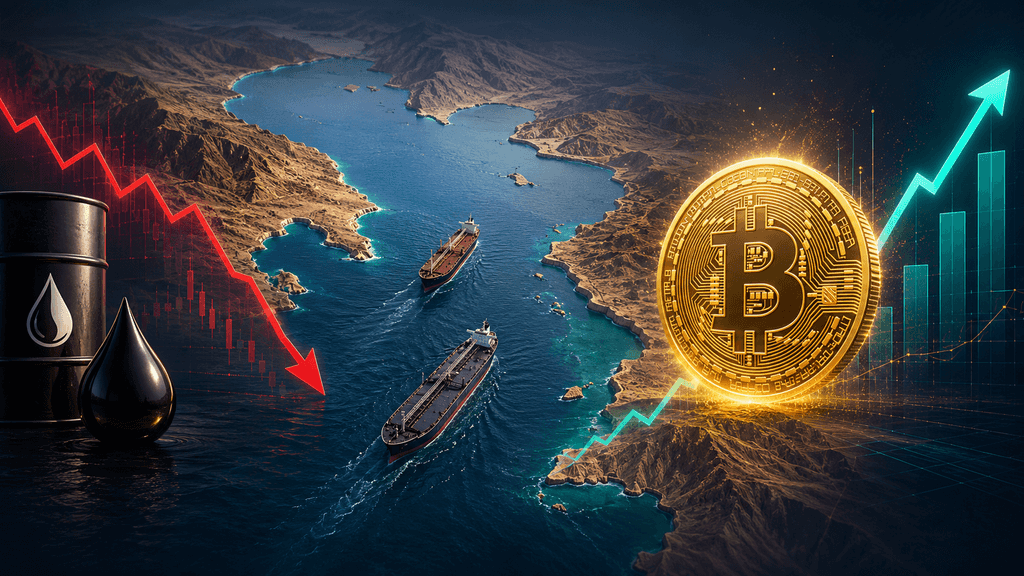
The Strait of Hormuz is once again becoming a major macro catalyst for Bitcoin. Iran and Oman are working on a framework that could allow more commercial shipping to move through the critical energy corridor, raising hopes that months of disruption to Middle Eastern oil flows could gradually ease. Yet the agreement is far from a simple return to pre-war conditions. Proposed transit fees, sanctions restrictions, insurance problems and possible limits on vessels deemed “hostile” remain major obstacles. On August 7, Brent crude was trading back above $83 as markets reconsidered how quickly normal shipping could actually return.
For crypto investors, the significance of Hormuz goes far beyond oil. A sustained decline in energy prices could reduce inflation pressure, change expectations for Federal Reserve policy and improve liquidity conditions for risk assets. Bitcoin has already shown sensitivity to this chain: when an earlier U.S.-Iran agreement pushed Brent lower in June, BTC briefly climbed above $65,500.
That raises the bigger question: if a workable Strait of Hormuz deal finally removes more of the geopolitical premium from oil, could Bitcoin become one of the indirect winners?
What Is Happening in the Strait of Hormuz?
The latest negotiations are not simply about declaring the Strait of Hormuz “open.” Iran and Oman are attempting to establish a workable system for commercial shipping after months of conflict disrupted normal traffic. Under proposals reported by Reuters, Tehran could gain greater authority over vessels entering the Gulf, while outbound traffic would operate under a route coordinated between Iran and Oman. Issues such as navigation management, transit approval, security and possible shipping fees are all part of the negotiations.
That distinction matters because the Strait was largely open to international commercial vessels without such charges before the war. A post-conflict framework in which Iran gains a formal role in determining which ships can enter would therefore represent more than the restoration of old shipping routes. It could create a new operating system for one of the world's most important energy chokepoints.
The diplomatic process has progressed far enough to move oil prices, but not far enough to remove uncertainty. The market is therefore trading two competing possibilities: one in which commercial traffic gradually normalizes and another in which Hormuz becomes a tightly managed corridor subject to political restrictions. For Bitcoin traders, understanding that difference is essential because only a durable increase in energy flows is likely to have a lasting effect on oil, inflation and monetary expectations.
Why the Hormuz Deal Is Still Fragile
The first major obstacle is money. Iran has reportedly sought transit-related fees equivalent to roughly 5% to 7% of cargo value, while Oman has discussed a lower figure of around 3%. Washington has pushed for no fees at all. For oil tankers carrying cargo worth tens or hundreds of millions of dollars, these percentages are economically significant rather than symbolic.
Sanctions make the issue even more complicated. Shipping companies may face serious legal consequences if fees must be paid to an Iranian entity subject to U.S. restrictions. Insurance is another obstacle: industry sources told Reuters that restrictive insurance clauses could terminate or complicate coverage if payments are made under the proposed arrangement. This creates a difficult situation in which a shipping company might be required to comply with Iran's rules to transit the strait while simultaneously risking sanctions or insurance problems by doing so.
The political restrictions are equally important. Iran has considered rules barring U.S., Israeli and other vessels classified as hostile, with possible penalties for violating the restrictions. That helped send Brent back above $83 on August 7 after prices had fallen earlier in the week on hopes for de-escalation. The market's message is clear: investors are not yet pricing a restoration of normal free navigation. They are pricing a possible conditional corridor, and that leaves substantial geopolitical risk embedded in oil prices.
Why Hormuz Matters So Much for Oil
The Strait of Hormuz is difficult to replace because of the enormous amount of energy that normally moves through it. U.S. Energy Information Administration data show oil flows through the strait exceeded 20 million barrels per day during each quarter of 2025. Even after disruption began, flows averaged about 14.6 million barrels per day in the first quarter of 2026. Before the crisis, that made Hormuz one of the world's two largest oil transit chokepoints.
Oil markets also react to more than barrels that are physically lost. When traders believe tankers could be attacked, delayed or prevented from leaving the Gulf, they add a geopolitical risk premium to prices. Shipping costs increase, insurance becomes more expensive, inventories become more valuable and refiners compete to secure alternative supplies. During the 2026 crisis, the impact became severe enough that the EIA estimated millions of barrels per day of Middle Eastern production had to be shut in because producers could not reliably move crude through the strait.
| Hormuz Scenario | Likely Oil Impact | Possible Bitcoin Impact |
| Broad, reliable reopening | Geopolitical premium falls sharply | Potentially bullish through lower inflation and better liquidity |
| Conditional or partial deal | Oil remains volatile | Mixed; limited macro benefit |
| Negotiations stall | Risk premium stays elevated | Neutral to bearish |
| New military escalation | Oil could spike sharply | Short-term risk-off pressure |
This is why the details of the Iran-Oman framework matter more than the word “deal.” A political announcement may cause a short-lived oil selloff, but a durable decline requires tankers to move regularly, insurance costs to fall and Gulf producers to restore output.
Lower Oil Could Ease Inflation Pressure
Oil is not the entire inflation basket, but energy prices can influence the economy through several channels at the same time. Higher crude prices feed into gasoline and diesel, transportation costs, aviation, petrochemicals, manufacturing and logistics. Businesses may eventually pass some of those costs to consumers, while visible gasoline prices can also affect household inflation expectations.
The reverse process matters just as much. If a functioning Hormuz agreement increases oil flows and removes a meaningful portion of the geopolitical premium, lower crude and gasoline prices could ease headline inflation. The EIA demonstrated the size of that potential adjustment in July, when it sharply lowered its oil-price outlook after increased Hormuz traffic and projected Brent to average $74 per barrel in the third quarter, alongside declining U.S. gasoline prices.
For Bitcoin traders, this is where the story becomes more important. The relevant question is not simply whether Brent trades at $83 or $78. It is whether cheaper energy changes the expected path of inflation enough to affect bond yields and Federal Reserve policy. Bitcoin investors should care less about oil in isolation and more about what lower oil does to monetary expectations.
How Lower Oil Prices Could Help Bitcoin
The bullish argument for Bitcoin runs through a chain of macroeconomic transmission rather than a direct oil-BTC relationship. A credible Hormuz agreement can reduce geopolitical risk. Lower geopolitical risk can pressure crude prices. Cheaper energy can ease inflation concerns. Softer inflation expectations can reduce the pressure for restrictive monetary policy, while Treasury yields and the dollar may become less supportive of defensive assets. That combination can improve the relative environment for Bitcoin and other risk assets.
Lower Yields Reduce the Opportunity Cost
Bitcoin does not produce a contractual yield. When investors can obtain high inflation-adjusted returns from Treasury bills or other low-risk instruments, holding volatile assets becomes less attractive at the margin. If easing inflation allows bond yields to decline, that opportunity cost may fall. The relationship is not mechanical, but lower real yields have historically created a more supportive environment for assets whose valuations depend heavily on liquidity and future demand.
The same logic applies to the dollar and global financial conditions. Bitcoin does not maintain a permanent inverse correlation with the U.S. dollar, but a softer dollar combined with easier liquidity can help globally traded risk assets. Institutional participation through spot ETFs has also made BTC more connected to traditional portfolio flows than in earlier cycles. In other words, a Middle Eastern shipping agreement can matter even if not a single Bitcoin transaction takes place anywhere near the Strait of Hormuz.
There is already a recent example. On June 15, an earlier U.S.-Iran agreement that reduced fears around Hormuz sent Brent down more than 4% toward $83 and helped Bitcoin rise roughly 2% to around $65,800, its highest level in nearly two weeks. That reaction illustrates the mechanism, but it should not be mistaken for a guaranteed trading rule. Lower oil can improve the macro backdrop for BTC without being sufficient to produce a sustained rally.
Why Bitcoin May Not Rally Immediately
Crypto markets have their own supply, demand and leverage dynamics. Even a perfect macro catalyst can be overwhelmed by large ETF outflows, deleveraging in perpetual futures, whale selling, stablecoin liquidity changes or a sudden crypto-specific security event. That is why traders should avoid reducing Bitcoin's price action to a single geopolitical headline.
Recent trading offers a good example. In late July, a pause in U.S.-Iran hostilities pushed Brent down more than 7% toward $87 and reduced market expectations for tighter Fed policy. Risk assets responded positively, but Bitcoin remained around $65,000 rather than breaking sharply higher. DeFi tokens actually showed stronger immediate reactions. This suggested that a major oil decline could improve market sentiment without automatically creating enough BTC demand for a breakout.
The implication is straightforward: Hormuz is a macro catalyst, not the entire Bitcoin market. A trader may correctly predict lower oil and still be wrong about BTC if institutional flows are weak or crypto leverage is positioned incorrectly. A stronger signal would be a combination of falling oil, declining Treasury yields, a softer dollar and improving spot Bitcoin ETF demand.
Three Scenarios for Bitcoin
The current situation is better analyzed through scenarios than through a single bullish or bearish forecast. The final impact depends not only on whether negotiators announce an agreement, but on what happens to commercial shipping afterward.
Bullish Scenario: Hormuz Reopens Broadly
In the most constructive outcome, Iran and Oman agree on operational rules that shipping companies, insurers and major governments can actually accept. Tanker traffic rises, transit costs become manageable, and Gulf producers steadily restore exports. The geopolitical risk premium embedded in Brent falls as the market becomes more confident that another sudden disruption is less likely.
For Bitcoin, the strongest bullish scenario would not simply be “oil falls.” It would be oil falls and monetary conditions improve with it. If lower energy prices help inflation expectations cool, Treasury yields retreat and markets begin pricing a more accommodative Federal Reserve path, BTC could benefit from both a geopolitical relief trade and a renewed liquidity narrative.
Neutral Scenario: A Limited or Conditional Deal
A more realistic outcome may be partial reopening. Iran could retain substantial authority over inbound traffic, some vessels could remain restricted, sanctions could continue to complicate payments, and war-risk insurance might stay expensive. More oil could move through the strait without the market treating Hormuz as fully normalized.
Under this scenario, Brent could trend lower but remain well above levels justified by global supply and demand alone. Bitcoin might receive some macro support, yet the effect would probably be insufficient to drive a major breakout without additional catalysts such as strong ETF inflows or improving global liquidity.
Bearish Scenario: Negotiations Break Down
The downside scenario would involve renewed military escalation, attacks on commercial vessels or the collapse of Iran-Oman negotiations. A fresh reduction in Gulf exports could rapidly rebuild the geopolitical premium in oil. The 2026 crisis has already demonstrated how sensitive energy markets can become when Hormuz traffic is restricted.
Higher crude would renew inflation concerns at a time when global markets remain highly sensitive to the Federal Reserve. Rising yields and a stronger defensive bid for the dollar could pressure equities and crypto simultaneously. Bitcoin might eventually regain a safe-haven narrative if the conflict became severe enough, but history suggests the first reaction to a sudden liquidity shock is often risk reduction rather than immediate demand for BTC.
Could Hormuz Talks Lead to a US-Iran Nuclear Deal?
The significance of an Iran-Oman shipping agreement extends beyond the energy market because Oman has long served as an intermediary between Washington and Tehran. Solving a concrete issue such as shipping routes could create a minimum level of trust needed for broader diplomatic discussions.
The logic is incremental. Negotiators first deal with practical questions—where ships can travel, who manages traffic, how security is provided and whether fees are charged. If those arrangements survive implementation, the diplomatic channel becomes more credible. That could make it easier to return to considerably harder issues such as uranium enrichment, sanctions relief, international inspections and wider regional security.
However, a Hormuz agreement should not be confused with a new nuclear agreement. Shipping talks can improve the environment for diplomacy without resolving the fundamental disagreements between Washington and Tehran. For markets, even the reopening of negotiations could reduce part of the Middle East risk premium, but investors would need evidence of sustained diplomatic progress before pricing a lasting geopolitical reset.
What Bitcoin Traders Should Watch Next
Political statements will generate headlines, but market confirmation will come from observable data. A document signed by governments matters far less to Bitcoin than whether that document changes energy flows, inflation expectations and financial conditions.
The most useful indicators to monitor are:
-
Brent crude: A sustained decline is more meaningful than a one-day reaction to diplomatic headlines.
-
Actual tanker traffic: Regular commercial flows would confirm that the arrangement works in practice.
-
War-risk insurance costs: Falling premiums would signal that shipping companies believe the security environment has improved.
-
U.S. Treasury yields: Lower yields would show that energy relief is beginning to influence monetary expectations.
-
The U.S. dollar: A softer dollar alongside lower yields would strengthen the liquidity case for risk assets.
-
Spot Bitcoin ETF flows: Positive institutional demand would show that an improved macro backdrop is translating into actual BTC buying.
-
U.S.-Iran diplomacy: New meetings or a broader negotiation framework would strengthen the case for a durable decline in regional risk.
The strongest bullish combination is therefore not simply “Hormuz agreement announced.” It is oil down + yields down + financial conditions easier + Bitcoin demand improving. That combination would provide much more convincing evidence that the geopolitical story is turning into a genuine crypto-market catalyst.
Is Lower Oil Really Bullish for Bitcoin?
Potentially—but indirectly. There is no reliable rule saying Bitcoin must rise whenever oil falls. Oil prices can decline because of weaker global demand, and a severe economic slowdown would hardly be an automatically bullish environment for crypto. The reason for the decline matters as much as the decline itself.
In the Hormuz case, however, falling oil caused by improved supply conditions would be different. If more Middle Eastern crude reaches the global market because geopolitical risk is falling, the move could simultaneously reduce inflation risk and improve investor sentiment. That is a much more constructive combination for Bitcoin than oil falling because consumers and businesses are entering a deep recession.
The time horizon also matters. In the short term, Hormuz headlines primarily influence risk sentiment and leveraged positioning. Over the medium term, traders should watch whether cheaper energy actually affects inflation and Fed expectations. Over a longer horizon, sustained U.S.-Iran de-escalation could remove part of the structural energy premium that has weighed on global financial markets throughout 2026. That would not guarantee a Bitcoin bull market, but it would remove one significant macro headwind.
|
KuCoin is celebrating its 9th anniversary with a special platform campaign filled with exclusive rewards, trading activities, and limited-time offers. Don’t miss the chance to participate and enjoy the benefits as the exchange marks nine years of growth and innovation. Visit the official campaign page now:
|

Conclusion
The emerging Iran-Oman framework around the Strait of Hormuz matters to Bitcoin because it sits at the intersection of energy, inflation and global liquidity. A credible agreement that restores commercial shipping could remove part of the geopolitical premium from crude oil, helping ease inflation concerns and potentially reducing pressure for restrictive monetary policy.
But the process remains fragile. Iran's proposed transit restrictions, fees, U.S. sanctions and insurance complications mean that a political framework is not the same as a fully functioning reopening. The rebound in Brent above $83 on August 7 shows that markets are still assigning meaningful probability to further disruption.
For Bitcoin, the decisive signal will therefore not be a signing ceremony. Traders should watch whether tankers actually move, whether oil remains lower, whether Treasury yields respond and whether institutional demand for BTC improves at the same time.
If oil, yields and liquidity begin moving together, the Strait of Hormuz could become much more than an energy story—it could become an important macro catalyst for Bitcoin.
FAQs
How much oil normally passes through the Strait of Hormuz?
Before the major 2026 disruptions, oil flows through the Strait of Hormuz generally exceeded 20 million barrels per day. EIA data show flows of roughly 20.2–20.7 million barrels per day during the four quarters of 2025, including crude oil, condensate and petroleum products. This enormous volume explains why even the possibility of restrictions can move global energy prices.
Can Saudi Arabia and the UAE completely bypass the Strait of Hormuz?
They have pipeline infrastructure that can send some crude to export terminals outside the strait, which provides an important emergency alternative. However, bypass capacity is not sufficient to replace all normal Gulf exports through Hormuz. Other major producers are even more dependent on the waterway, which is why reopening normal tanker routes remains economically important even when alternative pipelines are operating.
Does Bitcoin usually rise when oil prices fall?
No consistent one-to-one relationship exists. Bitcoin and oil can sometimes fall together during recession fears or rise together during periods of strong global demand. What matters is why oil is moving. A supply-driven decline caused by geopolitical de-escalation can be positive for BTC if it also lowers inflation expectations, bond yields and monetary-policy pressure.
Why does the Federal Reserve care about oil prices?
The Fed does not target oil prices directly, but energy costs can influence inflation and inflation expectations. Sustained increases in crude oil can raise transportation, gasoline and production costs throughout the economy. If those pressures persist, policymakers may become more concerned that inflation will remain above target. Conversely, lower energy prices can help reduce headline inflation and make the monetary-policy outlook less restrictive.
Could a US-Iran nuclear agreement affect crypto markets?
Yes, although mostly through indirect macro channels. A broader diplomatic agreement could reduce the risk of future Middle Eastern military escalation, lower the geopolitical premium in energy markets and potentially allow more Iranian oil to reach global markets if sanctions are eased. Those developments could affect inflation, interest-rate expectations and global risk sentiment—all factors that can influence Bitcoin and the wider crypto market.
Disclaimer: This content is for informational purposes only and does not constitute investment advice. Cryptocurrency investments carry risk. Please do your own research (DYOR).