

Silver Price Prediction: Will Silver Fall Below $50 in 2026?
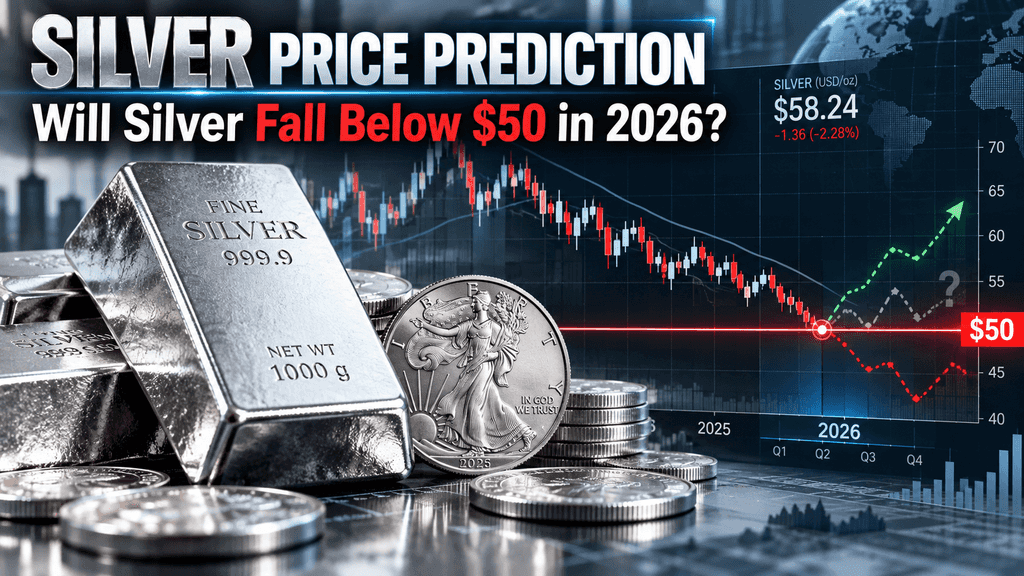
Silver's sharp October selloff has put a major psychological price level back in focus: $50 per troy ounce. On October 22, 2026, silver futures fell 4.6% to $54.764, their lowest closing price since November 2025, after oil prices surged and investors reassessed inflation and Federal Reserve policy risks. By October 23, silver had declined further, trading near $53.71, according to recent market data. The metal was also approximately 52% below its January record high of $115.08.
Could silver fall below $50 before the end of 2026? The possibility deserves attention, but it is not a certainty. Rising real yields, a stronger dollar, weaker industrial demand, and continued investment outflows could extend the decline. Conversely, easing inflation pressure, improving precious-metals demand, or a more accommodative Federal Reserve outlook could help silver stabilize. For cryptocurrency investors, the correction also offers a useful comparison with Bitcoin, which faces its own liquidity, ETF-flow, and derivatives-market pressures.
Key Takeaways
-
The $50 threshold is within reach: Silver's late-October decline has brought prices close to a major psychological level.
-
Monetary policy matters: Higher real yields and a stronger dollar can increase the opportunity cost of holding non-yielding silver.
-
Oil creates conflicting pressures: Expensive energy can raise inflation expectations while increasing the likelihood of restrictive monetary policy.
-
Industrial demand remains important: Silver's exposure to manufacturing and solar applications makes it different from gold and Bitcoin.
-
Bitcoin provides a useful market comparison: Both assets can respond to liquidity changes, but crypto-specific ETF flows and leverage introduce additional risks.
-
A break below $50 is not inevitable: Price confirmation, macroeconomic conditions, and investment demand will determine whether the decline continues.
Why Is Silver Falling in October 2026?
Silver's October weakness reflects a combination of inflation concerns, changing interest-rate expectations, and investor selling. On October 22, futures dropped 4.6% to $54.764, while Brent crude traded above $110 per barrel. Higher energy prices intensified concerns that inflation could remain persistent, potentially forcing central banks to maintain restrictive policies for longer.
The decline has been particularly severe because silver is sensitive to both investment positioning and industrial demand. When investors reduce exposure to precious metals, silver's relatively volatile market can experience sharper price movements than gold. At the same time, concerns about manufacturing activity can weaken expectations for industrial consumption.
Higher Interest-Rate Expectations Pressure Silver
Silver does not generate interest income, making its relative attractiveness sensitive to bond yields. When investors can earn higher returns on interest-bearing assets, the opportunity cost of holding silver increases. A stronger dollar can add pressure because dollar-denominated commodities become more expensive for buyers using other currencies.
The Federal Reserve's October 27–28 meeting is therefore an important near-term catalyst. FXEmpire's October 25 analysis identified the risk of renewed rate-hike expectations as a central factor behind the pressure on silver, particularly while oil prices remain elevated. The publication also noted that a sustained decline in the U.S. Dollar Index below 100.50 could support a recovery, although that level represents a technical observation rather than a guaranteed trigger.
Investors should distinguish between the Fed holding rates steady and the Fed signaling that monetary policy will become less restrictive. Even if rates remain unchanged, hawkish guidance could keep yields elevated and limit silver's recovery.
Oil Prices Create a Complicated Inflation Trade
Higher oil prices do not automatically benefit silver. Energy costs can increase inflation expectations, potentially supporting demand for inflation hedges. However, if persistent inflation encourages tighter monetary policy, higher real yields and a stronger dollar can outweigh that benefit.
This conflict helps explain why precious metals can fall during periods of rising inflation concerns. The direction of interest rates, rather than inflation alone, often determines how investors respond.
Oil prices also affect industrial businesses through transportation, electricity, and production costs. If higher energy expenses weaken manufacturing activity, silver could face additional pressure from the industrial side of its demand profile.
Can Silver Fall Below $50 Before the End of 2026?
Silver could break below $50 if selling pressure persists, real yields rise, and investors continue reducing precious-metals exposure. The late-October price decline has already moved the market into a region where traders are watching the $50–$55 range closely. StoneX's October 23 analysis identified this area as an important longer-term support zone and described the near-term outlook as weak until a clear reversal signal appears.
The $50 level matters for technical and psychological reasons. Traders often monitor round-number levels when placing orders or evaluating stop-loss thresholds. If silver approaches $50 during a period of thin liquidity, price movements could become more pronounced as positions are adjusted.
However, a brief intraday move below $50 would not necessarily establish a sustained breakdown. A daily or weekly close beneath the level, followed by failed attempts to recover it, would provide stronger evidence that the market is accepting lower prices.
What Would Confirm a Bearish Breakout?
Several indicators would make a move below $50 more concerning:
-
Silver repeatedly fails to reclaim recently broken support levels.
-
The U.S. dollar strengthens while real Treasury yields rise.
-
Investment demand weakens and selling persists across precious-metals markets.
-
Industrial-demand expectations deteriorate alongside broader manufacturing concerns.
These signals should be evaluated together rather than individually. A short-lived decline caused by forced selling may reverse quickly, while a breakdown accompanied by persistent macroeconomic pressure could last longer.
What Could Stop Silver From Falling Below $50?
A recovery becomes more plausible if the dollar weakens, real yields decline, and precious-metals investment demand stabilizes. Silver could also benefit if oil prices retreat enough to reduce inflation concerns without signaling a severe deterioration in industrial demand.
The market's response to the Federal Reserve meeting will be particularly important. A policy decision that is less restrictive than investors expect could support precious metals, while a hawkish surprise could reinforce downside risks.
Nevertheless, no single indicator guarantees that silver will hold above $50. The price must demonstrate stabilization through actual trading behavior, ideally supported by stronger buying interest and improving macroeconomic conditions.
Silver Price Forecast for Late 2026: Bullish, Base, and Bearish Scenarios
The most useful approach is to consider several possible outcomes instead of treating one price target as inevitable. Silver's late-2026 direction will depend on the interaction between monetary policy, the dollar, industrial demand, and investment positioning.
| Scenario | Potential drivers | Implication for the $50 level |
| Bullish | Falling real yields, a weaker dollar, and renewed precious-metals demand | Silver could stabilize and recover toward higher resistance levels |
| Base case | The Fed maintains rates while investors await clearer inflation signals | Silver could trade unevenly within the $50–$55 region |
| Bearish | Persistent inflation, higher yields, and continued selling | Silver could break below $50 and search for a lower trading range |
These are conditional scenarios, not guaranteed outcomes or precise price targets. They describe how market conditions could influence the probability of a sustained breakdown.
What Do Recent Forecasts Say?
FXEmpire's October 25 analysis placed $50 in focus as a potential downside level while identifying a sustained move above $60 as a development that could ease bearish pressure. The forecast reflects the publication's technical and macroeconomic assessment, not a consensus prediction shared by all analysts.
Other models remain less bearish. Trading Economics' October 26 commodity page indicated a forecast near $56.09 for the end of the fourth quarter, although model-based projections can change as market conditions and economic assumptions evolve.
The difference between these outlooks is important. One focuses on the possibility of a technical breakdown toward $50, while the other anticipates a higher quarter-end price. Neither establishes what silver will actually trade at. Investors should compare forecast dates, assumptions, and methodologies rather than selecting a target simply because it matches a preferred market view.
What Does Silver's Decline Mean for Bitcoin and Crypto Markets?
Silver's correction matters to cryptocurrency investors because both markets can react to changes in liquidity, interest-rate expectations, and risk appetite. However, their underlying drivers differ, so simultaneous price declines should not be interpreted as proof of a direct causal relationship.
Silver combines investment demand with industrial consumption. Bitcoin is more directly exposed to cryptocurrency-market positioning, derivatives leverage, exchange-traded fund flows, and changing demand for digital assets. These differences can produce divergent performance even when both assets face the same macroeconomic shock.
Why Silver and Bitcoin Can Fall Together
When investors reduce exposure to risky or volatile assets, they may sell positions to raise cash or reduce leverage. In such circumstances, even assets commonly described as inflation hedges can decline if investors prioritize liquidity over longer-term investment objectives.
Higher real yields can also pressure both markets, although the transmission mechanisms differ. For silver, rising yields increase the opportunity cost of holding a non-yielding commodity. For Bitcoin, restrictive financial conditions can reduce speculative demand and weaken the appeal of risk-sensitive investments.
A dollar rally can further complicate the outlook for both assets. Nevertheless, the relationship is not fixed, and crypto-specific catalysts can outweigh macroeconomic pressure.
What Bitcoin Investors Should Monitor
Crypto traders should watch spot Bitcoin ETF flows, spot-market volume, open interest, funding rates, and liquidation data. These indicators help distinguish genuine buying demand from short covering or leveraged price movements.
If Bitcoin stabilizes while silver continues to decline, the divergence may reflect differences in institutional flows, market positioning, or asset-specific demand. If both fall together, investors should examine whether the dollar, Treasury yields, and broader liquidity conditions are contributing to the weakness.
Key Indicators to Watch Before Silver Tests $50
The Federal Reserve decision on October 28 is the immediate event risk, but the direction of silver will depend on more than one announcement. Investors should monitor the dollar, real Treasury yields, oil prices, precious-metals flows, and signs of industrial-demand resilience.
A stronger dollar and rising real yields would reinforce the bearish case. Conversely, easing inflation concerns and improving investment demand could help silver stabilize before it reaches $50.
Technical confirmation also matters. A sustained move back above recently broken levels would weaken the immediate bearish structure, while repeated failures to recover could increase downside risks. Traders should distinguish between intraday volatility and a confirmed change in the broader price trend.
The central question is whether selling pressure continues after the next major macroeconomic catalyst. A decline driven by temporary positioning may reverse, but a sustained fall supported by tighter financial conditions and weakening demand would make a break below $50 more plausible.
Conclusion
Silver's late-October selloff has brought the $50-per-ounce threshold into focus, but the market has not established that a sustained break below this level is inevitable. Higher oil prices, persistent inflation concerns, and expectations for restrictive Federal Reserve policy have weakened precious-metals sentiment. Silver's industrial exposure also leaves it vulnerable if manufacturing demand deteriorates. Together, these factors create a credible downside scenario for the remainder of 2026.
The opposing case depends on falling real yields, a weaker dollar, and renewed investment demand. If those conditions emerge, silver could stabilize within its current support region rather than continue lower. The October 27–28 Federal Reserve meeting is therefore an important catalyst, although the market's response to the decision may matter more than the decision itself.
For cryptocurrency investors, silver's behavior offers a useful comparison with Bitcoin during periods of changing liquidity and risk appetite. Both assets can experience selling pressure, but their recovery drivers are different. The $50 level should be treated as a key market threshold to monitor, not a guaranteed downside target. Price confirmation and changing economic conditions will determine whether silver approaches that level or begins a broader recovery.
FAQs
Is silver priced per ounce or per gram?
International silver quotations commonly use U.S. dollars per troy ounce. A troy ounce is approximately 31.1035 grams, so investors comparing international prices with local retail prices must also account for currency conversion, premiums, and applicable taxes.
Why can silver move more sharply than gold?
Silver's market is smaller and its demand includes substantial industrial applications. Changes in investor positioning or manufacturing expectations can therefore produce pronounced price swings. Gold's demand profile is more heavily associated with investment, jewelry, and central-bank holdings.
What is the difference between spot silver and silver futures?
Spot silver generally refers to the current market price for the underlying metal, while futures are standardized contracts for delivery or settlement at specified terms. Futures prices can differ from spot prices because of financing costs, storage expenses, market expectations, and contract-specific factors.
Can a silver price rebound happen without a change in Federal Reserve policy?
Yes. Silver can recover because of short covering, improved physical demand, changes in investor positioning, or a weaker dollar. However, a rebound without improving macroeconomic conditions may be less durable if the underlying pressure from interest rates remains.
How does the gold-to-silver ratio help analyze silver?
The gold-to-silver ratio measures how many ounces of silver are needed to equal the price of one ounce of gold. A rising ratio means silver is underperforming gold, while a falling ratio indicates relative outperformance. The ratio provides context but does not independently predict future prices.
Disclaimer: This general market information, possibly from third-party, commercial, or sponsored sources, is provided for reference and educational purposes only and does not constitute financial or investment advice, an offer, solicitation, or guarantee. We disclaim liability for its accuracy, completeness, reliability, and any resulting losses. Investments/trading are risky; past performance doesn’t guarantee future results. Users should research, judge prudently, and take full responsibility. For further details, please consult KuCoin’s Terms of Use and Risk Disclosure.