

What Happens to Crypto ETFs During a US Government Shutdown? Lessons From the SEC’s 2025 Funding Lapse
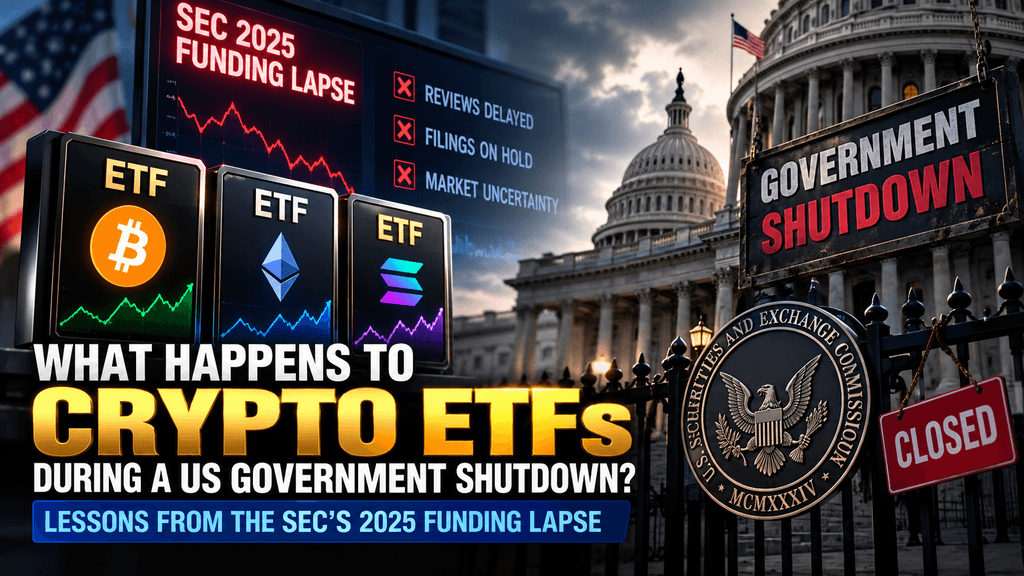
Crypto ETFs Remain Operational as Regulatory Reviews Stall During Shutdown
When Congress failed to pass funding legislation by October 1, 2025, the US federal government entered a 43-day shutdown that lasted until November 12. The Securities and Exchange Commission shifted to its contingency operations plan, furloughing the vast majority of staff and limiting activity to emergency functions focused on market integrity and investor protection. This created an immediate freeze on discretionary reviews of new financial products, including the more than 90 pending crypto ETF applications that had been building toward an expected wave of altcoin approvals. Existing spot Bitcoin and Ethereum ETFs continued operating without disruption, with creations, redemptions, and secondary-market trading proceeding as usual.
A limited number of issuers used statutory automatic-effectiveness provisions under the Securities Act of 1933 to bring certain products to market without active staff declarations. The episode offered a clear real-world test of how crypto ETFs behave when regulatory capacity contracts sharply. Crypto ETFs already trading remain fully functional during a government funding lapse, while new product pipelines experience delays rather than rejections, and issuers who prepare filings for automatic effectiveness can still achieve limited launches under existing law.
How the SEC Contingency Plan Suspends Discretionary Crypto Product Reviews
Under the SEC’s August 2025 operations plan for a lapse in appropriations, the agency retains only an extremely limited number of staff for emergencies involving human safety or property protection, including certain law enforcement and market surveillance duties. New product reviews fall outside these essential categories. Staff in the Divisions of Corporation Finance, Investment Management, and Trading and Markets cannot process pending applications, issue comment letters, accelerate the effectiveness of registration statements, or provide non-emergency interpretive guidance. For crypto ETFs, this means both the exchange-filed Rule 19b-4 process and the issuer-filed S-1 or N-1A registration statements are frozen. More than 90 applications covering Solana, XRP, Litecoin, Hedera, multi-asset strategies, and other digital-asset products sat idle once the shutdown began. The plan explicitly states that the agency will not review or approve applications for new financial products during the closure.
EDGAR remains operational for the submission of filings, and statutory deadlines continue to run, yet without staff available to act, progress on discretionary matters effectively stops. This structure ensures that routine market oversight continues at a minimal level while non-critical regulatory work waits for restored appropriations. The 2025 experience confirmed that the pause is procedural and temporary rather than a policy shift against crypto products. Issuers and exchanges therefore faced a binary reality: products already declared effective and listed continued without interruption, while anything still requiring affirmative SEC action entered a holding pattern. Bloomberg analysts and industry observers had anticipated early-October decisions on several Solana-focused funds after the September 17, 2025, approval of generic listing standards for commodity-based trust shares.
Those standards had shortened expected review timelines from as long as 240 days to roughly 75 days for qualifying products by eliminating individualized 19b-4 filings. The shutdown overrode that acceleration. Market participants tracked the contingency plan language closely, noting that the freeze applied uniformly across asset classes and was not crypto-specific. The practical result was a delayed “ETF Cryptober” that many had expected to broaden institutional access beyond Bitcoin and Ethereum. Once funding resumed on November 13, 2025, staff returned to a substantial backlog, illustrating that the duration of any future lapse will directly determine how long new-product momentum is interrupted.
Existing Spot Bitcoin and Ethereum ETFs Operate Without Interruption
Spot Bitcoin and Ethereum ETFs that had already launched prior to October 1, 2025, continued normal operations throughout the entire 43-day shutdown. Creations and redemptions of shares proceeded through authorized participants, secondary-market trading on exchanges remained uninterrupted, and daily net asset value calculations continued under existing fund administration arrangements. BlackRock’s iShares Bitcoin Trust and Fidelity’s Wise Origin Bitcoin Fund, among others, maintained full functionality because these activities do not require ongoing discretionary SEC staff intervention once the products are effective and listed. Data platforms showed that assets under management for the Bitcoin ETF complex stood near $150 billion entering the shutdown period, with Ethereum funds holding more than $22 billion.
These figures reflected sustained institutional and retail demand that proved resilient to the political impasse. The contingency plan prioritizes market-integrity functions, so surveillance of trading and enforcement against imminent investor harm continued at a reduced staffing level. No reports emerged of halted creations, settlement failures, or unusual liquidity disruptions attributable to the funding lapse itself. This operational continuity provided an important signal to investors. Crypto ETFs function as exchange-traded vehicles whose day-to-day mechanics rely on market infrastructure, custodians, and authorized participants rather than continuous SEC product-review capacity.
Price discovery for the underlying Bitcoin and Ethereum therefore remained market-driven, influenced by broader macro factors and ETF flow data rather than regulatory staffing levels. Some observers noted that the absence of new product launches temporarily concentrated attention and flows on the existing suite of funds. The episode reinforced that once a crypto ETF clears the initial regulatory hurdles and begins trading, subsequent government funding gaps do not impair its ability to serve as a vehicle for exposure. Investors monitoring Bitcoin price movements during the period could observe that secondary-market liquidity held up, underscoring the separation between ongoing product operations and the frozen pipeline for new filings.
Automatic Effectiveness Provisions Enabled Limited Altcoin ETF Launches
A small number of issuers successfully brought new crypto ETFs to market during the shutdown by relying on the automatic-effectiveness mechanism in Section 8(a) of the Securities Act of 1933. By filing amended registration statements that removed delaying amendments, certain products became effective by operation of law after the statutory 20-day waiting period without requiring an affirmative staff declaration. Canary Capital used this pathway for its Litecoin and Hedera ETFs, which began trading in late October 2025. Bitwise similarly launched a Solana ETF, and Grayscale advanced the conversion of its Solana Trust.
These launches occurred while the bulk of the SEC remained furloughed, demonstrating that the statutory framework itself does not depend on active agency staff once the waiting period expires and exchange listing requirements are satisfied. SEC Chair Paul Atkins publicly noted that the use of the 20 days was consistent with existing law. The products represented the first US-listed ETFs for those specific assets and generated measurable trading volume on debut, with the Solana vehicle recording tens of millions of dollars in first-day activity. The strategy carried residual risk.
Staff returning after the shutdown retained the ability to request amendments or raise issues with the prospectuses. Issuers that had engaged in extensive pre-shutdown comment cycles were better positioned to proceed, having already addressed substantive concerns. Most larger managers chose to wait rather than accept the uncertainty of post-effectiveness review. The episode illustrated a narrow window available only to those who timed amendments carefully and accepted the possibility of later regulatory follow-up. Automatic effectiveness does not bypass exchange listing standards or other ongoing compliance obligations; it simply removes the need for active staff acceleration during a period when staff is unavailable. This distinction proved decisive for the handful of products that reached the market while the majority of the pipeline remained frozen.
Market Sentiment and Flow Patterns During the Approval Freeze
Bitcoin and Ethereum prices showed resilience in the early weeks of the shutdown, with some sessions reflecting safe-haven demand amid political uncertainty. Spot ETF flows continued, though the absence of new product catalysts tempered the pace of inflows that analysts had projected for an active October approval calendar. Estimates circulating before the shutdown suggested that a wave of altcoin ETF launches could unlock $5–10 billion in additional institutional capital. Those projections were deferred rather than cancelled. Secondary-market volumes in existing funds remained healthy, and no systemic liquidity stress appeared in the crypto ETF complex.
The concentration of attention on already-listed products may have supported tighter spreads and continued authorized-participant activity. Broader crypto market capitalization held relatively stable, indicating that the regulatory pause was absorbed as a timing issue rather than a fundamental negative signal. Investors tracking Ethereum price action during the period observed that price discovery continued to reflect global supply-demand dynamics, macroeconomic data releases, and residual ETF creation demand.
The lack of fresh Solana or XRP vehicles delayed potential diversification flows but did not reverse existing allocations. Industry commentary emphasized that the freeze was temporary and that the September 2025 generic listing standards remained intact for use once staff returned. Market participants therefore treated the shutdown as a postponement of catalysts rather than a change in the structural trajectory of crypto ETF adoption. This measured response contrasted with more volatile reactions seen in earlier market cycles when regulatory uncertainty was less clearly delineated between existing and pending products.
Duration of the 2025 Shutdown and Its Effect on Review Backlogs
The 2025 funding lapse lasted 43 days, from October 1 through November 12, making it the longest full government shutdown in US history measured by furlough impact. Upon reopening, the Division of Corporation Finance faced more than 900 registration statements filed during the closure in addition to the pre-existing crypto ETF pipeline. Staff issued post-shutdown guidance clarifying that filings that had become effective by operation of law did not require the reinsertion of delaying amendments. Reviews resumed in roughly chronological order, with priority given to clearing the accumulated volume. Crypto issuers that had maintained clean pre-shutdown comment histories were positioned to move more quickly once capacity returned.
The length of the lapse directly determined the size of the backlog and therefore the additional delay beyond the calendar days of the shutdown itself. Longer closures compound the recovery period because returning staff must both process new submissions and complete interrupted reviews. In the 2025 case, the 43-day duration pushed some expected launches from October into late November or December. Shorter lapses would produce correspondingly smaller backlogs. The experience demonstrated that issuers benefit from filing as complete and comment-resolved a package as possible before any potential funding deadline, thereby minimizing the post-reopening queue time. It also showed that the SEC’s contingency framework successfully preserved core market functions while accepting temporary friction in the new-product pipeline.
Generic Listing Standards and Their Interaction With Funding Lapses
On September 17, 2025, the SEC approved generic listing standards for commodity-based trust shares. Qualifying crypto ETFs could thereafter list without individualized Rule 19b-4 filings, compressing the expected timeline for many products. The standards excluded leveraged, inverse, actively managed, lending, and staking products. When the shutdown began two weeks later, the new pathway was already in place but could not be fully utilized because staff was unavailable to process the remaining S-1 or N-1A effectiveness steps. The combination of streamlined exchange listing rules and a frozen registration process created a partial acceleration that was interrupted mid-stream.
Once operations resumed, the generic standards remained available and are expected to support faster throughput in future cycles, provided funding remains continuous. The timing showed a structural vulnerability: even after rulemaking reduces process friction, the system still requires staff capacity to declare registration statements effective or to handle any residual comments. Future issuers can mitigate this by advancing filings as far as possible under the generic standards before appropriations deadlines. The 2025 sequence also confirmed that the standards themselves survive a funding lapse intact; they do not require continuous agency action to remain operative. This durability supports longer-term planning for product pipelines that span multiple fiscal years.
Continuity of Market Surveillance and Enforcement Functions
While product reviews halted, the SEC retained limited staff to address emergencies involving market integrity and investor protection. Surveillance systems continued to operate, and enforcement actions tied to imminent harm remained possible. No material gaps in crypto-market monitoring were reported during the 43 days. Trading venues, clearing houses, and custodians maintained their own compliance and operational controls independently of SEC staffing levels. The contingency plan’s emphasis on protecting property and human safety translated into continued oversight of secondary-market activity in listed crypto ETFs. This separation between discretionary product work and core market-protection functions proved effective in practice.
Investors therefore faced no elevated operational risk in existing products arising from reduced regulatory headcount. The continuity of surveillance supported confidence that unusual trading patterns or potential misconduct would still receive attention. Post-shutdown, the agency was able to resume broader examination and enforcement activity without evidence of accumulated systemic issues originating in the crypto ETF market during the lapse. The episode illustrated that the architecture of market oversight contains built-in resilience for already-listed vehicles.
Issuer Strategies That Proved Effective During the Pause
Asset managers that had completed extensive pre-filing dialogue with staff and resolved substantive comments were better positioned either to wait out the shutdown or, in a few cases, to pursue automatic effectiveness. Those that maintained flexible amendment strategies could remove delaying language when the political calendar indicated a prolonged impasse. Communication with exchanges remained possible, allowing listing applications to advance in parallel with the frozen SEC process. Firms that treated the contingency plan as a known operational constraint rather than an unexpected shock adjusted internal timelines and investor communications accordingly.
Transparent updates to prospective investors about the procedural nature of the delay helped manage expectations around launch dates. The contrast between managers who proceeded via automatic effectiveness and those who chose to wait underscored a risk-tolerance decision. First-mover advantages in trading volume and brand association accrued to the early launchers, yet they accepted the possibility of later staff requests for changes. Most large traditional-finance issuers preferred certainty and deferred launches. Both approaches were consistent with the legal framework; the choice depended on each firm’s assessment of competitive positioning versus residual regulatory risk.
Post-Reopening Guidance and the Path to Clearing the Pipeline
After funding was restored, the Division of Corporation Finance issued guidance addressing registration statements that had become effective by operation of law and the processing of the backlog. Staff confirmed that companies need not reinsert delaying amendments for those filings and reiterated Rule 430A accommodations for certain incomplete prospectuses filed during the closure. Reviews proceeded with an emphasis on expeditious clearance of the accumulated volume. Crypto ETF applicants that had kept their filings current and responsive moved forward once capacity returned.
The guidance reduced uncertainty about the status of automatic-effectiveness products and provided a roadmap for the remainder of the pipeline. This post-shutdown clarity helped restore momentum. Issuers could plan launch sequences with greater confidence, and market participants regained visibility into expected approval calendars. The experience showed that clear, prompt staff guidance upon reopening shortens the recovery period and limits secondary effects on market sentiment. Future lapses will likely follow a similar pattern of freeze, backlog, and guided resumption.
Impacts for Crypto Market Structure and Adoption
The 2025 shutdown demonstrated that crypto ETFs have matured into a market segment whose existing products are robust to temporary regulatory capacity constraints. Institutional allocators continued to use the available vehicles for exposure, and the absence of new launches did not reverse the structural shift toward regulated products. The episode also highlighted the value of rulemaking that reduces dependence on case-by-case staff action, such as the generic listing standards. At the same time, it revealed remaining points of friction where staff capacity is still required. For the industry, the primary lesson is preparation: advance filings as far as possible, maintain flexibility in registration-statement language, and communicate clearly with investors about procedural versus substantive delays.
Looking ahead, recurring funding debates will remain a calendar risk for product pipelines. Issuers and investors who internalize the operational distinction between listed products and pending applications will navigate those periods with less disruption. The 43-day test case of 2025 supplies a concrete reference for modeling the impact of future lapses on both timelines and market behavior. Monitoring Solana market data alongside regulatory calendars remains a practical approach for participants seeking to anticipate the next phase of product expansion once staffing normalizes.
Investor Considerations for Monitoring ETF Catalysts in Political Uncertainty
Investors evaluating crypto ETF exposure during periods of potential government funding stress should separate the performance and liquidity of already-listed products from the timing of new launches. Existing Bitcoin and Ethereum vehicles have demonstrated operational continuity. New-product catalysts can be deferred by weeks or months depending on the length of any lapse and the subsequent backlog. Tracking official SEC operational-status notices, the language of contingency plans, and issuer filings for removal of delaying amendments provides early indicators of possible automatic-effectiveness launches. Flow data and secondary-market spreads in current funds offer a more reliable near-term signal than projected approval calendars.
Diversification across multiple listed products can reduce reliance on any single anticipated launch. The 2025 experience confirmed that political funding disputes affect the regulatory pipeline more than the functioning of the market itself. Participants who treat shutdown risk as a known variable in product-timeline models rather than an existential threat to the asset class will be better positioned. Continued growth in assets under management for existing funds during the period reinforced that demand for regulated crypto exposure persists independently of short-term approval freezes.
🔥 Beyond the Headlines: What KuCoin 5.0 Means for You
Market news moves fast — but where you act on it matters just as much. This October, KuCoin launches KuCoin 5.0, transforming KuCoin into a rebuilt platform. Here's what actually changes for you:
-
One account for everything. Older platforms split your money across separate "spot," "margin," and "futures" accounts and expected you to understand why. KuCoin 5.0's unified account removes that entirely — deposit once, and everything is simply there (only available to VIPs for now).
-
Stocks, indices, and commodities. KuCoin 5.0 expands beyond crypto into global markets. When crypto chops sideways and equities rally (or the reverse), you rotate in minutes instead of opening a brokerage account and waiting days for fiat rails.
-
Real-world assets (RWA). Tokenized exposure to traditional assets like commodities, right inside your crypto account. One of the fastest-growing segments in global finance is no longer reserved for institutions — you access it from the same balance you trade with.
-
Earn while you learn. Not ready to trade? KCUSD lets your stablecoins earn daily, auto-compounding interest. The lowest-stress way to put your idle deposit to work for 4% yield.
-
An AI assistant in plain language. Ask questions, get market context, understand what you're looking at — built into the platform, no jargon required.
-
An app that doesn't overwhelm. Faster, cleaner, and consistent — intuitive from the first tap, not after a tutorial.
-
Safety you can check, not just trust. A MiCAR-licensed EU entity, Proof of Reserves you can verify yourself, and internationally certified security (SOC 2 Type II, ISO 27001:2022).
Create your account in minutes — and start on the platform built for where crypto is going, not where it's been.
FAQs
What exactly stops at the SEC during a government funding lapse?
The contingency plan suspends discretionary activities, including review of new product applications, issuance of comment letters, acceleration of registration-statement effectiveness, and non-emergency interpretive guidance. Essential functions limited to emergency market integrity and investor-protection matters continue with a skeleton staff. EDGAR filing systems remain operational so that submissions can still be made, but staff action on those submissions does not occur until appropriations are restored.
Do existing crypto ETFs stop trading or creating shares during a shutdown?
No. Once a product is effective and listed, creations, redemptions, and secondary-market trading continue through normal market infrastructure. Authorized participants, custodians, and exchanges operate independently of SEC product-review capacity. Surveillance of trading activity continues at a reduced but functional level.
Can new crypto ETFs still launch while the SEC is operating under a lapse plan?
Yes, in limited cases. Issuers may remove delaying amendments from registration statements so that the filings become effective automatically after the statutory 20-day period under the Securities Act. A small number of altcoin ETFs used this pathway successfully in October 2025. Most managers, however, chose to wait for active staff review to avoid residual post-effectiveness uncertainty.
How long did the 2025 shutdown last, and what was the effect on the crypto ETF pipeline?
The funding lapse ran 43 days from October 1 to November 12, 2025. More than 90 crypto ETF applications were frozen, creating a backlog that extended launch timelines beyond the calendar duration of the closure itself. Upon reopening, staff prioritized clearing the accumulated volume of filings submitted during the period.
Did the September 2025 generic listing standards help during the shutdown?
The standards reduced the need for individualized 19b-4 filings and shortened expected timelines for qualifying products. They remained in force during the lapse but could not fully accelerate launches because the parallel S-1/N-1A effectiveness process still required unavailable staff capacity. Once operations resumed, the standards continued to support faster processing.
Disclaimer: This content is for informational purposes only and does not constitute investment advice. Cryptocurrency investments carry risk. Please do your own research (DYOR).