

RAVE Crashes More Than 96%: Inside the Manipulation Investigation

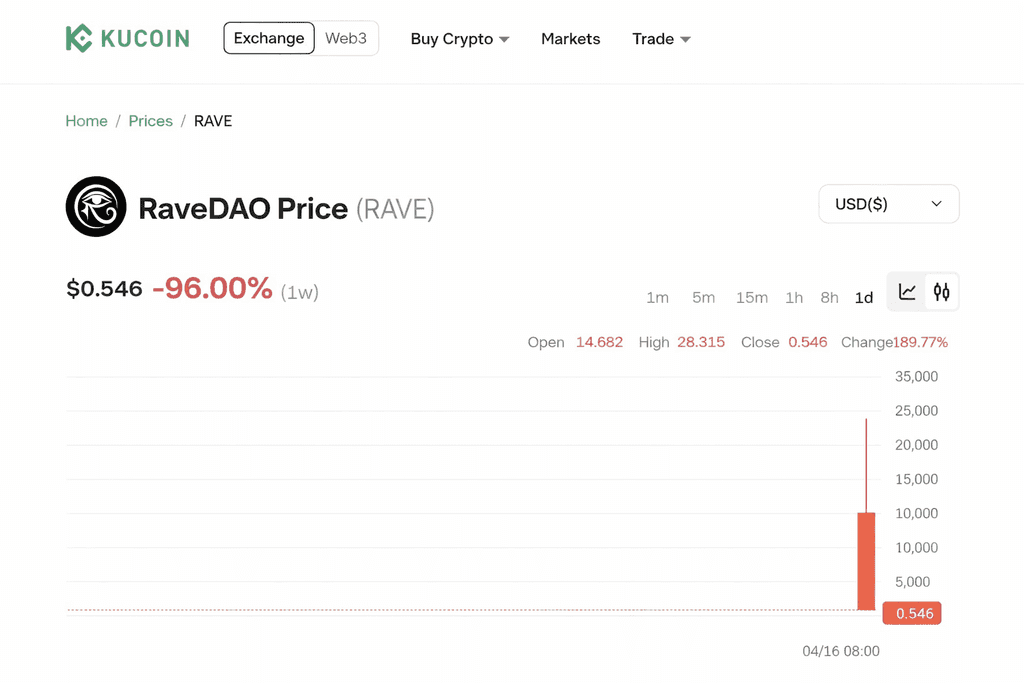
RAVE, the token linked to RaveDAO, went from breakout story to collapse case study within days. After trading near $0.25 in early April 2026, the token surged to more than $28 before plunging to roughly $0.55 to $0.56, leaving it down more than 96% from the peak. Public market data also placed its circulating supply near 248 million tokens against a 1 billion maximum supply.
The speed of that reversal is only part of the story. What turned RAVE into a major controversy was the wave of manipulation allegations that followed the rally, especially around wallet concentration, effective float, and suspicious onchain activity. Public reporting tied to the episode said blockchain investigator ZachXBT raised concerns that the token’s move did not resemble normal price discovery, while multiple outlets highlighted unusually concentrated holdings well before the full collapse played out.
That is what separates RAVE from an ordinary speculative drawdown. The market did not simply decide the token had become overvalued. It began asking whether the conditions behind the rally had made the price easier to influence from the start. That shift turned a fast-moving chart into a wider market-integrity story.
What Is RaveDAO?
RaveDAO presents itself as a community-driven entertainment protocol that combines electronic music culture, live events, NFT ticketing, governance, and philanthropy. Its official website describes the project as operating at the intersection of music, technology, and social impact, while a public-facing version of its platform claims more than 100,000 attendees, more than 70,000 NFTs minted, and over 20 global events.
The total token supply is capped at 1 billion, and the asset is intended to power onchain participation across live events, ticketing, creator collaborations, and other ecosystem functions. The same white paper frames the project as part of a broader entertainment business rather than a token launched in isolation.
That broader brand identity helped RAVE stand out. It was not being framed as a joke coin or a purely viral token. It came with a story tied to culture, events, and community ownership. But branding and market structure are not the same thing. Once the rally became extreme, attention shifted from the story the project was telling to the mechanics of how the token was actually trading.
How the Rally Started
-
RAVE’s price moved extremely fast: Historical market data shows the token trading around $0.25 in early April before surging sharply over the following days and eventually climbing above $28 before the collapse.
-
The speed of the rally made it impossible to ignore: A move of that size in less than two weeks was enough to put RAVE on the market’s radar very quickly.
-
Different outlets described the rally in different ways: Some reports called it a gain of more than 2,200% in one week, while others described it as roughly a 48x move in a week.
-
The message stayed the same across reports: No matter which timeframe was used, RAVE was posting one of the most extreme short-term rallies in the market.
-
Momentum helped pull in more attention: Parabolic rallies often attract even more traders as the price keeps climbing, screenshots spread online, and discussion intensifies.
-
The chart became the main attraction: In smaller or lesser-known tokens, price action itself can become the marketing, with traders focusing more on the next possible move than on the project’s fundamentals.
-
Fear of missing out likely fueled fresh buying: Once a token starts moving this quickly, many buyers enter simply because they do not want to miss the next leg higher.
-
Concerns started appearing before the crash: Analysts were already raising red flags while RAVE was still climbing, especially because the rally was unfolding against a weaker broader-market backdrop.
-
That created two competing narratives: On one side, RAVE looked like a breakout winner. On the other, it was already drawing suspicion because the move looked unusually sharp and structurally questionable.
Rising Market Suspicion Around RAVE
The biggest source of suspicion was supply concentration. Several reports tied to the controversy said a very large share of RAVE was controlled by a small number of wallets. One analysis cited roughly 90% of supply sitting in three wallets, while another report said nine addresses linked to the initial distribution controlled about 95% of the total supply. Other public summaries went even further, suggesting that one suspected team wallet held more than 95% and that effective control may have exceeded 98% when related wallets were included.
Effective float looked much smaller than the headline valuation
Public market data added to the concern. Public listings showed RAVE with a 1 billion total supply and about 248 million tokens in circulation, or roughly 24.8% of the total. That means only about one quarter of the theoretical supply was circulating during the rally and collapse.
If a relatively small circulating share is itself tightly concentrated, price can move far more violently than casual observers expect. A token may appear massive on paper because of its market capitalization or fully diluted valuation, but still trade like a thin and fragile market underneath. That mismatch between appearance and structure is a central part of the RAVE story.
Price action looked inconsistent with broad, natural demand
That is why the rally triggered more than simple disbelief. In a broad and healthy market, massive price appreciation is usually supported by a wide set of buyers and a reasonably distributed float. In a concentrated market, the same move can look much bigger than it really is because the available supply is limited and easier to push around. Public commentary around RAVE repeatedly focused on that gap between headline size and effective market depth.
The Manipulation Allegations
ZachXBT pushed the issue into public view
Public allegations around RAVE gained real traction through blockchain investigator ZachXBT. Reporting on the collapse says he argued that the token’s behavior raised serious concerns about market manipulation and tied those concerns to concentrated holdings and suspicious price activity. Reports surrounding the controversy said the public scrutiny intensified as outside investigators and commentators focused more closely on wallet relationships and token flows.
The scrutiny signaled more than casual speculation
That scrutiny mattered because it suggested the case was not being treated as routine market gossip. It implied that the wallet relationships, timing, and flows were serious enough to merit closer attention. In many token blowups, attention moves on quickly. Here, the public timeline helped keep the focus on how the rally may have been constructed rather than letting the story end with a generic explanation that a high-risk token simply crashed.
Multiple outlets echoed similar warning signs
Other reports reinforced the same concerns from different angles. They highlighted suspicious token flows during the rally and pointed to possible manipulation, extreme token concentration, and pre-pump transfers as major red flags. Commentary also emphasized concentration, volatility, and the risk of a collapse much deeper than a routine pullback.
Allegations remain separate from proof
That said, the distinction between allegation and proof is important. Public reporting supports the claim that serious red flags were raised. It supports the claim that concentration and wallet activity were viewed as suspicious. It does not, based on the sources reviewed here, amount to a final public conclusion that the case is fully resolved. The most accurate framing is that RAVE became the subject of a widely discussed manipulation controversy, not that every allegation has already been formally proven.
The Price Collapse
-
RAVE’s reversal was nearly as dramatic as its rally: After climbing to more than $28, the token later traded near the $0.53 to $0.56 range on major market trackers.
-
The scale of the drop was severe: That left RAVE down more than 96% from its peak, with some comparisons putting the full drawdown even deeper depending on the exact intraday high used.
-
The speed of the decline made the collapse especially striking: A move that had looked unstoppable only days earlier suddenly broke down and reversed with unusual force.
-
The story quickly changed from momentum to market structure: What first looked like a breakout rally turned into a broader concern about liquidity, volatility, and how sustainable the price move really was.
-
Earlier warning signs started to look more important in hindsight: Earlier coverage had already pointed to unusual volatility, liquidity concerns, and smart-money exits during the rise.
-
Reports also highlighted the damage in valuation terms: Several outlets estimated that roughly $6 billion to $6.3 billion in paper value was wiped out during the crash.
-
Those market-value figures should be treated carefully: Because RAVE was moving so violently, the losses are best understood as approximate paper-value estimates rather than fixed realized losses.
-
Even with that caution, the collapse was massive: The size and speed of the wipeout made RAVE one of the most dramatic reversals in the market.
Market Structure and RaveDAO’s Position
-
Thin market conditions made the collapse more severe
The same features that can fuel a spectacular rally can also speed up a collapse. When circulating supply is limited, ownership is concentrated, and momentum buyers are rushing in, even a relatively small push can create outsized price moves. But once confidence starts to break, that same structure can leave the market with very little support. Sellers move to exit, new buyers step back, and the result is often a sharp breakdown rather than a gradual correction.
-
Crowd sentiment reversed just as quickly as the rally
RAVE also showed how fast market psychology can change. During the rally, the story was built around explosive gains, rising attention, and momentum. Once manipulation allegations started gaining traction, that same attention cycle turned negative. Confidence faded, skepticism replaced excitement, and the token’s momentum worked in reverse. In speculative markets, a narrative breakdown can be just as powerful as the original surge.
-
Headline valuation did not necessarily reflect real market depth
One of the clearest lessons from the collapse is that a large-looking market can still be unstable underneath. Traders often see a strong market cap and assume it reflects deep liquidity and broad participation. But if the effective float is limited and much of the supply is concentrated, the token can still behave like a narrow and fragile market. RAVE’s collapse is a strong example of how headline valuation can overstate true market depth.
-
RaveDAO continued to position itself around utility and culture
RaveDAO’s public-facing identity remained centered on utility, events, and community culture. Its website and white paper continued to describe the project as a Web3 entertainment platform built around live events, NFT ticketing, participation, and philanthropy. That branding positioned the token as part of a broader ecosystem rather than as a purely speculative asset.
-
The collapse changed how the market viewed the project
That brand narrative, however, was overshadowed by the crash. Once attention shifted to supply concentration, wallet behavior, and the scale of the drawdown, the market stopped discussing RAVE mainly as an entertainment-linked ecosystem token. Instead, it began treating the project as a case study in how a strong narrative can sit on top of a structurally fragile market.
What the RAVE Crash Means for the Wider Market
-
Concentration risk remains one of the clearest warning signs
RAVE shows how concentrated ownership can completely change the way a rally should be read. When most of a token’s supply sits in a small number of wallets, large price moves do not always reflect broad market demand. In that kind of setup, the rally may be driven more by market structure than by real depth or wide participation. That is why wallet concentration remains one of the most important signals to watch in any token analysis. In RAVE’s case, concentration concerns were not a side detail. They became one of the main reasons the rally started to look suspicious.
-
Tokenomics matter just as much as the price chart
A strong chart can attract attention, but tokenomics often explain whether that move is actually sustainable. Circulating supply, vesting schedules, future unlocks, and wallet distribution all shape how a token behaves once momentum starts building. With RAVE, the mix of a 1 billion maximum supply and only about 248 million tokens in circulation became a key part of the story. That structure helps explain how the token was able to move so aggressively on the way up and then collapse so sharply on the way down. The bigger lesson is simple: price action should never be viewed in isolation from supply dynamics.
-
A strong narrative does not guarantee a stable market
A project can have branding, community traction, event-driven visibility, and utility claims, yet still trade in a fragile way. RAVE had a recognizable identity tied to entertainment, culture, and participation, which made the story more compelling during the rally. But a good narrative does not automatically mean the underlying market is healthy. Supply distribution, effective float, and actual price formation still matter far more once volatility rises. RAVE is a reminder that market excitement can hide structural weakness until the reversal begins.
-
Fast-moving rallies can hide deeper weakness
In speculative markets, a rapid rise often creates the impression that something strong and organic is happening. In reality, a token can move sharply simply because the float is limited and the market is easier to push around. That can make the rally look bigger, stronger, and more sustainable than it really is. RAVE is a good example of how a market can appear powerful on the surface while remaining thin underneath. By the time traders notice that weakness, the breakdown may already be underway.
-
The bigger lesson goes beyond one token
RAVE is not just a story about one collapse. It reflects a wider pattern seen across speculative digital-asset markets. Concentrated supply, limited float, fast momentum, and strong storytelling can combine to create explosive upside and equally destructive downside. That is why the case matters beyond RAVE itself. It highlights the importance of looking past headline gains and asking who holds the supply, how much is really circulating, and whether the market is as deep as it appears. In the end, the wider lesson is that structure matters just as much as story, and sometimes much more.
Call to Action
Want to follow RAVE price action, market updates, and broader crypto developments in one place? Visit KuCoin to explore live market data, token information, and the latest exchange updates.
Conclusion
RAVE fall was not just another sharp correction. It was a collapse of more than 96% following one of the most extreme short-term rallies of the month, and it unfolded alongside serious public allegations about concentrated supply and suspicious market behavior. The token’s path from roughly $0.25 to more than $28 and then down to around $0.55 is now being treated as a cautionary example of how quickly confidence can evaporate when market structure comes under scrutiny.
The most accurate reading of the situation is also the most measured one. Public reporting clearly supports strong suspicion and serious scrutiny. It does not yet support presenting every allegation as a fully resolved fact. Even so, the warning signs exposed by the RAVE episode are hard to ignore concentrated ownership, limited effective float, explosive momentum, and a collapse that erased nearly the entire rally. That combination is exactly what turned RAVE from a breakout token into one of April 2026’s biggest market-integrity stories.
FAQs
What happened to the RAVE token?
RAVE surged from around $0.25 in early April 2026 to more than $28 before collapsing back to roughly the $0.53 to $0.56 range. That made it one of the sharpest short-term reversals in the market.
Why did RAVE crash more than 96%?
The collapse followed an extremely fast rally that was later overshadowed by concerns about wallet concentration, limited effective float, and suspicious onchain activity. Once confidence broke, the downside accelerated quickly.
Was RAVE accused of market manipulation?
Yes. Public reporting around the rally and crash highlighted allegations of possible market manipulation, especially tied to concentrated holdings and unusual token flows. However, allegations are not the same as formal proof.
Why was wallet concentration such a big issue?
Wallet concentration mattered because it raised questions about how much of the supply was actually in the hands of a small number of holders. In that kind of market, price can become easier to influence and much more volatile.
What is RaveDAO?
RaveDAO presents itself as a Web3 entertainment project focused on electronic music culture, live events, NFT ticketing, governance, and community participation. The token was positioned as part of a broader ecosystem rather than as a standalone speculative asset.
How much of the RAVE supply was circulating?
Public token data placed RAVE’s circulating supply near 248 million tokens out of a 1 billion maximum supply. That means only about one quarter of the total supply was circulating during the rally and collapse.
Why did traders become suspicious while RAVE was still rising?
Traders became suspicious because the rally looked unusually sharp even before the crash started. The speed of the move, the concentration of supply, and reports of suspicious wallet activity made some analysts question whether the price action reflected normal market demand.
Disclaimer
The information provided on this page may originate from third-party sources and does not necessarily represent the views or opinions of KuCoin. This content is intended solely for general informational purposes and should not be considered financial, investment, or professional advice. KuCoin does not guarantee the accuracy, completeness, or reliability of the information, and is not responsible for any errors, omissions, or outcomes resulting from its use. Investing in digital assets carries inherent risks. Please carefully evaluate your risk tolerance and financial situation before making any investment decisions. For further details, please consult KuCoin’s Terms of Use and Risk Disclosure.