

Nvidia, Apple, and Microsoft S&P 500 Concentration: Why Three Stocks Now Exceed 21%
Introduction
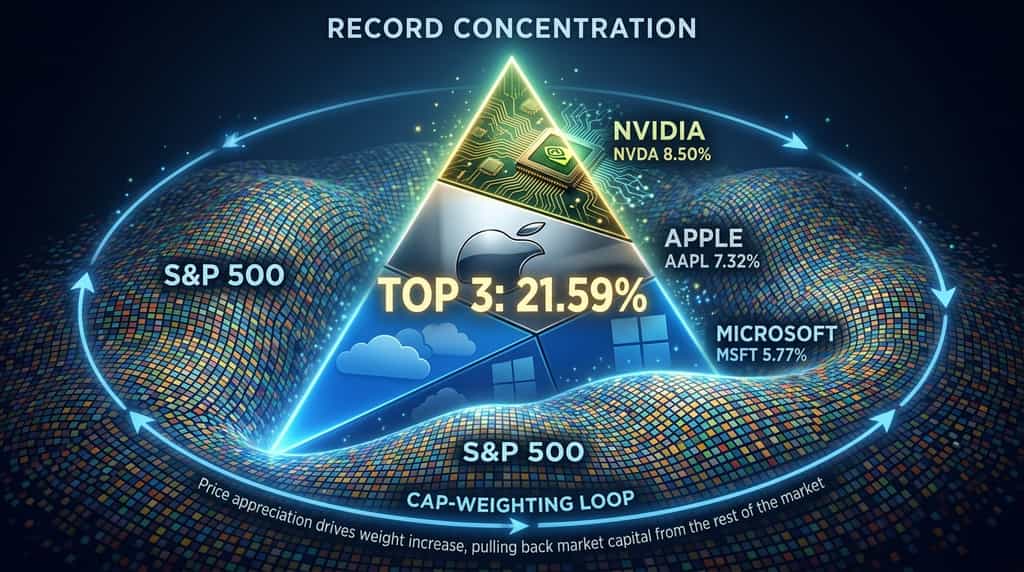
Three companies now decide more of the S&P 500 than at any point captured in recent index and ETF filings. Based on State Street Investment Management holdings for the SPDR S&P 500 ETF Trust as of October 2, 2026, Nvidia, Apple, and Microsoft together account for 21.59% of the fund that tracks the benchmark. Nvidia alone is 8.50%, Apple is 7.32%, and Microsoft is 5.77%. According to S&P Dow Jones Indices data as of September 30, 2026, the largest constituent already carried an 8.4% weight, and the top 10 constituents reached 39.1% of an index with 503 members and about $68.4 trillion in total constituent market capitalization.
That concentration is the direct result of float-adjusted market-cap weighting. A rising share price increases a stock's index weight, which pulls in more passive capital, which can support the price again. The loop has left a so-called diversified U.S. large-cap portfolio heavily exposed to three technology balance sheets, three product cycles, and one dominant theme: artificial intelligence infrastructure.
Why Do Nvidia, Apple, and Microsoft Now Exceed 21% of the S&P 500?
Nvidia, Apple, and Microsoft exceed 21% of the S&P 500 because the index weights companies by float-adjusted market value, and these three now sit at the top of that ranking. According to State Street Investment Management, as of October 2, 2026, the SPDR S&P 500 ETF Trust held Nvidia at 8.50%, Apple at 7.32%, and Microsoft at 5.77%. Added together, that is 21.59% of a fund with about $815.3 billion in assets.
The same filing shows how narrow the next tier is. Amazon was 3.71%, Alphabet Class A was 3.03%, Broadcom was 2.54%, Alphabet Class C was 2.43%, Meta Platforms was 2.41%, Micron Technology was 1.82%, and Tesla was 1.57%. The top 10 lines sum to 39.10%. Alphabet's two share classes together were 5.46%, still below Microsoft on a combined basis and well below Nvidia or Apple.
S&P Dow Jones Indices reported a matching picture at the index level as of September 30, 2026. The largest constituent weight was 8.4%, the top 10 constituents were 39.1%, and the index held 503 companies with a combined market capitalization of $68,448,592 million. A single name near 8.4% of that total implies a market value on the order of $5.7 trillion. Three names above 21% imply a combined footprint above $14 trillion inside a $68.4 trillion universe.
Passive products do not dilute that math. The SPDR S&P 500 ETF Trust seeks results that, before fees, correspond to the S&P 500. An investor who buys the tracker is buying the weights. There is no separate decision to own 8.50% Nvidia. The methodology makes that decision.
|
Holding
|
Weight, Aug. 31, 2026
|
Weight, Oct. 2, 2026
|
|
Nvidia
|
8.07%
|
8.50%
|
|
Apple
|
7.03%
|
7.32%
|
|
Microsoft
|
5.69%
|
5.77%
|
|
Three-stock total
|
20.79%
|
21.59%
|
|
Information Technology sector
|
37.87%
|
40.06%
|
Source: State Street Investment Management SPDR S&P 500 ETF Trust disclosures. August 31 figures from the Asia-Pacific factsheet. October 2 figures from the fund holdings page.
How Fast Has S&P 500 Concentration Risen in 2026?
Concentration has risen inside a single quarter, not only across a multi-year bull market. Based on State Street Investment Management factsheets, Nvidia, Apple, and Microsoft were a combined 20.79% of the SPDR S&P 500 ETF Trust as of August 31, 2026. By October 2, 2026, the same three holdings were 21.59%. That is a gain of 0.80 percentage points in roughly one month.
Each name moved higher. Nvidia rose from 8.07% to 8.50%. Apple rose from 7.03% to 7.32%. Microsoft rose from 5.69% to 5.77%. The Information Technology sector weight moved with them, from 37.87% on August 31 to 40.06% on October 2. Four dollars of every ten in the tracker now sit in one GICS sector.
S&P Dow Jones Indices data as of September 30, 2026, place the top 10 at 39.1% and the single largest name at 8.4%. The October 2 ETF snapshot is consistent with that month-end index print, with the top 10 at 39.10%. The benchmark is not drifting toward equal exposure. It is tightening around the same cluster of companies.
The speed matters more than the round number. A 0.80 percentage point increase in one month means new cash into S&P 500 trackers is being deployed into a heavier Nvidia-Apple-Microsoft mix than it was in late summer. Rebalancing does not offset this. In a cap-weighted index, rebalancing largely restores weights after corporate actions. Price appreciation itself is the rebalance.
A practical reading of the October 2 file is that the other 500-odd lines share the remaining 78.41%. Many of those lines are large businesses. Their index influence is still small next to a stock with an 8.50% weight. One Nvidia down day can offset a broad advance across dozens of smaller constituents. One Nvidia up day can do the reverse.
What Is Pushing Nvidia, Apple, and Microsoft Weights Higher?
Share prices are pushing the weights higher, and company-specific capital returns are reinforcing the bid. On September 28, 2026, Nvidia announced that its board had authorized an additional $150 billion under the existing share repurchase program, taking the remaining authorization to $235 billion. According to Nvidia's investor relations release, the company expects to execute the remaining program through fiscal year 2028, and management described the increase as a reflection of confidence in long-term AI and accelerated-computing demand.
A buyback authorization is not the same thing as an immediate reduction in share count. It is capacity. Still, a $235 billion remaining authorization is large enough to matter for float over time. If shares are retired, float-adjusted market capitalization can fall even if the price is firm, which can trim index weight. If the authorization mainly supports the price, the weight can rise. Recent filings show the weight rose. Nvidia's SPDR weight moved from 8.07% on August 31 to 8.50% on October 2, spanning the September 28 announcement.
Apple's higher weight tracks a stock trading near its highs after the company's mid-September product cycle. The index does not score product reviews. It scores market value. A higher Apple price, with a large free float, lifts the S&P 500 weight automatically. Apple moved from 7.03% to 7.32% between the August 31 and October 2 State Street snapshots.
Microsoft's move was smaller, from 5.69% to 5.77%, but the level is still the third-largest line in the tracker. Cloud and AI software demand sit behind that valuation. S&P Global Market Intelligence noted in its 2026 Visible Alpha AI Monitor that expected AI-exposed revenue had been revised higher, with Nvidia a central driver of those revisions, and that Microsoft's Azure business was expected to generate more than $130 billion by the end of fiscal 2027 on Visible Alpha consensus. Those are forecast figures, not reported results, but they help explain why investors have been willing to pay up for the third-largest index holding.
The common driver is AI capital spending. Chip designers, device platforms, and cloud software vendors do not earn revenue the same way. They do share a customer set: enterprises and cloud providers building computing capacity. When that spending expands, all three market values can rise together. When it pauses, the index feels the pause three times.
What Risks Does Record Mega-Cap Concentration Create for Index Investors?
The main risk is that index returns and three-stock returns have become hard to separate. A 10% decline in a group that is 21.59% of the tracker subtracts roughly 2.2 percentage points from the fund before any other holding moves. A 10% decline in a stock that is 0.15% of the index is a rounding error. Position size, not narrative, sets the loss.
Correlation risk sits on top of weight risk. Nvidia, Apple, and Microsoft do not report the same earnings. They do share sensitivity to AI capital budgets, U.S. technology multiples, and the dollar. If cloud providers slow orders, Nvidia's data-center revenue is the direct hit. Microsoft's cloud growth rate is the second-order hit. Apple is more device-driven, but its multiple still trades with the same liquidity and rate backdrop. A common shock can hit all three weights at once.
Valuation risk is the third layer. Concentration can be earned by profits, and these firms do generate very large profits. Concentration can also be earned by a higher multiple on those profits. If the multiple compresses while earnings hold up, index weight still falls, and passive funds sell into that fall as prices drop. The September 28 Nvidia authorization shows management is willing to return capital. It does not cap the multiple investors will pay.
Liquidity risk is easy to miss in mega-caps. Nvidia, Apple, and Microsoft are among the most liquid stocks in the world. The risk is not that the shares cannot be traded. The risk is that the same shares sit in index funds, active funds, options hedges, and retail portfolios at the same time. When many holders reduce risk together, liquidity in the largest names can still gap.
Drawdown math is asymmetric for late buyers of the index. An investor who bought the S&P 500 years ago received the weight increase as a gain. An investor who buys the tracker now inherits the 21.59% starting weight. Future returns depend on whether these three market values keep compounding faster than the other 500 companies. The index will not warn when that stops. It will simply print a lower weight after the prices have already moved.
There is also a benchmark-risk loop for active managers. A manager who underweights Nvidia by 5 percentage points needs large wins elsewhere to match the index if Nvidia rises. That career pressure pulls active money toward the same names. The active market starts to look like the passive market. True diversification inside U.S. large caps shrinks even for investors who never bought an index fund.
Beyond the Headlines: What KuCoin 5.0 Means for You
Market news moves fast — but where you act on it matters just as much. This October, KuCoin launches KuCoin 5.0, transforming KuCoin into a rebuilt platform. Here's what actually changes for you:
-
One account for everything. Older platforms split your money across separate "spot," "margin," and "futures" accounts and expected you to understand why. KuCoin 5.0's unified account removes that entirely — deposit once, and everything is simply there (only available to VIPs for now).
-
Stocks, indices, and commodities. KuCoin 5.0 expands beyond crypto into global markets. When crypto chops sideways and equities rally (or the reverse), you rotate in minutes instead of opening a brokerage account and waiting days for fiat rails.
-
Real-world assets (RWA). Tokenized exposure to traditional assets like commodities, right inside your crypto account. One of the fastest-growing segments in global finance is no longer reserved for institutions — you access it from the same balance you trade with.
-
Earn while you learn. Not ready to trade? KCUSD lets your stablecoins earn daily, auto-compounding interest. The lowest-stress way to put your idle deposit to work for 4% yield.
-
An AI assistant in plain language. Ask questions, get market context, understand what you're looking at — built into the platform, no jargon required.
-
An app that doesn't overwhelm. Faster, cleaner, and consistent — intuitive from the first tap, not after a tutorial.
-
Safety you can check, not just trust. A MiCAR-licensed EU entity, Proof of Reserves you can verify yourself, and internationally certified security (SOC 2 Type II, ISO 27001:2022).
Create your account in minutes — and start on the platform built for where crypto is going, not where it's been.
Conclusion
Nvidia, Apple, and Microsoft now exceed one-fifth of the S&P 500 tracker, and the official files leave little room for debate about the level. State Street Investment Management reported a combined 21.59% weight on October 2, 2026, up from 20.79% on August 31, 2026. S&P Dow Jones Indices reported an 8.4% largest-constituent weight and a 39.1% top-10 weight as of September 30, 2026, inside a 503-member index worth about $68.4 trillion. Information Technology alone was 40.06% of the SPDR fund at the October 2 snapshot.
The cause is the index rule, not a hidden rebalance. Float-adjusted market-cap weighting rewards the stocks that have already risen. Nvidia's September 28, 2026 decision to lift its remaining buyback authorization to $235 billion added a company-level bid under the largest weight in the benchmark. Apple and Microsoft extended their own weights into early October. The Magnificent Seven complex, using October 2 holdings, sits near 34.74% once Alphabet's two classes are combined.
The practical result is a benchmark that can rise or fall on a very short list of earnings calls. Measuring the largest weight, the top three, the top 10, and the technology sector weight is enough to see the risk. Capped indexes, equal-weight indexes, and a separate crypto risk budget are the main ways to step away from that list. None of them removes market risk. They only change which prices the portfolio has to survive.
FAQs
Does the standard S&P 500 cap any single stock's weight?
No. The standard S&P 500 is float-adjusted market-cap weighted, and S&P Dow Jones Indices does not apply a single-stock ceiling in that version. Capped variants exist separately for investors who want a maximum weight. The 8.50% Nvidia weight in the October 2, 2026 SPDR holdings file is allowed under the headline methodology.
Do buybacks automatically reduce a stock's S&P 500 weight?
No. A repurchase authorization, including Nvidia's $235 billion remaining program announced on September 28, 2026, only creates capacity to buy shares. Index weight falls if float-adjusted market value falls relative to the rest of the index. If the price rises faster than any share-count reduction, the weight can still climb, which is what the August 31 to October 2 filings show for Nvidia.
How many companies are in the S&P 500 right now?
S&P Dow Jones Indices listed 503 constituents as of September 30, 2026. The count can differ from 500 because of multiple share classes, pending corporate actions, and index additions or deletions. State Street's October 2 tracker file still concentrates 39.10% of assets in ten lines regardless of the exact membership count.
Is the Information Technology weight the same thing as Nvidia, Apple, and Microsoft?
No. Information Technology was 40.06% of the SPDR S&P 500 ETF Trust on October 2, 2026. Nvidia, Apple, and Microsoft were 21.59% combined, so they are a bit more than half of that sector sleeve, not the entire sleeve. Broadcom, Micron, and other hardware and software names make up much of the rest. Alphabet and Meta sit in Communication Services and are outside that 40.06% figure.
Can a crypto allocation offset S&P 500 concentration inside the same account?
It can reduce single-methodology exposure, but it does not cancel equity drawdowns. Bitcoin and Ether trade on different rails from Nvidia shares, yet both can fall when global liquidity tightens. A KuCoin position sized as a separate risk bucket diversifies the account structure. It is not a hedge unless the position is explicitly built and managed as one.
Disclaimer: This article is for informational purposes only and does not constitute financial, legal, or investment advice. Always conduct your own research before interacting with digital assets.