

The US-Russia Duopoly Era: 2026 Global Bitcoin Mining Map and Geopolitical Games
2026/06/20 09:01:02
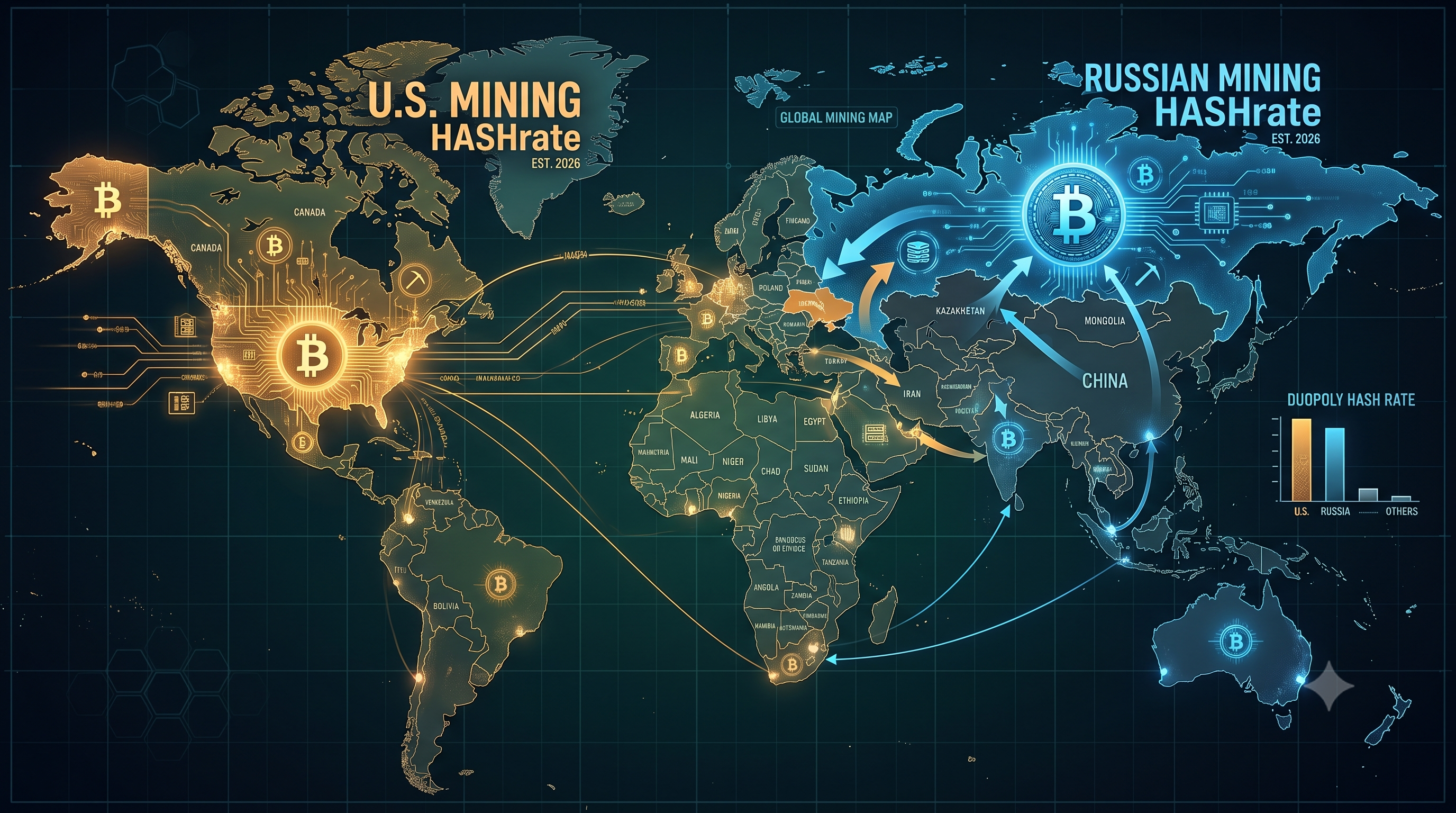
Global Bitcoin mining in mid-2026 is entirely defined by an aggressive geopolitical tug-of-war between the United States and the Russian Federation. Both sovereign superpowers have fully recognized the strategic economic value of proof-of-work infrastructure, fundamentally altering the decentralized ethos of the cryptocurrency sector. The United States is accelerating toward complete corporate institutionalization, actively passing legislation to absorb digital assets into its national reserves and integrating mining hardware into its domestic energy grid. Conversely, Russia is executing a draconian crackdown on the gray market, implementing severe criminal penalties and total surveillance to monopolize the revenue generated by its vast natural gas resources. As the global hash rate experiences a historic contraction, market dominance has rapidly consolidated into these two adversarial nations. This emerging US-Russia duopoly dictates the future of digital asset security, transforming sheer computing power into an essential tool of modern financial statecraft.
Tips: New to crypto? KuCoin's Knowledge Base has everything you need to get started.
Key Takeaways
-
Corporate Consolidation in the US: American publicly traded miners like Bitdeer and Marathon Holdings now control the vast majority of the global institutional hash rate, leveraging immense capital to survive post-halving margin compression.
-
American Legislative Support: The newly introduced "Mined in America Act" seeks to secure domestic supply chains by phasing out foreign hardware and officially codifying a Strategic Bitcoin Reserve.
-
Russian Criminalization of Mining: The Russian State Duma passed sweeping legislation in May 2026 that punishes unregistered, illegal cryptocurrency mining with massive fines and up to five years in federal prison.
-
Total Surveillance Grid in Russia: Russian authorities now mandate the registration of specific ASIC network addresses, giving state regulators complete visibility into local energy loads and mining operations.
-
The AI and HPC Pivot: Top-tier mining corporations globally are actively retrofitting their massive data centers to support Artificial Intelligence and High-Performance Computing, creating a stable dual-revenue floor.
The 2026 Global Hash Rate Landscape: A Tale of Two Superpowers
The Great Hash Rate Contraction and the Rise of Hosted Mining
The global Bitcoin hash rate has recently undergone a violent and historic contraction, fundamentally altering the basic economics of the entire digital asset industry. Over a highly volatile six-month period leading into the summer of 2026, the global hash rate plummeted from roughly 1300 EH/s down to approximately 700 EH/s. Industry analysts confirm that this structural stress test was significantly more severe than the notorious 2021 China mining ban. This massive operational drop was primarily driven by the abrupt capitulation of inefficient, independent self-miners who simply could no longer sustain profitability. Rising global energy costs, compounded by complex post-halving tokenomics, effectively flushed undercapitalized participants out of the network. The only surviving entities in this ruthless market are those boasting ironclad corporate balance sheets, access to exceptionally cheap power agreements, or highly diversified revenue streams that do not rely solely on block rewards.
Hosted mining solutions have rapidly absorbed the market share lost by struggling independent self-miners across the globe. At the landmark Bitcoin 2026 Conference, industry executives highlighted that the hosted mining model—particularly institutional seven-year contracts offering fixed energy rates—provides the critical financial stability required to weather extreme hash rate volatility. Major companies like BitFuFu successfully scaled their managed hash rate from 24 EH/s to an impressive 38 EH/s during the broader market decline by exclusively leveraging these long-term hosting agreements. By allowing third-party institutional investors to deploy heavy capital into enterprise-grade data centers without the burden of managing physical hardware, hosted mining has structurally stabilized the global network. This operational shift signifies the permanent end of the hobbyist era, moving the entire proof-of-work ecosystem into a rigid, service-oriented enterprise framework.
AI/HPC Integration: The New Frontier for Miners
The most significant operational trend among top-tier Bitcoin miners in 2026 is the aggressive, industry-wide pivot toward Artificial Intelligence (AI) and High-Performance Computing (HPC). Realizing that absolute reliance on volatile Bitcoin block rewards is a flawed long-term business model, major publicly traded miners are completely retrofitting their massive energy capacities to accommodate AI data centers. Bitdeer, an industry leader, publicly reported an AI Cloud Annual Recurring Revenue (ARR) of approximately $69 million in early 2026, while simultaneously negotiating advanced stages for massive Colocation AI Data Centers in Norway. This strategic pivot allows mining corporations to reliably monetize their vast energy contracts and sophisticated hydro-cooling infrastructure by serving the booming AI sector. Ultimately, this creates a formidable dual-revenue floor that protects mining operations from bankruptcy during inevitable cryptocurrency bear markets.
Hardware manufacturers are rolling out ultra-efficient rigs specifically designed to combat the exorbitant costs of electricity and complement these new enterprise data centers. Next-generation hardware efficiency has officially become the ultimate deciding factor for mining profitability in the 700 EH/s environment. In April 2026, Bitdeer officially launched the mass production of its highly anticipated SEALMINER A4 series, which features an industry-leading efficiency rating of 9.45 Joules per Terahash (J/T). Simultaneously, global manufacturer Bitmain showcased its new "Heating + Hashrate" solutions, alongside their advanced AR1901 and AR1902 Hydro Cooling Packages. By seamlessly repurposing the immense thermal output generated by ASIC machines for broader industrial and residential heating use, these hardware innovations allow modern miners to extract double the economic value from every single unit of electricity consumed.
The United States: Securing the Strategic Bitcoin Reserve
Corporate Dominance: Bitdeer, Marathon, and CleanSpark
American mining corporations have successfully scaled to unprecedented operational heights in 2026, securing the absolute majority of global institutional hash rate. Bitdeer currently dictates the pace of the entire sector, reporting a staggering 87.4 EH/s of total hash rate under management by late spring, alongside an impressive 65.5 EH/s generated through direct self-mining. Marathon Holdings closely shadows this dominance at over 66 EH/s, pioneering aggressive geographic diversification by capturing otherwise wasted flared gas energy across various independent states. CleanSpark has similarly crossed the monumental 50 EH/s milestone, notably achieving this feat by relying entirely on American-based infrastructure and low-cost sustainable power agreements in Georgia and Wyoming. This massive corporate consolidation definitively proves that well-capitalized, publicly traded entities are the only market participants currently capable of expanding their operations amidst tightening global margins.
| Company Name | Total Hash Rate Under Management (EH/s) | Key 2026 Strategic Focus |
| Bitdeer | 87.4 EH/s | Hardware manufacturing (SEALMINER A4) & AI Cloud integration. |
| Marathon Holdings | >66.0 EH/s | Geographic diversification and flared gas energy capture. |
| CleanSpark | 50.0 EH/s | Sustainable American energy sourcing and infrastructure scaling. |
American miners are increasingly forced into highly creative energy arrangements due to escalating and unpredictable utility tariff pressures across the United States. During industry panels throughout 2026, energy analysts emphasized that standard U.S. utility rates are quickly becoming prohibitively expensive for continuous, unhedged self-mining operations. Consequently, leading mining firms are rapidly retreating from traditional metropolitan electrical grids and establishing remote operations directly alongside stranded energy sources. Mega-facilities are migrating toward isolated locations in Wyoming, Texas, and the Dakotas, specifically targeting flared natural gas and excess solar energy that lacks transmission infrastructure. By capturing energy that would otherwise be entirely wasted, U.S. miners secure long-term power purchase agreements at a mere fraction of standard utility costs, perfectly insulating their balance sheets against sudden grid-wide tariff hikes.
The "Mined in America Act" and Hardware Independence
United States lawmakers are actively passing aggressive legislation to classify Bitcoin mining as critical national security infrastructure. The comprehensive "Mined in America Act," officially introduced by Senators Bill Cassidy and Cynthia Lummis in the spring of 2026, marks a historic policy shift by establishing a voluntary federal certification program for domestic facilities. Crucially, the bill mandates a strict, phased transition away from mining hardware manufactured by foreign adversaries, explicitly aiming to secure the physical supply chain of American mining operations. Furthermore, this landmark legislation officially codifies President Donald Trump's prior executive order to establish a Strategic Bitcoin Reserve permanently housed within the Department of the Treasury. By directly integrating digital asset mining with existing federal energy programs, the U.S. government has elevated hash rate production to a matter of sovereign economic defense.
Tax Clarity and the Legislative Push (H.R. 9175)
Tax clarity has finally become an urgent legislative priority for the U.S. government, ensuring that domestic miners can accurately forecast their long-term operational and capital costs. On June 9, 2026, the House Ways and Means Committee heavily reviewed the "Tax Clarity for Mining and Staking Act" (H.R. 9175). This highly anticipated bill fundamentally alters the financial landscape for institutional miners by proposing rules that defer federal taxes on newly minted block rewards until the asset is officially sold or disposed of, rather than taxing it immediately upon network receipt. Representatives are currently debating crucial amendments designed to allow miners a comprehensive four-year tax deferral window. This robust bipartisan effort to streamline accounting methods demonstrates a powerful governmental commitment to keeping digital asset operations highly lucrative and economically viable exclusively within U.S. borders.
Everyday cryptocurrency users and small-scale operators in the United States are simultaneously receiving much-needed legislative relief from burdensome, granular tax reporting requirements. Representative Rudy Yakym officially introduced the "Less Paperwork for Digital Asset Owners Act" (H.R. 9178) in June 2026, specifically targeting the frustrating tax implications of micro-transactions. This specific bill establishes a critical de minimis exception, explicitly dictating that no capital gain or loss is recognized on the disposition of a digital asset if it is used to pay network fees aggregating under $10. By vastly streamlining the IRS reporting process and allowing a simplified accounting method for widely traded digital assets, the U.S. Congress is directly alleviating unnecessary administrative paperwork for casual users and encouraging the broader, frictionless adoption of decentralized payment networks.
Russia: From Gray Zone to Criminalization
The May 2026 Duma Bill and Prison Sentences for Illegal Mining
The Russian Federation has decisively abandoned its tolerant "gray zone" approach to cryptocurrency mining, replacing it with harsh criminal penalties designed to eradicate unauthorized shadow operators. On May 27, 2026, the Russian State Duma aggressively passed a landmark bill in its first reading that strictly criminalizes all illegal mining activities across the country. Designed to force all profitable crypto operations under the absolute purview of the Federal Tax Service, the legislation adds Article 171.6 directly to the Russian Criminal Code. The Russian central government estimates that out of 50,000 potential mining entities operating within its borders, fewer than 1,500 are officially included in the state registry. By threatening heavy prison sentences and massive asset seizures, the Kremlin is rapidly consolidating total control over its domestic hash rate to ensure all revenues are taxed.
Punishment for operating outside Russia's state-approved cryptocurrency mining registry is exceptionally severe and designed to instantly deter large-scale, off-grid industrial operations. Under the newly passed legislation, individuals or corporate entities caught mining without proper state registration while generating significant income face immediate fines up to 1.5 million rubles. However, the legal penalties escalate drastically for organized criminal groups or operations causing large-scale strain on the local electrical grid infrastructure. These major violators face devastating fines reaching up to 2.5 million rubles or up to five full years in a federal prison, alongside the total state seizure of all hardware and assets obtained through the illegal mining activity. This draconian, zero-tolerance approach underscores Russia's absolute desperation to legally monopolize the massive revenue generated by its natural gas-powered energy sector.
| Legal Violation Category | Maximum Financial Fine | Additional Criminal Penalty |
| Basic Unregistered Mining | Up to 1.5 Million Rubles | Confiscation of illegally mined assets. |
| Organized/Large-Scale Mining | Up to 2.5 Million Rubles | Up to 5 years imprisonment & hardware seizure. |
The Expanding National Registry and Grid Surveillance
Total digital surveillance of all physical mining hardware is now a mandatory, non-negotiable requirement for operating a legal digital asset facility anywhere in Russia. As of late May 2026, the Russian Ministry of Finance drastically expanded its official information requirements, forcing all mining infrastructure operators to submit exact network address data and hardware IP addresses for every active ASIC machine. Local grid operators and the Russian Central Bank now have unfettered, real-time access to this comprehensive national registry. This integration allows the surveillance state to precisely monitor electrical infrastructure loads in remote regions with high concentrations of mining capacity, instantly identifying any mathematical discrepancies between legally registered hardware and actual power consumption. Consequently, the concept of operational anonymity in Russian Bitcoin mining has been entirely eradicated.
The taxation of cryptocurrency mining has ultimately become a vital economic lifeline for the heavily sanctioned and isolated Russian government. With the prolonged financial drain of ongoing military conflicts and severely dwindling traditional export incomes, the Kremlin is aggressively monetizing its domestic digital economy to fund state operations. Moving cryptocurrency from an ignored technological novelty into a strict criminal legal framework allows the state to legally inject billions of rubles directly into the national federal budget through corporate taxation. The mandatory reporting of all mined digital assets ensures a clear, enforceable boundary between tolerated personal hobbyists—who are strictly capped at 6,000 kWh per electricity month—and industrial-scale operations that must pay heavy federal taxes. This regulatory clampdown is engineered entirely to finance the state apparatus.
The Russian state is simultaneously designing a heavily gated, highly restricted system for retail investors to access cryptocurrency markets, prioritizing state control over financial freedom. While industrial mining is tightly locked down, the government is considering controlled access to digital assets strictly for non-qualified, everyday citizens. This limited strategy allows ordinary Russians to use crypto as a minor financial hedge against rising domestic fiat inflation, but it is bound by exceptionally strict, state-mandated limits on transaction volumes and maximum investment sizes. By capping retail involvement, the Kremlin aims to prevent massive, uncontrolled capital flight while still offering a localized pressure release valve for citizens looking to protect their wealth. However, the state notably offers zero legal protection against market volatility or exchange fraud, leaving these retail investors highly exposed to systemic risks.
Conclusion
The 2026 global Bitcoin mining map is irreversibly dominated by the calculated, opposing geopolitical strategies of the United States and Russia. Both superpowers have fundamentally shifted the narrative of cryptocurrency from a decentralized experiment into a highly regulated mechanism of national economic defense. The United States continues to lead through massive corporate scaling, securing its dominance by drafting the "Mined in America Act," pursuing a Strategic Bitcoin Reserve, and actively integrating hash rate with innovative AI and HPC data centers. Conversely, Russia has entirely weaponized its regulatory framework, criminalizing the gray market and imposing a total surveillance grid to extract maximum tax revenue from its natural gas abundance. As the global hash rate recovers from its historic mid-year contraction, independent miners are rapidly being replaced by institutional and state-aligned entities. Ultimately, this rigid duopoly guarantees that the future of digital asset infrastructure will be tightly controlled, highly institutionalized, and perpetually tied to the broader macroeconomic ambitions of competing world powers.
FAQs
What role do Middle Eastern countries play in the global mining ecosystem?
Middle Eastern countries like Iran and Kuwait leverage their heavily subsidized natural gas sectors to offer extremely cheap electricity for mining, creating a highly profitable third pillar outside the dominant US-Russia duopoly. Because domestic energy policies heavily subsidize the cost of electricity, operators in these regions can mine Bitcoin at a fraction of the cost seen in Western nations, though they often face severe geopolitical sanctions and supply chain isolation.
How does the upcoming 2027 US Presidential election impact crypto regulation?
The 2027 election cycle introduces severe regulatory uncertainty as the previous bipartisan support for cryptocurrency is tested by intense political polarization. While current bills like the Mined in America Act enjoy momentum, shifting administrative priorities could significantly slow down the executive implementation of pro-mining policies, forcing mining corporations to hedge their legislative bets through aggressive lobbying.
Are European nations increasing their share of the global hash rate in 2026?
European nations are largely exiting the industrial-scale mining sector due to exceptionally strict environmental regulations and their ongoing reliance on expensive imported natural gas. While a few niche, highly specialized renewable energy setups remain active in Nordic regions like Norway, the broader European continent has priced itself out of the competitive global proof-of-work market.
What happens to seized cryptocurrency assets under the new Russian laws?
Confiscated digital assets and physical hardware from illegal Russian mining operations are systematically liquidated by state-appointed financial institutions. The fiat equivalents generated from these liquidations are directly injected into the federal budget to offset the massive economic deficits caused by international trade sanctions.
Will the Mined in America Act affect retail home miners?
Retail home miners are generally exempt from the stringent certification processes and hardware restrictions outlined in the Mined in America Act. The legislation primarily targets enterprise-scale data centers, institutional mining pools, and corporate entities managing vast amounts of grid infrastructure, leaving small-scale hobbyists largely unaffected by federal compliance mandates.
Disclaim: This article is for informational purposes only and does not constitute financial or investment advice. Cryptocurrency investments carry significant risk. Always conduct your own research before trading.