

AI Infrastructure Boom at Risk? Why Elon Musk Warns That 200+ Neoclouds Could Fail
Introduction
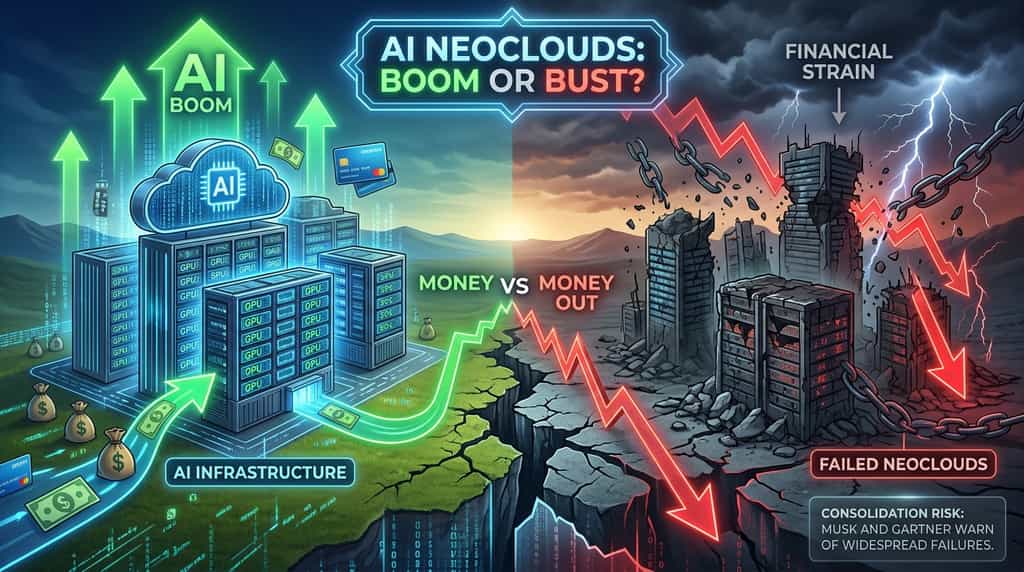
The artificial intelligence infrastructure boom is facing a critical question: can the revenue generated by AI justify the enormous cost of building and financing the computing systems behind it? In October 2026, Elon Musk warned that more than 200 specialized AI cloud providers, known as neoclouds, could face widespread failures and consolidation as financing becomes harder to obtain. His comments highlight a growing concern that demand for AI computing may expand rapidly while many infrastructure providers struggle to earn sustainable returns.
The warning comes as Gartner's October 14, 2026, analysis estimates that more than $3.5 trillion in AI infrastructure spending could be exposed to impairment by the end of 2030 if current investment patterns continue. Gartner also predicts that more than 80% of neocloud providers could cease operating independently by 2030.
The central issue is not whether AI computing demand will continue to grow, but whether infrastructure providers can convert that demand into profitable, financeable businesses. Capital costs, debt exposure, access to electricity, construction delays, hardware depreciation, and customer concentration will help determine which companies remain competitive.
Why Did Elon Musk Warn That More Than 200 AI Neoclouds Could Fail?
Musk's warning reflects the financial pressure facing AI cloud providers that depend heavily on data-center revenue and external financing. His argument is that companies with limited revenue outside AI infrastructure may find it increasingly difficult to fund expensive computing equipment if lenders become more selective.
In his October 25, 2026, public comments, Musk said SpaceX had secured approximately $40 billion in debt financing to purchase graphics processing units (GPUs). He attributed the company's financing position to its investment-grade credit standing and revenue from businesses such as Starlink and rocket launches. He contrasted that financial position with neocloud providers that rely primarily on AI data centers for revenue.
Musk's central concern is that a large number of specialized providers may be competing for capital while facing similar business risks. Building AI infrastructure requires substantial upfront spending on GPUs, networking equipment, data-center facilities, cooling, electricity, and supporting systems. Companies must then generate sufficient revenue to cover operating expenses, interest payments, equipment replacement, and the original investment.
The distinction between Musk's prediction and a confirmed industry outcome is important. His forecast does not establish that every neocloud is financially distressed or that more than 200 companies will necessarily fail. It identifies a possible consolidation scenario in which providers with stronger financing, lower costs, differentiated services, and more durable customer contracts gain an advantage over weaker competitors.
What Are AI Neoclouds and Why Are They Under Pressure?
AI neoclouds are specialized cloud infrastructure providers that supply computing capacity optimized for artificial intelligence workloads. They typically offer access to GPU clusters, high-performance networking, storage, and software environments that customers use to train, fine-tune, or run AI models.
Unlike diversified hyperscale cloud providers, many neoclouds focus on AI computing as their primary business. Their specialization can help them serve customers seeking dedicated GPU capacity or particular configurations. However, it can also leave them more exposed to fluctuations in AI infrastructure demand, hardware prices, borrowing costs, and customer spending.
The business model is capital-intensive. Providers may need to purchase or finance GPUs before all their capacity is contracted, while data-center development requires access to land, electricity, cooling systems, and suitable network connections. Revenue may arrive gradually as facilities become operational and customers begin using the equipment. If construction or customer deployment is delayed, financing expenses can accumulate before the expected income starts.
Gartner's October 14 analysis identifies this mismatch between capital spending and potential revenue as a major industry risk. The firm estimates that AI providers will spend nearly $1 trillion on AI infrastructure in 2026 and invest another $6 trillion from 2027 through 2030. Gartner projects that enterprise and consumer AI revenue attributable to data centers may reach no more than $3.6 trillion during that period, compared with $8.5 trillion in cumulative revenue that data-center owners would need to cover announced capital spending, financing costs, and a 12% return on invested capital. These are Gartner's estimates and projections, not guaranteed future outcomes.
The figures illustrate the difference between demand growth and investment returns. Even when customers want more AI computing, individual providers may struggle if their infrastructure costs too much, their financing is expensive, or their utilization rates are insufficient.
Could the AI Infrastructure Boom Become a Financial Bubble?
The AI infrastructure boom could experience a significant correction if investment grows faster than profitable demand, but the available evidence does not prove that the entire AI sector is a bubble. A more precise concern is that some infrastructure projects may fail to generate adequate returns even while AI adoption continues to expand.
The distinction matters because infrastructure investment can be commercially justified at the industry level while individual companies still lose money. If several providers build capacity for the same pool of customers, competition may push rental prices lower. Providers with high debt payments and large fixed costs may then struggle to maintain margins, particularly when equipment needs to be refreshed before the original investment has been recovered.
Gartner's October 2026 analysis estimates that more than $3.5 trillion of AI infrastructure spending could be exposed to impairment by the end of 2030, with potential asset write-down exposure exceeding $4 trillion through 2032 under its stated scenario. It also forecasts that more than 80% of neocloud providers could cease operating independently by 2030 because of cost pressure and insufficient differentiation. These estimates describe a risk scenario, not a prediction that every project will fail.
Several conditions could make the industry more vulnerable:
-
Excess capacity: Providers may build more computing capacity than customers can profitably use.
-
Expensive financing: Higher borrowing costs or tighter credit standards can increase the financial burden on highly leveraged operators.
-
Falling rental prices: Competition among providers may reduce the revenue earned per GPU or computing unit.
-
Rapid hardware depreciation: New generations of accelerators can reduce the relative value of existing equipment before providers have recovered their investment.
-
Delayed infrastructure delivery: Construction, electricity connections, and cooling systems may take longer than expected, delaying revenue generation.
Conversely, sustained customer demand, long-term contracts, disciplined capital spending, and lower operating costs could support profitable businesses. The key question is whether individual providers can generate returns that justify their capital commitments.
Which Companies Should Be on the AI Infrastructure Watchlist?
Several companies deserve closer monitoring as the AI infrastructure market enters a potential consolidation phase, but their exposure varies significantly by business model. CoreWeave (NASDAQ: CRWV), Nebius Group (NASDAQ: NBIS), and IREN (NASDAQ: IREN) are particularly relevant because they have direct exposure to specialized AI cloud infrastructure. For these companies, investors should track debt maturities, interest expenses, capital expenditure, customer concentration, GPU utilization, and how quickly contracted revenue converts into operating cash flow. A large order backlog can signal demand, but it does not automatically guarantee profitable delivery or sufficient cash generation.
Oracle (NYSE: ORCL) is another important company to watch because it is investing heavily in data centers while also operating an established enterprise software and cloud business. Its expanding AI infrastructure commitments should be assessed alongside capital spending, financing requirements, contract execution, and returns on invested capital. Meanwhile, NVIDIA (NASDAQ: NVDA) is a key supplier whose results can help reveal whether demand for AI computing hardware remains strong, although supplier revenue growth alone does not prove that every AI cloud operator can earn an adequate return. Amazon, Microsoft, and Alphabet also merit attention as established cloud providers with broader business operations and substantial AI infrastructure investments.
The distinction is important: established cloud platforms and specialized GPU cloud providers face different financing pressures and sources of revenue. Gartner's October 2026 analysis projected that more than 80% of neocloud providers could cease operating independently by 2030. This is a sector-level forecast, not a prediction that every named company will fail. The most useful signals will be sustained customer demand, improving cash flow after capital expenditure, manageable debt, high utilization, and evidence that AI infrastructure spending is generating durable economic returns. Gartner's AI infrastructure risk analysis provides further context, while Reuters' October 25 report on Elon Musk's warning explains why access to financing and diversified revenue may become increasingly important.
Conclusion
Elon Musk's warning that more than 200 AI neoclouds could face failures and consolidation highlights a genuine challenge for the AI infrastructure industry: demand for computing capacity must eventually translate into sustainable financial returns. Specialized cloud providers face significant upfront costs for GPUs, data centers, electricity, networking, and financing. If revenue, utilization, or project delivery falls short of expectations, even a growing market may leave individual companies under financial pressure.
Gartner's October 2026 analysis reinforces the concern, estimating that more than $3.5 trillion in AI infrastructure spending could be exposed to impairment by the end of 2030 under its stated scenario. Its forecast that more than 80% of neocloud providers could cease independent operations by 2030 points to possible consolidation, but it does not establish that every provider will fail or that AI adoption will stall.
The key distinction is between the long-term potential of AI and the financial viability of each infrastructure investment. Diversified revenue, sound financing, reliable power access, contracted demand, and disciplined capital allocation may help providers remain competitive. Investors and enterprise customers should examine company-level evidence rather than assume that all AI infrastructure businesses will benefit equally from the boom.
FAQs
1. What is an AI neocloud?
An AI neocloud is a specialized cloud provider that supplies computing infrastructure optimized for AI workloads. Its services may include access to GPUs, high-performance networking, storage, and software environments for training and running AI models.
2. Why does Elon Musk believe many neoclouds could fail?
Musk argues that providers relying heavily on AI data-center revenue may struggle to obtain financing if lenders become more selective. Their high capital requirements and dependence on future customer demand can make them financially vulnerable when projects are delayed or revenue falls short.
3. Does Gartner predict that all AI cloud companies will fail?
No. Gartner's October 14, 2026, analysis predicts that more than 80% of neocloud providers could cease operating independently by 2030. That outcome includes potential consolidation and other changes in ownership or business structure, not necessarily the bankruptcy of every affected company.
4. What is the biggest financial risk for AI infrastructure providers?
A major risk is failing to generate enough revenue and cash flow to cover capital expenditure, operating costs, financing expenses, and hardware replacement. This risk increases when equipment is underused, rental prices decline, or projects become operational later than planned.
5. Could consolidation benefit the AI infrastructure market?
Consolidation could allow stronger operators to acquire assets, combine operations, and improve utilization. However, it can also create disruption for customers and creditors, and it does not guarantee that the remaining providers will earn attractive returns.
Disclaimer
This general market information, possibly from third-party, commercial, or sponsored sources, is provided for reference and educational purposes only and does not constitute financial or investment advice, an offer, solicitation, or guarantee. We disclaim liability for its accuracy, completeness, reliability, and any resulting losses. Investments/trading are risky; past performance doesn’t guarantee future results. Users should research, judge prudently, and take full responsibility. For further details, please consult KuCoin’s Terms of Use and Risk Disclosure.