

After July Market Swings, Nvidia Earnings Loom as August’s Biggest Catalyst for US Stocks
Introduction
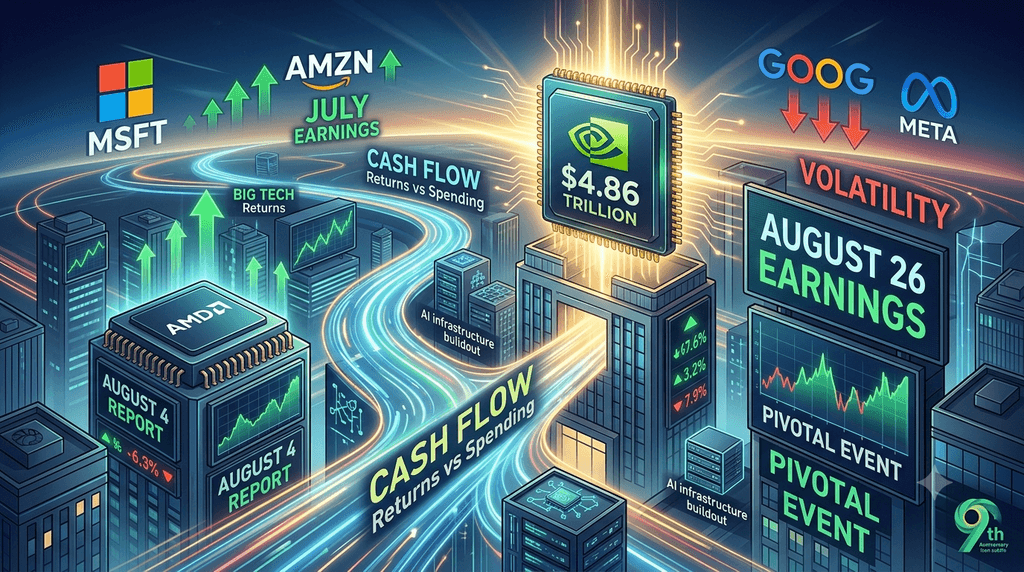
July’s earnings season left US equities on edge, with sharp swings driven by how clearly Big Tech explained AI spending returns. Microsoft and Amazon shares surged after detailing strong AI demand and capital expenditure payoffs, while Alphabet and Meta lagged for failing to fully clarify the same. Now, as August begins, Nvidia’s earnings report on August 26, 2026, after the market close stands as the month’s most critical event for the broader US stock market. This release from the roughly $4.86 trillion AI chip leader will test whether investors still reward AI investment or demand clearer proof of cash-flow efficiency.
Why Did July’s Big Tech Earnings Create Such Volatility in US Stocks?
July’s results revealed a clear market divide: companies that linked AI capital spending to measurable demand and revenue growth were rewarded, while those that did not faced pressure. Microsoft delivered roughly $90 billion in quarterly revenue, up 18% year-over-year, with Azure growing 43% and a substantial cloud backlog signaling real contracts. Shares jumped sharply as investors saw AI investments converting into tangible results. Amazon posted AWS revenue of $42.2 billion, up 37% — its fastest pace in 18 quarters — with AI and chips businesses each exceeding $25 billion run rates. The stock soared more than 10% in response, according to reports from late July 2026.
In contrast, Alphabet reported solid revenue growth and 82% cloud expansion but raised 2026 capital expenditure guidance to $195–205 billion. The stock declined as free cash flow turned negative and investors questioned the scale of spending without clearer near-term returns. Meta delivered $60.8 billion in revenue, up 28%, yet raised AI-related capital spending plans and saw free cash flow compress; shares dropped around 9–10% after the report. Based on market reactions tracked in late July 2026, pure AI spending without explicit demand proof no longer commands automatic approval.
These outcomes set a higher bar heading into August. Investors now prioritize evidence that AI infrastructure spending generates returns rather than simply expanding capacity.
Why Is Nvidia’s August 26 Earnings Report the Pivotal Event for the US Market?
Nvidia’s second-quarter fiscal 2027 results, due after the close on August 26, 2026, carry outsized weight because the company sits at the center of the AI infrastructure buildout with a market capitalization near $4.86 trillion. The report will influence not only semiconductor stocks but also broader indices, given Nvidia’s role as the primary supplier of AI accelerators. According to company calendars confirmed in early August 2026, the release coincides with peak focus on whether AI leaders are deploying capital productively.
Beyond headline revenue and earnings, the critical metric is cash flow. Nvidia’s most recent quarterly free cash flow stood near $48.5–48.6 billion. As a company valued in the multi-trillion-dollar range, any shortfall or unclear explanation of cash generation risks broader market turbulence. The report must demonstrate whether the AI industry leader is spending efficiently or simply expanding capacity without matching returns. Strong guidance on data-center demand and cash conversion could stabilize or lift the market; weaker signals could amplify the volatility already seen in July.
What Should Investors Watch in AMD’s August 4 Earnings Report?
AMD reports fiscal second-quarter 2026 results after the close on August 4, 2026, offering an early read on competitive dynamics in AI chips. At a recent share price near $472–476, AMD’s market capitalization remains under $800 billion while management continues targeting the $1 trillion threshold. Market attention centers on four areas: whether data-center revenue growth sustains above 50%, the shipment trajectory of MI350 and MI450 products (ramp versus capacity constraints), any softening in Helios delivery guidance, and whether full-year revenue guidance meets or exceeds consensus expectations.
These details matter because AMD competes directly in the same AI accelerator market as Nvidia. Positive surprises could support broader semiconductor sentiment ahead of Nvidia’s larger report; shortfalls could heighten caution. Recent trading data from early August 2026 shows AMD shares fluctuating around the mid-$470s as investors position for the release.
How Do Traditional DCF Valuations Compare for Nvidia and AMD?
Traditional discounted cash flow models highlight a notable valuation gap between the two chipmakers despite their overlapping AI exposure. Under standard DCF assumptions, AMD’s estimated fair value sits near $130 per share, yet the stock recently traded near $472. Nvidia, by comparison, trades near $200 against an estimated fair value around $180 — a far smaller premium. This difference implies that Nvidia currently carries lower valuation risk. Even if its upcoming earnings fall short of optimistic expectations, the potential downside appears more contained than for AMD, whose current price embeds significantly higher future growth assumptions.
Investors trading on forward AI narratives should weigh this disparity. While both companies benefit from the same secular demand, the DCF lens indicates Nvidia’s risk-reward profile is more balanced at present levels.
How Could Nvidia’s Cash Flow Narrative Shape Broader Market Sentiment in August?
Nvidia’s ability to articulate cash-flow generation and capital efficiency will set the tone for the rest of the month. With free cash flow already in the high $40 billions in the prior quarter, the company must show that AI-related investments continue to convert into durable cash rather than pure capacity expansion. A clear explanation supporting sustained demand and disciplined spending could reinforce confidence across AI-related equities and the wider market. Conversely, any ambiguity risks renewing the scrutiny that weighed on Alphabet and Meta in July.
Because Nvidia’s market capitalization approaches $5 trillion, its report functions as a proxy for the health of the entire AI investment cycle. Positive clarity may support risk assets; lingering questions about returns on capital could extend the volatility observed after July’s mixed tech results.
Should You Trade AI and Semiconductor Themes on KuCoin?
Nvidia’s August 26 earnings and AMD’s earlier report create heightened interest in AI infrastructure narratives that often spill into related cryptocurrency markets. On KuCoin, traders can access a range of AI-themed tokens, blockchain infrastructure projects, and digital assets that historically show sensitivity to major semiconductor and Big Tech developments.
KuCoin offers deep liquidity, advanced charting tools, and products such as spot trading, futures, and structured products that allow flexible positioning around high-impact events like Nvidia’s report. Users can monitor correlations between traditional AI leaders and on-chain AI or compute-related tokens while managing risk through stop orders and position sizing. Registration on KuCoin provides immediate access to these markets, enabling traders to respond quickly to post-earnings moves in the broader AI ecosystem.
Join KuCoin 9th Anniversary Trading Campaign
KuCoin is celebrating its 9th anniversary with a special platform campaign filled with exclusive rewards, trading activities, and limited-time offers. Don’t miss the chance to participate and enjoy the benefits as the exchange marks nine years of growth and innovation. Visit the official campaign page now:

Conclusion
July’s earnings season established a new standard: markets now reward clear evidence that AI capital expenditure translates into demand and cash flow rather than open-ended spending. Microsoft and Amazon benefited from providing that clarity, while Alphabet and Meta faced pressure for less definitive explanations.
Against this backdrop, Nvidia’s August 26, 2026, earnings stand as the dominant catalyst for US stocks in August. Investors will scrutinize not only growth metrics but especially free cash flow near the $48–50 billion range and the company’s ability to justify its multi-trillion-dollar valuation through efficient capital deployment.
AMD’s August 4 report offers an earlier checkpoint on data-center momentum and product ramps. Traditional DCF analysis further underscores that Nvidia currently embeds lower valuation risk than AMD. Together, these events will determine whether the AI investment cycle retains investor confidence or faces renewed skepticism in the weeks ahead. Clarity from Nvidia remains the pivotal variable for market direction through the rest of the month.
FAQs
When exactly does Nvidia report earnings in August 2026?
Nvidia is scheduled to release its second-quarter fiscal 2027 financial results after the market close on August 26, 2026.
What free cash flow figure did Nvidia report in its most recent quarter?
Nvidia generated approximately $48.5–48.6 billion in free cash flow in its latest reported quarter, according to company data released earlier in 2026.
What are the main metrics to watch in AMD’s August 4 earnings?
Key items include data-center revenue growth sustainability above 50%, MI350/MI450 shipment progress, Helios delivery guidance, and full-year revenue outlook versus expectations.