

Solana Q3 2026 Report: Revenue Jumps 48% as Stablecoin Supply Reaches $16.8B
Introduction
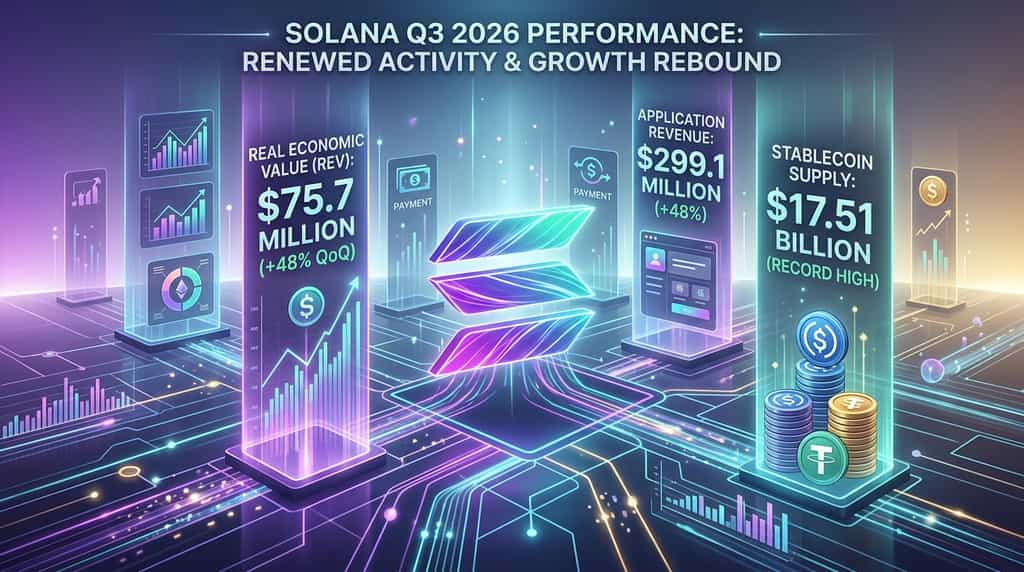
Solana's third-quarter 2026 performance points to renewed activity across its network, with revenue metrics rebounding and stablecoin adoption reaching new highs. According to Blockworks' Q3 2026 protocol report, Solana's real economic value (REV) increased 48% quarter over quarter to $75.7 million, while revenue generated by applications on the network also rose 48% to $299.1 million. Meanwhile, the Solana Foundation's September ecosystem roundup reported that stablecoin supply reached a record $17.51 billion during the month.
Together, these indicators suggest that Solana's activity is expanding across trading, payments, stablecoins, and tokenized assets. However, rising network activity does not automatically translate into higher SOL prices. Investors need to distinguish between application revenue, protocol-level value capture, and demand for SOL itself. The key question is whether the third-quarter rebound reflects sustainable ecosystem growth or activity that could weaken as market conditions change.
What Were Solana's Key Q3 2026 Performance Highlights?
Solana's Q3 performance improved across several major indicators, including REV, application revenue, decentralized exchange (DEX) activity, and tokenized equities. The figures suggest a stronger quarter for the ecosystem, although each metric measures a different part of its economic activity.
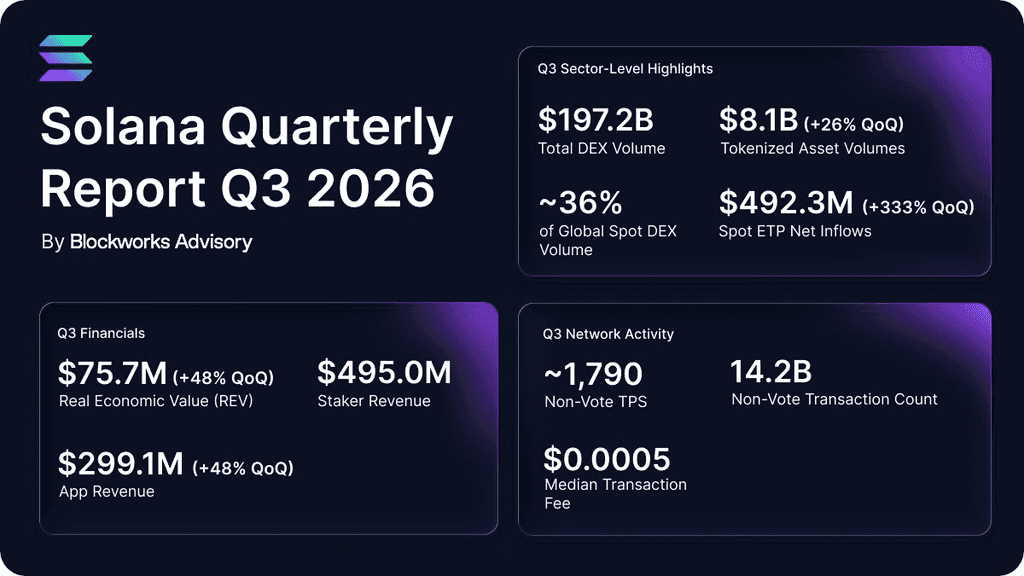
According to the Blockworks quarterly report published on October 15, 2026, Solana's REV rose 48% quarter over quarter to $75.7 million, marking its first quarterly increase since Q4 2024. Application revenue increased 48% to $299.1 million, its highest quarterly total since Q3 2025. These figures show that both network-level economic activity and revenue generated by applications strengthened during the quarter.
The report also highlighted growing activity in decentralized trading and tokenized equities. Solana's DEX volume rose 23% to $197.2 billion, while tokenized-equity value traded reached a quarterly record of $7.1 billion, up 40% from Q2. The report attributed a strong contribution to September, when monthly application revenue reached $117.1 million and REV reached $30.1 million.
Why Did Solana Application Revenue Rise 48% in Q3 2026?
Solana application revenue increased because activity across trading and consumer-facing applications strengthened during Q3, with several major platforms contributing to the rebound. According to the Blockworks Q3 2026 report, applications generated $299.1 million in quarterly revenue, up 48% from Q2. The figure measures revenue earned by applications operating within the ecosystem, rather than revenue collected directly by the Solana protocol.
The distribution of application revenue matters as much as the overall increase. Blockworks reported that Pump generated $121.5 million, representing approximately 41% of application revenue. Collector Crypt generated $35 million, Fomo generated $24.9 million, Pacifica generated $18 million, and Axiom generated $16.2 million. This shows that Solana's application economy includes several meaningful contributors, but revenue remains concentrated in a relatively small group of platforms.
The monthly trend also points to improving momentum. According to the same report, application revenue rose from $75.4 million in July to $106.5 million in August and $117.1 million in September. September was the strongest month for application revenue since January 2026. Fomo's revenue quadrupled quarter over quarter, while Axiom's revenue grew 65%, indicating that growth was not limited to the largest application.
However, application revenue is not the same as SOL token revenue. Trading platforms may earn fees from users, while the Solana protocol receives value through transaction fees and other network-level mechanisms. An application can become more profitable without all of that revenue flowing to SOL holders. Investors should therefore examine both application growth and the mechanisms through which network activity creates demand for the native token.
What Does Solana's Rising Stablecoin Supply Mean for the Ecosystem?
Rising stablecoin supply suggests that Solana is attracting more dollar-denominated liquidity for payments, trading, lending, and other onchain financial activity. The Solana Foundation's September 2026 ecosystem report recorded a stablecoin supply of $17.51 billion, a new high. Its September payments review separately reported that supply reached $17.3 billion on September 25.
Stablecoins can support ecosystem growth in several ways. Traders use them to move between positions without repeatedly converting funds to fiat currency. Decentralized finance (DeFi) applications use them for lending, borrowing, collateral, and liquidity provision. Businesses can also use stablecoins to settle payments across borders or move dollar-denominated value outside traditional banking hours. These use cases can make a blockchain useful even when users do not want direct exposure to the price volatility of SOL.
Solana's payments infrastructure also developed during September. According to the Solana Foundation's October 9 review, Column integrated stablecoins into its banking core, allowing businesses to convert between supported stablecoins and dollars through the same ledger used for services such as ACH, wires, and SWIFT. The report also described the launch of Open USD on Solana on September 30, with reserves held at BlackRock, Lead Bank, and BNY, and business minting and redemption supported through named payment providers.
These developments provide examples of how stablecoin adoption can extend beyond crypto trading. Nevertheless, stablecoin supply alone does not prove that all the capital is being used productively. Some balances may sit idle, move between protocols, or support leveraged positions. To evaluate the strength of adoption, investors should consider supply alongside transfer activity, active users, payment volumes, lending demand, and the durability of liquidity.
Can Solana's Q3 Growth Translate Into Higher SOL Demand?
Solana's growth could support SOL demand if it leads to more persistent network usage, greater demand for transaction fees, and stronger participation in staking and ecosystem applications. However, the relationship is indirect: higher application revenue or stablecoin supply does not guarantee a corresponding increase in SOL's price.
SOL plays several roles in the network. Users need SOL to pay transaction fees, validators stake SOL to participate in network security, and market participants use it as a liquid asset across supported trading and DeFi applications. More onchain activity can increase the need to hold or acquire SOL, but the scale of that effect depends on transaction costs, user behavior, protocol economics, and how much activity is driven by speculative trading.
The Q3 report provides evidence of broader usage. According to the Solana Foundation's September roundup, the network processed 8.78 billion non-vote transactions during Q3, up 23.3% from Q2. Its September DEX volume reached $78.33 billion, up from $65.29 billion in August, while tokenized-stock trading volume was approximately $4.4 billion for the month. These metrics suggest that Solana is being used across multiple market categories, not just for transfers of its native token.
Still, the quality of activity matters. High transaction counts can reflect bots, arbitrage, or short-lived speculative demand, while elevated trading volume can rise and fall rapidly with market sentiment. Stronger evidence of durable growth would include recurring payment usage, stable liquidity, sustained application revenue across multiple platforms, and increasing demand that remains resilient during weaker market conditions.
SOL investors should also account for token supply dynamics, staking yields, network fees, and competition from other blockchains. Adoption can improve the ecosystem's fundamentals, but token valuation depends on how investors price those fundamentals relative to risk and future growth expectations.
Beyond the Headlines: What KuCoin 5.0 Means for You
Market news moves fast — but where you act on it matters just as much. This October, KuCoin launches KuCoin 5.0, transforming KuCoin into a rebuilt platform. Here's what actually changes for you:
-
One account for everything. Older platforms split your money across separate "spot," "margin," and "futures" accounts and expected you to understand why. KuCoin 5.0's unified account removes that entirely — deposit once, and everything is simply there (only available to VIPs for now).
-
Stocks, indices, and commodities. KuCoin 5.0 expands beyond crypto into global markets. When crypto chops sideways and equities rally (or the reverse), you rotate in minutes instead of opening a brokerage account and waiting days for fiat rails.
-
Real-world assets (RWA). Tokenized exposure to traditional assets like commodities, right inside your crypto account. One of the fastest-growing segments in global finance is no longer reserved for institutions — you access it from the same balance you trade with.
-
Earn while you learn. Not ready to trade? KCUSD lets your stablecoins earn daily, auto-compounding interest. The lowest-stress way to put your idle deposit to work for 4% yield.
-
An AI assistant in plain language. Ask questions, get market context, understand what you're looking at — built into the platform, no jargon required.
-
An app that doesn't overwhelm. Faster, cleaner, and consistent — intuitive from the first tap, not after a tutorial.
-
Safety you can check, not just trust. A MiCAR-licensed EU entity, Proof of Reserves you can verify yourself, and internationally certified security (SOC 2 Type II, ISO 27001:2022).
Create your account in minutes — and start on the platform built for where crypto is going, not where it's been.
Conclusion
Solana's Q3 2026 results show a meaningful rebound in ecosystem activity. According to Blockworks' quarterly report, REV increased 48% quarter over quarter to $75.7 million, while application revenue rose 48% to $299.1 million. The Solana Foundation's September ecosystem reporting also showed stablecoin supply reaching a record $17.51 billion, alongside growth in decentralized trading, tokenized equities, and network transactions.
These figures strengthen the case that Solana is developing beyond a single-use trading network. Stablecoins can support payments and DeFi liquidity, tokenized equities can bring new financial activity onchain, and application revenue can indicate that users are willing to pay for services built on the network. Yet these trends should not be treated as proof that SOL must rise in price.
The next test is whether Solana can sustain revenue across a wider range of applications, retain stablecoin liquidity, and convert network usage into durable demand for SOL. Investors should monitor the quality and concentration of revenue, payment adoption, network economics, competition, and broader market conditions. Q3 provides evidence of renewed momentum, but continued growth and token performance remain uncertain.
FAQs
1. What is Solana's REV?
REV stands for real economic value, a metric used in Solana ecosystem reporting to measure selected economic value generated by network activity, including transaction fees and priority fees. Its exact components depend on the methodology used by the reporting provider, so comparisons should use consistent definitions.
2. Does higher application revenue mean SOL holders receive that revenue?
No. Application revenue is generally earned by individual protocols or businesses. SOL holders do not automatically receive those earnings. The effect on SOL depends on network fee mechanisms, staking economics, token demand, and the way applications use the network.
3. What is the difference between stablecoin supply and stablecoin transaction volume?
Stablecoin supply measures the value of stablecoins present on a network at a given time, while transaction volume measures the value transferred over a period. Supply can remain stable even when transaction volume changes substantially, and high transaction volume does not necessarily mean an equivalent increase in net capital entering the network.
Disclaimer: This article is for informational purposes only and does not constitute financial, legal, or investment advice. Always conduct your own research before interacting with digital assets.