

Solana Alpenglow Upgrade Live on Mainnet: How Solana’s Biggest Consensus Overhaul Cuts Finality to 150ms
Introduction
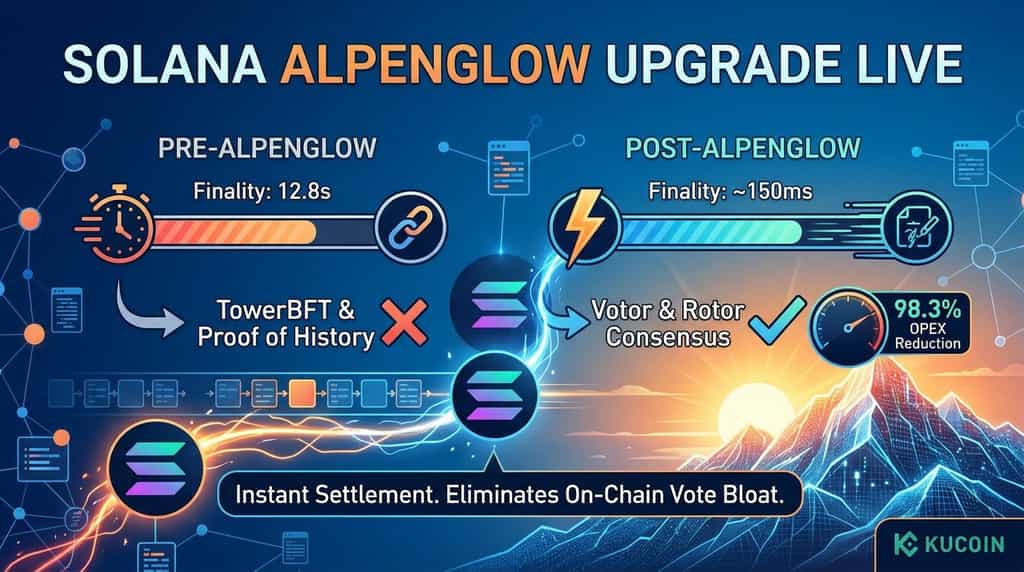
Solana has officially completed the Alpenglow network upgrade on mainnet, marking the single most significant consensus overhaul since genesis in 2020. According to official announcements from the Solana Foundation in October 2026, Alpenglow successfully went live, reducing transaction finality from 12.8 seconds down to approximately 150 milliseconds, a dramatic 85x acceleration in confirmation speeds. This protocol transformation replaces the legacy TowerBFT and Proof of History consensus frameworks with a high-performance, certificate-based voting model designed to eliminate network bloat and provide instant settlement certainty. For everyday users, decentralized finance participants, and institutional traders, this upgrade solves historical congestion bottlenecks, positioning Solana as one of the fastest settlement layers in the entire digital asset industry.
What Is the Solana Alpenglow Upgrade and How Does It Work?
The Solana Alpenglow upgrade is a sweeping core protocol overhaul that replaces traditional consensus mechanisms with Votor and Rotor to achieve near-instantaneous transaction finality. According to technical documentation released by Anza and the Solana Foundation in October 2026, the upgrade removes Proof of History from the consensus path and replaces TowerBFT with a direct, certificate-based voting structure.
Replacing TowerBFT with Votor
Votor is the newly deployed consensus protocol that replaces TowerBFT to streamline validator communication. Based on developer briefings from the Solana Foundation, Votor enables validators to exchange cryptographic signatures off-chain rather than relying on sequential, multi-round incremental voting structures. This transition removes epoch-based tower lockouts and eliminates the risk of slashing tied to missed slots, ensuring continuous and uninterrupted consensus execution across the global node network.
Eliminating On-Chain Vote Bloat
Alpenglow eliminates on-chain validator vote transactions, which previously consumed approximately 75 percent of total block space on the Solana network. According to network telemetry data cited by the Solana Foundation, removing these vote transactions frees up massive block capacity for user transactions, smart contract executions, and high-throughput decentralized applications without increasing hardware requirements for node operators.
How Does Alpenglow Achieve 150-Millisecond Transaction Finality?
Alpenglow achieves its target 150-millisecond finality by employing a dual-path consensus architecture combined with advanced, one-hop block propagation. According to engineering specifications published by core developers in October 2026, this structural redesign eliminates the latency bottlenecks inherent in multi-hop gossip networks.
Dual-Path Consensus Mechanics
The Votor protocol introduces two parallel validation paths that execute simultaneously to maximize settlement efficiency. The fast path triggers immediate finalization in approximately 100 milliseconds when a proposed block secures over 80 percent of total staked weight support in the initial round. If support reaches between 60 and 80 percent, a secondary path completes finalization in roughly 150 milliseconds, ensuring deterministic settlement across all network participants.
Rotor Block Propagation
Rotor replaces the legacy Turbine gossip network with a streamlined block distribution framework. Based on simulation data and mainnet deployment telemetry from the Solana Foundation, Rotor utilizes a direct broadcast from block leaders to validators, reducing propagation latency to under 20 milliseconds and ensuring that all global nodes receive block data simultaneously.
What Are the Key Performance Differences Before and After Alpenglow?
The Alpenglow upgrade delivers an 85-fold improvement in confirmation speed while slashing validator operating overhead and freeing up three-quarters of total network block space. According to performance metrics published on the official Solana Foundation Alpenglow dashboard in October 2026, the contrast between the legacy architecture and the new mainnet configuration is substantial.
| Performance Metric | Pre-Alpenglow Architecture | Post-Alpenglow Mainnet Configuration |
| Transaction Finality | ~12.8 seconds | ~100–150 milliseconds |
| Consensus Framework | TowerBFT & Proof of History | Votor & Rotor |
| Block Space Allocation | ~75% consumed by on-chain votes | 100% available for user transactions |
| Validator Operating Cost | High ledger storage overhead | Reduced by ~98.3% via off-chain voting |
| Minimum Profitable Stake | ~4,850 SOL | ~450 SOL |
How Does the Alpenglow Upgrade Impact SOL Validators and Stakers?
Alpenglow drastically reduces validator operating costs and lowers the barriers to entry for node participation while leaving everyday SOL token balances entirely unaffected. According to developer disclosures by the Solana Foundation, the transition to off-chain BLS signatures cuts annual node operating expenses by approximately 98.3 percent.
Reduction in Validator Operating Overhead
Validator operating overhead drops significantly because on-chain vote transaction fees are replaced by lightweight, off-chain validator admission tickets. Based on economic analyses published by core contributors in October 2026, the minimum profitable stake required to run a validator node profitably falls from approximately 4,850 SOL down to roughly 450 SOL, fostering greater decentralization across the validator set.
Implications for SOL Holders and Delegators
Standard SOL holders and token stakers are not required to perform any manual upgrade actions. According to official user guidelines from major ecosystem dashboards, existing wallet addresses, token balances, and delegated staking positions remain completely secure and fully operational without interruption. Furthermore, lower operating costs for validators can positively influence net staking yields over time.
How Will Alpenglow Shape the Future of Solana DeFi and High-Frequency Trading?
Alpenglow unlocks institutional-grade performance characteristics that enable high-frequency on-chain trading, real-time payment settlement, and complex financial derivatives protocols. According to institutional research reports cited by ecosystem analysts in October 2026, absolute finality under 200 milliseconds eliminates the probabilistic risk that previously hindered high-speed decentralized exchanges.
DeFi applications operating on Solana can now execute margin trades, automated market maker swaps, and decentralized lending liquidations with deterministic certainty. By matching or exceeding the settlement speed of traditional financial rails like Visa network authorizations, Alpenglow bridges the gap between decentralized infrastructure and high-volume institutional finance, attracting new capital and robust developer activity to the ecosystem.
Conclusion
The successful mainnet activation of the Alpenglow upgrade represents a defining milestone in Solana history, permanently transforming network performance and settlement efficiency. By replacing legacy consensus architecture with the high-speed Votor and Rotor protocols, Solana has achieved a remarkable 85-fold reduction in transaction finality down to 150 milliseconds. According to official data from the Solana Foundation, this upgrade successfully eliminates on-chain vote bloat, frees up 75 percent of block space for user transactions, and slashes validator operating overhead by over 98 percent. These technical enhancements eliminate historical congestion hurdles, paving the way for advanced decentralized finance applications, real-time payment settlements, and institutional-grade high-frequency trading. For both developers and digital asset participants, Alpenglow cements Solana's position as a premier, high-performance layer-1 blockchain. As the ecosystem enters this new era of instant settlement, platforms like KuCoin ensure that users can effortlessly access and trade Solana tokens while engaging with the future of high-speed blockchain technology.
Frequently Asked Questions
What action is required from regular SOL token holders following the Alpenglow upgrade?
No action is required from everyday SOL holders or token stakers. Your wallet balances, private keys, and delegated staking accounts are entirely unaffected, and existing wallets will function normally without any manual intervention.
How does Alpenglow affect Solana transaction fees for regular users?
Transaction fees remain stable and predictable following the upgrade. While Alpenglow reorganizes how validator votes are processed off-chain, baseline transaction fee structures for user transfers and smart contract interactions are preserved.
Why do network telemetry dashboards report lower transaction volume after Alpenglow?
Network dashboards report smaller aggregate transaction counts because validator voting transactions are no longer published on-chain. Removing these votes eliminates ~75 percent of ledger bloat, meaning transaction counters now reflect true user activity rather than internal consensus messages.
What is the difference between Votor and the legacy TowerBFT consensus model?
Votor replaces TowerBFT by utilizing off-chain BLS cryptographic signatures and dual-path consensus rounds. This eliminates multi-round epoch lockouts and reduces block finality from 12.8 seconds down to approximately 150 milliseconds.
How does the Alpenglow upgrade affect decentralized exchange (DEX) performance?
Alpenglow empowers DEXs and trading protocols with deterministic settlement speeds under 200 milliseconds. This eliminates probabilistic finality risks, enabling high-frequency trading, instant order matching, and real-time arbitrage execution on-chain.
Disclaimer
This general market information, possibly from third-party, commercial, or sponsored sources, is provided for reference and educational purposes only and does not constitute financial or investment advice, an offer, solicitation, or guarantee. We disclaim liability for its accuracy, completeness, reliability, and any resulting losses. Investments/trading are risky; past performance doesn’t guarantee future results. Users should research, judge prudently, and take full responsibility. For further details, please consult KuCoin’s Terms of Use and Risk Disclosure.