

Will the U.S. Stock Market Crash in 2026? What Investors Should Watch
2026/06/23 11:35:00
Introduction
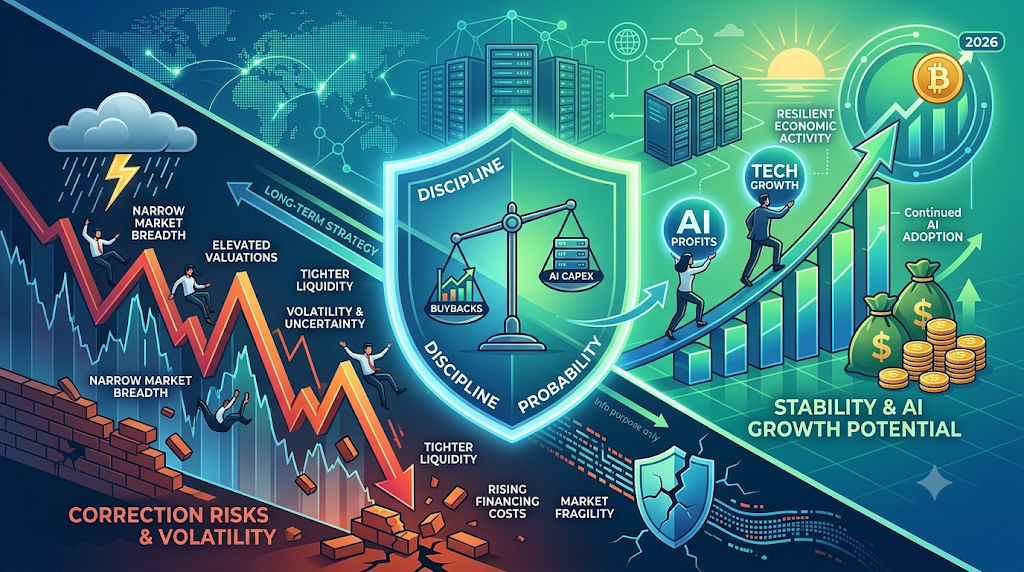
The U.S. stock market is still trading near record territory in 2026, but confidence is becoming increasingly selective. While headline indexes continue to climb, underneath the surface a different story is emerging: leadership has narrowed, volatility has returned to mega-cap technology names, and investors are debating whether the AI boom is creating the foundation for the next growth cycle or planting the seeds of a painful correction.
So, will the U.S. stock market crash in 2026?
The short answer is no one can predict a crash with certainty, and a full-scale collapse is not the base case today. However, several structural risks deserve attention: weakening market breadth, changing corporate capital allocation behavior, tighter financial conditions, and rising expectations embedded into AI-related earnings. A black swan event is impossible to forecast, but the market environment has become more fragile than index performance alone suggests.
What Is Driving Fears of a U.S. Stock Market Crash in 2026?
The biggest reason investors are worried is not that markets look weak on the surface - it is that gains have become increasingly concentrated.
According to recent market outlook updates from Goldman Sachs Research, a relatively small number of large technology companies continue to account for a disproportionate share of S&P 500 earnings revisions and index gains. AI investment is expected to contribute roughly 40% of S&P 500 earnings growth in 2026, while hyperscaler capital expenditure continues to expand aggressively.
That concentration creates opportunity but also dependency.
If only a narrow group of companies supports market performance, disappointment from even one segment can spread quickly through sentiment.
Several investors have pointed to recent sharp pullbacks in selected technology names as evidence that capital is becoming more selective. Companies perceived as directly exposed to AI infrastructure continue attracting flows, while adjacent sectors have struggled to maintain momentum.
This does not automatically mean a crash is coming. But it does suggest the market is less diversified than headline indexes imply.
Why Narrow Market Leadership Matters
A concentrated rally usually becomes vulnerable when expectations become extreme.
Historically, broad participation across sectors creates stronger market foundations. When capital flows become concentrated into a handful of themes, volatility increases because future returns depend heavily on those themes continuing to outperform.
Current market discussions increasingly focus on whether AI infrastructure spending can generate enough economic returns to justify valuations.
That debate matters more than short-term price movement.
Could AI Capital Spending Become a Hidden Risk for U.S. Stocks?
AI investment is currently both the market's biggest bullish argument and its most discussed vulnerability.
Recent estimates cited by Goldman Sachs indicate hyperscaler AI-related capital spending may reach approximately $757 billion in 2026 and continue rising into 2027. Multiple market forecasts suggest that spending is approaching the scale of annual operating cash flows for major cloud companies.
This matters because corporate finance dynamics may change.
Over the past decade, large technology companies helped support U.S. equities through aggressive stock repurchases. Buybacks reduced share count, supported earnings per share growth, and created consistent equity demand.
Now investors are debating whether capital is shifting.
Instead of returning excess cash to shareholders, large technology firms are increasingly directing resources into data centers, compute infrastructure, chips, energy procurement, and AI deployment.
That shift creates three possible market effects:
| Potential Shift | Possible Market Impact |
| Lower buyback growth | Reduced structural equity demand |
| Higher capital expenditure | Lower near-term free cash flow |
| More external financing | Greater sensitivity to interest rates |
Importantly, this does not mean buybacks have disappeared.
Public filings still show major authorization programs remain active across large U.S. companies in 2026. However, market participants increasingly question whether buybacks will continue growing fast enough to offset rising capital requirements.
Why Investors Care About Buybacks
Buybacks have acted as one of the largest structural buyers in U.S. Equities. When companies slow repurchases while simultaneously increasing investment spending, the market may lose part of its historical support mechanism.
That does not trigger crashes by itself. But combined with elevated valuations and tighter liquidity, it can increase downside sensitivity.
Is Monetary Policy Becoming a Bigger Problem for Stocks?
Higher interest rates remain one of the clearest macro risks. The market continues watching U.S. Treasury yields closely because yields affect valuation multiples directly.
When long-duration growth stocks trade at elevated expectations, changes in discount rates can have outsized effects. Many investors view the 10-year Treasury region around 4.5% as psychologically important because sustained higher yields raise borrowing costs and compete with equities for capital.
Recent institutional outlooks remain constructive overall but acknowledge that higher capital costs reduce valuation expansion potential. Goldman Sachs continues forecasting positive equity returns in 2026 but expects returns to moderate compared with previous years.
Why Higher Yields Matter More During an AI Boom
AI infrastructure is capital intensive. Companies building compute clusters and data centers require long investment horizons before returns become visible.
If financing costs rise while monetization remains uncertain, investors may become less willing to pay premium valuations. That is why interest rates and AI spending are becoming linked narratives.
Could Earnings Disappointments Trigger an AI-Led Correction?
The market may be pricing near-perfect execution. When expectations become elevated, earnings reports start acting as catalysts rather than confirmations. Memory, semiconductor, cloud infrastructure, and AI supply chain companies increasingly influence broader index sentiment.
Investors have recently focused on whether individual earnings releases can affect not only company valuations but expectations across the entire AI ecosystem. This does not mean one earnings report causes a crash.
But disappointment can trigger reassessment. The key risk is not weaker results - it is weaker results combined with crowded positioning.
What Would an AI Correction Look Like?
A correction would likely happen in stages:
-
Earnings growth slows.
-
AI spending guidance becomes more cautious.
-
Valuation multiples compress.
-
Market leadership rotates.
-
Indexes weaken.
This would resemble a sector reset more than a systemic financial crisis.
What Signals Would Suggest a Real U.S. Market Crash Is Developing?
A crash normally requires multiple conditions appearing simultaneously. Investors should monitor indicators rather than headlines.
| Indicator | Why It Matters |
| Market breadth deterioration | Signals narrowing participation |
| Treasury yields rising sharply | Increases valuation pressure |
| Corporate financing acceleration | Suggests cash flow stress |
| Earnings estimate cuts | Weakens forward expectations |
| Credit spreads widening | Indicates systemic concern |
One important distinction: market concentration alone is not enough. Technology concentration existed during previous bull cycles without causing immediate crashes.
The question is whether earnings can continue supporting valuations. Recent institutional forecasts still expect positive S&P 500 performance in 2026 despite acknowledging concentration and elevated expectations. Goldman Sachs recently projected further upside while warning that momentum and narrow breadth deserve attention.
Is the Current Environment Similar to the Dot-Com Bubble?
The answer is partially, but not completely. There are similarities:
-
Strong narrative momentum
-
Heavy capital spending
-
Elevated expectations
-
Concentrated winners
But there are also differences. Today's leaders generate real cash flow and operate profitable businesses. Unlike many companies during the late-1990s internet cycle, today's largest AI beneficiaries already dominate existing markets. The debate is not whether AI is real.
The debate is whether expectations have moved ahead of monetization. That distinction matters.If AI economics eventually justify spending, current valuations may prove reasonable. If returns disappoint, markets may reprice.
How to Trade US Stocks and Bitcoin on KuCoin
KuCoin also offers exposure to trading US stock perps — meaning you can rebalance between crypto and US equity narratives without leaving the platform. Combined with the security infrastructure of a tier-one global exchange, KuCoin is positioned for investors who want flexibility across both asset classes.
Conclusion
The U.S. stock market could experience volatility in 2026, but a crash should not be treated as the default scenario. The more realistic debate is whether the market enters a period of broader participation and sustainable earnings growth or transitions into a sharper repricing of concentrated AI expectations.
Several warning signs deserve attention. Capital expenditure is accelerating across major technology companies. Market leadership has narrowed. Interest rates remain restrictive. Expectations around earnings continue rising.
At the same time, strong corporate profitability, continued AI adoption, and resilient economic activity remain important supports. Markets rarely collapse because of one headline.
They usually weaken when valuation pressure, financing stress, and changing investor psychology reinforce each other. Rather than attempting to predict a black swan event, investors may benefit more from tracking capital flows, earnings quality, and market breadth.
FAQs
-
What percentage decline qualifies as a stock market crash?
There is no universal definition, but declines above 20% over a short period are commonly described as crashes or bear markets.
-
Can AI alone cause a stock market crash?
No. AI may amplify expectations, but crashes typically require multiple factors including liquidity tightening and earnings deterioration.
-
Is holding cash the best strategy if investors expect a crash?
Not necessarily. Gradual allocation and diversification often reduce timing risk more effectively than staying fully in cash.
-
Does a U.S. stock market correction affect crypto?
Often yes. Liquidity conditions and investor risk appetite can influence both asset classes, although correlations change over time.