

What Differentiates MicroStrategy’s Bitcoin Strategy from BlackRock’s IBIT ETF?
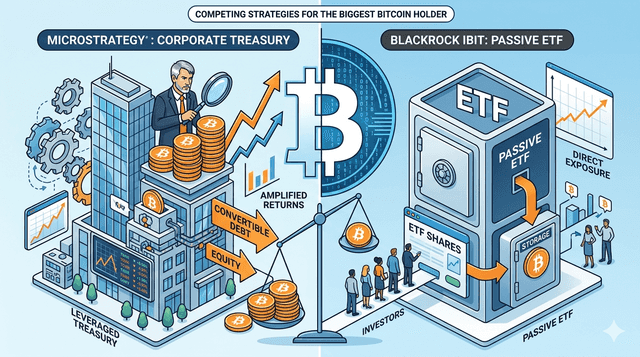
Introduction
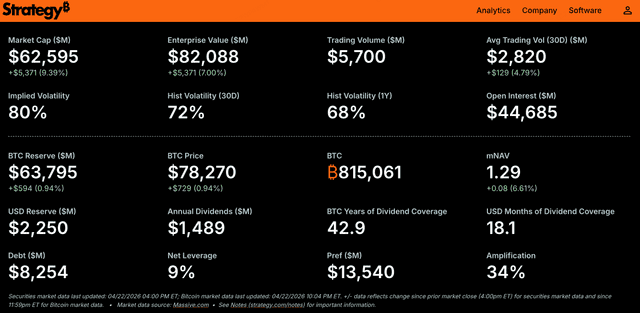
In January 2020, MicroStrategy held zero Bitcoin. By April 2026, the company held over 815,000 BTC worth approximately $63.795 billion at current price, officially surpassing BlackRock’s iShares Bitcoin Trust ETF as the world’s largest institutional Bitcoin holder. This transformation from a software company into the planet’s largest Bitcoin treasury represents one of the most audacious corporate capital allocation decisions in modern financial history.
BlackRock’s IBIT tells a different story. The ETF launched in January 2024 and crossed $55 billion in assets under management within two years, becoming the most successful ETF launch in history. Both entities now compete for the title of largest Bitcoin holder, but the similarities end there. The investment structures, risk profiles, return mechanisms, and strategic purposes differ fundamentally.
Understanding these differences matters for investors evaluating exposure to Bitcoin through different vehicles. This analysis breaks down what separates MicroStrategy’s corporate treasury Bitcoin strategy from BlackRock’s passive ETF approach.
MicroStrategy’s Corporate Treasury Bitcoin Strategy
The Evolution from Software Company to Bitcoin Treasury Company
MicroStrategy began as enterprise software company, developing business intelligence platforms for corporate clients. When CEO Michael Saylor converted the company treasury into Bitcoin in August 2020, skeptics dismissed the move as eccentricity. The stock traded below $200 per share, and the company carried a market capitalization that seemed disconnected from its underlying software business.
Saylor’s thesis was straightforward: Bitcoin would preserve purchasing power better than cash during inflationary periods. He pointed to Bitcoin’s fixed supply of 21 million coins and its resistance to debasement. The company would buy Bitcoin directly rather than distribute cash to shareholders.
The strategy evolved through several phases:
-
Phase 1 involved direct Bitcoin purchases with operating cash flow
-
Phase 2 introduced convertible debt instruments that allowed the company to borrow cheaply while promising bondholders minimal returns
-
Phase 3 saw the emergence of Bitcoin-backed bonds, where MicroStrategy issued debt and used proceeds to purchase additional Bitcoin
The company effectively created a leveraged Bitcoin investment vehicle within a traditional corporate structure.
How MicroStrategy’s Leverage Strategy Works
The mechanism behind MicroStrategy’s outperformance involves financial engineering rather than Bitcoin mining expertise.
The company issues convertible senior notes, essentially bonds that can be converted into company stock at predetermined prices. These instruments carry low interest rates because investors receive equity upside as compensation. MicroStrategy then uses proceeds to purchase Bitcoin, which appreciates faster than the cost of borrowing.
The result creates asymmetric returns for MSTR stockholders. When Bitcoin rises, MicroStrategy’s Bitcoin holdings appreciate while the company only pays fixed interest on its debt. When Bitcoin falls, the company still pays fixed interest but the equity dilution from convertible bonds provides a floor.
Michael Saylor has described the strategy as “increasing beta to Bitcoin” through corporate structures. MSTR stockholders effectively hold leveraged Bitcoin exposure without managing Bitcoin directly. The company has expanded this concept through the Bitcoin Treasury framework, encouraging other corporations to adopt similar strategies.
BlackRock’s IBIT ETF Structure
The Passive Investment Approach
BlackRock’s iShares Bitcoin Trust operates as a traditional exchange-traded fund designed for retail and institutional investors seeking direct Bitcoin exposure without custody complications.
The ETF structure is straightforward: investors purchase shares representing fractional ownership of Bitcoin held in cold storage. BlackRock manages custody through specialized Bitcoin custodians, with Coinbase serving as primary custodian for IBIT. The fund charges an expense ratio of 0.25%, representing the annual cost of fund management and operations.
IBIT launched on January 11, 2024, and immediately set records. The fund crossed $10 billion in assets within six weeks, establishing itself as the most successful ETF debut in history. By April 2026, IBIT held approximately 803,000 BTC worth $55 billion, representing roughly 49% of the entire US spot Bitcoin ETF market.
The investment thesis for IBIT differs fundamentally from MicroStrategy. IBIT shareholders own Bitcoin indirectly through ETF shares traded on traditional stock exchanges. The shares track Bitcoin’s price directly without leverage or financial engineering. Institutional investors favor this structure for compliance, custody, and operational simplicity.
Why Institutions Choose IBIT
BlackRock’s IBIT attracts institutional capital through three mechanisms:
-
Regulatory clarity through SEC oversight provides investment committee comfort
-
Operational efficiency eliminates transaction costs associated with direct Bitcoin transfers
-
Liquidity provision through market makers ensures tight bid-ask spreads
Daily trading volume exceeds $1 billion during active market periods, allowing large institutions to establish positions without significant market impact.
BlackRock’s $900 million Bitcoin purchase in April 2026 demonstrates continued institutional confidence in the Bitcoin allocation. The company has become one of the largest institutional Bitcoin accumulators, though MicroStrategy’s direct treasury strategy now edges ahead in total holdings.
Key Differences: Structure, Leverage, and Returns
Investment Structure Comparison
The fundamental difference between MicroStrategy and BlackRock IBIT lies in investment structure.
MicroStrategy represents a leveraged corporate treasury play. MSTR stock price movements correlate with Bitcoin but amplify returns through financial engineering. The company borrows through convertible debt, accumulates Bitcoin, and provides stockholders with leveraged exposure that traditional markets cannot replicate efficiently.
BlackRock IBIT represents direct Bitcoin price exposure through an ETF wrapper. IBIT shares trade on stock exchanges but represent direct ownership of Bitcoin in cold storage. The fund does not borrow or use leverage. Returns equal Bitcoin price changes minus management fees.
The governance implications differ significantly. MSTR stockholders face corporate risk including competitor threats, regulatory changes affecting technology companies, and employee retention challenges. IBIT shareholders face only Bitcoin price risk and fund management risk.
Return Profile Comparison
The return profiles have diverged dramatically since 2024.
MSTR stock has significantly outperformed IBIT shares, with the stock gaining over 400% compared to Bitcoin’s roughly 300% appreciation during the same period. The leverage embedded in MicroStrategy’s capital structure creates amplified returns during bull markets.
The mechanism is simple mathematics. MicroStrategy borrows at 0.875% through convertible notes and purchases Bitcoin earning 20%+ annual returns. The spread compounds dramatically over time, creating returns that exceed direct Bitcoin ownership.
However, this leverage cuts both directions. During Bitcoin drawdowns, MicroStrategy’s stock experiences amplified losses. The company also faces debt obligations that mature regardless of Bitcoin prices. The convertible debt structure provides some downside protection through equity conversion features, but MSTR stockholders bear more complex risks than IBIT holders.
The following table summarizes the core differences:
| Aspect | MicroStrategy (MSTR) | BlackRock IBIT |
| Structure | Leveraged corporate treasury | Passive ETF |
| Holdings | 815,000+ BTC | 803,000+ BTC |
| Return profile | Leveraged Bitcoin exposure | Direct Bitcoin exposure |
| Fees | None (stock-based) | 0.25% expense ratio |
| Leverage | Convertible debt | None |
| Target investor | Growth-oriented speculators | Risk-adjusted allocators |
| Trading venue | NASDAQ (stock) | NYSE Arca (ETF) |
Why These Strategies Attract Different Investors
MicroStrategy’s Appeal
Growth-oriented investors and Bitcoin maximalists favor MicroStrategy because the structure amplifies Bitcoin exposure without derivatives complexity.
Michael Saylor has articulated a clear thesis: holding Bitcoin on corporate balance sheets provides better returns than holding cash. The strategy has attracted copycat implementations from companies including Metaplanet in Japan and Semler Scientific in the United States.
MSTR stock trades on NASDAQ, providing access to investors in retirement accounts, 401k plans, and brokerages that restrict cryptocurrency access. The stock component attracts option traders, creating liquidity and volatility that direct Bitcoin cannot match.
The leverage component attracts sophisticated investors comfortable with complex financial instruments. Option strategies on MSTR can express views on Bitcoin with different risk profiles than direct ownership.
BlackRock IBIT’s Appeal
Conservative allocators and institutional investors favor IBIT because the structure provides pure Bitcoin exposure without leverage risk.
Investment advisors can recommend IBIT within fiduciary frameworks that prohibit direct cryptocurrency allocation. The ETF wrapper transforms Bitcoin from an alternative asset into a traditional investment vehicle, enabling allocation within standard portfolio construction frameworks.
The custody structure eliminates self-custody risks. BlackRock’s relationship with Coinbase provides institutional-grade security that individual investors cannot replicate. The fund carries insurance on Bitcoin holdings, protecting shareholders against custody breaches.
The liquidity profile suits institutional rebalancing. Major institutional features include:
-
Daily trading volume supports large position establishment
-
Bid-ask spreads remain tight during volatile market conditions
-
The fund provides tax-advantaged retirement account access
How to Invest in Bitcoin Through KuCoin
Step 1: Create Your KuCoin Account
New users can register on KuCoin and access cryptocurrency trading across spot and futures markets. The platform supports Bitcoin trading against multiple quote currencies, providing flexibility for various investment strategies. Simply visit the KuCoin website or download the mobile application to begin registration.

Step 2: Execute Your Bitcoin Trade
KuCoin offers multiple Bitcoin investment pathways depending on risk tolerance. Bitcoin spot trading provides direct ownership through the BTC/USDT trading pair, suitable for long-term holders seeking direct exposure. Bitcoin futures contracts offer leveraged positions for active traders managing risk with defined position sizes.
Step 3: Position Management
For direct Bitcoin exposure, dollar-cost averaging through regular purchases smooths volatility over extended periods. Setting recurring buy orders eliminates emotional decision-making and builds positions systematically.
For MSTR exposure, position sizing requires consideration of leverage amplification. The stock experiences larger drawdowns than Bitcoin during bear markets. Stop-loss levels should account for volatility differences compared to direct Bitcoin ownership.
For IBIT exposure, treatment resembles traditional ETF investing with long holding periods. The 0.25% expense ratio remains manageable for extended positions, and the fund provides tax-advantaged retirement account access.
Conclusion
MicroStrategy and BlackRock IBIT represent fundamentally different approaches to Bitcoin investment, despite both holding substantial BTC positions.
MicroStrategy operates as a leveraged corporate treasury vehicle, using convertible debt to amplify Bitcoin returns. The strategy suits growth-oriented investors comfortable with corporate risk and leverage complexity. MSTR stockholders receive amplified Bitcoin exposure through financial engineering, creating returns that exceed direct Bitcoin ownership during bull markets while experiencing larger drawdowns during corrections.
BlackRock IBIT operates as a passive ETF wrapper, providing direct Bitcoin exposure through an institutional-grade structure. The strategy suits conservative allocators seeking pure Bitcoin exposure without leverage or corporate risk. IBIT shareholders experience Bitcoin returns minus a 0.25% expense ratio, with the fund’s liquidity and regulatory clarity attracting institutional capital.
Both strategies have merit depending on investment objectives. Growth-oriented investors may prefer MicroStrategy’s leveraged approach. Risk-adjusted allocators may prefer IBIT’s direct exposure. Understanding these differences enables informed allocation decisions aligned with individual investment goals.
FAQs
Q: Why has MicroStrategy’s stock outperformed Bitcoin and IBIT?
A: MicroStrategy uses convertible debt instruments to leverage Bitcoin exposure. When Bitcoin rises, the company pays fixed interest on debt while Bitcoin appreciation compounds. MSTR stockholders receive leveraged exposure that exceeds direct Bitcoin returns. The financial engineering creates asymmetric returns during bull markets.
Q: Is MicroStrategy riskier than holding Bitcoin directly?
A: Yes. MicroStrategy carries corporate risk alongside Bitcoin risk. The company faces debt obligations, competitive pressures, and operational challenges unrelated to Bitcoin prices. During Bitcoin drawdowns, MSTR stock typically falls more than Bitcoin. The leverage amplifies both gains and losses.
Q: What does BlackRock IBIT’s institutional approval mean?
A: IBIT’s ETF structure complies with SEC regulations and investment advisor fiduciary standards. Financial advisors can recommend IBIT to clients within standard suitability frameworks. The institutional endorsement validates Bitcoin as an allocation-worthy asset class for retirement accounts and managed portfolios.
Q: Can retail investors access both MicroStrategy and IBIT through traditional brokerages?
A: Yes. Both MSTR stock and IBIT shares trade on major US stock exchanges. MicroStrategy trades on NASDAQ under the MSTR ticker, while IBIT trades on NYSE Arca under the IBIT ticker. Most US brokerages support trading both instruments.
Q: What is MicroStrategy’s Bitcoin accumulation target?
A: MicroStrategy has signaled a target of 1 million BTC by the end of 2026, requiring approximately $18 billion in additional Bitcoin purchases. The aggressive accumulation strategy relies on continued convertible debt issuance and equity raises to fund purchases.