

U.S. Bank Launches USBDC Stablecoin on Stellar in Live Cross-Border Payment Pilot
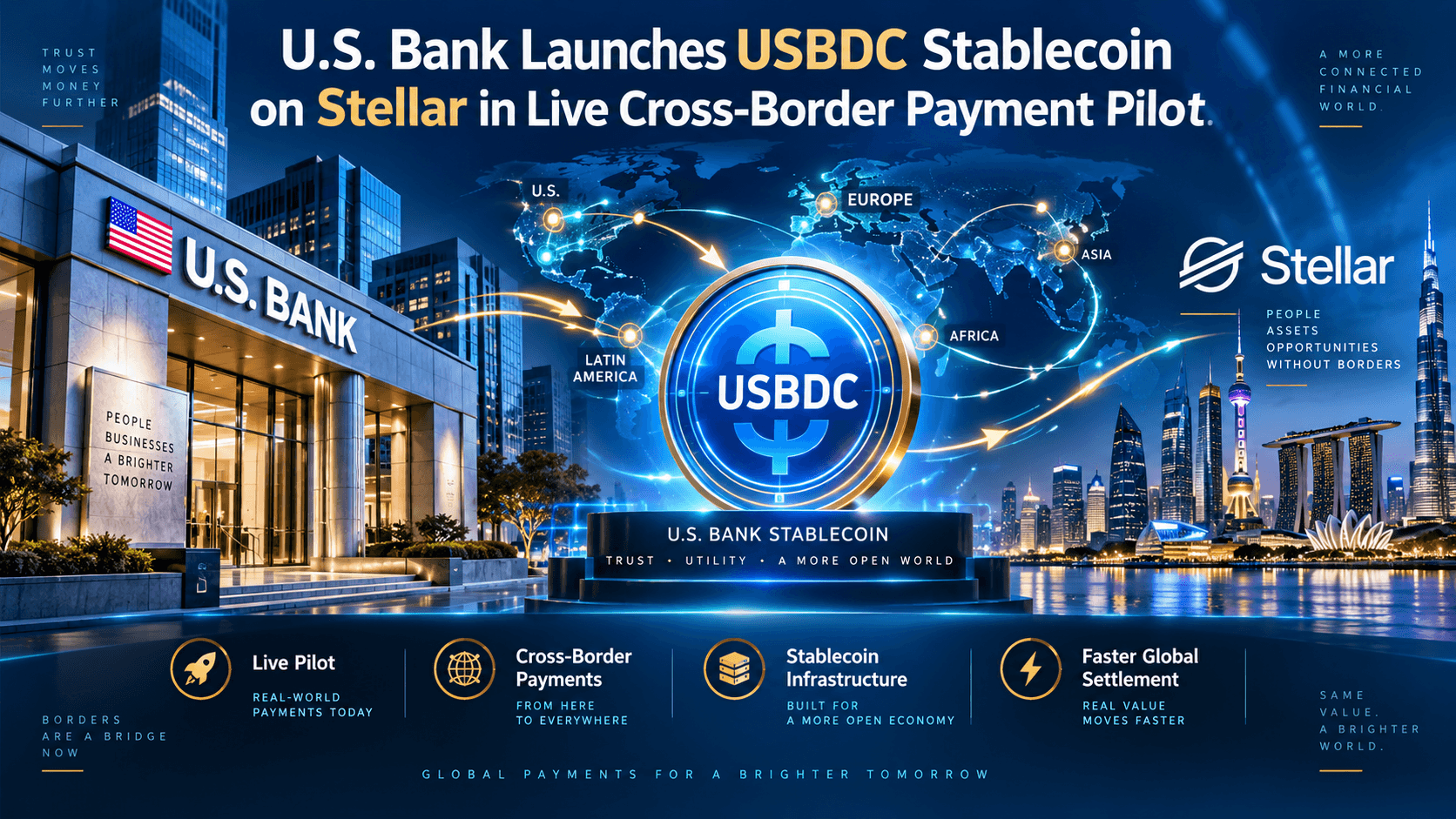
U.S. Bank Advances Public-Blockchain Stablecoin Settlement for Institutional Treasury Use
U.S. Bank announced on September 9, 2026, the successful completion of a live pilot transaction using USBDC, its proprietary U.S. dollar-backed stablecoin. The payment moved value between the bank’s own entities in North America and Europe on the public Stellar blockchain. This marked one of the first instances of a major U.S. commercial bank deploying its own stablecoin on a public network while keeping the transfer fully integrated with existing finance, risk, compliance, and operations systems. The exercise tested the complete lifecycle of the token, including minting, payment execution, redemption, freezing, and clawback functions through the bank’s internally developed Digital Asset Platform.
The pilot validates that a regulated institution can move value on-chain around the clock without abandoning the controls supervisors expect. USBDC remains an internal tool at this stage, with no disclosed transaction size, no customer access, and no commercial launch timeline. Future exploration centers on institutional applications such as liquidity management, collateral mobility, and cross-border treasury operations. This development builds directly on work begun in November 2025 with the Stellar Development Foundation and PwC. The September 2026 USBDC pilot demonstrates that a top-tier U.S. bank can issue and settle a dollar-backed token on public blockchain infrastructure while preserving full operational and risk integration, positioning the technology for practical treasury use rather than retail speculation.
How the North America-to-Europe USBDC Transfer Actually Worked
The recent live transaction successfully connected U.S. Bank entities that are located across two distinct continents, utilizing the innovative Stellar network. During this process, value was transferred on-chain in near real time, all while maintaining a strong connection to the bank’s core systems that manage finance, risk, compliance, and operations. As detailed in the official announcement, the pilot program meticulously evaluated every critical step that an issuer must effectively control: the creation of new tokens, the execution of the payment process, the redemption of tokens back to traditional balances, the ability to freeze tokens when necessary, and the power to claw them back if required. The native features of Stellar’s protocol provided robust support for these essential issuer controls without the need for any custom overlays or additional modifications.
Settlement of transactions was finalized in mere seconds at a sub-cent cost, which is consistent with the network’s long-standing performance metrics that boast an impressive 99.99 percent uptime. Importantly, no customer funds or external counterparties were involved in this transaction. The entire transfer remained securely within the bank’s corporate structure, which allowed for safe and thorough validation of the end-to-end process. This internal focus significantly reduced operational risk while simultaneously proving the technical and control layers that are required for any potential future expansion. Therefore, this exercise functions as a controlled proof of concept, rather than a full-scale market launch, demonstrating the capabilities and reliability of the system in a real-world environment.
Why Stellar’s Native Controls Matter for Bank-Issued Tokens
Stellar was chosen as a preferred option in part due to the fact that its protocol inherently incorporates the compliance tools that regulated issuers require to operate effectively. This means that issuers have the capability to freeze assets when necessary, establish specific authorization requirements, and exercise clawback rights at the asset level. Importantly, these functionalities are integrated as native network features, rather than relying on additional smart contracts that could complicate the process. During the pilot program, U.S. Bank utilized these precise features, which confirmed their effectiveness in a live environment while ensuring that the token remains closely linked to traditional banking infrastructure.
This combination of features not only delivers remarkable speed and low transaction costs but also maintains the essential ability to intervene when required by regulatory frameworks or risk management policies. The design of the network is strategically aligned with the institutional requirements necessary for cross-border treasury movement, where aspects such as finality, cost predictability, and continuous availability are of utmost importance. By adopting these controls rather than developing them from the ground up, the bank was able to significantly reduce both the complexity involved in development and the ongoing operational overhead that typically accompanies such initiatives.
Validation of U.S. Bank’s Digital Asset Platform
The pilot also functioned as a comprehensive live stress test of the bank’s internally developed Digital Asset Platform. This innovative platform is designed to issue, manage, and facilitate the movement of tokenized assets, all while creating a seamless and efficient bridge between traditional banking systems and modern blockchain networks. The successful execution of various processes, including minting, payment, redemption, freezing, and clawback, clearly demonstrated that the platform is capable of handling the full lifecycle of these transactions under real-world conditions. Throughout this process, the integration with core finance, risk management, compliance, and operations systems remained intact and fully operational.
This validation is particularly significant because it illustrates that the technology can effectively operate within existing bank processes rather than merely alongside them. Jamie Walker, who serves as the Head of Digital Assets and Money Movement, described the pilot as yet another important step in the broader digital asset strategy. This strategy is focused on addressing and solving real challenges faced by clients while simultaneously preserving the essential elements of safety and reliability. As a result, the platform now stands as a solid foundation for any future expansion of tokenized products and services that the bank may pursue.
Institutional Use Cases Now Under Active Exploration
With the successful completion of the pilot program, U.S. Bank is now actively engaged in evaluating a variety of practical applications for the USBDC. The primary areas of focus for this evaluation include enhanced liquidity management, improved collateral mobility, and the development of more efficient cross-border treasury operations. These specific use cases are designed to emphasize institutional efficiency, increased transparency, and faster settlement speeds, rather than focusing on consumer payments or trading activities.
The bank’s official statements consistently frame the token as a valuable tool for corporate treasury management and the movement of money within regulated frameworks. At this stage, exploration remains firmly within the evaluation phase. To date, no commercial product, client onboarding process, or pricing structure has been publicly announced. The primary focus continues to be on demonstrating that blockchain technology can effectively improve existing banking workflows without introducing any unacceptable new risks that could jeopardize the integrity of the banking system.
Building on the November 2025 Stellar and PwC Partnership
The September 2026 live transfer represents a continuation of the work that was publicly outlined in November 2025. During that time, U.S. Bank made a significant disclosure regarding its testing of custom stablecoin issuance on the Stellar blockchain, in collaboration with both the Stellar Development Foundation and PwC. The earlier phase of this initiative focused primarily on the development of issuance capabilities and the establishment of compliance frameworks necessary for regulatory adherence. The recent pilot project has transitioned from the initial construction phase to the actual movement of value between legal entities located on two different continents.
This progression serves to illustrate a carefully considered, multi-stage approach to the implementation of stablecoin technology. Capability was first established under controlled conditions, allowing for thorough testing and validation, and was subsequently validated through a live intercompany payment transaction. The ongoing continuity of the relationship with Stellar, along with the active involvement of PwC, underscores the strong emphasis placed on auditability and the maintenance of institutional-grade processes throughout the entire operation. This meticulous approach ensures that all aspects of the project are aligned with regulatory standards and best practices in the financial industry.
Positioning Among Broader Banks Stablecoin Initiatives
U.S. Bank’s proprietary approach operates in conjunction with various other industry initiatives aimed at exploring the potential of stablecoins. In recent discussions, several large financial institutions have expressed interest in forming joint ventures focused on stablecoin projects, with ambitious targets set for launches in the year 2027. Meanwhile, fintech companies continue to hold a significant share of the existing markets for dollar-pegged tokens, showcasing their dominance in this evolving landscape. By taking the innovative step of issuing its own token on a public blockchain and maintaining comprehensive issuer controls, U.S. Bank is effectively testing a model that ensures risk management and compliance remain firmly within the bank’s established operational framework.
It is important to note that this pilot program does not aim to replace the ongoing discussions taking place within the industry; rather, it serves to illustrate one viable pathway for a regulated issuer to navigate the complexities of the stablecoin ecosystem. In a broader context, reporting from Reuters highlights the competitive landscape in which banks are racing to develop advanced blockchain-based payment capabilities, particularly as stablecoins continue to gain traction and adoption among users. U.S. Bank’s internal pilot initiative provides valuable and concrete operational data, moving beyond mere conceptual announcements. This initiative offers a measurable data point that can be instrumental for other financial institutions as they evaluate and consider the implementation of similar technology solutions in their own operations.
Settlement Speed and Cost Advantages Observed
Stellar’s performance characteristics supported the pilot’s objectives. Settlement occurs in seconds, transaction costs remain below one cent, and the network has maintained extremely high uptime for more than a decade. These attributes address long-standing frictions in cross-border treasury movement, where traditional rails often involve multi-day settlement windows and higher intermediate fees. The bank explicitly cited near-instant settlement and sub-cent costs as reasons the network suits regulated financial services.
Because the transfer remained internal, the pilot isolated the performance of the blockchain layer itself. Observed results confirmed that the combination of speed, cost, and continuous availability can coexist with the freeze and clawback powers a regulated issuer requires. This combination is particularly relevant for 24/7 global cash management needs that traditional systems cannot fully satisfy.
Risk Management Through Freeze and Clawback Functions
A pivotal aspect of the pilot program was the effective and successful implementation of freezing and clawback capabilities. These essential functions empower the issuer with the ability to halt the movement of tokens or reverse transactions when it becomes necessary for reasons related to compliance, legal obligations, or risk management considerations. On the Stellar blockchain, these controls are designed to operate at the protocol level, which means that the bank did not have to depend solely on external contracts or off-chain processes to manage these functions.
The rigorous testing conducted in a live environment confirmed that these controls operate as expected, ensuring that the token remains seamlessly connected to the core banking systems throughout the process. The existence of these robust controls sets the USBDC pilot apart from stablecoins that are purely permissionless in nature. This capability allows the bank to uphold the intervention rights that regulatory supervisors expect, all while not sacrificing the operational advantages that come with public blockchain settlement.
Impact for Global Cash Management Capabilities
CEO Gunjan Kedia stated that the pilot demonstrates the bank’s ability to accelerate global cash management and money movement capabilities. The 24/7 nature of blockchain settlement removes the time zone and business day constraints of conventional systems. When combined with native issuer controls and integration into existing risk frameworks, the technology offers a path to faster, more transparent internal liquidity movement across regions.
The pilot itself remained limited to intercompany transfers, yet the operational lessons apply directly to future client-facing treasury services. The bank’s statements emphasize creating value for clients by harnessing new technology inside the established banking system rather than outside it. This framing keeps the initiative aligned with the institution’s core risk culture and regulatory obligations.
Technical Transparency and On-Chain Verification
The Stellar issuer address associated with the pilot has been publicly noted as GDABKPZMAIULVJVJJQM7L3VIG5A2IS5V4KP2P3YNP6YWRUBJNBGFGG6E. This level of transparency allows external observers to verify the existence of the token on the public ledger while the bank retains exclusive control over issuance and intervention rights. The combination of public settlement rails and private operational control is a defining feature of the pilot design.
Because the transaction was internal, the amount transferred was not disclosed. The absence of a published figure does not diminish the technical milestone; it simply reflects the controlled scope of the test. On-chain visibility of the issuer account provides independent confirmation that the infrastructure is live and functional.
Next Steps in Digital Asset Strategy
Jamie Walker characterized the pilot as another step forward in the broader digital asset strategy. The bank’s focus remains on solutions that address genuine client needs while upholding the safety, security, and reliability clients expect. Exploration of liquidity management, collateral mobility, and cross-border treasury continues, yet no timeline for commercial availability has been set.
The successful validation of the Digital Asset Platform creates a technical foundation for those evaluations. The measured pace reflects the priorities of a large regulated institution. Capability is proven first in a controlled setting, then expanded only when controls and integration have been demonstrated. This approach prioritizes operational integrity over quick market introduction.
Industry Context and Competitive Space
U.S. Bank’s move occurs as stablecoin activity expands across both traditional finance and crypto-native firms. The bank already provides related services, including custody for certain stablecoin reserves and bitcoin-related products. The proprietary USBDC pilot adds an issuance capability on public rails to that portfolio. By choosing a public network with native compliance features rather than a closed private ledger, the bank tests a model that combines transparency with control.
Other institutions continue to evaluate both proprietary and consortium approaches. The U.S. Bank pilot supplies concrete operational evidence that a major commercial bank can complete a live cross-border transfer on public infrastructure while keeping risk frameworks intact. That evidence contributes useful data to the wider industry discussion.
Practical Lessons for Treasury and Operations Teams
The pilot offers several practical observations for institutions considering similar technology. First, native protocol controls for freeze and clawback can reduce the need for complex custom logic. Second, integration with existing core systems is achievable and essential for regulatory acceptance. Third, performance characteristics of certain public networks already meet institutional requirements for speed and cost in treasury contexts.
Fourth, an internal pilot provides a low-risk environment in which to validate both technology and processes before any external exposure. These lessons remain specific to the tested environment and should not be generalized without further validation. The absence of disclosed transaction size and commercial plans means the results apply primarily to intercompany and internal treasury scenarios at present.
🔥 Beyond the Headlines: What KuCoin 5.0 Means for You
Market news moves fast — but where you act on it matters just as much. This October, KuCoin launches KuCoin 5.0, transforming KuCoin into a rebuilt platform. Here's what actually changes for you:
-
One account for everything. Older platforms split your money across separate "spot," "margin," and "futures" accounts and expected you to understand why. KuCoin 5.0's unified account removes that entirely — deposit once, and everything is simply there.
-
Stocks, indices, and commodities. KuCoin 5.0 expands beyond crypto into global markets. When crypto chops sideways and equities rally (or the reverse), you rotate in minutes instead of opening a brokerage account and waiting days for fiat rails.
-
Real-world assets (RWA). Tokenized exposure to traditional assets like commodities, right inside your crypto account. One of the fastest-growing segments in global finance is no longer reserved for institutions — you access it from the same balance you trade with.
-
Earn while you learn. Not ready to trade? KCUSD lets your stablecoins earn daily, auto-compounding interest. The lowest-stress way to put your idle deposit to work for 4% yield.
-
An AI assistant in plain language. Ask questions, get market context, understand what you're looking at — built into the platform, no jargon required.
-
An app that doesn't overwhelm. Faster, cleaner, and consistent — intuitive from the first tap, not after a tutorial.
-
Safety you can check, not just trust. A MiCAR-licensed EU entity, Proof of Reserves you can verify yourself, and internationally certified security (SOC 2 Type II, ISO 27001:2022).
Create your account in minutes — and start on the platform built for where crypto is going, not where it's been.
FAQs
What exactly is USBDC, and who issued it?
USBDC is the proprietary U.S. dollar-backed stablecoin issued by U.S. Bank for the September 2026 pilot. It is designed for internal and institutional use rather than open trading or retail distribution. The token was minted and transferred on the Stellar public blockchain under the bank’s Digital Asset Platform. Full issuer control, including freeze and clawback rights, remained with U.S. Bank throughout the test.
Was the cross-border payment a customer transaction?
No. The transfer occurred solely between U.S. Bank entities in North America and Europe. It was an intercompany pilot designed to validate technology and controls in a live environment without involving external clients or third-party funds. No customer access or commercial product has been announced.
Which functions were tested during the pilot?
The bank evaluated minting of new tokens, execution of the payment, redemption back to traditional balances, freezing of tokens, and clawback of tokens. All functions operated successfully while remaining integrated with the bank’s core finance, risk, compliance, and operations systems. These capabilities are essential for any regulated issuer.
Why was the Stellar blockchain chosen?
Stellar provides native protocol support for issuer controls such as freeze and clawback, near-instant settlement, sub-cent transaction costs, and a long record of high uptime. These features align with the requirements of regulated financial institutions for cross-border treasury movement. The pilot built on an existing strategic relationship with the Stellar Development Foundation.
Is USBDC available to clients or the public?
At present, it is not. The pilot was strictly internal. U.S. Bank has not disclosed any timeline, eligibility criteria, or commercial terms for client use. Exploration of future applications continues, but no launch date has been provided.
What future applications is the bank exploring?
Primary areas under evaluation include enhanced liquidity management, collateral mobility, and cross-border treasury operations. These focus on institutional efficiency, transparency, and settlement speed inside regulated frameworks. The Digital Asset Platform validated during the pilot is intended to support such use cases if and when they move forward.
Disclaimer: This content is for informational purposes only and does not constitute investment advice. Cryptocurrency investments carry risk. Please do your own research (DYOR).