

Ethereum Records High Transaction Volume While Network Fees Drop to Historical Lows
2026/05/27 18:09:02
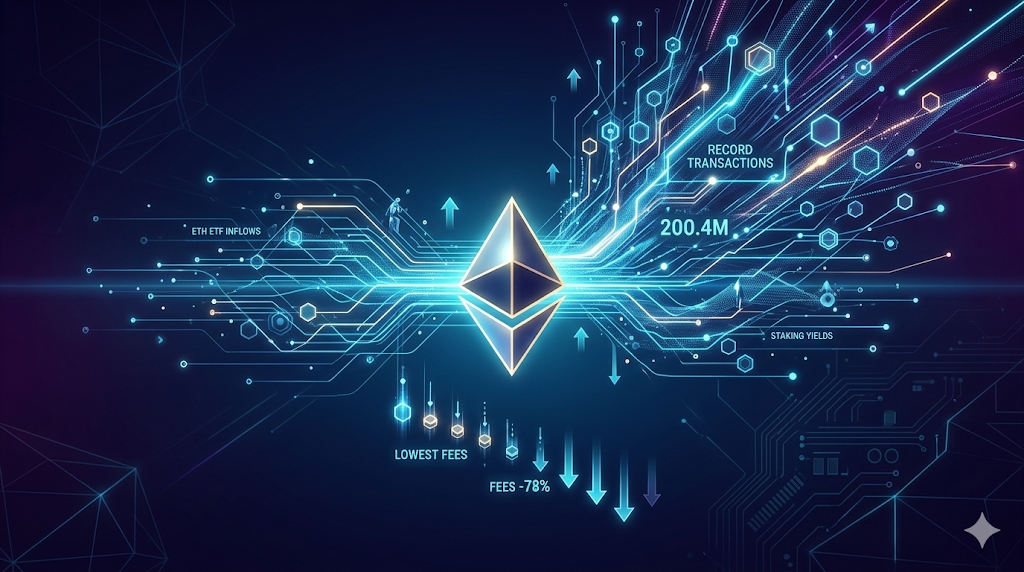
Did you know that Ethereum recently processed an all-time high of 200.4 million quarterly transactions while slashing user costs by over 78%? The network successfully broke its historical fee-activity correlation. Upgrades like Glamsterdam in early 2026 allowed transaction volume to surge without triggering the massive network congestion seen in previous cycles. This technological leap cements Ethereum's position as a scalable, institutional-grade settlement layer.
The Paradox of High Volume and Low Fees
Record-breaking activity no longer guarantees exorbitant network costs on the modern Ethereum blockchain. During the first quarter of 2026, the Layer 1 mainnet logged an unprecedented 200.4 million transactions. Despite this massive computational demand, average transaction costs plummeted to historical lows. Users frequently paid between $0.15 and $0.20 for basic settlements. This incredible combination of high usage and low cost fundamentally reshapes the platform's long-term economic model and encourages continuous global adoption.
Breaking the Fee-Activity Correlation
Structural protocol upgrades deliberately severed the long-standing connection between network congestion and soaring user fees. By significantly increasing block capacity and optimizing data storage, developers ensured that transaction pricing remains highly stable. Even when daily Layer 1 transactions peaked at 1.87 million in late 2025, base fees rarely spiked above a few cents. Low fees directly stimulate further on-chain engagement from retail users who were previously priced out of the decentralized ecosystem.
The Impact of the Glamsterdam Upgrade
The Glamsterdam upgrade successfully reduced overall Ethereum Layer 1 transaction fees by approximately 78% in the first half of 2026. This vital hard fork introduced parallel execution and account abstraction, significantly improving baseline network throughput. On-chain metrics from Token Terminal demonstrate the immediate financial relief provided by Glamsterdam's activation, with gas prices occasionally dropping to a microscopic 0.052 Gwei. The upgrade proved that scaling the base layer remains highly effective for institutional settlements.
Layer 2 Networks and the Scalability Shift
Layer 2 rollups now process significantly more daily transactions than the Ethereum mainnet itself, permanently lowering congestion across the entire ecosystem. These secondary networks handle the bulk of retail activity, leaving the base layer completely free for massive finality settlements. Based on L2Beat statistics from early 2026, networks like Base and Arbitrum successfully maintain over 1.9 million daily transactions. This parallel processing infrastructure constitutes the undeniable core of Ethereum's long-term scaling roadmap.
EIP-4844 and the Blob Space Revolution
The EIP-4844 implementation slashed Layer 2 data posting costs by up to 99%, completely revolutionizing rollup economics. By introducing a separate pricing market called "blob space," scaling networks no longer compete with regular users for highly expensive mainnet block space. Transactions on Layer 2 networks now cost a fraction of a cent. This permanent cost reduction solidifies rollups as the default execution environment, ensuring that everyday users enjoy fast and affordable cryptographic interactions.
Moving Decentralized Finance to Rollups
Decentralized finance protocols actively migrate their primary operations to Layer 2 networks to offer highly competitive trading fees. High-frequency traders and algorithmic bots require negligible transaction costs to remain profitable and execute complex smart contracts instantly. According to a Symbiosis Finance report from March 2026, developers prioritize building sophisticated user interfaces directly onto these faster rollups. The mainnet essentially functions as a highly secure, decentralized vault supporting these active sub-networks.
Institutional Capital and Ethereum ETFs
Regulated spot Exchange-Traded Funds generated massive institutional demand for Ethereum throughout 2025 and 2026, fundamentally altering the network's ownership demographics. These traditional financial vehicles allow corporate treasuries to gain digital asset exposure without managing complex cryptographic keys. Based on financial disclosures in early 2026, massive asset managers actively accumulate the asset to secure baseline staking yields. This persistent corporate buying pressure actively tightens exchange reserves and stabilizes broader market volatility.
Spot ETF Inflows in 2025 and 2026
Spot Ethereum ETFs captured a staggering $9.8 billion in net inflows during the 2025 calendar year, validating the network's transition into a globally recognized asset class. Investors aggressively utilized these funds to bypass the complexities of decentralized exchanges. Major financial institutions aggressively marketed Ethereum ETFs to their high-net-worth clients as a mandatory portfolio diversifier. The ETF infrastructure serves as the primary, heavily regulated bridge between traditional Wall Street capital and decentralized technology.
Wall Street's Quantitative Shift
Top-tier quantitative trading firms are visibly rotating capital from Bitcoin directly into Ethereum-based investment vehicles, highlighting a growing preference for utility assets. Jane Street's 13F filings from March 31, 2026, revealed an $82 million allocation into Ethereum ETFs while simultaneously reducing their primary Bitcoin position by 71%. This massive institutional rotation proves that sophisticated investors actively recognize Ethereum's fundamental strengthening. Wall Street clearly values the network's record-breaking transaction volumes and established dominance.
Staking Dynamics and Network Security
Ethereum's network security reached unprecedented levels as staking participation hit all-time highs in mid-2026. A massive portion of the circulating supply remains permanently locked within validator nodes to process transactions and earn consistent rewards. This deep financial commitment directly prevents hostile entities from accumulating enough voting power to execute a 51% attack against the blockchain. A highly staked network inherently guarantees cryptographic safety while effectively transforming Ethereum into a scarce, yield-bearing commodity.
Record-Breaking Staked ETH Participation
Over 32.4% of the total Ethereum supply was officially staked in active validator nodes by late May 2026, representing a historic milestone for the consensus mechanism. More than 37 million ETH currently powers the network's decentralized security infrastructure. On-chain data reveals a staking queue exceeding 2.5 million ETH, demonstrating relentless institutional demand for network participation. This massive lock-up confirms that the global community prioritizes long-term capital preservation over immediate, speculative liquidity.
The Yield Seeking Baseline for Investors
Staked Ethereum officially serves as the baseline, risk-free yield rate for the entire decentralized finance ecosystem, generating an average 3% to 4% annual return. Yield-seeking capital naturally gravitates toward this protocol-level reward system, completely replacing the risky yield farming strategies of previous market cycles. Institutions view this staking APR as the digital equivalent of a traditional government treasury bond. This predictable, protocol-generated cash flow allows corporate entities to accurately forecast quarterly earnings.
The Deflationary Burn Problem
The dramatic drop in network fees inadvertently disrupted Ethereum's highly anticipated deflationary tokenomics, temporarily returning the asset to an inflationary state. Because the protocol burns a portion of every transaction fee, lower base costs mean significantly less ETH is permanently destroyed. The network currently struggles to maintain the deflationary pressure that passive investors heavily expected. Record-breaking transaction activity no longer guarantees a shrinking circulating supply, forcing the community to reevaluate its economic narratives.
Reduced Fee Revenue Modifies ETH Supply
The EIP-1559 burn mechanism simply cannot keep pace with validator issuance when gas prices constantly hover near 0.05 Gwei. During periods of extreme congestion in past years, massive fee burns actively reduced the total token supply daily. However, data from Crypto Briefing in May 2026 confirms that the network creates more tokens to reward validators than it destroys through transaction fees. The successful scaling of Layer 2 networks directly starved the mainnet burn mechanism.
Evaluating the Long-Term Economic Impact
Moderate inflation does not threaten Ethereum's long-term viability as a global settlement layer, as the slight supply increase is a necessary compromise for mass adoption. An affordable, frictionless network naturally attracts trillions of dollars in real-world asset tokenization and institutional capital. These massive network effects and expanding user bases far outweigh the narrow benefits of strict deflation. By prioritizing upgrades like Glamsterdam, developers actively chose fundamental utility over speculative tokenomics.
Stablecoins and the Global Settlement Layer
Stablecoin transactions now represent the primary source of economic activity and value transfer on the Ethereum network. These digital dollars allow global businesses and individuals to settle international payments instantly without navigating volatile cryptocurrency price swings. Standard Chartered estimated in early 2026 that stablecoins account for up to 40% of all Ethereum transactions. This vital, non-speculative utility firmly solidifies the blockchain as the ultimate backend settlement infrastructure for the traditional financial system.
Dollar-Denominated Value on Ethereum
Ethereum successfully captured the majority market share for dollar-denominated value settlement, completely dominating competing Layer 1 networks. Over $158 billion in stablecoin assets officially reside on the blockchain, representing more than half of the entire global market. Financial institutions explicitly trust Ethereum's robust security architecture to custody these massive corporate reserves. According to DeFiLlama data from February 2026, this baseline economic activity sustains network usage regardless of broader speculative market sentiment.
Stablecoin Transaction Dominance
The predictable, low-fee environment created by recent upgrades makes Ethereum highly competitive against legacy payment processors like Visa. Merchants can finally process micro-transactions and global stablecoin swaps for mere pennies, completely eliminating traditional banking bottlenecks. With stable regulatory frameworks providing legal certainty, commercial banks comfortably launch their own tokenized currencies directly onto the blockchain. This widespread institutional stablecoin integration effectively guarantees Ethereum's permanent relevance in the future of decentralized global commerce.
Market Sentiment Amid Price Disconnect
A massive disconnect currently exists between Ethereum's record-breaking on-chain fundamentals and its lagging market price, creating intense debate among analysts. While network activity, staking metrics, and institutional ETF inflows hit all-time highs, the token frequently trades significantly below its 2025 cyclical peaks. Trading near $2,100 in late May 2026, the asset remains actively suppressed by broader macroeconomic uncertainties. However, seasoned investors recognize that underlying network usage ultimately dictates long-term price discovery.
Strong Fundamentals Versus Current Valuation
The blockchain's flawless technical performance completely contradicts the bearish sentiment dominating retail social media channels. Transaction throughput remains incredibly high, user costs are negligible, and network security is mathematically impenetrable. By every objective software metric, Ethereum is currently executing its scaling roadmap perfectly. Quantitative analysts heavily emphasize that historically low exchange reserves indicate impending price appreciation. A sudden spike in retail demand will inevitably face massive, immediate supply-side resistance from staked wallets.
Future Roadmap and Technical Milestones
The developer community continues pushing toward aggressive scaling targets, aiming for a highly anticipated 100 million gas block limit. Future technical upgrades will further expand data availability and drastically enhance cryptographic verification speeds, ensuring Ethereum maintains its unassailable technological moat. The second half of 2026 promises massive user experience improvements through full account abstraction integration. This upgrade will make wallet management entirely frictionless, eliminating seed phrases and seamlessly enabling gasless sponsored transactions.
How to Trade Ethereum (ETH) on KuCoin
Trading Ethereum (ETH) requires a platform with adequate liquidity and reliable trading infrastructure. KuCoin provides the marketplace and tools necessary to execute various investment strategies, catering to both retail users and professional trading entities looking for deep market access.
Setting Up Your KuCoin Trading Account
Registering and funding a KuCoin account is a straightforward process protected by standard platform security protocols.
-
Identity Verification (KYC): Users need to complete standard identity verification processes to unlock full trading features and higher withdrawal limits.
-
Funding the Account: Once verified, you can buy digital assets via traditional fiat gateways or deposit existing stablecoins (such as USDT or USDC) and crypto directly into your platform wallet. The user interface is designed to be accessible for both beginners and experienced traders.
Executing Spot Trades
Executing an ETH spot purchase allows you to directly own Ethereum tokens for long-term holding, strategic deployment, or staking.
-
Limit Orders: Traders frequently place limit orders to specify an exact entry or exit price, allowing the system to automatically execute the trade once the market reaches the designated price level.
-
Market Orders: Traders use market orders to execute trades instantly at the current prevailing market price.
Executing Futures Trades
For experienced users managing risk or looking to hedge positions, KuCoin Futures offers derivative contracts with customizable leverage options.
-
Leverage: Leverage amplifies both potential gains and losses, making proper trade setups essential.
-
Risk Management: Utilizing strict stop-loss and take-profit orders is standard practice to manage capital risk and mitigate sudden market volatility.
Conclusion
Ethereum's transition into a high-volume, low-fee settlement layer marks the most significant architectural achievement in the history of decentralized finance. By seamlessly executing over 200 million quarterly transactions while dropping basic fees below five cents, the network successfully solved its infamous congestion crisis. Protocol upgrades like EIP-4844 and Glamsterdam fundamentally broke the correlation between massive user activity and exorbitant gas prices. Layer 2 rollups now process the vast majority of retail interactions, allowing the mainnet to serve efficiently as a secure institutional vault.
Despite the temporary loss of deflationary tokenomics, the network's underlying fundamentals have never been stronger. Record-breaking staking participation, massive stablecoin integration, and billion-dollar ETF inflows prove that Wall Street and retail users alike deeply trust the platform. While the current market price remains temporarily disconnected from these massive technological victories, the tightened circulating supply heavily favors long-term holders. As Ethereum continues to execute its scaling roadmap, the blockchain guarantees its position as the ultimate foundation for global digital commerce.
FAQs
What was the Glamsterdam upgrade on the Ethereum network?
The Glamsterdam upgrade was a major hard fork activated in the first half of 2026 that introduced parallel execution and account abstraction. It successfully improved baseline network throughput and reduced overall Layer 1 transaction fees by approximately 78%.
Why did Jane Street rotate capital into Ethereum ETFs?
Jane Street reduced its Bitcoin ETF exposure and actively funneled $82 million into Ethereum ETFs during Q1 2026 to capitalize on the network's strong utility fundamentals. Quantitative firms increasingly favor Ethereum's record-breaking transaction volumes and established decentralized finance dominance.
What is EIP-4844 and how did it help scale the network?
EIP-4844, introduced during the Dencun upgrade, created a separate pricing market called "blob space" specifically for Layer 2 rollups. This allowed scaling networks to post transaction data to the mainnet without competing for standard block space, slashing Layer 2 fees by 99%.
How does staking affect the circulating supply of Ether?
Staking actively locks up Ether within validator nodes to secure the network, directly removing those tokens from liquid public exchanges. With over 32.4% of the total supply staked in 2026, the available circulating supply is severely constricted, preventing massive retail sell-offs.
Why is Ethereum currently experiencing structural inflation?
The network relies on burning a portion of base transaction fees to reduce the overall token supply. Because recent technical upgrades drastically lowered gas prices, the network currently issues more new tokens to reward active validators than it permanently destroys through fee burns.
Disclaimer:This content is for informational purposes only and does not constitute investment advice. Cryptocurrency investments carry risk. Please do your own research (DYOR).