

Raydium Commits $1M to Solomon USDv as New Yield-Bearing Solana Stablecoin Launches
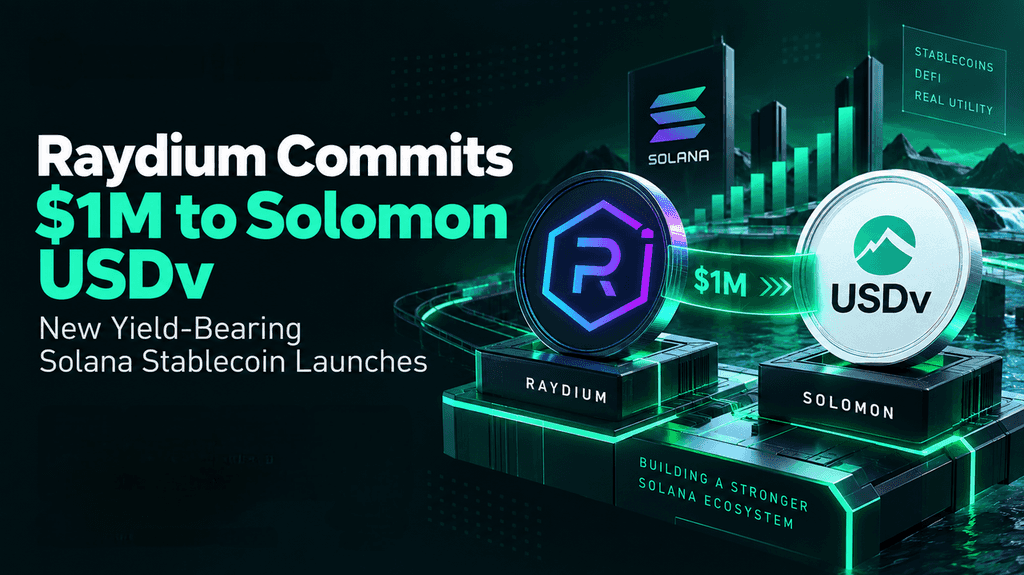
Raydium is supporting the launch of Solomon’s redesigned USDv stablecoin with an initial $1 million treasury allocation and a role as its primary liquidity venue on Solana. The new USDv combines 1:1 backed by short-dated U.S. Treasuries and cash reserves with a rewards system that allows eligible balances to remain usable across supported wallets and DeFi applications. The launch brings together several important crypto themes, including Solana stablecoin liquidity, Treasury-backed digital dollars, DeFi capital efficiency and yield-generating stablecoin models. The key question is whether USDv can turn its launch infrastructure into sustained trading activity and broader adoption across the Solana ecosystem. That will depend on how quickly the stablecoin builds liquidity, attracts recurring users and expands into additional Solana-based applications beyond its initial Raydium markets.
Why Raydium Committed $1 Million to Solomon USDv and Became Its Primary Liquidity Venue
Raydium’s treasury allocation gives USDv an early source of liquidity while placing the stablecoin inside an established decentralized trading environment. Rather than distributing initial liquidity across many venues, Solomon can use Raydium as a central market for USDv pairs, liquidity pools and future integrations. This gives the stablecoin a clearer route to market while allowing Raydium to expand the range of dollar-denominated assets available across its Solana-based trading infrastructure. For a new stablecoin, having a recognizable liquidity venue from the beginning can also improve market accessibility and make it easier for traders to understand where the deepest USDv markets are developing.
Why Raydium Is Backing Solomon USDv With Treasury Capital
The treasury allocation provides USDv with capital that can help establish active markets during its early rollout. For a newly launched stablecoin, liquidity matters because shallow markets can create wider spreads, larger price impact and weaker trading conditions. By committing funds at launch, Raydium can help create a stronger starting point for USDv without relying entirely on third-party liquidity providers. Early market depth can also make a new stablecoin more practical for larger trades and liquidity strategies, especially during the period when organic demand is still developing.
The partnership also fits Raydium’s broader role as a Raydium decentralized exchange built around Solana token swaps and liquidity pools. Solomon gains immediate access to infrastructure already used by traders and liquidity providers, while Raydium adds another potential quote asset for swaps and market creation. The value of the arrangement will ultimately depend on whether USDv develops regular trading activity rather than remaining dependent on launch incentives. Continued liquidity from independent market participants would be particularly important because it would show that demand is expanding beyond capital supplied during the initial rollout.
Why Raydium Became USDv’s Primary Liquidity Venue
Using one major venue for the initial rollout can make USDv markets easier to access and may improve price discovery during the early stage of adoption. Concentrated liquidity can also make it simpler for traders to find deeper pools instead of splitting activity across several small markets. This approach may be especially useful during the first phase of a stablecoin launch, when trading activity and market-maker participation can otherwise become fragmented across multiple decentralized exchanges.
The partnership may support several areas of development:
-
New USDv trading pairs may give Solana projects another dollar-denominated market option.
-
Token launches could eventually incorporate USDv where sufficient liquidity exists.
-
Liquidity providers may gain access to additional USDv-based pool structures.
-
Stablecoin market diversity could increase as another reserve-backed asset enters Solana DeFi.
-
Market infrastructure may expand if USDv is adopted across more Raydium products over time.
The important measure will be how much organic activity develops after the initial rollout. Persistent volume, deeper pools and continued participation from liquidity providers would offer stronger evidence of demand than the size of the launch allocation alone. Growth in the number of active USDv markets could also show whether the stablecoin is becoming useful as a trading and settlement asset rather than remaining concentrated in a small number of incentivized pools.
How Solomon USDv Works: Treasury Backing, Yield Rewards and No-Staking Model
Solomon’s redesigned USDv is structured as a reserve-backed digital dollar rather than the earlier model that relied on a separate staked token. Its architecture separates reserve management from reward distribution, allowing the same USDv token to remain transferable while qualifying balances participate in Solomon’s rewards infrastructure. The design aims to make USDv usable across everyday onchain activity instead of requiring users to move funds into a separate yield product. This structure may appeal to users who want access to stablecoin liquidity while retaining the ability to move capital between supported wallets, applications and DeFi positions.
How USDv Uses U.S. Treasuries and Cash to Support Its Dollar Backing
USDv is designed around 1:1 backing from short-dated U.S. Treasuries and cash reserves. This means the supply of the stablecoin is intended to correspond with assets held within its reserve structure rather than relying primarily on crypto market strategies to maintain value. The model reflects the broader principles behind how stablecoins work, where reserve design, redemption mechanisms and market liquidity all contribute to maintaining a target price. Short-duration Treasury assets are commonly considered relatively liquid instruments, which can be important for reserve management when redemptions need to be processed efficiently.
Even with reserve backing, USDv can still trade slightly above or below $1 on secondary markets. Prices on decentralized exchanges depend on real-time supply, demand and available liquidity, while the broader risk profile also includes custody arrangements, counterparties, reserve management and smart-contract security. Investors should therefore distinguish between the value of the reserves and the price available in a particular liquidity pool at a given moment. The strength of the peg will also depend on whether market participants trust the redemption process and whether sufficient liquidity remains available during periods of heavier buying or selling pressure.
Where Solomon USDv Yield Rewards Come From
The economic source behind USDv rewards is primarily the income generated by its reserve assets, particularly short-duration U.S. Treasuries. These securities can produce interest while serving as backing for the stablecoin, creating a potential source of revenue that can be distributed through Solomon’s rewards framework. This creates a different economic structure from stablecoin systems that rely heavily on crypto-native incentives or continuously issued reward tokens. It also links part of USDv’s reward economics to traditional fixed-income assets rather than purely speculative market activity.
This structure differs from crypto yield models driven mainly by token emissions, leveraged lending or derivatives funding rates. However, the reward paid to eligible USDv holders does not necessarily equal the yield earned by the underlying reserves. USDv rewards are variable, and factors such as program rules, reserve economics and eligibility conditions can affect distributions over time. A Treasury-backed reserve therefore provides an economic foundation for the system but should not be interpreted as a fixed-return guarantee. Changes in short-term interest rates may also affect reserve income over time, although that does not mean user rewards will automatically move by the same amount or at the same speed.
How USDv Earns Without Staking Wrapping or Lockups
The new USDv model does not require eligible users to exchange their stablecoins for a separate staking token. After enrollment, qualifying balances can be tracked through Solomon’s infrastructure while the original USDv remains available for transfers or use in supported applications. This can reduce some of the friction associated with traditional yield products, where users may need to deposit assets into a vault or receive a separate receipt token before becoming eligible for rewards.
Several features distinguish this design from traditional staking systems:
-
Balance tracking can recognize qualifying USDv across supported onchain locations.
-
Reward routing allows eligible distributions to be sent separately from the principal balance.
-
Single-token design avoids dividing liquidity between a base token and a separate staked version.
-
Onchain flexibility may allow qualifying balances to remain active within supported DeFi positions.
-
Dynamic eligibility enables the system to account for changing balances without requiring repeated staking transactions.
This model may improve capital flexibility because users do not necessarily have to choose between keeping USDv liquid and participating in rewards. However, support can vary by wallet or application, so users still need to confirm whether a specific position qualifies. Broader adoption of the model will therefore depend partly on how many Solana wallets and DeFi protocols integrate the required reward-tracking infrastructure over time.
How the Raydium USDv Launch Is Shaping Solana Stablecoin Liquidity and DeFi
USDv enters a Solana market where stablecoins already play an important role in trading, liquidity provision, payments and collateral. The addition of another reserve-backed dollar asset may broaden the range of options available to users, but its wider impact will depend on whether it can establish utility beyond its initial Raydium markets. Readers following the network can also monitor the broader Solana live price and market overview alongside changes in Solana’s DeFi and stablecoin activity. As Solana applications continue competing for liquidity, stablecoins that combine deep markets with broad protocol support may become increasingly important to the network’s onchain financial activity.
USDv May Add More Depth to Solana Stablecoin Markets
Stablecoins allow traders to move between crypto positions while remaining in a dollar-denominated asset, making them a key part of decentralized market infrastructure. If USDv attracts consistent deposits and trading demand, it could add additional depth to selected Solana markets and provide another quote asset for token pairs. Deeper stablecoin liquidity can help markets handle larger transactions with less price impact, while giving liquidity providers more options for constructing pools around dollar-denominated assets.
More stablecoin choice can be useful, but it also creates a risk of spreading capital across too many shallow pools. USDv will therefore need sufficient market depth to remain efficient as usage grows. Healthy liquidity, competitive spreads and reliable conversions into other major assets will matter more than simply having a large number of listed pairs. The quality of USDv liquidity will also become important if the token begins serving as a bridge between trading, payments and other Solana DeFi applications.
New DeFi Integrations May Expand USDv Utility Beyond Trading
USDv’s longer-term role will depend on whether other Solana applications choose to integrate it. Stablecoins become more useful when they can move between trading, lending, collateral, payments and treasury-management applications without requiring users to switch assets repeatedly. Wider integration can also improve network effects because every additional supported application creates another potential use case for the same stablecoin balance.
Potential future use cases include:
-
Lending markets that accept USDv as a borrowable asset or collateral.
-
Stablecoin pools that connect USDv with other dollar-pegged assets.
-
Protocol treasuries that use reserve-backed stablecoins for onchain cash management.
-
Token markets that use USDv as a quote currency.
-
Payments and settlement through wallets or applications that support USDv transfers.
Each integration would require its own risk assessment. Protocols are likely to consider liquidity, reserve transparency, redemption mechanics and smart-contract security before adopting USDv more broadly. Stronger integration across independent applications would be especially important because it would indicate that USDv is gaining utility beyond the ecosystem of its initial launch partners.
Adoption Liquidity and Competition Will Determine USDv Growth
The strongest evidence of USDv adoption will come from usage data after the launch period. Circulating supply, trading volume, active liquidity and protocol integrations can show whether the stablecoin is gaining recurring demand rather than temporary interest. Other useful signals may include growth in wallet participation, the number of active trading pairs and whether liquidity remains stable after initial incentive programs are reduced.
Competition will also be significant because established Solana stablecoins already benefit from deep liquidity and broad application support. USDv does not necessarily need to displace those assets to succeed, but it will need to develop a clear role within the ecosystem. Continued integration across DeFi applications and consistent market activity would provide stronger evidence that the token is becoming part of Solana’s stablecoin infrastructure. Its ability to maintain transparent reserves and reliable market access will also be important as users compare USDv with other dollar-linked assets.
Conclusion
Raydium’s support gives Solomon USDv an established starting point in the Solana DeFi market, while the redesigned stablecoin introduces a model built around Treasury-backed reserves and flexible reward distribution. Its long-term relevance will depend on more than the initial launch announcement. Liquidity quality, recurring trading activity, reserve transparency and integration across wallets and DeFi protocols will determine whether USDv develops into a widely used Solana stablecoin. For investors and crypto users, the project adds another approach to combining dollar-denominated liquidity with onchain rewards, while still carrying the market, technical and regulatory risks associated with stablecoins and DeFi. The coming months should provide a clearer picture of whether USDv can build sustained demand and become a meaningful part of Solana’s broader stablecoin economy.
FAQs
Is Solomon USDv the same as the original USDv token
No. Solomon redesigned USDv in 2026 and began winding down the earlier structure that used a separate sUSDv token and a different yield strategy. The newer version uses a reserve-backed structure and a redesigned rewards system, so holders of legacy USDv should follow Solomon’s official migration process rather than assuming the two versions operate in the same way. The change is important because older information about USDv may describe mechanics that no longer apply to the current product.
Can anyone earn rewards by holding USDv
Not necessarily. Reward eligibility may depend on enrollment, supported wallets, jurisdiction and where the USDv balance is held. A user should therefore confirm whether a particular wallet or DeFi position qualifies under the current program rules. Eligibility requirements may also evolve as Solomon expands integrations or updates the reward system.
How can investors track USDv adoption after launch
Useful indicators include circulating supply, trading volume, liquidity depth and the number of wallets or applications supporting USDv. Growth across several of these measures can provide a clearer picture of adoption than launch-day volume alone. Investors may also watch whether liquidity remains active after early incentives decline and whether additional Solana protocols begin integrating the stablecoin.
Will USDv compete directly with USDC and other Solana stablecoins
USDv will operate in the same broader market, but different stablecoins can coexist by serving different uses. Established assets may remain dominant in some areas, while USDv could develop demand around its reserve structure and reward model. Its competitive position will ultimately depend on liquidity, integrations, user trust and how easily it can move across the Solana ecosystem.
Disclaimer
The information provided on this page may originate from third-party sources and does not necessarily represent the views or opinions of KuCoin. This content is intended solely for general informational purposes and should not be considered financial, investment, or professional advice. KuCoin does not guarantee the accuracy, completeness, or reliability of the information, and is not responsible for any errors, omissions, or outcomes resulting from its use. Investing in digital assets carries inherent risks. Please carefully evaluate your risk tolerance and financial situation before making any investment decisions. For further details, please consult KuCoin’s Terms of Use and Risk Disclosure.