

Polymarket vs. Kalshi: Who is the True King of Prediction Markets in 2026?
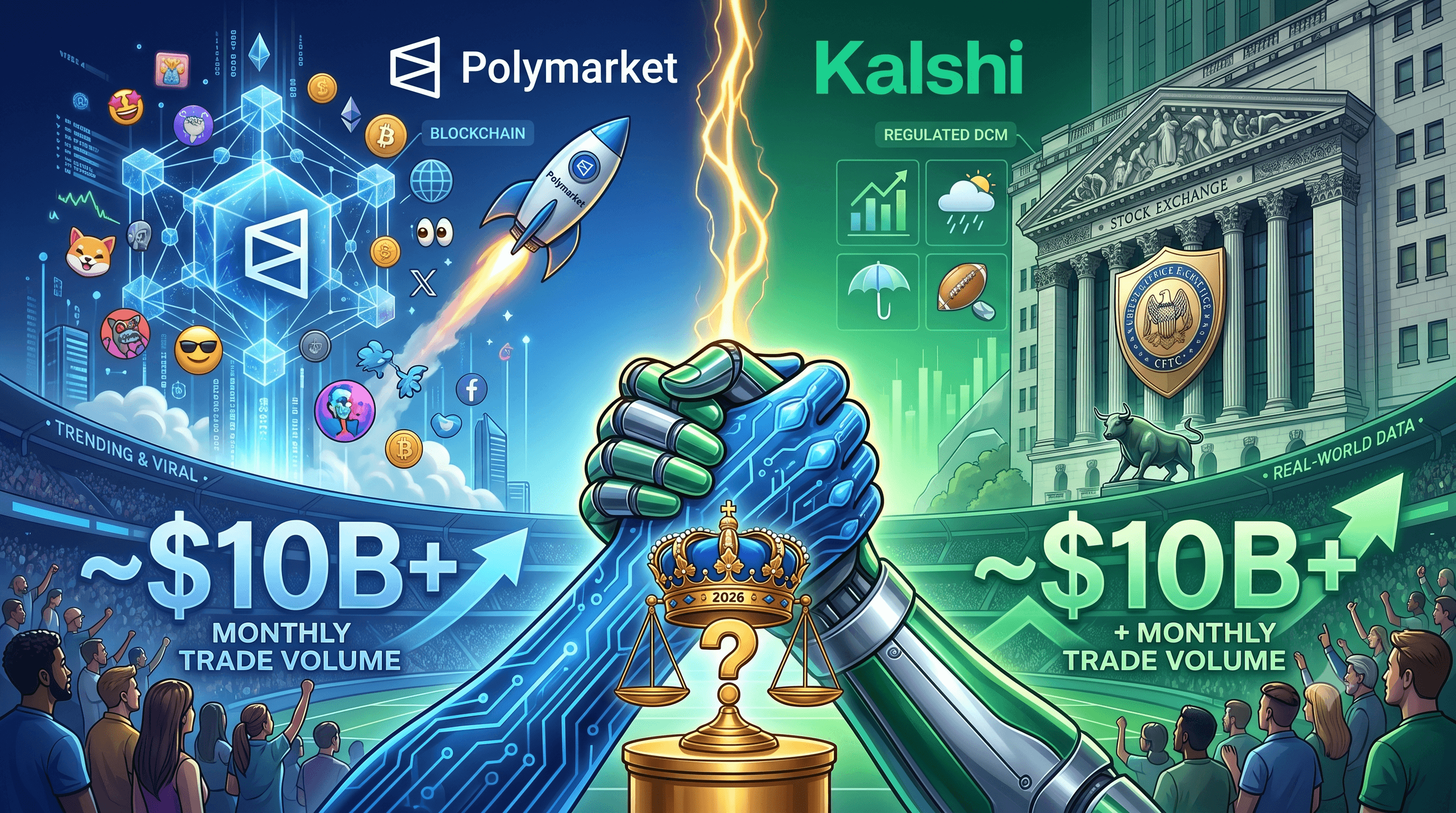
The landscape of decentralized finance and traditional derivatives has undergone a seismic shift. By mid-2026, prediction markets have transformed from niche experimental platforms into multi-billion-dollar behemoths dictating global sentiment. They are no longer just betting platforms; they are real-time, financialized news engines that politicians, hedge funds, and retail traders use to gauge the truth in an era of deepfakes and algorithmic misinformation.
According to recent data from TRM Labs, on-chain prediction market volumes reached a staggering $36 billion in the first quarter of 2026 alone, eclipsing traditional on-chain casino gambling for the first time in history. At the absolute center of this financial revolution stand two undisputed giants: Polymarket and Kalshi.
While both platforms serve the same fundamental purpose—allowing users to trade shares based on the probability of future events—their underlying DNA, target audiences, and operational philosophies could not be more diametrically opposed. Polymarket represents the wild, permissionless frontier of Web3, while Kalshi is the meticulously regulated, suited-up darling of traditional Wall Street.
As we navigate the explosive events of June 2026, from record-breaking World Cup volumes to the Commodity Futures Trading Commission's (CFTC) heavy-handed regulatory drafts, the ultimate question remains: Who will definitively claim the throne? This comprehensive guide breaks down the ultimate battle between Polymarket and Kalshi across every conceivable metric.
The Core Philosophy: Decentralized Web3 vs. Wall Street Compliance
To truly understand the divergence between Polymarket and Kalshi, we must examine the foundational architecture upon which they are built. The differences represent two entirely different visions for the future of global finance and information consensus.
Polymarket: The Global Crypto Native
Built on the Polygon blockchain, Polymarket operates as a decentralized, crypto-native application. It exclusively utilizes USDC (a US dollar-pegged stablecoin) as its medium of exchange. Its primary selling points are global accessibility, permissionless entry, and a distinct lack of traditional banking friction. For the crypto-native trader—often referred to as a "Degen" in the Web3 space—Polymarket offers an uncensored arena where one can bet on everything from complex geopolitical conflicts to fleeting pop culture drama.
Kalshi: The Strictly Regulated TradFi Challenger
Kalshi operates within the strict, heavily monitored confines of the US financial system. Regulated directly by the CFTC as a Designated Contract Market (DCM), Kalshi functions much like a traditional commodities exchange (such as the Chicago Mercantile Exchange). It strictly uses fiat US dollars, mandates rigorous Know Your Customer (KYC) compliance, and focuses primarily on macroeconomic data, government policy outcomes, and officially sanctioned events. It is designed for retail US citizens and institutional Wall Street whales looking for legal hedging mechanisms, completely blocking the global crypto market.
Platform DNA: At a Glance
| Feature | Polymarket | Kalshi |
| Foundation | Decentralized (Polygon Blockchain) | Centralized (Traditional Cloud Servers) |
| Currency | Crypto (USDC) | Fiat (USD) |
| Target Audience | Global Web3 Natives, Crypto Funds | US Retail, Wall Street Institutions |
| Regulatory Status | Unregulated/Offshore (US Restricted) | Fully CFTC Regulated (DCM) |
| Access/Login | Web3 Wallet (Metamask, Phantom, etc.) | Traditional Login & Bank Link (Plaid) |
| Market Variety | Infinite (Geopolitics, Crypto, Pop Culture) | Restricted (Economics, Politics, Sports) |
Interface and User Experience (UX): The Robinhood-ification of Prediction Markets
How a user interacts with a platform fundamentally alters who uses it. By 2026, the UI/UX war between these two platforms has defined their retail success.
Kalshi’s TradFi Polish:
Kalshi has taken direct inspiration from Robinhood. Its mobile app is a masterclass in behavioral design, utilizing clean fonts, intuitive sliding bars, and a frictionless fiat onboarding process via Apple Pay and Plaid. Users do not need to understand "bids" and "asks"; they are presented with simple "Yes/No" buttons and probability percentages. This consumer-friendly interface is explicitly designed to convert the average sports bettor or casual stock trader into a prediction market participant without exposing them to the terrifying complexities of derivatives trading.
Polymarket’s Web3 Dashboard:
Polymarket, while vastly improved since its inception, still retains the DNA of a decentralized exchange (DEX). Its interface heavily features order books, liquidity depths, and wallet connection prompts. While Polymarket has introduced features like magic links and credit card on-ramps to mask the crypto backend, the core experience still demands a baseline understanding of Web3 mechanics. However, for power users, Polymarket’s interface is far superior, offering API integration and granular data visualization that Kalshi hides behind its simplified mobile UI.
Demographics and User Base: Who is Actually Trading?
To understand the 2026 prediction market war, we must analyze the stark demographic differences between the two user bases.
Kalshi's Domestic Professional Base:
Because Kalshi requires a US Social Security Number and a linked US bank account, its user base is entirely domestic. According to aggregated 2026 user analytics, Kalshi’s base skews heavily toward white-collar professionals looking to hedge real-world risks.
-
Average Age: 38
-
Income Bracket: Middle to Upper-Middle Class
-
Profession: Highly concentrated in finance, law, tech, and real estate sectors across major hubs like New York, Chicago, and San Francisco.
Polymarket's Global Web3 Base:
Polymarket’s pseudonymous, wallet-based login makes precise demographic profiling difficult, but geographic wallet clustering and community data reveal a younger, hyper-globalized, and significantly more risk-tolerant audience.
-
Average Age: 24
-
Geographic Breakdown: 45% Southeast Asia (Vietnam, Philippines), 25% Latin America (Argentina, Brazil), 15% Europe, and 15% Rest of World.
-
Profession: Retail crypto day-traders, algorithmic arbitrage operators, and citizens in developing nations using USDC to speculate while hedging against local currency inflation.
The Rise of AI Agents: The Hidden War of Algorithms
A massive, entirely new angle in the 2026 prediction market space is the domination of Artificial Intelligence. Neither platform is purely driven by human clicks anymore; they are battlegrounds for Large Language Models (LLMs).
Polymarket's Swarm of "News Bots": Polymarket’s permissionless API means anyone can deploy a trading bot. Currently, the platform is flooded with autonomous AI agents. These LLMs are hooked up to X (formerly Twitter) Firehoses, Bloomberg terminals, and global news APIs. The second a verified news source tweets a geopolitical update, AI agents comprehend the text, calculate the probability shift, and execute USDC trades on Polymarket in milliseconds. This is why Polymarket odds often update faster than the news goes viral on social media.
Kalshi's Institutional Algorithms: Kalshi also hosts heavy algorithmic trading, but of a different breed. Rather than scrapers looking for pop-culture news, Kalshi’s APIs are dominated by quantitative hedge funds. These institutional algorithms ingest raw government data (like API feeds from the Federal Reserve or the Department of Energy) and execute massive block trades based on historical macroeconomic correlations. It is a sterile, data-driven environment compared to Polymarket's chaotic news-driven AI swarms.
Security, Custody, and the Nightmare of Taxes
The structural differences between Web3 and TradFi create entirely different risk profiles for the end-user, particularly regarding capital security and government reporting.
| Friction Point | Polymarket | Kalshi |
| Asset Custody | Self-Custody (User holds private keys) | Centralized (Platform holds USD in banks) |
| Primary Risk | Smart Contract Exploits, Wallet Phishing | Bank Runs, Platform Insolvency |
| Tax Reporting | User must manually track thousands of on-chain micro-transactions (No forms provided). | Platform automatically issues IRS Form 1099-B for capital gains/losses. |
| Privacy | Pseudonymous (Wallet address visible, identity hidden). | Fully Doxxed (SSN, ID, and employer recorded). |
For institutional investors, the "Tax Reporting" row is the ultimate dealbreaker. A traditional hedge fund cannot legally navigate the accounting nightmare of Polymarket's thousands of undeclared USDC transactions. Kalshi’s automated 1099 generation provides the legal safety net required for millions of dollars to enter the space.
The 2026 Landscape: Current Events Shaping the Rivalry
Media Influence and "The New Polling"
By 2026, traditional political polling has been largely discredited due to algorithmic bias and plummeting response rates. Mainstream media networks like CNN, Fox News, and Bloomberg now routinely display prediction market odds on live television.
However, they prefer Kalshi. Because Kalshi verifies that its users are US citizens (eliminating foreign interference in political markets) and operates under the CFTC, traditional news anchors view it as a legitimate source of "financialized truth." Polymarket is often cited by alternative media and crypto-journalists, but its lack of KYC makes mainstream pundits hesitant to trust its political odds, fearing manipulation by foreign bot farms.
The 2026 World Cup: A Tale of Two Audiences
The 2026 World Cup has proven to be the ultimate stress test for both platforms' scalability.
-
Polymarket's Global Liquidity: Within the first week of the tournament, Polymarket shattered records, accumulating over $1.8 billion in total wagers related to the "World Cup Winner" market alone. The platform saw over $58 million in trading volume surrounding obscure matches simply because global crypto traders were exploiting deep liquidity for complex cross-border arbitrage.
-
Kalshi's Mainstream Push: Kalshi captured roughly $120 million in World Cup volume. Because it is fenced off from global crypto capital, its numbers are smaller. However, Kalshi's strategy is undeniably mainstream. They recently signed legendary sports figures as brand ambassadors and have aggressively targeted the DraftKings demographic, proving that US retail is hungry for regulated alternatives to traditional sportsbooks.
The Insider Trading Epidemic
As prediction markets grow, so does the incentive to cheat. Both platforms are battling severe insider trading controversies.
-
Polymarket's Wild West: Polymarket has been rocked by high-profile scandals, including individuals trading on classified intelligence or internal corporate leaks. Because Polymarket allows for relative anonymity (via VPNs despite geo-blocking), policing bad actors is incredibly difficult. The burden of investigation falls on decentralized "on-chain sleuths."
-
Kalshi's Iron Fist: Kalshi has taken a draconian approach. In June 2026, Kalshi announced that users trading in "high insider risk" markets must provide verified employer and occupational data. Kalshi’s heavily centralized nature allows it to act as an aggressive financial police force, freezing accounts at the first sign of statistical anomaly.
Market Architecture and Agility: CTF vs. Order Books
The speed at which a platform can spin up a new market determines its ability to capture viral attention.
Polymarket’s Conditional Token Framework (CTF):
This elegant blockchain architecture utilizes Automated Market Makers (AMMs) alongside order books. It allows for incredibly rapid market generation. If a sudden scandal erupts, Polymarket can deploy a liquidity pool within hours. Furthermore, CTF allows for complex combinatorial odds (e.g., "Will Candidate X win the election AND interest rates drop by 50 basis points?"). This speed makes Polymarket the default home for breaking news.
Kalshi’s Central Limit Order Book (CLOB):
Kalshi utilizes a traditional Central Limit Order Book. Every bid must be matched by a specific ask. More importantly, because every market on Kalshi is technically a financial derivative, it must undergo a rigorous internal and regulatory compliance review. This legal red tape means Kalshi moves at a glacial pace compared to Polymarket, completely missing out on the rapid, viral events that drive massive retail engagement in the Web3 space.
The Oracle Dilemma: How Do We Define the Truth?
Perhaps the most critical and heavily debated difference between the two platforms is their oracle mechanism—the system used to determine the final, irrefutable outcome of a bet.
Polymarket and the UMA Optimistic Oracle
Polymarket outsources its truth-finding to the UMA (Universal Market Access) Optimistic Oracle. This is a purely decentralized, crypto-native solution. When a market closes, an outcome is proposed. If no one disputes it within a specific time frame, the outcome is finalized. If a dispute occurs, decentralized UMA token holders vote to determine the truth.
Kalshi: The Centralized Judge and Jury
Kalshi completely rejects the decentralized oracle model. Instead, Kalshi acts as the sole arbiter of truth, completely centralized and legally bound by its CFTC regulations. Kalshi’s outcomes are pegged strictly to verified, official sources: the Bureau of Labor Statistics for inflation data, the Federal Election Commission for political races, or official government press releases. To the crypto purist, this level of centralization is abhorrent. However, to an institutional market maker looking to hedge $50 million against rising interest rates, Kalshi offers absolute, legally binding certainty.
The Regulatory Hammer: The June 2026 CFTC Draft Rules
The regulatory landscape reached a boiling point on June 10, 2026, when the CFTC released a highly anticipated draft regarding the strict regulation of prediction markets.
The proposed rules signify a massive paradigm shift. The CFTC aims to categorically ban any prediction contracts involving military conflicts, terrorism, political assassinations, and the violent overthrow of governments. This is a direct, targeted strike against the most controversial (and highly trafficked) markets native to Polymarket.
Conversely, the draft rules explicitly greenlight and formally legitimize markets based on sports outcomes, economic indicators, and legislative actions. This regulatory clarity is a massive victory for Kalshi, perfectly aligning with their heavily sanitized, data-driven approach to market creation.
For Polymarket, these rules represent an existential threat. While they operate offshore, blocking US IP addresses is no longer enough to avoid the wrath of US regulators, especially because they utilize USDC—a stablecoin issued by Circle, a highly regulated US entity. If the US government pressures Circle to blacklist Polymarket's smart contracts, the platform's liquidity could evaporate overnight.
Conclusion:
When evaluating Polymarket versus Kalshi, one must separate the short-term battle for retail volume from the long-term war for institutional dominance.
Currently, Polymarket is the undisputed king of sheer volume, global user experience, technological agility, and pure, unadulterated capital efficiency. It has successfully gamified global news for the crypto generation and built an unmatched liquidity engine powered by AI and decentralized capital. Kalshi, hampered by slow fiat rails, banking hours, and extreme KYC friction, simply cannot compete with Polymarket's speed and virality.
However, the reality of global finance is unforgiving. Pure decentralization cannot support a multi-trillion-dollar institutional hedging market. As prediction markets transition from Degen playgrounds to legitimate macroeconomic instruments, traditional capital will demand legal certainty. Major hedge funds will not tolerate the ambiguity of the UMA oracle, nor will they risk capital on a platform actively fighting a shadow war against the CFTC and the DOJ.
Polymarket currently mirrors the early days of Binance—dominating the globe through sheer technological superiority, an incredibly frictionless user experience, and a blatant, rebellious disregard for traditional financial borders. But just as Binance was eventually forced to pay historic fines, implement aggressive global KYC, and bow to international regulators to survive, Polymarket faces the exact same destiny.
In the long run, the true "King of Prediction Markets" will not be the platform with the most rebellious Web3 ethos. It will be the one that successfully merges the lightning-fast blockchain settlement layer with the ironclad, legally bound compliance of traditional finance. To swallow Kalshi and the TradFi market entirely, Polymarket must eventually put on a suit, accept the regulatory hammer, and compromise. Because in the end, "Code is Law" always eventually bows to the actual Law.
FAQs
Can I use Polymarket if I live in the United States?
Technically, no. Polymarket blocks US IP addresses to comply with CFTC regulations. Using a VPN violates their terms of service and exposes you to legal risks; Kalshi is the fully legal alternative for US residents.
Why does Polymarket use USDC instead of normal US Dollars?
USDC is a dollar-pegged stablecoin that enables instant, 24/7 global transactions on the blockchain. This allows for permissionless trading and immediate weekend settlements that traditional banking infrastructure cannot support.
How does Kalshi guarantee the outcome of an event?
Kalshi acts as a centralized oracle, legally binding its contracts to official, predetermined data sources (e.g., official government CPI reports), leaving zero room for subjective interpretation or community disputes.
What is the UMA Oracle, and why is it controversial on Polymarket?
UMA is a decentralized voting system used by Polymarket to resolve disputed outcomes. It is controversial because token holders can be swayed by financial biases in highly ambiguous markets, leading to contested payouts.
Can I lose money on these platforms?
Yes. Prediction markets involve real financial risk. Contracts settle at $1 if correct, $0 if wrong. Only trade what you can afford to lose.
🔥You Might Like:
Disclaimer: This article is for informational purposes only and does not constitute financial or investment advice. Cryptocurrency investments carry significant risk. Always conduct your own research before trading.