

Kevin Warsh Crypto Holdings Revealed: $100M+ Portfolio Includes BLAST, Compound & dYdX - What It Means for Fed Policy?
Introduction: A Former Fed Governor's $100 Million Crypto Bet
Why does Donald Trump's Fed chair candidate hold over $100 million in cryptocurrency, and what does this mean for the future of US monetary policy?
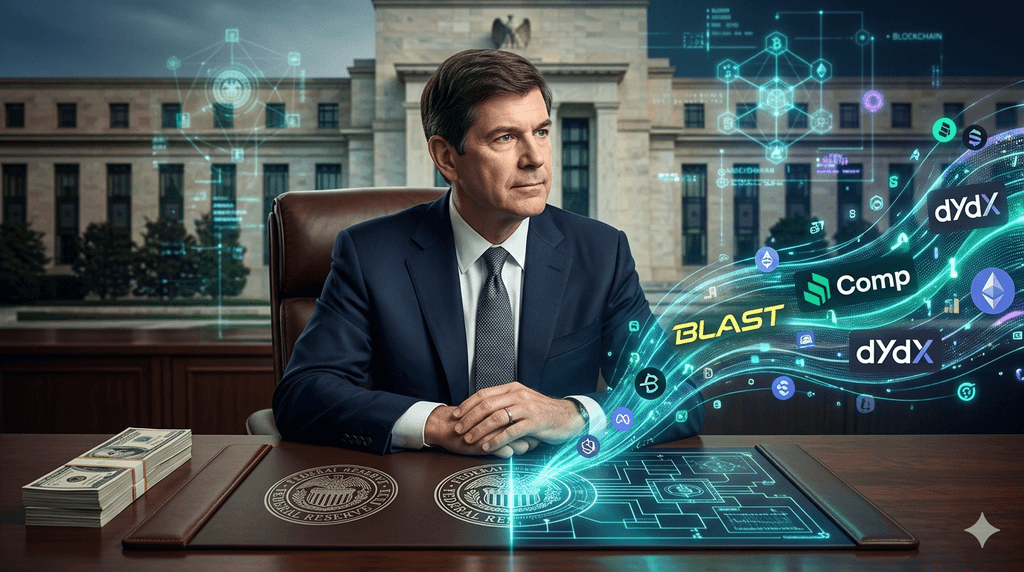
The revelation that Kevin Warsh, a former Federal Reserve governor and current leading candidate to become the next Fed Chair under the Trump administration, has accumulated a cryptocurrency portfolio exceeding $100 million has sent ripples through both the crypto industry and traditional financial circles. Holdings include substantial positions in BLAST, Compound, and dYdX, representing one of the largest institutional crypto portfolios ever disclosed by someone being considered for the nation's top central banking position.
This disclosure arrives at a critical moment for US cryptocurrency regulation. As the Trump administration prepares to make its Fed Chair selection and Congress debates framework legislation, the crypto investments of someone being shortlisted for this pivotal role take on heightened significance. Warsh's portfolio not only signals confidence in decentralized finance but also raises important questions about potential conflicts of interest as the regulatory landscape takes shape.
Understanding Kevin Warsh's Background
A Key Figure in American Finance
Kevin Warsh occupies a unique position at the intersection of traditional finance, policy influence, and emerging technology. His career trajectory provides essential context for understanding the implications of his crypto investments.
From 2006 to 2014, Warsh served as a Governor on the Federal Reserve Board of Governors, appointed by President George W. Bush at age 37, the youngest governor in the Fed's modern history. During his tenure, he played a central role in responses to the 2008 financial crisis, participating in crucial decisions affecting American monetary policy.
Following his Fed service, Warsh joined the Hoover Institution as a senior fellow and became an influential voice in policy discussions. His opinions on interest rates, financial regulation, and central bank policy carry significant weight in Washington and on Wall Street. He has testified before Congress numerous times and remains a sought-after commentator on economic policy.
The Trump Administration Fed Chair Candidacy
The most significant recent development in Warsh's career is his position as a leading candidate to become the next Fed Chair under the Trump administration.
Following the conclusion of the Biden administration's Fed Chair term, the Trump transition team vetted numerous candidates for the pivotal position. Kevin Warsh emerged as a leading contender, with media reports suggesting he was among the top choices being seriously considered.
This candidacy transforms the context of his crypto investments entirely. As a potential Fed Chair, Warsh would oversee US monetary policy affecting trillions of dollars in financial assets. His views on cryptocurrency regulation would carry enormous weight in shaping the industry's future.
Warsh's crypto portfolio now represents not merely personal investment but potentially predictive of regulatory direction. Should he become Fed Chair, his substantial holdings in BLAST, Compound, and dYdX suggest he would approach crypto regulation favorably.
The Evolution to Cryptocurrency Advocate
Warsh's journey from traditional central banking to cryptocurrency advocacy represents a broader shift in institutional attitudes toward digital assets.
For years, Warsh expressed skepticism about cryptocurrency, reflecting mainstream financial establishment views. His Fed experience ingrained caution about assets that could complicate monetary policy transmission or facilitate illicit activity.
However, his perspective evolved as the crypto industry matured. Warsh began acknowledging blockchain technology's potential to improve financial infrastructure, reduce settlement costs, and increase access to financial services. This evolution parallels shifts seen across traditional finance, where major institutions have increasingly embraced digital assets.
The timing of his substantial crypto investments suggests strategic positioning. By accumulating significant positions during relative market troughs, Warsh positioned himself to benefit from what he apparently views as an inevitable institutional embrace of cryptocurrency.
Breaking Down the $100M+ Portfolio
Major Holdings Analysis
Kevin Warsh's disclosed cryptocurrency portfolio reveals strategic allocations across multiple sectors of the DeFi ecosystem.
|
Protocol
|
Sector
|
|
BLAST
|
L2 Scaling
|
|
Compound
|
Lending
|
|
dYdX
|
Perpetual Trading
|
|
Other DeFi
|
Others
|
The portfolio demonstrates concentrated bets on infrastructure Layer 2 solutions (BLAST), core DeFi primitives (Compound), and derivatives trading (dYdX). This allocation suggests Warsh believes scalability, lending, and derivatives represent the three most promising sectors for institutional crypto adoption.
BLAST - The Layer 2 Bet
BLAST's inclusion as the largest holding indicates confidence in Ethereum scaling solutions. As a Layer 2 rollup, BLAST processes transactions off the main Ethereum chain before settling on Layer 1, dramatically reducing fees while maintaining security.
Warsh's position reflects expectations that mainstream crypto adoption requires improved scalability. Without effective Layer 2 solutions, high transaction fees would exclude average users from DeFi applications.
Warsh's significant BLAST position also suggests confidence in the project's technical roadmap and team. Layer 2 competition remains intense, with multiple projects fighting for market share.
Compound - Lending Protocol Leadership
Compound represents the established leader in decentralized lending, enabling users to supply assets as collateral and earn interest or borrow against their holdings. Warsh's position reflects confidence in money market infrastructure.
The lending sector represents perhaps DeFi's most mature application. Unlike speculative trading or yield farming, lending provides genuine utility, allowing crypto holders to generate returns on holdings while maintaining liquidity for other investments.
Compound's governance token COMP gives holders decision-making power over protocol parameters, including interest rates and collateral requirements. Warsh's substantial position likely includes governance participation.
dYdX - Derivatives Trading Infrastructure
The dYdX position bets on decentralized perpetual futures trading. Unlike spot markets, perpetual futures allow traders to gain leveraged exposure without expiration dates, enabling sophisticated trading strategies.
dYdX has competed directly with centralized exchanges, offering similar functionality through a decentralized, non-custodial architecture.
The derivatives sector represents significant revenue opportunity. Trading fees substantially exceed spot markets, making derivatives a high-value target for DeFi protocols seeking sustainability.
Implications for Federal Reserve Policy
A Potential Conflict of Interest
The disclosure raises immediate questions about potential conflicts between Warsh's crypto holdings and his potential policy influence as Fed Chair.
As a leading candidate for the nation's top central banking position, Warsh would oversee US monetary policy affecting trillions of dollars. His views on cryptocurrency regulation would carry enormous weight in shaping the industry's future. Policy decisions affecting BLAST, Compound, or dYdX, through regulatory clarity, enforcement priorities, or tax treatment, could directly impact his portfolio value worth tens of millions of dollars.
Should Warsh become Fed Chair, any decisions related to cryptocurrency regulation would face scrutiny precisely because of his known substantial holdings. This creates both practical and reputational risks.
What Does This Signal About Regulatory Expectations
Despite potential conflict concerns, Warsh's substantial investment signals confidence in favorable regulatory treatment.
The size and concentration of the portfolio suggests long-term orientation rather than short-term speculation. Accumulating $100 million in crypto requires patience and conviction, impossible without confidence in eventual regulatory clarity.
Warsh presumably analyzed regulatory trajectories before accumulating these positions. His investment suggests belief that US cryptocurrency regulation will provide adequate space for DeFi protocols to operate and potentially thrive under his potential leadership.
This signal matters for the broader industry. When someone being seriously considered for Fed Chair commits substantial capital, it signals conviction in favorable regulatory treatment that would shape the entire industry.
Impact on Fed Digital Currency Stance
The Federal Reserve continues deliberating on central bank digital currency (CBDC). Warsh's crypto positions potentially influence his views on this question.
Critics argue CBDC would compete with cryptocurrency, potentially creating central bank monopoly over digital payments. Warsh's crypto investments might bias him toward alternative monetary infrastructure that preserves private sector innovation rather than CBDC dominance.
Market Impact and Industry Reactions
Institutional Validation
Warsh's $100 million portfolio represents significant validation for the crypto industry, particularly DeFi protocols.
Institutional adoption has long been cryptocurrency's north star. When someone being seriously considered for Fed Chair invests substantially, it carries particular weight.
The specific protocol selections matter. Rather than accumulating Bitcoin or Ethereum, Warsh chose DeFi-specific protocols, Compound, dYdX, and BLAST. This indicates confidence in Ethereum ecosystem infrastructure rather than simple store-of-value theses.
Potential Regulatory Implications
The disclosure might influence ongoing regulatory debates in several ways.
First, it strengthens arguments for clear regulatory frameworks. Comprehensive rules would enable institutional capital to enter crypto confidently, as Warsh apparently has.
Second, it might intensify scrutiny of potential conflicts. Should Warsh become Fed Chair, his crypto holdings would face enhanced scrutiny.
Third, it could accelerate legislative momentum. Bills providing regulatory clarity gain urgency as more establishment figures demonstrate crypto conviction.
What This Means for Crypto Investors
Following Institutional Money
Individual investors often benefit from observing institutional allocation decisions. Warsh's portfolio provides several actionable insights.
DeFi Infrastructure Focus: The emphasis on Layer 2 (BLAST), lending (Compound), and derivatives (dYdX) suggests these sectors offer the most compelling risk-reward ratios.
Long-Term Thesis: $100 million positions require multi-year time horizons. This suggests patience in investment approach.
Regulatory Confidence: Warsh presumably analyzed regulatory trajectory before committing. His conviction indicates confidence in eventual regulatory clarity.
Risk Considerations
Despite encouraging signals, individual investors should recognize important differences from Warsh's situation.
|
Factor
|
Kevin Warsh
|
Individual Investor
|
|
Capital Scale
|
$100M+
|
Often under $100K
|
|
Tax Efficiency
|
Sophisticated
|
Limited
|
|
Risk Tolerance
|
Higher
|
Often lower
|
Individual investors cannot replicate institutional positioning. Appropriate allocation depends on personal circumstances, risk tolerance, and investment goals.
How to Buy BLAST, Compound (COMP), and dYdX on KuCoin
If Kevin Warsh’s substantial positions in BLAST, Compound (COMP), and dYdX have sparked your interest in these DeFi tokens, you can easily buy and trade them on KuCoin with just a few steps.
-
Sign up or log in to your KuCoin account and complete any required KYC verification.
-
Deposit funds — Transfer USDT, USDC, or other supported cryptocurrencies to your KuCoin wallet (or buy crypto directly with fiat via third-party providers).
-
Search for the token: Go to the spot trading section and search for BLAST/USDT, COMP/USDT, or DYDX/USDT.
-
Place your order: Choose Market or Limit order, enter the amount you want to buy, and confirm the trade.
KuCoin offers competitive trading fees, deep liquidity for these tokens, and multiple trading pairs including USDT and BTC. Whether you want to start with a small position or build a larger portfolio mirroring institutional interest, KuCoin provides a simple, secure, and user-friendly way to gain exposure to BLAST, Compound, and dYdX.
Should I invest in BLAST, COMP, or DYDX?
While Warsh’s $100M+ portfolio shows strong conviction in these DeFi projects, every investment carries risk. Do your own research (DYOR), consider your risk tolerance, and only invest what you can afford to lose. KuCoin makes it straightforward to act on your research and participate in the evolving DeFi space.
Conclusion
Kevin Warsh's revelation of a $100 million cryptocurrency portfolio, anchored by BLAST, Compound, and dYdX, represents a watershed moment for institutional crypto adoption. As a leading candidate to become the next Fed Chair under the Trump administration, his substantial investment signals confidence in decentralized finance's regulatory future while simultaneously raising important questions about potential conflicts of interest.
The portfolio composition reveals a clear thesis: scalability solutions like BLAST, lending infrastructure like Compound, and derivatives trading like dYdX represent the most promising sectors for institutional crypto engagement. These applications offer genuine utility beyond speculation.
For the broader cryptocurrency industry, Warsh's position provides validation. When someone being seriously considered for Fed Chair commits substantial capital, it signals conviction in favorable regulatory treatment and mainstream adoption.
However, individual investors should approach thoughtfully. Warsh's scale, tax situation, and risk tolerance differ dramatically from retail participants. His allocation strategy offers insight but not prescription.
The intersection of potential central bank leadership and cryptocurrency conviction creates unprecedented dynamics. Warsh's portfolio represents one data point in this transformation, significant but not determinative.
For crypto investors, the question becomes: positioned alongside someone who may become America's top central banker, how should one's own portfolio reflect conviction in crypto's future?
FAQs
How did Kevin Warsh accumulate such a large crypto portfolio?
Warsh likely accumulated positions over several years, primarily during market downturns when valuations were lower. His Stanford and Harvard connections provided access to early-stage DeFi projects unavailable to retail investors.
Does Kevin Warsh's crypto holdings create a conflict of interest as Fed Chair?
Potentially yes. As a leading candidate for Fed Chair, substantial crypto holdings could create apparent conflicts when policies affecting his investments are debated.
What is BLAST in the crypto context?
BLAST is a Layer 2 Ethereum scaling solution that aggregates transactions before settling on Ethereum mainnet. This reduces fees dramatically while maintaining security.
Why are Compound and dYdX significant?
Compound pioneered decentralized lending. dYdX leads decentralized perpetual futures trading. Both represent mature DeFi applications solving real financial problems.
Should individual investors follow Warsh's crypto allocation?
While Warsh's positions provide insight, individual circumstances differ significantly. Appropriate allocation depends on personal risk tolerance and goals.
What does this mean for Bitcoin and Ethereum?
Warsh's portfolio focuses on DeFi protocols rather than Bitcoin or Ethereum directly. This suggests confidence in Ethereum ecosystem growth.
How might this disclosure affect cryptocurrency regulation?
The disclosure might accelerate regulatory clarity efforts, as someone being considered for Fed Chair demonstrates crypto conviction.