

HYPE Token Price Prediction 2026: How Much Is Hyperliquid (HYPE) Really Worth?
2026/05/22 10:12:02
Introduction
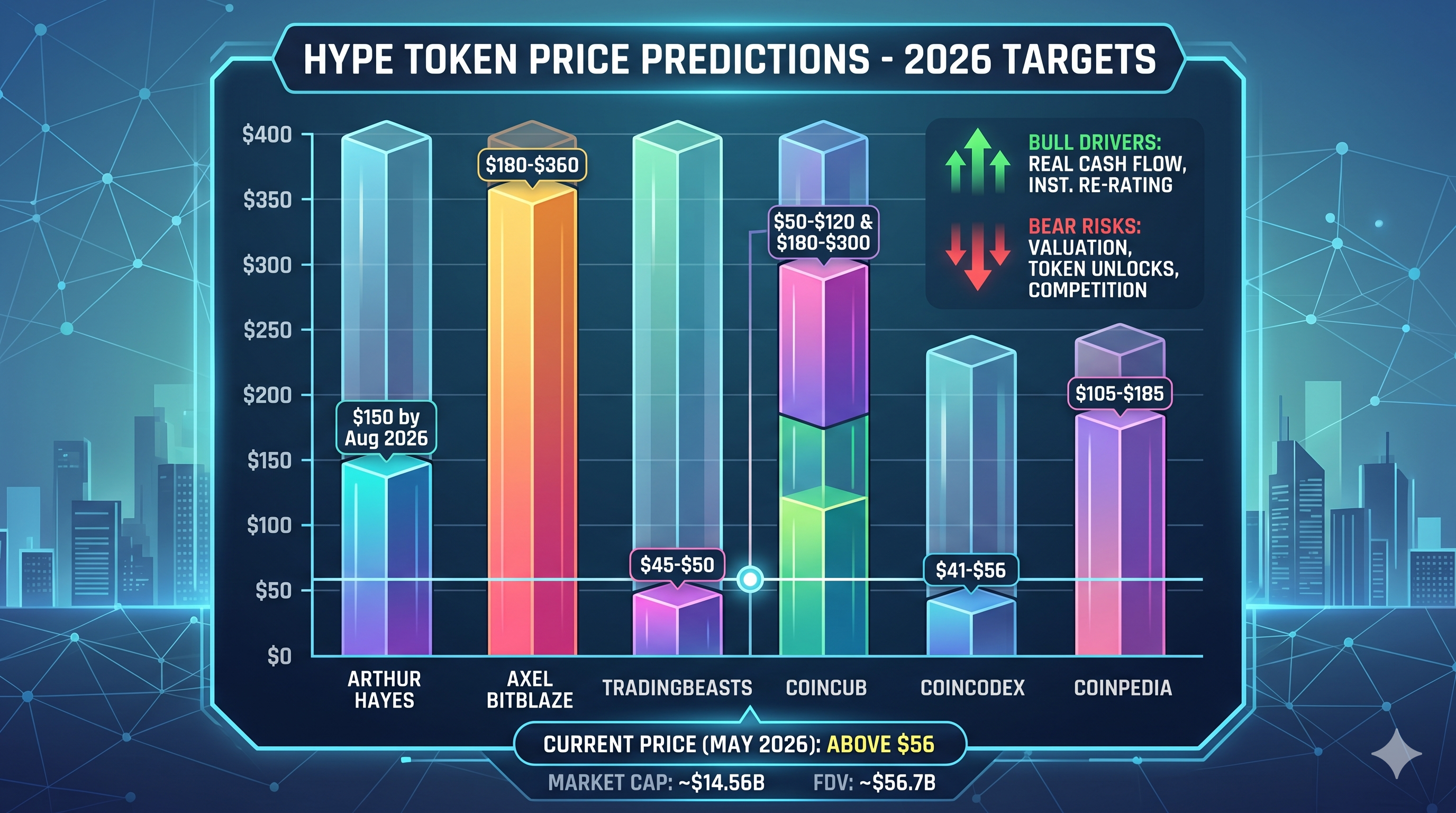
Arthur Hayes thinks HYPE hits $150 by August 2026. Axel Bitblaze argues $360 is fair value. TradingBeasts says $49 is the ceiling. So which is it? Hyperliquid's HYPE token price now trades above $56, giving it a roughly $14.56 billion circulating market cap and a $56.7 billion fully diluted valuation — and analyst price targets span a brutal 7x range.
The disagreement exists because HYPE defies traditional crypto valuation models. It is simultaneously a perp DEX token, an L1 ecosystem asset, a platform token with real cash flows, and — increasingly — a competitor to CME, Nasdaq, and CEX. This article breaks down every major 2026 HYPE price prediction, the bull case anchored in Hyperliquid's cash flow machine, and the bear case warning that valuations have run far ahead of fundamentals.
What Is Hyperliquid and Why Does HYPE Matter in 2026?
Hyperliquid is the dominant on-chain perpetuals exchange and a custom Layer 1 blockchain, and HYPE is its native token capturing fees, governance rights, and buyback flows. Unlike most DeFi tokens, HYPE benefits from a continuous buyback mechanism funded by protocol revenue — making it function more like a fee-generating equity than a speculative altcoin.
The protocol has become the default venue for on-chain leveraged trading, regularly handling daily perp volumes that rival mid-tier centralized exchanges. According to recent commentary from Arthur Hayes in his March 2026 essay "$HYPE Man," no other project in crypto returns as much capital to token holders as Hyperliquid does through its buyback program.
HYPE Tokenomics at a Glance
-
Circulating supply: ~254 million HYPE
-
Maximum supply: ~1 billion HYPE
-
Current price (May 2026): above $56
-
Circulating market cap: ~$14.56 billion
-
Fully diluted valuation (FDV): ~$56.7 billion
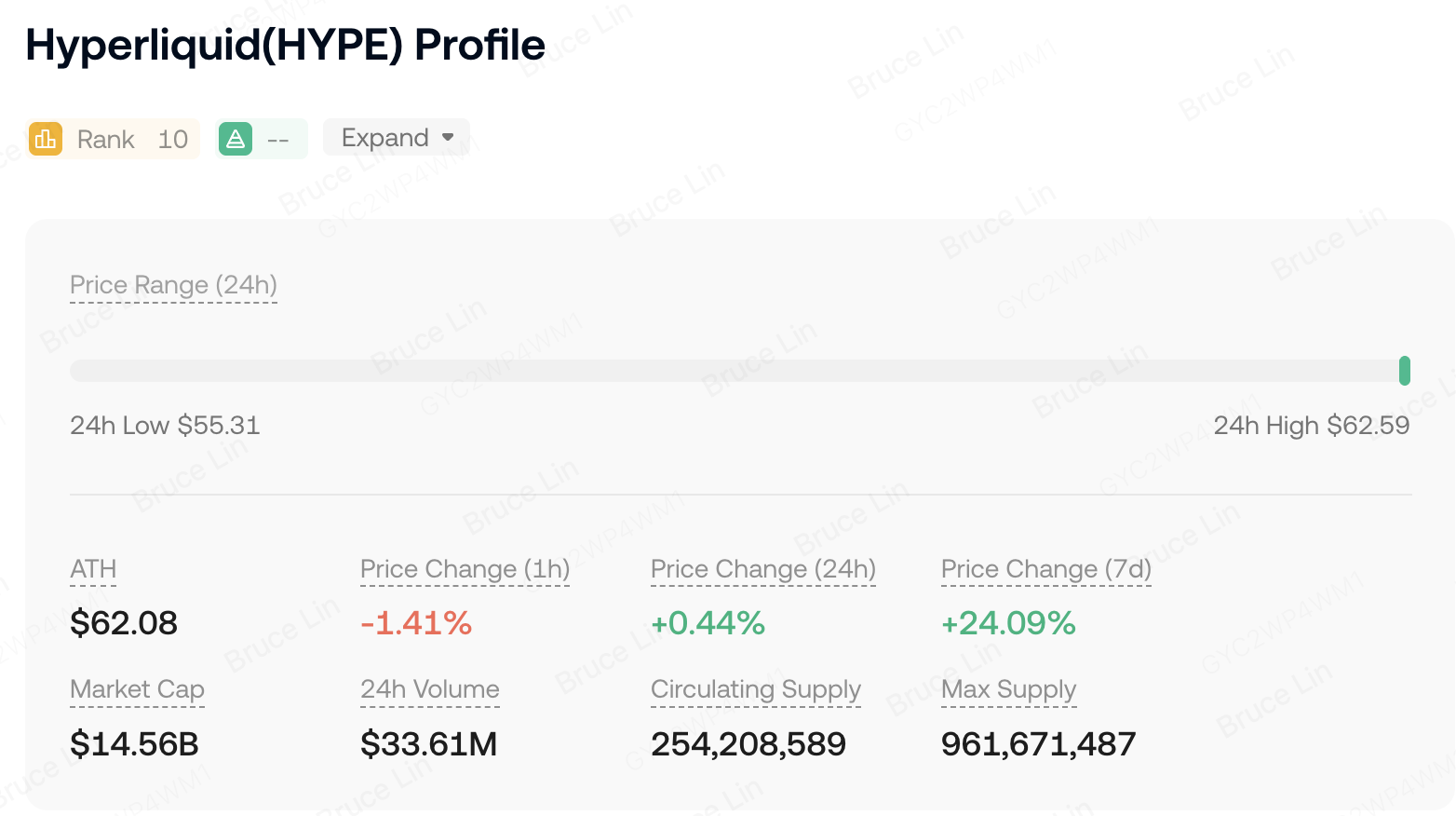
The gap between circulating market cap and FDV is critical — future unlocks remain one of the most cited bear arguments against HYPE.
Why Is HYPE So Hard to Value?
HYPE is hard to value because it doesn't fit any single crypto valuation framework — it is a hybrid. Traditional crypto assets each have clean valuation lenses: L1s trade on ecosystem activity, DeFi protocols on TVL, memecoins on attention flow, and exchange tokens on fee revenue and buybacks.
Hyperliquid is all of these at once. It runs its own chain (HyperEVM), hosts a growing ecosystem, generates exchange-like cash flow, and increasingly competes with traditional finance venues. That is why analyst targets diverge so wildly — they each weight a different layer of the business.
Matt Hougan has publicly argued that the market still prices Hyperliquid as a "crypto perp DEX," when its real ambition is to become a global trading platform spanning equities, FX, commodities, and prediction markets.
What Are Analysts Predicting for HYPE in 2026?
Analyst predictions for HYPE in 2026 range from $45 on the conservative end to $360 in the most aggressive bull case. The market has effectively stratified into three tiers: a fair-value camp around current prices, a structural bull camp at $100–$150, and a super-bull camp targeting multi-hundred-dollar prices.
Below is a consolidated view of the most-cited 2026 forecasts.
Major HYPE Price Targets for 2026
|
Source
|
2026 Price Target
|
Implied Circulating Mcap
|
Implied FDV
|
|
Arthur Hayes
|
$150
|
~$38B
|
~$150B
|
|
DCo (bear model)
|
$60
|
~$15.2B
|
~$60B
|
|
Coincub (conservative)
|
$50–$120
|
~$12.7B–$30.5B
|
~$50B–$120B
|
|
Coincub (bull case)
|
$180–$300
|
~$45.7B–$76.2B
|
~$180B–$300B
|
|
CoinCodex
|
$41–$56 (2026), $100 by Feb 2027
|
~$10.4B–$14.2B
|
~$41B–$56B
|
|
Coinpedia
|
$105–$185 (long-term)
|
~$26.7B–$47B
|
~$105B–$185B
|
|
3Commas / TradingBeasts
|
$45.2–$49.6
|
~$11.5B–$12.6B
|
~$45B–$50B
|
|
Axel Bitblaze
|
$180–$360
|
~$45.7B–$91.4B
|
~$180B–$360B
|
Arthur Hayes: $150 by August 2026
Arthur Hayes set the most-circulated bull target in his March 2026 essay, arguing HYPE reaches $150 by August 2026 based on cash-flow returns to holders rather than volume growth alone. He frames Hyperliquid as a "continuously buying back" exchange rather than a typical altcoin — closer to a public stock-repurchasing company than to UNI or dYdX.
DCo: $60 as the Bear-Case Floor
Research firm DCo published a March 13, 2026 valuation model arguing that even under a bearish framework, HYPE deserves a $60 price. Their core comparison anchors Hyperliquid revenue at roughly 15% of CME's revenue — yet HYPE's valuation sits far below what that ratio would imply. DCo argues the market hasn't priced in HIP-3, multi-asset trading, or Hyperliquid's global liquidity network.
Coincub: Two Scenarios From $50 to $300
Coincub splits its model into conservative ($50–$120) and bull ($180–$300) cases. The conservative case assumes Hyperliquid gradually absorbs CEX derivatives volume. The bull case assumes Hyperliquid successfully competes with Binance and Coinbase, attracts institutional adoption, and enters "global trading infrastructure" valuation territory.
CoinCodex, Coinpedia, and 3Commas: The Quantitative View
Quantitative platforms are notably more conservative. CoinCodex projects $41–$56 through 2026, with $100 only reached by February 2027. Coinpedia models $105–$185 as a long-term (2030) range based on compounding fee capture, HyperEVM growth, and sustained buybacks. 3Commas-aggregated models from TradingBeasts and WalletInvestor cluster tightly at $45–$50 — implying current price is already at fair value.
Axel Bitblaze: $180–$360 Super-Bull Case
Crypto KOL Axel Bitblaze argues HYPE eventually deserves $180–$360 because Hyperliquid will simultaneously own Binance's platform attributes, Solana's chain attributes, and CME's derivatives attributes. This is the most aggressive mainstream forecast and corresponds to a $1.8T–$3.6T FDV.
What Drives the HYPE Bull Case?
The HYPE bull case rests on four pillars: real cash flow, expanding addressable market, structural buyback pressure, and a re-rating from "DEX comparable" to "global exchange comparable." Each pillar materially raises the valuation ceiling.
Real Cash Flow and Buyback Mechanics
Hyperliquid generates substantial protocol revenue from perp trading fees and routes a significant portion into HYPE buybacks. This makes HYPE economically similar to a share-repurchasing exchange equity. According to Arthur Hayes, no other crypto project returns as much value to token holders.
Expanding Addressable Market Beyond Crypto
Hyperliquid's roadmap targets equities, FX, commodities, and prediction markets — categories worth trillions of dollars in daily volume. 21Shares research highlighted that during a recent geopolitical shock, Hyperliquid's on-chain contracts priced the event nearly 48 hours ahead of traditional markets, demonstrating genuine price-discovery capability.
Institutional Re-Rating
Starting in May 2026, multiple institutional research desks have stopped benchmarking Hyperliquid against UNI and dYdX, and started benchmarking it against CME, ICE, and Nasdaq. This comp shift alone justifies a materially higher multiple, because traditional exchanges trade at premium valuations relative to crypto DEXs.
HyperEVM and Ecosystem Growth
HyperEVM is positioning Hyperliquid as a full Layer 1 ecosystem, not just a perp venue. Sustained ecosystem growth adds an L1 valuation layer on top of the exchange business — effectively giving HYPE a second valuation engine.
What Are the Biggest Risks to HYPE in 2026?
The biggest risks to HYPE are stretched valuation, token unlock supply pressure, competitive threats from CEXs and other DEXs, and regulatory exposure as Hyperliquid moves into traditional asset classes. Whales have already been observed taking large short positions, voting with their capital that the rally has gone too far.
Valuation Has Outrun Near-Term Fundamentals
At roughly $14.56 billion circulating market cap and $56.7 billion FDV, HYPE already trades at multiples that exceed many publicly listed exchanges. As noted in recent commentary from The Motley Fool in May 2026, retail enthusiasm has compressed years of expected growth into months — leaving little margin for execution missteps.
Quantitative models from TradingBeasts, WalletInvestor, and CoinCodex all suggest current price sits at or above fair value for 2026.
Token Unlock and Supply Overhang
Only ~25% of maximum supply is in circulation. As future tranches unlock, sell pressure could weigh heavily on price — particularly if early holders and team allocations come to market during sentiment cooldowns. The $56.7B FDV is the number long-term holders must ultimately justify.
Competitive Threats
Centralized exchanges, including Binance, OKX, and KuCoin, retain the dominant share of global derivatives volume. Newer perp DEXs continue to launch with aggressive token incentives. Hyperliquid's lead is real but not insurmountable, and any volume share loss directly hits the buyback engine that supports HYPE's price floor.
Regulatory Exposure
As Hyperliquid expands into equities, FX, and prediction markets, it enters categories with heavy regulatory oversight in major jurisdictions. A regulatory crackdown — particularly in the US or EU — could constrain the global-exchange thesis that justifies the bull-case valuations.
Whale Short Positioning
Multiple large wallets have opened significant short positions against HYPE, signaling that sophisticated capital views the current price as overextended. While whale positioning is not predictive, it reflects genuine disagreement about valuation among informed participants.
What Is the Realistic HYPE Price Range for 2026?
The realistic HYPE price range for 2026 sits between $45 and $150, with the median analyst view clustering around $60–$120. This range balances Hyperliquid's proven cash flow against unproven institutional adoption and unlock risk.
A break above $150 would require Hyperliquid to demonstrably win institutional flow and successfully launch multi-asset trading at scale. A break below $45 would likely require a broader crypto bear market, a major security incident, or accelerated unlock-driven selling. The most likely scenario, based on aggregated analyst views, is sideways-to-upward consolidation in the $55–$120 band through 2026.
Conclusion
HYPE's 2026 valuation debate is really a debate about what Hyperliquid is becoming. If it remains a best-in-class perp DEX, quantitative models pricing it at $45–$60 are correct, and the current rally has already captured most of the upside. If it becomes a global trading platform competing with CME and Nasdaq, then Arthur Hayes' $150 target and even Axel Bitblaze's $180–$360 range become defensible.
The fundamental case is genuinely strong — real cash flow, continuous buybacks, expanding product surface, and a clear institutional re-rating already underway in May 2026. The risks are equally real — stretched valuation, an 75% unlock overhang, whale shorts, and regulatory exposure as Hyperliquid moves into traditional asset classes.
For most participants, the prudent stance is to acknowledge that HYPE's narrative ceiling is far higher than its current price, while also accepting that the path there will not be linear. Position sizing, unlock-schedule awareness, and disciplined risk management matter more than picking the exact peak.
Frequently Asked Questions (FAQs)
What is the highest HYPE price prediction for 2026?
The highest mainstream HYPE price prediction for 2026 is $360 from crypto KOL Axel Bitblaze, who argues Hyperliquid will eventually combine Binance's platform attributes, Solana's chain attributes, and CME's derivatives attributes. Among institutional voices, Arthur Hayes' $150 target by August 2026 is the most widely circulated bull case.
Is HYPE overvalued at current prices?
It depends on which comparable you use. Quantitative models like TradingBeasts and CoinCodex view HYPE at $56 as fair to slightly overvalued for 2026. Cash-flow models comparing Hyperliquid to CME and Nasdaq, including DCo's framework, argue HYPE is still undervalued because the market has not priced in multi-asset trading and global liquidity expansion.
How does HYPE's buyback mechanism work?
HYPE's buyback mechanism routes a portion of protocol fee revenue into open-market HYPE purchases, creating continuous structural demand. According to Arthur Hayes, no other crypto project returns as much capital to token holders as Hyperliquid, making HYPE economically comparable to a public company executing aggressive share repurchases.
What is HYPE's fully diluted valuation versus circulating market cap?
HYPE's circulating market cap is approximately $14.56 billion based on ~254 million tokens in circulation at above $56, while its fully diluted valuation is approximately $56.7 billion based on the 1 billion maximum supply. The roughly 4x gap reflects future token unlocks that long-term holders must absorb.
What could trigger a HYPE price crash?
A HYPE price crash could be triggered by accelerated token unlocks creating supply pressure, regulatory action against on-chain derivatives in major jurisdictions, a successful competitive attack from another perp DEX or CEX, a security incident on Hyperliquid or HyperEVM, or a broader crypto bear market reducing overall trading volumes and protocol revenue.