

How to Short Crypto in a Bear Market: A Step-by-Step Guide for Beginners
TL;DR — Key Takeaways
-
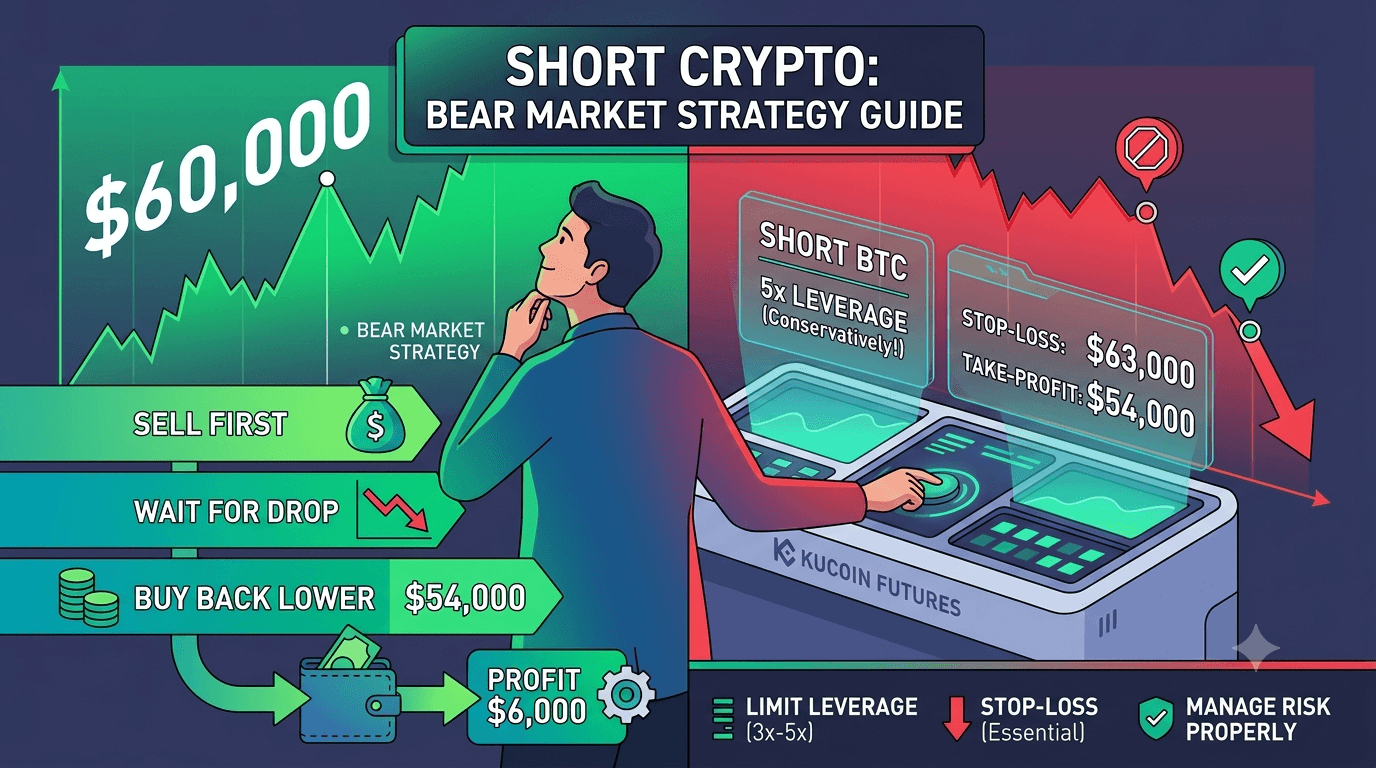
Shorting means borrowing and selling an asset, planning to buy it back cheaper later to pocket the difference.
-
Perpetual futures are the most accessible way to short crypto—no expiry date, no need to borrow actual coins.
-
This guide on how to short crypto bear market setups walks you through creating a KuCoin Futures account, depositing funds, opening your first BTC short, and managing risk properly.
-
Always use stop-losses and limit leverage (start with 3x–5x) to protect your capital.
What Does "Shorting Crypto" Actually Mean?
If you're searching for a reliable crypto bear market shorting strategy that takes you from zero to your first live trade, this step-by-step tutorial has you covered.
Shorting is simply the opposite of buying low and selling high. When you short, you sell high first, then buy low later. Here's how it works in practice:
-
You borrow Bitcoin (BTC) and immediately sell it at the current market price—say $60,000.
-
You wait for the price to drop.
-
You buy BTC back at the lower price—say $54,000.
-
You return the borrowed BTC and keep the $6,000 difference (minus fees).
In traditional markets, this process involves borrowing the actual asset. In crypto, perpetual futures contracts make it much simpler—you never touch the underlying Bitcoin. You're trading a derivative that tracks BTC's price, and your profit or loss is settled in USDT (Tether).
Why short in a bear market? Because bear markets are defined by falling prices. While spot holders watch their portfolios shrink, short sellers profit from the decline. As of July 2026, BTC has pulled back roughly 12.7% from its June highs near $70,800, with key support hovering around the $58,000–$60,000 zone.
Why Perpetual Futures Are the Best Way to Short Crypto in a Bear Market
Perpetual futures are the go-to instrument for crypto shorting. Here's why:
|
Feature
|
Perpetual Futures
|
Spot + Margin
|
Traditional Shorting
|
|
Expiry
|
Never expires
|
Varies
|
Varies
|
|
Leverage
|
Up to 125x (use far less)
|
Up to 5x
|
No leverage
|
|
Ease of Use
|
Open short in 2 clicks
|
Complex borrowing
|
Requires special accounts
|
|
Fees
|
~0.02%–0.06%
|
Higher borrow fees
|
Brokerage commissions
|
How perpetual futures stay tied to the spot price: Instead of expiring, these contracts use a funding rate—a small payment exchanged between longs and shorts every 8 hours. If the funding rate is positive, longs pay shorts. If negative, shorts pay longs. This mechanism keeps the futures price anchored to the underlying spot price.
As of July 5, 2026, the BTC perpetual funding rate across major exchanges sits at approximately 0.0065%, indicating a relatively balanced market with slight long bias
Step 1: Create and Verify Your KuCoin Futures Account
To start shorting, you need an exchange account with futures support. KuCoin Futures is a strong choice for beginners—competitive fees (0.02% maker / 0.06% taker), a user-friendly interface, and deep liquidity across 200+ perpetual contracts.
Here's how to get started:
-
Sign up at KuCoin.com with your email or phone number.
-
Complete KYC verification—this is now mandatory on KuCoin and most regulated exchanges. Have your government-issued ID ready; verification typically takes under 30 minutes.
-
Enable 2FA (two-factor authentication) using Google Authenticator or SMS to secure your account.
-
Navigate to Futures from the main dashboard and complete the futures trading quiz (required for first-time users).
Step 2: Deposit Funds (USDT Recommended)
You need collateral (margin) to open a short position. USDT (Tether) is the standard because most perpetual contracts are USDT-margined.
Deposit options:
-
Transfer from KuCoin Spot wallet — If you already hold USDT in your KuCoin spot account, transfer it to your Futures wallet instantly.
-
Crypto deposit — Send USDT from an external wallet (ERC-20, TRC-20, or BEP-20 networks supported).
-
Fiat on-ramp — Buy USDT directly with a credit/debit card or bank transfer via KuCoin's third-party providers.
For this tutorial, let's assume you transfer $500 USDT to your KuCoin Futures wallet as starting capital.
Once funded:
-
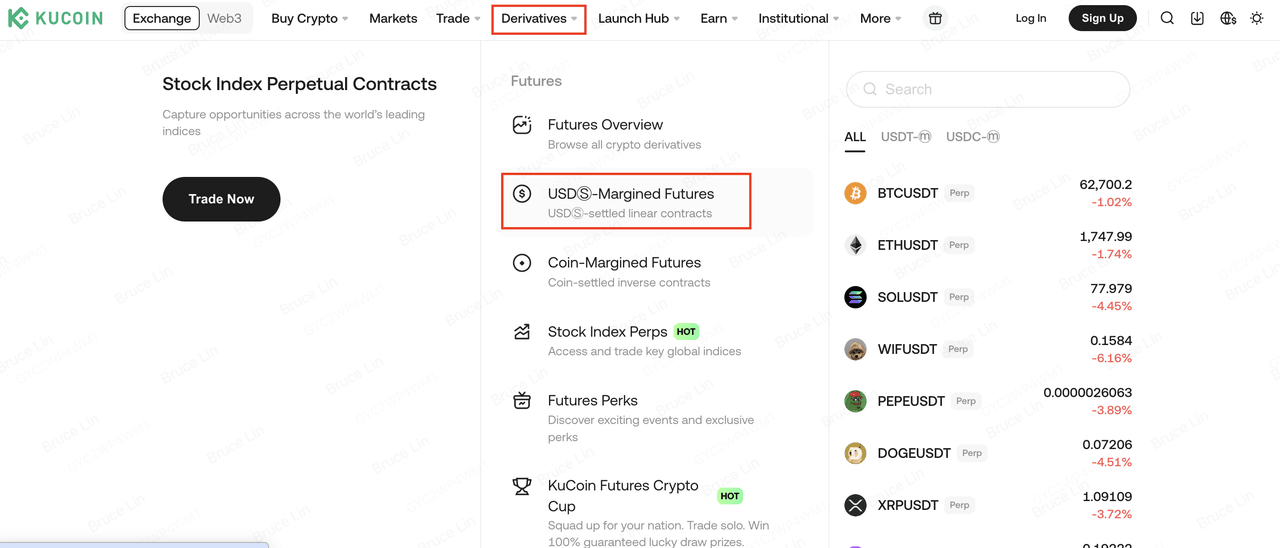
From the KuCoin homepage, click "Derivatives > USD-Margined Futures" in the top navigation bar.
-
Select "BTC/USDT Perpetual" from the contract list (it's usually the first or most traded pair).
-
Familiarize yourself with the interface:
-
Left side: Price chart with TradingView integration (indicators, drawing tools, timeframes).
-
Right side: Order book (bid/ask prices) and recent trades.
-
Bottom: Your open positions, orders, and position history.
-
Step 4: Set Your Leverage (Start Conservative)
Leverage amplifies both gains and losses. KuCoin Futures offers up to 125x leverage on BTC perpetuals, but beginners should use 3x–5x maximum.
To set leverage:
-
Look for the "Leverage" slider or dropdown in the order panel (default is usually 10x).
-
Drag it down to 5x.
-
Confirm the adjustment.
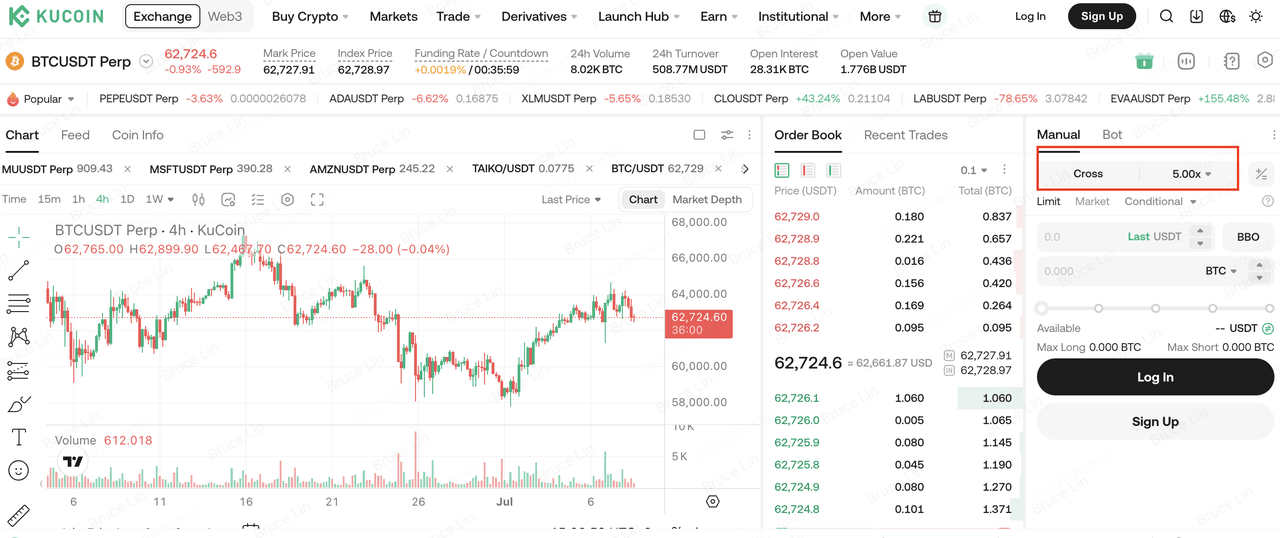
What 5x leverage means: With $500 USDT at 5x leverage, you control a $2,500 position size. A 10% drop in BTC price gives you a 50% return on your margin (before fees). But a 20% move against you risks liquidation.
Warning: At 10x leverage, a ~9–10% adverse move against your position triggers liquidation—you lose your entire margin. At 5x, you have roughly ~18–20% breathing room. Always start low.
Step 5: Place Your First Short Order
Now for the main event—opening your short position on BTC. Here's the exact process on KuCoin:
Choose Your Order Type
|
Order Type
|
When to Use
|
How It Works
|
|
Market
|
Immediate execution
|
Shorts at the best available price right now. Fast but slippage possible.
|
|
Limit
|
Precision entry
|
Set your exact short price. Waits for the market to hit it. Lower fees (maker rate).
|
|
Stop-Limit
|
Breakdown entry
|
Triggers a limit order when BTC breaks below a key support level.
|
For beginners, a Limit order is recommended—you control your entry price and pay the lower 0.02% maker fee instead of the 0.06% taker fee.
Enter the Trade (Live Example)
Let's say BTC is trading at $60,000, and you believe it will test lower support around $54,000:
-
Select "Limit" as your order type.
-
Price: Enter $60,000 (your desired short entry).
-
Size: Enter 0.04 BTC (~$2,400 at $60K). With 5x leverage, this requires $480 USDT margin from your $500 balance.
-
Select "Short" or "Sell/Short" button (red).
-
Confirm the order details and click "Sell/Short BTC".
Your limit order now sits in the order book. Once BTC hits $60,000, the order fills and your short position is live.
Set Stop-Loss and Take-Profit (Critical)
Before or immediately after your position opens, set protective orders:
-
Stop-Loss: Set at $63,000 (5% above your entry). If BTC rallies to $63K, your position closes automatically, limiting your loss to roughly 25% of your margin (~$120).
-
Take-Profit: Set at $54,000 (10% below your entry). If BTC drops to $54K, your position closes, locking in roughly 50% return on margin (~$240 profit before fees).
To set these on KuCoin, click your open position in the "Positions" tab, then enter your Stop-Loss and Take-Profit prices.
Step 6: Monitor and Manage Your Position
After opening your short, here's what to track:
-
Unrealized PnL: Shows your live profit or loss. Refresh the page or watch it update in real time.
-
Mark Price: The fair value price used for liquidation calculations. Your position gets liquidated if the mark price hits your liquidation level.
-
Funding Rate: Check this every 8 hours. If positive, you receive funding (shorts get paid by longs). If negative, you pay funding.
-
Margin Ratio: Displays how close you are to liquidation. Keep this well above 100%.
When to close your short manually:
-
Your take-profit target hits.
-
Your stop-loss triggers (pre-set).
-
You see a bullish reversal signal on the chart and want to cut losses early.
-
The bearish thesis is invalidated (e.g., BTC reclaims $65,000 with strong volume).
Risk Management: Rules Every Beginner Must Follow
Shorting is inherently risky—losses are theoretically unlimited because an asset can keep rising. These rules keep you alive:
1. Never Risk More Than 1–2% Per Trade
With a $500 account, risk no more than $5–$10 per trade. This means sizing your position and stop-loss so that if you're wrong, the loss is capped at $5–$10.
2. Use Isolated Margin (Not Cross)
KuCoin offers two margin modes:
-
Isolated: Only the margin allocated to this position is at risk. If liquidated, only that margin is lost—your futures wallet balance is safe. Recommended for beginners.
-
Cross: Your entire futures wallet backs the position. Higher liquidation threshold, but one bad trade can wipe your whole account.
3. Keep Leverage Low
Start with 3x–5x. Only increase after 50+ profitable trades in demo or small real size.
4. Always Use a Stop-Loss
No exceptions. Set it before you enter the trade, not after. Emotional decision-making after a loss leads to bigger losses.
5. Short in Confirmed Downtrends
Don't short into support. Wait for breakdowns below key levels with volume confirmation. As of July 2026, traders are watching whether BTC can hold the $58,000–$60,000 support zone or breaks down toward $53,000–$54,000.
6. Take Profits in Stages
Don't wait for the perfect bottom. Close 50% of your position at your first target, 25% at the second, and let the rest run with a trailing stop.
Common Mistakes First-Time Shorters Make
|
Mistake
|
Why It Hurts
|
The Fix
|
|
Using too much leverage
|
Liquidated on a small pullback
|
Cap at 5x until experienced
|
|
No stop-loss
|
One bad trade wipes the account
|
Set SL before entering every trade
|
|
Shorting into support
|
Bounces kill short positions
|
Wait for breakdown confirmation
|
|
Revenge trading
|
Doubling down after a loss compounds damage
|
Take a 24-hour break after 2 consecutive losses
|
|
Ignoring funding rates
|
Negative rates eat into profits
|
Check funding before holding overnight
|
Conclusion
Learning how to short crypto in a bear market opens up a powerful skill set—profiting from price declines instead of just watching your portfolio shrink. This guide walked you through the entire journey: understanding what shorting is, why perpetual futures are the best tool for the job, setting up your KuCoin Futures account, depositing funds, placing your first BTC short, and managing risk like a professional.
Remember the core principles: start with low leverage (3x–5x), always use stop-losses, risk only 1–2% per trade, and practice on KuCoin's demo account before going live. The July 2026 market—with BTC testing the $58,000–$60,000 support zone after a sharp ~12.7% pullback—illustrates why shorting skills matter in bearish conditions.
Ready to take the next step? Open your KuCoin Futures account today and practice your first short in demo mode. Bear markets don't have to be boring—equip yourself with the right tools and knowledge to trade both sides of the market.
FAQs
How much money do I need to start shorting crypto?
You can start with as little as $50–$100 USDT on KuCoin Futures. However, a $300–$500 starting balance gives you enough room to manage risk properly with small position sizes. Always use money you can afford to lose entirely.
Is shorting crypto illegal?
No, shorting crypto via perpetual futures is legal in most jurisdictions. However, it is restricted or banned in some regions. Check your local regulations before trading. KuCoin requires KYC verification and restricts futures trading in certain jurisdictions.
What's the difference between a futures short and a spot short?
A spot short involves borrowing actual Bitcoin, selling it, and buying it back later—complex and limited availability. A futures short is a simple contract bet that the price will drop. No borrowing, no lenders, just click "Short." Futures also offer leverage, which spot shorts typically don't.
Can I lose more than my initial investment when shorting?
On KuCoin Futures with isolated margin, no—your maximum loss is the margin you allocated to that position. With cross margin, yes, a liquidation can consume your entire futures wallet. This is why beginners should always use isolated margin.
What happens if Bitcoin keeps going up when I'm short?
Your unrealized loss increases. If it reaches your liquidation price, your position is automatically closed and your margin is lost. This is why stop-losses are essential—shorting has theoretically unlimited loss potential without them.