

Anthropic Leases SpaceX-Linked Colossus Supercomputer With 220,000 NVIDIA GPUs: Why It's a Bullish Catalyst for NVDA Stock
2026/05/10 08:08:20
Introduction
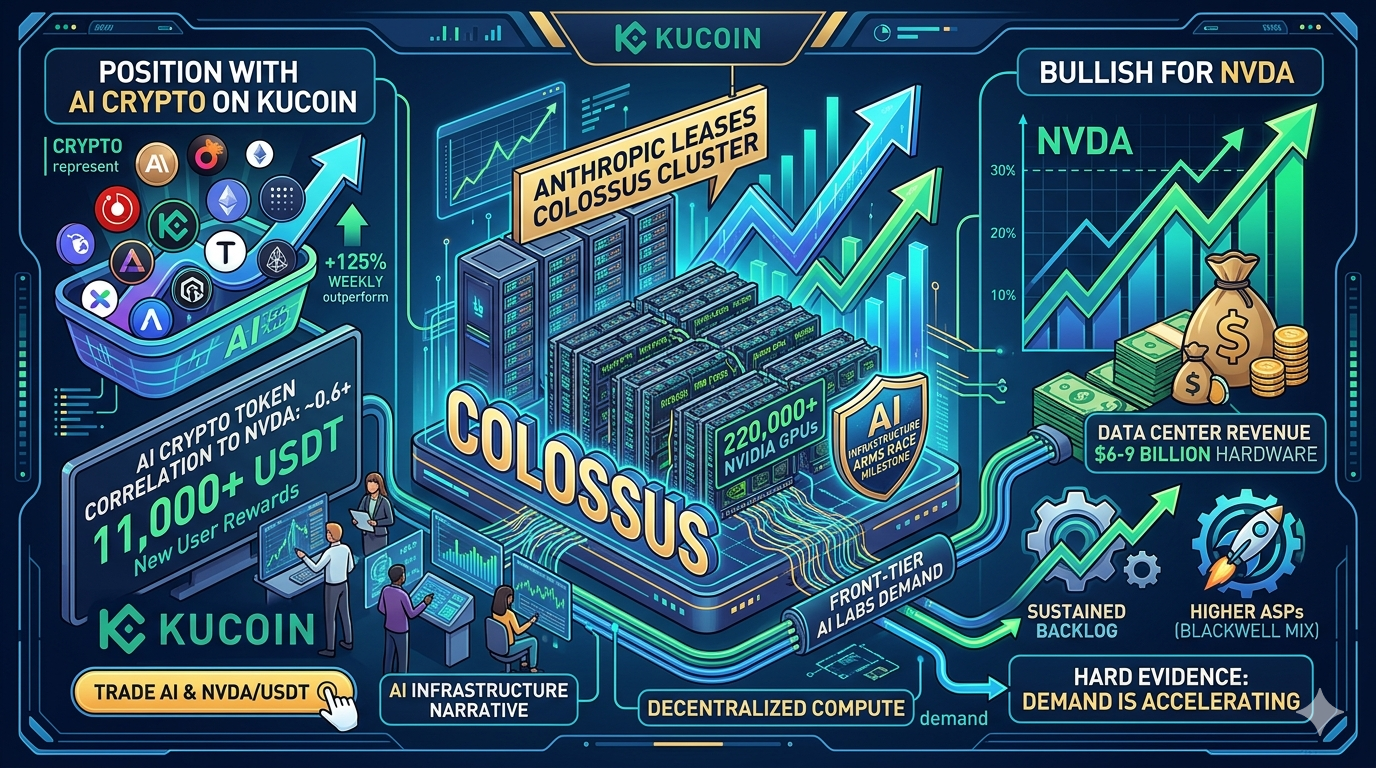
The AI infrastructure arms race just hit a new milestone — Anthropic has reportedly secured access to the Colossus supercomputer cluster equipped with 220,000 NVIDIA GPUs, one of the largest single AI compute deployments ever assembled. For NVIDIA shareholders, this is more than a headline. It's hard evidence that demand for high-end accelerators is accelerating, not cooling. Each H100 and H200-class GPU in that cluster represents tens of thousands of dollars in NVIDIA revenue, and the deal signals that frontier AI labs are willing to lease — not just buy — massive compute blocks to keep training the next generation of models. This article breaks down what the lease means, why it's bullish for NVDA, and how crypto traders can position around the AI-compute narrative on KuCoin.
What Is the Colossus Supercomputer and Why Does Anthropic Want It?
Colossus is a hyperscale GPU cluster originally built to train frontier AI models, now reportedly leased in part to Anthropic to expand its Claude model training capacity. The system houses roughly 220,000 NVIDIA GPUs — a mix of H100, H200, and next-generation Blackwell-class accelerators — making it one of the top three AI supercomputers globally by raw compute.
Anthropic's motivation is straightforward: training frontier models like Claude Opus and Claude Sonnet requires exponentially more compute with each generation. According to recent disclosures from major AI labs in early 2026, training runs for next-generation models are projected to consume 10x to 25x the FLOPs of their 2024 predecessors. Without access to clusters of this scale, Anthropic risks falling behind OpenAI, Google DeepMind, and xAI in the model-capability race.
Key Specs of the Colossus Cluster
-
Approximately 220,000 NVIDIA GPUs deployed across the cluster
-
Mixed fleet of H100, H200, and Blackwell-generation accelerators
-
High-bandwidth NVLink and InfiniBand interconnects
-
Designed for both training and large-scale inference workloads
Why Lease Instead of Build?
Leasing lets Anthropic scale compute in months instead of the 18-to-24 months required to design, permit, and energize a new data center. It also shifts capital expenditure off the balance sheet, preserving cash for talent and research while still locking in priority access to NVIDIA silicon that remains supply-constrained.
How Does This Deal Impact NVIDIA's Revenue Outlook?
The Anthropic-Colossus arrangement directly reinforces NVIDIA's data center revenue trajectory, which has become the single largest growth engine in the semiconductor industry. Based on NVIDIA's most recent quarterly disclosures in early 2026, data center revenue accounts for roughly 88% of total company sales, with hyperscaler and frontier AI lab demand driving consistent beat-and-raise quarters.
A 220,000-GPU cluster, valued at list prices, represents somewhere between $6 billion and $9 billion in NVIDIA hardware depending on the H100/H200/Blackwell mix — and that figure excludes networking gear, NVLink switches, and software licensing where NVIDIA also captures margin.
Three Direct Bullish Implications for NVDA
-
Sustained backlog visibility — Frontier labs continue to absorb every GPU NVIDIA can produce, validating bullish forward guidance.
-
Mix shift to higher-margin Blackwell — As Blackwell GPUs ramp into clusters like Colossus, average selling prices and gross margins should expand.
-
Networking attach rate — NVIDIA's Spectrum-X and InfiniBand revenue grows alongside every large GPU deployment, adding a second revenue lever.
Why Is the AI Compute Narrative Bullish for Crypto Markets?
The AI compute boom spills directly into crypto through three vectors: AI-themed tokens, decentralized GPU networks, and the broader risk-on sentiment that lifts both Nasdaq tech and digital assets. When NVIDIA prints record earnings, AI tokens historically outperform the broader crypto market by a wide margin in the following weeks.
According to on-chain analytics platforms tracking AI sector tokens in Q1 and Q2 2026, the AI narrative segment has consistently ranked among the top three performing crypto categories on weeks coinciding with major NVIDIA or hyperscaler announcements.
AI Tokens to Watch
|
Token Category
|
What It Does
|
Why the Colossus News Matters
|
|
Decentralized compute (e.g., RNDR, AKT, IO)
|
Aggregates GPU supply for AI workloads
|
Validates demand for non-hyperscaler GPU access
|
|
AI agent platforms (e.g., FET, AGIX, TAO)
|
Hosts on-chain AI models and agents
|
Benefits from broader AI adoption tailwind
|
|
Data and inference networks
|
Provides training data or inference endpoints
|
Rising training costs increase value of efficiency layers
|
The Correlation With NVDA
NVDA stock and the AI crypto basket have shown a rolling 90-day correlation above 0.6 for most of the past year, according to market data aggregators tracking cross-asset performance. That means traders watching NVDA earnings and AI infrastructure deals can use them as leading indicators for AI token positioning.
What Are the Risks to This Bullish Thesis?
Concentration risk is the biggest threat to the NVDA bull case, even with deals like Anthropic-Colossus on the books. NVIDIA's data center business depends on a narrow group of customers — hyperscalers, sovereign AI projects, and frontier labs — and any pullback in their capex plans would hit revenue immediately.
Three Risks Investors Should Track
-
Custom silicon competition — Google's TPU, Amazon's Trainium, and Anthropic's own potential ASIC efforts could erode NVIDIA's share over time.
-
Export controls — Ongoing U.S. restrictions on advanced GPU sales to China and other markets cap addressable demand.
-
AI capex digestion — If model performance gains plateau, hyperscalers could slow GPU orders, similar to past semiconductor cycles.
Crypto-Specific Risks
AI token narratives are notoriously volatile. A single disappointing earnings report from NVIDIA or a hyperscaler can trigger 30% to 50% drawdowns in AI-themed tokens within days. Position sizing and stop discipline matter more in this sector than in large-cap crypto.
How Does Anthropic's Compute Strategy Compare to Competitors?
Anthropic is following the same hyperscale playbook as OpenAI and xAI but with a stronger emphasis on leasing and partnership-based access rather than fully owned infrastructure. OpenAI relies primarily on Microsoft Azure, xAI built its own Memphis-based cluster, and Google DeepMind uses internal TPU pods alongside NVIDIA capacity.
Compute Footprint Comparison
|
Lab
|
Primary Compute Source
|
Estimated GPU-Equivalent Scale
|
|
OpenAI
|
Microsoft Azure
|
Several hundred thousand accelerators
|
|
xAI
|
Owned Colossus-class cluster
|
200,000+ GPUs
|
|
Anthropic
|
AWS Trainium plus leased NVIDIA clusters
|
200,000+ GPU-equivalents
|
|
Google DeepMind
|
Internal TPU plus NVIDIA
|
Proprietary, very large
|
The leasing model lets Anthropic match competitors on scale without the multi-year build cycle, but it also creates dependency on third-party operators and exposes the company to lease-rate inflation if GPU scarcity persists.
Should You Trade AI-Themed Crypto on KuCoin?
KuCoin offers one of the deepest selections of AI-themed tokens for traders looking to express the AI compute thesis through crypto. The platform lists major decentralized GPU tokens, AI agent tokens, and emerging AI infrastructure projects, with both spot and futures markets available for active position management.
Here's how to get started:
-
Create a KuCoin account — Sign up and complete identity verification to unlock full trading limits.
-
Fund your account — Deposit USDT, USDC, or BTC via on-chain transfer or supported fiat channels.
-
Research AI token listings — Use KuCoin's market data tools to compare volume, liquidity, and price action across AI sector tokens. Now users on KuCoin also trade on tokenized stocks like NVDA/USDT.
-
Choose spot or futures — Spot suits long-term thematic exposure; futures allow leveraged directional bets on short-term catalysts like NVIDIA earnings.
-
Set risk parameters — Use stop-loss orders and position sizing rules, especially given AI token volatility.
KuCoin's deep order books, competitive fees, and broad altcoin coverage make it a practical venue for traders building positions around AI infrastructure narratives like the Anthropic-Colossus deal.
Conclusion
The Anthropic lease of the Colossus supercomputer with 220,000 NVIDIA GPUs is a powerful bullish signal for NVDA stock and the broader AI compute trade. It confirms that frontier AI labs continue to commit billions in compute spending, validates NVIDIA's data center growth trajectory, and reinforces the secular thesis that drives both AI equity and AI-themed crypto performance.
For NVIDIA shareholders, the deal supports continued backlog visibility, a favorable mix shift toward higher-margin Blackwell silicon, and growing networking attach revenue. For crypto traders, the news strengthens the case for AI-themed tokens, particularly decentralized GPU networks and AI agent platforms that benefit from the same demand wave lifting NVIDIA.
Risks remain — custom silicon, export controls, and potential capex digestion all warrant monitoring — but the direction of travel is clear. AI compute demand is structural, not cyclical, and deals of this scale will continue to define market leadership through the rest of the decade. Traders watching this theme can position through both equities and AI-sector crypto on platforms like KuCoin.
FAQs
1. How much could the Colossus lease be worth to NVIDIA in revenue terms?
A 220,000-GPU cluster represents roughly $6 billion to $9 billion in NVIDIA hardware at list pricing, depending on the exact mix of H100, H200, and Blackwell accelerators, plus additional revenue from NVLink, InfiniBand, and software licensing.
2. Does Anthropic still use Amazon Trainium chips?
Yes. Anthropic maintains a strategic partnership with AWS that includes heavy use of Trainium accelerators alongside NVIDIA GPUs. The Colossus lease supplements rather than replaces that AWS relationship, giving Anthropic a multi-silicon strategy.
3. Which AI crypto tokens have the strongest correlation to NVDA stock?
Decentralized GPU tokens such as Render (RNDR), Akash (AKT), and io.net (IO) tend to track NVDA most closely because they directly monetize GPU compute. AI agent tokens like Bittensor (TAO) and Fetch.ai (FET) also show strong but slightly lower correlations.
4. Is it better to trade NVDA stock or AI crypto for AI exposure?
Each offers different risk-reward profiles. NVDA provides regulated equity exposure with earnings visibility but lower volatility, while AI crypto offers higher beta and 24/7 trading but with greater drawdown risk. Many traders allocate to both for diversified AI thematic exposure.
5. What's the biggest near-term catalyst to watch after this deal?
NVIDIA's next quarterly earnings report is the most important catalyst, since it will reveal whether deals like Anthropic-Colossus are translating into raised forward guidance. Hyperscaler capex commentary from Microsoft, Amazon, Google, and Meta also moves both NVDA and AI crypto significantly.