

Rosfinmonitoring and Crypto Oversight: Why the New 60,000-Ruble Threshold Changes the Rules for Everyone
2026/07/10 14:47:00
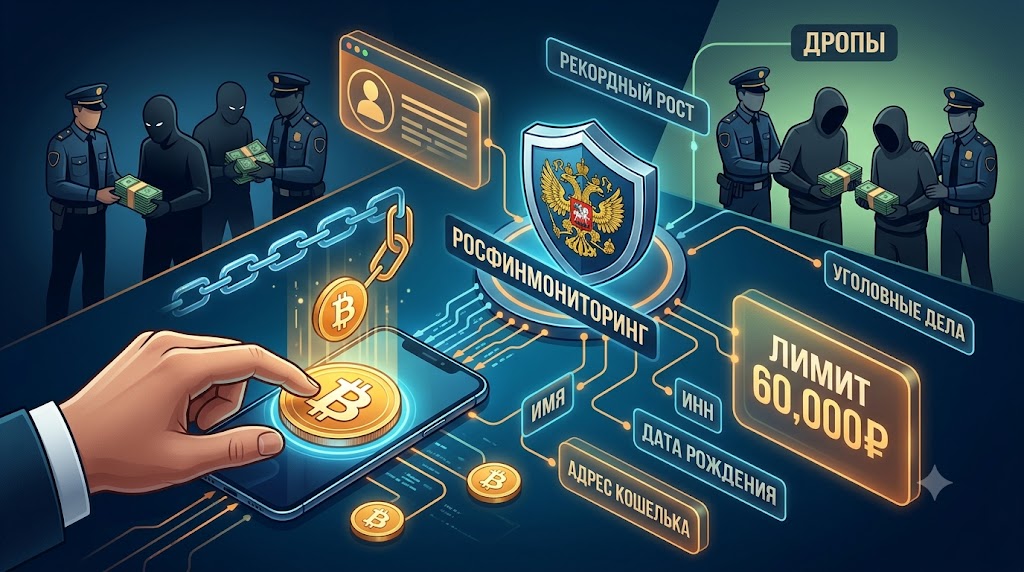
A single crypto transaction of 60,000 rubles or more — and data about your wallet, name, and date of birth is automatically sent to Rosfinmonitoring. This isn't speculation; it's the substance of amendments currently moving through the State Duma alongside the law "On Digital Currency and Digital Rights." At the same time, banks have reported a record surge in detecting drops — front of persons whose accounts are used to cash out stolen and criminal proceeds, including funds routed through crypto schemes. Below, we break down exactly what threshold is being introduced, what the regulator will track, how banks are catching drops, and what all of this means for anyone trading digital assets.
What Threshold Will Rosfinmonitoring Set for Crypto Transaction Oversight
The mandatory reporting threshold will be transactions of 60,000 rubles or more, per single transaction or on a cumulative basis. This figure appears in amendments to the digital currency law that require digital custodians and banks to automatically transmit crypto transaction data to oversight authorities. An earlier draft had discussed a 100,000-ruble threshold, but the final version tightened it to 60,000 rubles — the regulator clearly opted for the more conservative scenario to close loopholes for splitting transactions into smaller amounts.
Separate oversight is being established for foreign trade transactions involving cryptocurrency. According to clarifications to the law on digital currency and digital rights, information on crypto payments in foreign trade deals exceeding 10 million rubles will automatically flow to the financial intelligence service to monitor capital outflow and ensure FATF compliance. An earlier version of the companion bill had set the foreign trade threshold at 1 million rubles — the discrepancy shows the parameters are still being finalized as the bill moves through readings, but the underlying principle of total oversight for large transactions has already been agreed upon by all relevant agencies.
It's worth understanding the broader context: this tightening isn't happening in isolation — it comes against the backdrop of the digital ruble's planned launch in September–October 2026. The regulator has a direct interest in ensuring that crypto investments don't drive capital outflow or compete with state digital instruments at the moment they roll out to the market.
What Exactly Will the Regulator Learn About Each Transaction
For transactions of 60,000 rubles and above, reporting will include far more than just the fact of a transfer — it will include an extensive set of personal data. This means the wallet's on-chain address identifier, the name of the individual or organization, actual residential address, date of birth, and taxpayer identification number (INN). The term "address identifier" has already entered legal usage — it refers to an address within the digital custodian system that allows the wallet owner to be unambiguously identified, distinguishing a legitimate transaction from an anonymous attempt to move funds.
If a transaction is below 60,000 rubles, residential address and INN don't need to be disclosed — but the owner's name and wallet address are transmitted regardless. In effect, this marks the end of anonymous crypto payments within Russia: every crypto wallet operating through Russian infrastructure becomes tied to a real person, not just a digital identifier.
| Transaction type | Reporting threshold | Data transmitted |
| Domestic digital currency transaction | From 60,000 rubles | Wallet address identifier, name, residential address, date of birth, INN |
| Domestic transaction below threshold | Up to 60,000 rubles | Owner's name and wallet address identifier |
| Foreign trade (VED) crypto transaction | From 1 million (per some clarifications — from 10 million) rubles | Full details on payer and counterparty |
For comparison: the current version of Anti-Money Laundering Law No. 115-FZ already classifies digital financial asset transactions of 1 million rubles or more as subject to mandatory reporting — the new amendments effectively lower the threshold specifically for retail crypto transactions, bringing the rules closer to those already applied to ordinary bank transfers.
Why Banks Have Sharply Increased Suspicious Account Checks
Banks have become far more active in detecting drops thanks to closer cooperation with Rosfinmonitoring and improved data quality. According to a Rosfinmonitoring report, the number of alerts about financial violations from credit institutions has grown nearly threefold, and joint efforts by banks and other market participants prevented more than 400 billion rubles from moving into the shadow economy. The number of banks reporting drop-related transactions at all grew by 20% in 2025.
The regulator is placing particular emphasis on the crypto angle: the number of banks informing Rosfinmonitoring about suspicious operations linked to cryptocurrency rose one-and-a-half times in 2025, as confirmed by an official agency representative in comments to Rossiyskaya Gazeta. This means crypto cash-out schemes are no longer staying in a gray zone — banks have learned to recognize the tell-tale patterns of P2P exchanges, amount-splitting, and transfer chains routed through intermediaries. According to separate estimates from Rosfinmonitoring's deputy head, the overall number of drop-related reports across the system rose almost 2.8 times year-over-year, and the volume of individual transactions bearing hallmarks of drop activity exceeded 90 billion rubles.
This growth is driven not only by tighter rules but also by technological progress: banks are merging anti-fraud systems, compliance, and payment monitoring into a single pipeline, enabling real-time detection of suspicious transactions rather than after-the-fact discovery. The average lifespan of a drop's card, according to industry sources, has shrunk to just one day — meaning fraud schemes are forced to swap out cash-out tools almost daily.
How the State Punishes Drops — Real Prison Terms, Not Just Fines
The fight against drop networks has shifted from card freezes to criminal prosecution. Since mid-2025, an updated version of Article 187 of the Russian Criminal Code has been in effect, directly covering the transfer of a bank card, account access, or carrying out transactions on someone else's instructions for payment. Penalties range from fines and mandatory labor to actual imprisonment, with organizers of such schemes — who recruit drops and coordinate cash-outs — facing up to six years in prison.
Enforcement is picking up rapidly: according to the Ministry of Internal Affairs, between July 2025 and February 1, 2026, 832 criminal cases were opened under Article 187, with 174 drops and 69 organizers already held criminally liable. Given that reports of drop activity to Rosfinmonitoring continued growing at nearly threefold rates in the following months, expert estimates suggest the cumulative number of opened cases had already surpassed two thousand by mid-2026 — a trend directly relevant to anyone providing their cards or crypto wallets for cashing out stolen funds. One side effect of the crackdown is a sharp rise in the black-market price of "drop kits": a bundle of a card, SIM card, and copy of a passport that cost 5,000–10,000 rubles a year and a half ago now goes for 20,000–30,000 rubles, while commissions for drop services have jumped from 1–2% to 15–20%. This indirectly confirms that the risk for drops now clearly outweighs the reward.
Can Wallets on Foreign Exchanges Like Bybit or HTX Be Traced
Yes, indirectly — through requirements imposed on banks and digital custodians serving Russian citizens. Formally, Rosfinmonitoring has no direct access to foreign platforms' servers and cannot request their user databases outright. But the new rules obligate any organization — including foreign financial entities, as long as they serve Russian citizens — to transmit data on their clients' crypto transactions, including the link between a wallet and an identity, exactly as is already required of Russian digital custodians.
The key moment is withdrawal via P2P. The instant cryptocurrency is converted into rubles and lands in a Russian bank account in an amount of 60,000 rubles or more, the bank is obligated to request information about the counterparty to the deal. Refusing to disclose who transferred the funds and why can, under the logic of Anti-Money Laundering Law No. 115-FZ, result in the account being frozen — banks have long applied the principle of "no confirmation, no access" to ordinary transfers, and that same principle now extends to crypto P2P deals. It's precisely at this stage that the link between an "anonymous wallet" and a "real bank account" becomes transparent to the regulator, even if the exchange itself is physically outside Russian jurisdiction.
An additional transparency factor is the international Travel Rule standard, which requires end-to-end sender and receiver information to accompany the crypto transaction itself. A similar requirement already applies across the EU and most FATF-member jurisdictions, so its rollout in Russia fits logically into a broader global trend rather than standing out as a uniquely national initiative.
How to Legally Pay Taxes on Cryptocurrency in Russia
Cryptocurrency is officially classified as property in Russia, and income from this property is subject to personal income tax. The rate is progressive — 13% for most income, rising to 15% once an individual's annual income exceeds the established threshold. Annual reporting requires filing a 3-NDFL tax return, accompanied by supporting documentation: exchange statements and, if needed, wallet screenshots recording the movement of funds and transaction history.
An additional risk for those unable to prove the origin of their crypto assets comes from the Central Bank's new powers. The regulator will be granted the authority to directly restrict or fully prohibit specific individuals from carrying out certain crypto transactions. If a person doesn't pay taxes and can't explain the source of their funds, the Central Bank can block their access to digital asset transactions regardless of where those assets are held — whether on a Russian digital custodian platform or a foreign exchange.
Other elements of the upcoming reform round out the overall regulatory picture. Retail investors without qualified investor status are set to face mandatory, free testing before purchasing cryptocurrency — a licensed intermediary must decline the transaction if the test isn't passed successfully. Trading in privacy coins like Monero, designed to conceal transfer information, is expected to be banned outright, while the Central Bank and Rosfinmonitoring would be granted discretionary authority to prohibit any other digital asset. All of this fits a single logic: the more transparent the transaction and the clearer the source of funds, the lower the risk of running into restrictions.
How to Trade Cryptocurrency on KuCoin Under the New Rules
Trading cryptocurrency legally is both possible and advisable — which means it makes sense to build a transparent transaction history in advance rather than rely on anonymity, which no longer works under the new conditions. KuCoin supports identity verification procedures and provides a complete transaction history, which comes in handy when preparing a 3-NDFL tax return or confirming the source of funds to a bank. This reduces the risk of an account freeze when withdrawing rubles and cuts down on unnecessary questions from oversight authorities at the stage of converting crypto into fiat.
Before withdrawing funds via P2P, it's worth preparing documentation confirming the legitimacy of the transaction in advance: a record of the asset's purchase, tax payment data, and a brief comment explaining the purpose of the transfer. Using an exchange with transparent compliance practices and a clear transaction history makes it easier to get through checks from both the bank and Rosfinmonitoring — reducing the risk of frozen funds amid tightening oversight. Keeping consistent records of every transaction, from purchase to sale, spares you from having to scramble and reconstruct a transaction history the moment a bank has already asked for explanations.
Conclusion
Russia is decisively bringing the crypto market under its anti-money-laundering framework: transactions of 60,000 rubles or more will automatically be reported to Rosfinmonitoring along with data on the owner's wallet, name, address, and INN, while foreign trade crypto deals fall under oversight at substantially higher amounts. In parallel, banks have sharply ramped up detection of drops — the number of violation alerts has grown nearly threefold, and criminal cases under Article 187 of the Criminal Code now number in the thousands and continue rising alongside the black-market price of "drop kits."
Anonymity in crypto payments within Russia's financial system is effectively disappearing: even transactions with foreign exchanges become transparent the moment they're converted into rubles via P2P, while Travel Rule requirements and foreign-trade oversight close off the remaining loopholes. The legal path forward is to pay personal income tax on crypto earnings, complete mandatory testing where required, keep supporting documentation, and use platforms with a clear transaction history. Anyone working with cryptocurrency on an ongoing basis should get their records in order now, before the new requirements become an unpleasant surprise at the next large withdrawal.
Frequently Asked Questions
What happens if a crypto transaction above 60,000 rubles isn't reported?
The reporting obligation falls on banks and digital custodians, not on the individual user — data is transmitted automatically once the threshold is reached. But if a counterparty to the deal refuses to disclose information, the bank can suspend the transaction or freeze the account under 115-FZ rules pending clarification.
Are foreign exchanges required to hand over data to Russian users?
Yes, if the platform serves Russian citizens — the new rules explicitly extend to "foreign financial organizations" working with Russian clients, including the transmission of wallet and counterparty details.
How can I check whether my account might get frozen during a P2P transfer?
It's worth preparing an explanation for the payment and supporting documents in advance — an exchange transaction record and tax reporting data. Frequent, large P2P transfers without a comment and without a record of the asset's purchase are more likely to trigger a manual bank review.
What is Article 187 of the Russian Criminal Code, and who does it target?
It's the article covering illegal circulation of payment instruments, expanded with provisions against drop networks: transferring a card, wallet, or account access to another person for payment. Penalties range from fines and mandatory labor to up to six years in prison for scheme organizers.
Do individual entrepreneurs and legal entities have separate crypto reporting obligations?
Yes — legal entities and entrepreneurs are subject to their own internal control and beneficiary disclosure requirements, with separate fines for violations of anti-money-laundering law: 30,000–50,000 rubles for officials and 700,000 rubles to 1 million rubles for organizations.