

Nine Crypto Groups Form Quantum Alliance to Address Bitcoin's Quantum Threat
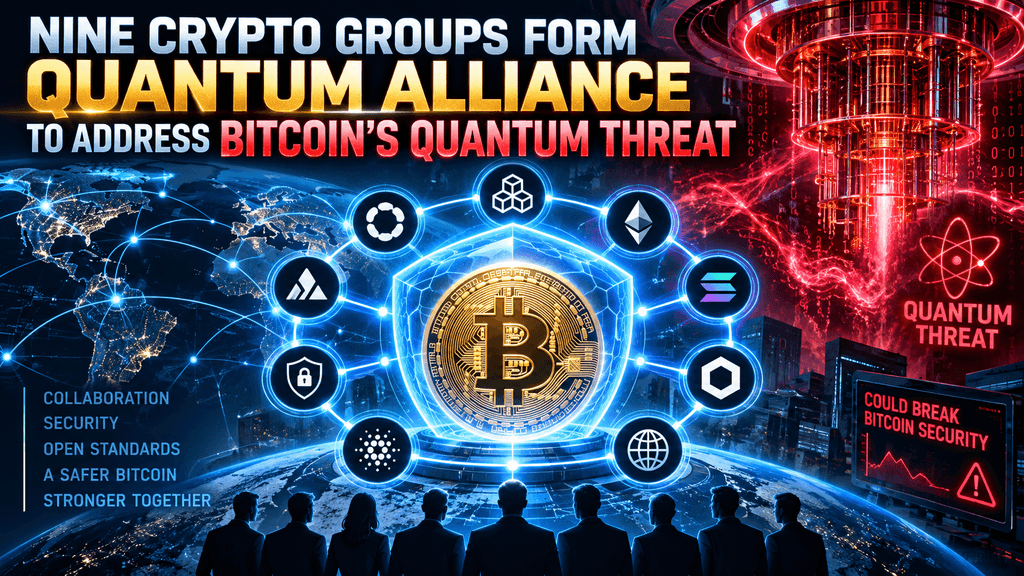
Quantum Alliance Sets Standards for Blockchain Quantum Readiness
In mid-October 2026, nine blockchain organizations announced the Quantum Alliance, an open standards initiative designed to establish clear, testable criteria for post-quantum readiness across networks, wallets, and infrastructure. The group formed as industry attention intensified around the long-term risk that sufficiently powerful quantum computers could one day derive private keys from publicly exposed public keys on chains that still rely on elliptic-curve cryptography. Estimates cited by the Alliance place between 6.04 million and 6.4 million bitcoin, roughly 30.2 percent of total supply, in addresses where public keys are already visible on-chain, including early pay-to-public-key outputs and reused addresses. At Bitcoin market prices near $81,500 in mid-October, that exposure represented hundreds of billions of dollars in notional value.
No existing quantum machine can perform such an attack today, yet recent research from Google Quantum AI and other groups has lowered estimated hardware requirements, while models developed by Alliance contributors point toward a possible early window around March 2028. The Alliance aims to replace marketing claims of “quantum resistance” with shared definitions, testing methods, benchmarks, and migration guidance modeled on the Internet Engineering Task Force’s open, evidence-based process. By creating verifiable open standards for signatures, key management, migration, and related systems, the Quantum Alliance seeks to give the industry a practical common language for assessing and improving quantum readiness before any cryptographically relevant quantum computer arrives.
Founding Members Span Protocols, Wallets, and Security Layers
The Quantum Alliance launched with contributors from Quantus, American Fortress, Intmax, Keystone, the Midnight Foundation, Postquant Labs, Abelian, The Vault, and Hacken. These organizations cover base-layer protocols, privacy-focused networks, rollups, hardware wallets, addressing systems, quantum-compute marketplaces, and security auditing. Quantus, a proof-of-work chain that has used NIST’s ML-DSA post-quantum signature standard from its first block, is represented by founder and CEO Christopher Smith. Postquant Labs, which develops the Quip Network for quantum hardware access, contributed co-founders Colton Dillion and Dr. Richard T. Carback III. Keystone’s CTO Aaron Chen brings experience in open-source, air-gapped hardware wallets. The Midnight Foundation, linked to Cardano’s privacy efforts, is represented by CTO Sebastien Guillemot.
American Fortress focuses on Send-to-Name payment addressing, while Intmax works on stateless zero-knowledge rollups. Abelian, The Vault, and Hacken round out the group with lattice-based and security-audit perspectives. According to reports from Crypto Briefing and The Quantum Insider, the roster was deliberately assembled to span every technical layer a large-scale migration would need to cross. The Alliance does not plan to launch a new blockchain or product; its role is to publish open criteria, testing procedures, and compatibility guidance so that any project claiming quantum readiness can be evaluated against the same yardstick rather than proprietary marketing language.
Exposed Public Keys Create a Permanent On-Chain Vulnerability Window
Bitcoin and many other chains rely on elliptic-curve signatures whose security rests on the difficulty of deriving a private key from a public key under classical computing assumptions. Once a public key appears on-chain, through early pay-to-public-key outputs, address reuse after spending, or certain script types, it remains permanently visible in the ledger. A sufficiently large, fault-tolerant quantum computer running Shor’s algorithm could, in principle, recover the corresponding private key and spend the funds. Alliance materials and supporting coverage estimate that 6.04 million to 6.4 million BTC currently sit in this exposed state, representing approximately 30.2 percent of supply.
Within that total, roughly 1.1 million BTC are widely attributed to early holdings associated with Satoshi Nakamoto. These coins cannot be moved or secured by their original owners if the private keys are lost or inaccessible. Europol and other analyses have separately shown that the primary quantum risk targets wallets and exposed keys rather than the ability to rewrite blockchain history itself. Because public keys already on-chain cannot be retroactively hidden, the exposure is structural. The Alliance treats this permanent visibility as a core reason standards and migration planning must begin while the threat remains theoretical.
Four Working Groups Target Migration, Privacy, Wallets, and Interoperability
The Alliance has organized its initial work into four parallel groups. The blockchain migration track examines how live networks can adopt new signature schemes without invalidating existing balances, including the practical handling of already-exposed public keys and dormant or inaccessible accounts. The post-quantum zero-knowledge systems group focuses on updating privacy and proof technologies so that they remain secure under quantum assumptions. Wallet security covers key management, hardware and software signing, and the practical steps users and custodians must take. Cross-chain compatibility aims to ensure that different networks can migrate without creating fragmentation or incompatible security models.
Proposals are expected to advance through public evidence, rough consensus, and working implementations rather than corporate size or token-weighted voting, following the IETF model. Everything the Alliance produces is intended to be published openly so that any team can test claims against the same criteria. This structure addresses the current absence of an industry-wide definition of “quantum-ready” even though NIST finalized its first post-quantum cryptography standards in August 2024. No single authority can compel a decentralized network to adopt those standards, which is precisely the coordination problem the Alliance is attempting to solve.
Google Research and IonQ Estimates Tighten the Hardware Timeline
Recent technical papers have reduced the estimated resources required for a cryptographically relevant attack on Bitcoin’s secp256k1 curve. A March 2026 Google Quantum AI study, co-authored with researchers linked to the Ethereum Foundation and Stanford, concluded that fewer than 500,000 physical qubits could suffice under specific hardware assumptions, approximately one-twentieth of earlier estimates. In September 2026, IonQ estimated that a fault-tolerant trapped-ion machine with roughly 20,000 physical qubits could solve the secp256k1 problem in about 26 days per attempt. Google’s later Willow-chip results, published around the same period, demonstrated roughly 40-fold error reduction in preparing the special quantum states needed for advanced calculations, although substantial scaling challenges remain and no machine yet exists that can execute a full attack.
These figures do not mean an attack is imminent; they illustrate how the engineering bar continues to move. Alliance contributors have developed a Quantum Doom Clock model that has pointed to March 2028 as an early possible window since early 2025. The model tracks qubit progress and is presented as an early-warning indicator rather than a firm deadline. Members themselves differ on exact timing: some view 2028 as a realistic planning horizon, while others emphasize that the precise date is unknown and that custodians must prepare for the possibility of an earlier arrival.
Migration Challenges Include Dormant Coins and Consensus Requirements
Moving existing funds to quantum-resistant schemes raises difficult technical and governance questions. Exposed public keys cannot simply be “upgraded” in place; owners who still control the private keys can generate new addresses under a post-quantum scheme and move the coins, but lost or inaccessible keys leave those balances permanently vulnerable under classical assumptions. Debates within the broader community have included proposals to freeze certain dormant coins versus allowing them to remain spendable under whatever future technology emerges. The Alliance’s migration working group is expected to examine practical pathways, including staged adoption, hybrid signature schemes, and support for both individual users and institutional multiparty systems.
Changing Bitcoin’s signature method would require broad agreement among developers, miners, exchanges, wallet providers, and users, an inherently slow process in a decentralized system. Other networks face similar coordination costs. Coinbase, which holds a significant share of client bitcoin, has publicly argued for beginning preparation now with flexible post-quantum signatures and a separate treatment of the lost-coin question so that it does not delay broader protections. The Alliance’s role is not to dictate outcomes but to supply shared technical criteria and migration guidance that networks can adapt.
Wallet and Key-Management Standards Form a Critical Defense Layer
Hardware and software wallets sit at the direct interface between users and the cryptographic risk. Keystone and other wallet-focused contributors emphasize air-gapped designs, secure key generation, and the need for clear upgrade paths once post-quantum schemes are standardized. Custodians must also consider whether their systems can complete a migration on the timeline an early quantum capability might impose. The Alliance’s wallet-security track is expected to produce benchmarks and testing methods so that claims of quantum-resistant key management can be independently verified.
This includes support for hybrid classical-plus-post-quantum constructions during transition periods and practical guidance on how users should handle existing exposed addresses. Because many institutional holdings rely on multiparty computation or specialized custody systems, the standards must accommodate both retail and large-scale operational realities. Progress in this area will determine how quickly individual and institutional holders can reduce their exposure once suitable algorithms and implementations are available.
Zero-Knowledge Systems Require Parallel Post-Quantum Updates
Privacy technologies that rely on zero-knowledge proofs face their own cryptographic transition. Many current constructions rely on assumptions that quantum algorithms could weaken. The Alliance’s dedicated track on post-quantum zero-knowledge systems aims to evaluate and standardize approaches that remain secure under quantum threat models. This work is particularly relevant for privacy-focused networks and rollups that use ZK technology for scalability or confidentiality.
Updating these systems without breaking existing applications or creating new attack surfaces requires careful engineering and shared test criteria. Contributors from projects already exploring lattice-based or other post-quantum primitives bring practical implementation experience. The goal is not to prescribe a single proof system but to ensure that claims of quantum resistance in the zero-knowledge domain can be measured against transparent benchmarks, reducing the risk that privacy layers become the weakest point in an otherwise upgraded stack.
Cross-Chain Compatibility Prevents Fragmented Security Models
As different networks migrate at different speeds, incompatible signature schemes or key formats could create friction or security gaps at bridges and interoperability layers. The Alliance’s cross-chain compatibility group is tasked with developing guidance so that migrations remain coherent across ecosystems. This includes shared definitions of readiness levels, testing procedures for hybrid environments, and recommendations that reduce the chance of one chain’s upgrade inadvertently weakening connections to another.
Because the crypto market still relies overwhelmingly on classical signatures, coordinated standards reduce the likelihood of isolated, marketing-driven claims that later prove difficult to verify or interoperate. Open publication of the resulting criteria is intended to allow any project, regardless of size, to adopt or test against the same framework.
Industry Context Shows Coordination Gaps Despite Existing NIST Standards
The U.S. National Institute of Standards and Technology finalized its first post-quantum cryptography standards in August 2024, providing algorithms such as ML-DSA that some projects have already begun adopting. Yet no centralized authority can compel decentralized networks to implement them, and the industry has lacked an agreed definition of what “quantum-ready” means for a live blockchain, a wallet, or a custodial system. Marketing claims of quantum resistance have proliferated without consistent testing methods.
The Quantum Alliance positions itself as the missing coordination layer: an open body that publishes definitions, test suites, benchmarks, and migration guidance so that claims can be evaluated on evidence rather than assertion. Coverage notes that the group’s IETF-style process deliberately avoids voting power weighted by company size or token holdings. Success will depend on whether networks, wallet providers, and auditors actually use the resulting materials.
Satoshi-Era Holdings Amplify Both Technical and Philosophical Questions
Approximately 1.1 million BTC associated with early mining are frequently cited within the broader exposure figure. These coins sit at addresses whose public keys are visible, and in many cases the corresponding private keys are presumed lost or inaccessible. The question of whether such coins should be frozen, left spendable, or subject to some other policy has generated sustained debate. Alliance members have expressed differing views on both the timeline and the appropriate treatment of vulnerable funds.
Some emphasize that whoever first develops a capable quantum machine could, in theory, claim those coins; others stress that planning for migration of controllable funds should not be delayed by unresolved philosophical questions about dormant holdings. The Alliance itself is not positioned as a governance body for Bitcoin or any other chain; its contribution is technical standards that can inform whatever policy choices communities eventually make.
Preparing Holders, Custodians, and Developers for Quantum Threats
For individual holders of bitcoin in addresses that have never revealed a public key, the immediate risk remains low because the public key is only exposed when funds are spent. Reused or early addresses carry higher structural exposure. Custodians and exchanges that control large volumes of client assets face operational questions about migration capacity and the timeline they must assume. Developers working on new networks or upgrades can already incorporate NIST-standardized algorithms and will benefit from shared testing criteria once the Alliance publishes them.
The broader market, still valued near $2.9 trillion and overwhelmingly dependent on classical signatures, gains a clearer path to measuring progress. Recent Europol guidance has similarly urged phased post-quantum transitions focused on wallets and exposed keys. The Alliance’s open standards approach is intended to make that transition more measurable and less fragmented.
Timeline Uncertainty Demands Preparation Regardless of Exact Dates
No quantum computer today can break secp256k1 at scale. Estimates of when a cryptographically relevant machine might appear continue to shift with each engineering advance, yet the direction of travel is toward lower resource requirements. Alliance contributors’ Quantum Doom Clock, Google’s qubit-reduction papers, and IonQ’s trapped-ion estimates collectively support treating the late 2020s as a planning horizon rather than a distant theoretical concern.
Members repeatedly note that the precise date is less important than whether migration systems can be ready if capability arrives earlier than expected. By focusing on verifiable standards, testing methods, and migration guidance rather than predicting a single year, the Alliance aims to give the industry tools that remain useful across a range of possible timelines.
🔥 Beyond the Headlines: What KuCoin 5.0 Means for You
Market news moves fast — but where you act on it matters just as much. This October, KuCoin launches KuCoin 5.0, transforming KuCoin into a rebuilt platform. Here's what actually changes for you:
-
One account for everything. Older platforms split your money across separate "spot," "margin," and "futures" accounts and expected you to understand why. KuCoin 5.0's unified account removes that entirely — deposit once, and everything is simply there (only available to VIPs for now).
-
Real-world assets (RWA). Tokenized exposure to traditional assets like commodities, right inside your crypto account. One of the fastest-growing segments in global finance is no longer reserved for institutions — you access it from the same balance you trade with.
-
Earn while you learn. Not ready to trade? KCUSD lets your stablecoins earn daily, auto-compounding interest. The lowest-stress way to put your idle deposit to work for 4% yield.
-
An AI assistant in plain language. Ask questions, get market context, understand what you're looking at — built into the platform, no jargon required.
-
An app that doesn't overwhelm. Faster, cleaner, and consistent — intuitive from the first tap, not after a tutorial.
-
Safety you can check, not just trust. A MiCAR-licensed EU entity, Proof of Reserves you can verify yourself, and internationally certified security (SOC 2 Type II, ISO 27001:2022).
Create your account in minutes — and start on the platform built for where crypto is going, not where it's been.
FAQs
What exactly is the Quantum Alliance, and when did it launch?
The Quantum Alliance is an open standards body formed by nine blockchain organizations in mid-October 2026. Its purpose is to define what post-quantum readiness means for networks, wallets, and infrastructure and to publish common testing criteria, benchmarks, and migration guidance so that quantum-resistance claims can be verified against shared evidence rather than marketing language.
Which organizations are founding members?
Founding contributors come from Quantus, American Fortress, Intmax, Keystone, the Midnight Foundation, Postquant Labs, Abelian, The Vault, and Hacken. The group includes protocol teams, privacy and rollup projects, hardware wallet developers, addressing specialists, quantum-compute marketplace builders, and security auditors.
How many bitcoins are considered quantum-exposed?
Alliance materials and supporting reports estimate 6.04 million to 6.4 million BTC, or about 30.2 percent of total supply, sit in addresses where the public key is already visible on-chain. This figure includes early pay-to-public-key outputs, reused addresses, and roughly 1.1 million BTC associated with early holdings.
Can a quantum computer steal bitcoin today?
No. Existing quantum machines lack the scale and error correction required to run Shor’s algorithm against secp256k1 at practical speed. The risk is prospective and depends on future hardware advances.
What are the four working groups?
The Alliance is organizing work around blockchain migration (including handling exposed keys and dormant accounts), post-quantum zero-knowledge systems, wallet security and key management, and cross-chain compatibility. Proposals advance through public evidence and working implementations.
Why create new standards when NIST already published post-quantum algorithms?
NIST standards provide cryptographic building blocks, but the industry has lacked an agreed definition of what “quantum-ready” means for a live blockchain, a wallet, or a custodial system, and no single party can compel decentralized networks to adopt any particular scheme. The Alliance supplies the missing shared testing and migration framework.
Disclaimer: This content is for informational purposes only and does not constitute investment advice. Cryptocurrency investments carry risk. Please do your own research (DYOR).