

Where Should Investors Move Money During Global Market Turmoil?
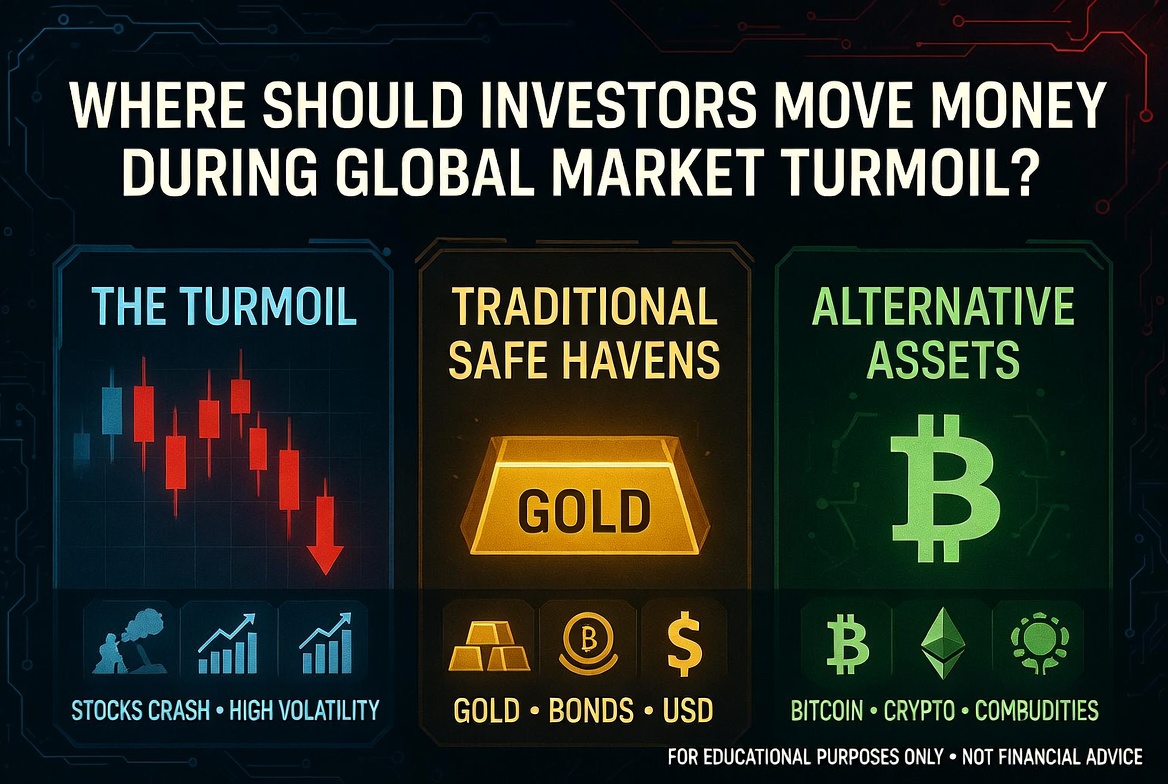
Periods of intense market volatility, whether driven by geopolitical conflict, inflation concerns, or macroeconomic shifts, force investors to reassess where their capital should be positioned. History shows that sharp downturns in equities, bond stress, or commodity price shocks often prompt reallocations toward assets perceived as safer or more resilient. For long-term and tactical investors alike, clarity on which assets tend to hold value, which ones decline, and why can make the difference between capital preservation and significant losses.
In recent months, global markets reacted sharply to renewed military tensions, shifts in monetary policy expectations, and inflation volatility. Risk assets, such as major stock indices, experienced significant drawdowns as fear and uncertainty rose among traders. On certain days in early March, the S&P 500 slid more than 1% amid heightened risk aversion, while global benchmarks such as the MSCI World Index posted similar declines as geopolitical headlines dominated trading floors.
As a result, many investors rotated capital into traditional safe-haven assets. One notable example is the surge in money held in U.S. money market funds, which recently reached record levels near $8 trillion, a strong indication that market participants are prioritizing liquidity and capital preservation over risk exposure.
Gold, long regarded as a cornerstone of crisis‑era portfolios, has also reflected this risk‑off sentiment. During times of elevated uncertainty, gold prices have often risen as investors seek a store of value outside traditional paper assets. In March 2026, gold recorded gains even as broader markets struggled, demonstrating its ongoing role as a hedge against turmoil.
At the same time, the rise of digital assets, especially Bitcoin, has introduced new considerations for capital allocation during turbulent periods. Bitcoin’s market structure, with 24/7 trading, decentralized liquidity, and global access, sets it apart from traditional assets. However, empirical behavior during stress events reveals that Bitcoin often shares downside risks with equities in the short term. For example, during geopolitical escalations in March 2026, Bitcoin initially experienced a drop alongside global stock markets before stabilizing later in the week.
Meanwhile, altcoins, digital tokens beyond Bitcoin, have shown deeper volatility and sharper drawdowns due to thinner liquidity and higher leverage concentration among traders. This mixed performance underscores the importance of understanding not just where capital is moved, but why.
Investors today face a broader set of tools and instruments than ever before. Exchanges such as KuCoin offer spot trading, futures markets, staking, and Copy Trading, each providing ways to adjust exposure dynamically. These tools, combined with thoughtful allocation strategies and risk management practices, can help investors navigate market turmoil in a disciplined and informed way.
In the sections that follow, we’ll explore traditional safe havens, digital asset behavior, alternative strategies, and practical guidance on where investors might consider moving money during periods of heightened uncertainty.
Understanding Market Turmoil: What Drives Capital Rotation?
Market turmoil does not happen randomly. It is usually triggered by a combination of geopolitical shocks, economic uncertainty, and financial system stress, which together push investors to reduce risk exposure. Understanding these drivers helps explain why money flows out of certain assets and into others during volatile periods.
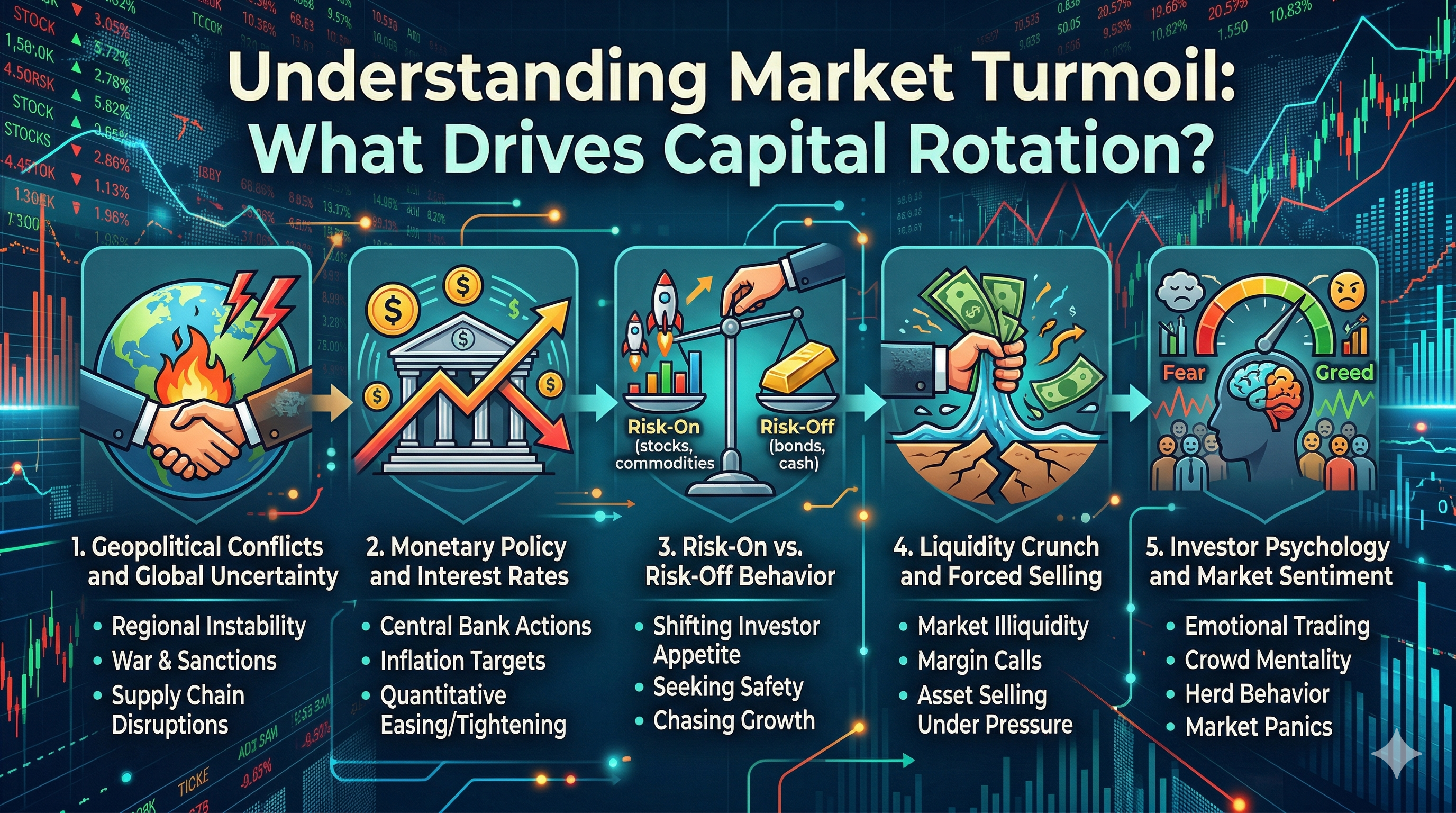
1. Geopolitical Conflicts and Global Uncertainty
Military conflicts and geopolitical tensions are among the fastest catalysts for market instability. When uncertainty rises, such as during the recent escalation involving the United States and Iran, investors often react immediately by selling risk assets and moving into safer alternatives. These reactions are driven less by fundamentals and more by uncertainty and fear of escalation.
Markets tend to price in worst-case scenarios quickly. For example, during recent tensions, global equities declined while oil prices surged due to concerns over supply disruptions. According to market updates, geopolitical shocks can trigger simultaneous moves across asset classes, including equities, commodities, and crypto.
This creates a chain reaction:
-
Stocks fall due to reduced growth expectations
-
Energy prices rise due to supply fears
-
Investors shift capital into safe havens
2. Monetary Policy and Interest Rates
Central banks play a major role during market stress. When inflation is high or economic growth slows, central banks may adjust interest rates or liquidity policies, which directly affect asset prices.
Higher interest rates typically reduce liquidity in the system, making risk assets less attractive. Investors can earn returns from safer instruments like government bonds or money market funds instead. This dynamic has been visible in recent months, where tightening financial conditions pushed investors toward low-risk, liquid instruments.
Data shows that assets in U.S. money market funds reached nearly $8 trillion, reflecting strong demand for safety and liquidity during uncertain conditions.
This shift highlights a key point: when liquidity tightens, risk assets struggle.
3. Risk-On vs. Risk-Off Behavior
Investors often describe market conditions using two modes:
-
Risk-on: Investors are willing to take risk (stocks, crypto, growth assets rise)
-
Risk-off: Investors avoid risk (safe havens rise, equities and crypto fall)
During turmoil, markets enter a risk-off phase. In this environment:
-
Equities decline
-
High-yield assets lose demand
-
Safe havens like gold and government bonds gain interest
Bitcoin and other cryptocurrencies often fall into the risk-on category, at least in the short term. During sudden shocks, Bitcoin has shown correlation with equities, meaning it can drop alongside stock markets before stabilizing. This behavior was observed during recent geopolitical tensions, where BTC initially declined before recovering later.
This pattern is also supported by broader research showing that cryptocurrencies tend to behave like risk assets during periods of stress, rather than consistent safe havens.
4. Liquidity Crunch and Forced Selling
One of the most important drivers of market turmoil is liquidity pressure. When markets drop quickly, leveraged traders may face margin calls, forcing them to sell positions to cover losses. This can accelerate declines across multiple asset classes.
In crypto markets, this effect is even more visible due to high leverage in derivatives trading. Large liquidation events can push prices down rapidly, even if the underlying fundamentals have not changed.
For example:
-
A sudden drop in Bitcoin can trigger futures liquidations
-
Liquidations create more selling pressure
-
Prices fall further in a short time
This feedback loop explains why markets often overreact in the short term.
Platforms like KuCoin provide tools such as stop-loss orders, margin controls, and futures hedging, which can help traders manage this type of risk more effectively.
5. Investor Psychology and Market Sentiment
Finally, market turmoil is heavily influenced by human behavior. Fear spreads quickly, especially in the age of real-time news and social media. Investors often react to headlines before fully understanding the situation.
During volatile periods:
-
Negative news leads to panic selling
-
Social sentiment turns bearish
-
Short-term traders exit positions quickly
This creates momentum-driven moves that may not reflect long-term fundamentals.
Understanding this helps investors stay grounded. Instead of reacting emotionally, experienced participants focus on data, diversification, and risk management.
Market turmoil is driven by a mix of geopolitics, monetary policy, liquidity conditions, and investor psychology. These forces push capital away from risk assets and into safer instruments.
For investors, the goal is not to predict every move, but to understand how and why money flows during crises, and position accordingly.
Traditional Safe Havens: Where Money Usually Flows First
When markets become unstable, investors tend to move capital into assets that have a long track record of preserving value. These are commonly referred to as safe havens, and they play a central role during periods of global uncertainty. While no asset is completely risk-free, some have historically shown the ability to hold value better than others when equities and higher-risk investments decline.
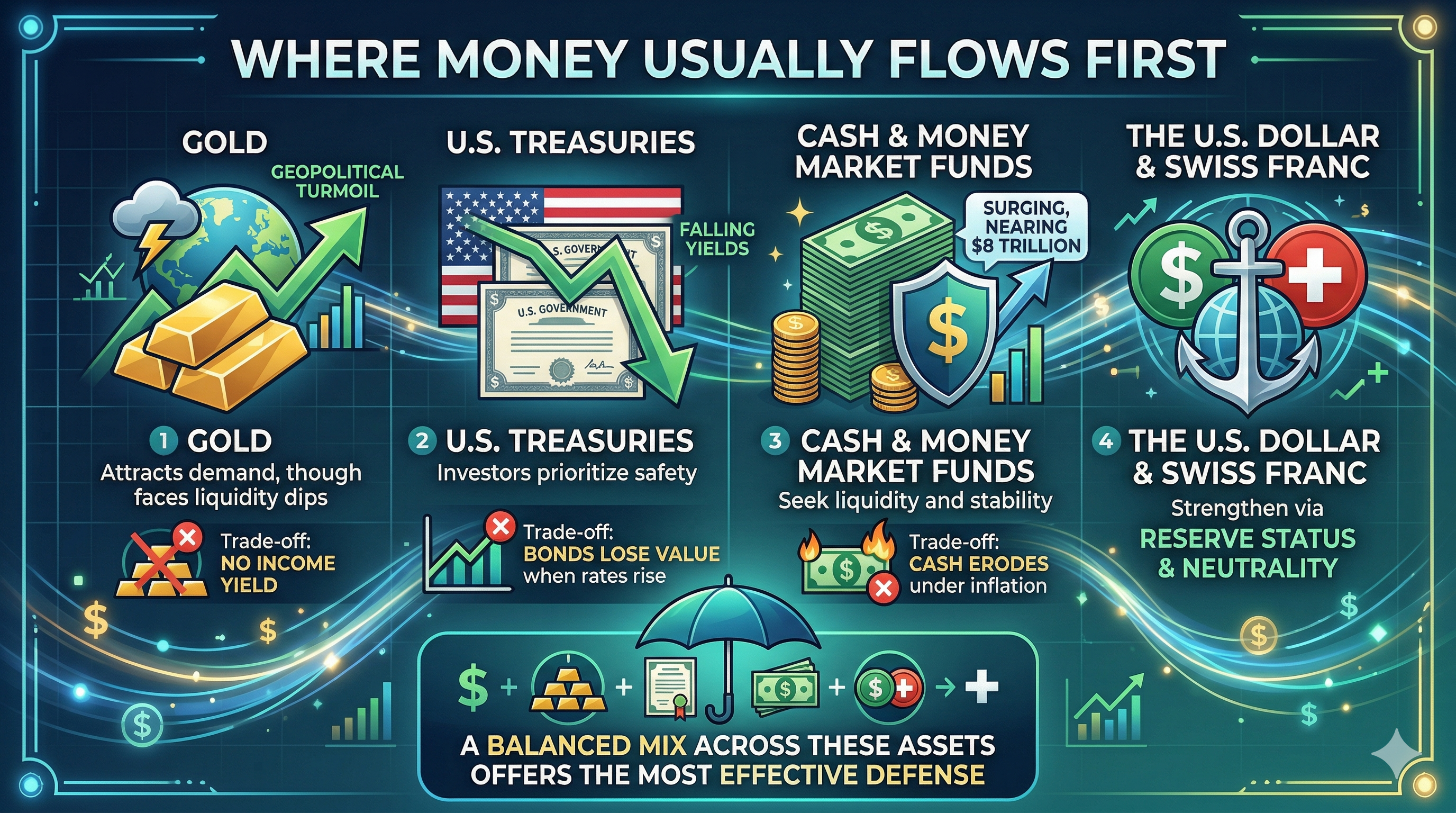
Gold remains one of the most widely recognized safe-haven assets. Its appeal comes from its independence from any single government or financial system, as well as its long history as a store of value. During periods of geopolitical tension and inflation, gold often attracts strong demand. Recent data shows that gold prices moved higher during the latest wave of geopolitical concerns, reinforcing its role as a defensive asset in uncertain markets. However, it is important to note that gold is not immune to short-term volatility. In situations where liquidity becomes tight across markets, even gold can experience temporary declines as investors sell assets to raise cash.
Government bonds, particularly U.S. Treasury securities, are another key destination for capital during market stress. These instruments are backed by the U.S. government and are widely considered among the safest investments globally. When demand for Treasuries rises, their prices increase and yields fall, reflecting investors’ willingness to accept lower returns in exchange for safety. During recent market turbulence, Treasury yields declined as investors shifted away from equities and into fixed-income assets, highlighting their role in capital preservation. This pattern has been observed repeatedly across financial crises, reinforcing the importance of bonds in diversified portfolios.
Cash and cash equivalents, such as money market funds, also play a major role during turbulent periods. Investors often prioritize liquidity, ensuring that funds are readily available without exposure to market volatility. This behavior is reflected in the sharp rise in assets held in U.S. money market funds, which recently approached $8 trillion, indicating a strong preference for low-risk, liquid holdings. While cash does not generate high returns, it provides stability and flexibility, allowing investors to re-enter markets when conditions improve.
Currencies also play a role in safe-haven strategies. The U.S. dollar, for example, tends to strengthen during global uncertainty because it is widely used in international trade and held as a reserve currency by central banks. Similarly, the Swiss franc has historically been viewed as a stable currency due to Switzerland’s strong financial system and political neutrality. During periods of geopolitical stress, capital often flows into these currencies, increasing their value relative to others.
Despite their advantages, traditional safe havens come with limitations. Gold does not produce income, bonds can lose value if interest rates rise, and holding large amounts of cash can erode purchasing power during inflationary periods. This means that while these assets provide stability, they may not offer strong long-term growth on their own.
Understanding how these safe havens function allows investors to make more informed allocation decisions during market turmoil. Rather than relying on a single asset, combining gold, bonds, cash, and currencies can help balance risk and maintain flexibility. This foundation also creates room to consider other asset classes, including digital assets, which behave differently under stress and may offer additional diversification opportunities.
Digital Assets During Market Turmoil: Opportunity or Risk?
Digital assets have added a new layer to how investors think about capital allocation during unstable market conditions. Unlike traditional instruments, cryptocurrencies operate on decentralized networks, trade around the clock, and are accessible globally. These features make them attractive in certain situations, but their behavior during market stress is not always aligned with the idea of being a “safe haven.”
Bitcoin is often the first point of focus. It is the largest cryptocurrency by market capitalization and because of its scale and liquidity, Bitcoin tends to be more stable than other digital assets, yet it still reacts to global risk sentiment. When geopolitical tensions rise or macroeconomic uncertainty increases, Bitcoin frequently experiences short-term declines alongside equities. This pattern was visible during recent market stress, where BTC dropped before stabilizing once selling pressure eased.
This behavior highlights an important point: Bitcoin does not consistently act like gold or government bonds during crises. Instead, it often behaves like a risk-sensitive asset in the short term, especially when markets react quickly to breaking news. Research and market observations suggest that correlations between Bitcoin and major stock indices tend to increase during periods of stress, meaning both asset classes can move in the same direction temporarily.
At the same time, Bitcoin has shown the ability to recover faster than many traditional assets after the initial shock passes. This is partly due to its global nature and the absence of centralized control. Investors in different regions can continue trading regardless of local banking restrictions, which can support demand even when traditional systems are under pressure. Over longer time frames, this has led some investors to treat Bitcoin as a complementary asset rather than a direct replacement for safe havens.
Altcoins present a different risk profile. Assets such as Ethereum, Solana, and other smaller-cap tokens tend to experience larger price swings due to lower liquidity and higher speculative activity. During periods of uncertainty, these assets often decline more sharply than Bitcoin. In recent market movements, while Bitcoin saw moderate pullbacks, several altcoins recorded double-digit losses within short time frames. This reflects their sensitivity to investor sentiment and the fact that capital usually exits smaller assets first when risk appetite declines.
Another factor to consider is the role of leverage in crypto markets. Many traders use derivatives to amplify potential returns, but this also increases downside risk. During volatile periods, sharp price movements can trigger liquidations, where positions are automatically closed to prevent further losses. These events can accelerate market declines and create rapid price swings, even without major changes in underlying fundamentals.
Despite these risks, digital assets still offer certain advantages. Their accessibility, speed of settlement, and independence from traditional banking systems can make them useful in specific scenarios, particularly in regions facing financial instability or capital controls. For investors with a structured approach, cryptocurrencies can be part of a broader diversification strategy rather than a standalone solution.
Managing exposure is key. Platforms like KuCoin provide access to spot markets, futures trading, and tools such as stop-loss orders, which allow users to control risk more effectively. These features can help reduce the impact of sudden market movements, especially when combined with disciplined position sizing.
Overall, digital assets should be viewed with balance. They can offer opportunities, especially during recovery phases, but they also introduce volatility that requires careful management. Understanding their behavior during stress periods helps investors decide how much exposure is appropriate within a diversified portfolio.
Alternative Strategies and Diversification During Market Stress
When markets turn unstable, relying on a single “safe” asset is rarely enough. Investors who manage risk effectively tend to spread exposure across different asset classes, each reacting differently to the same event. This approach reduces the chance that one negative move wipes out a large portion of a portfolio.
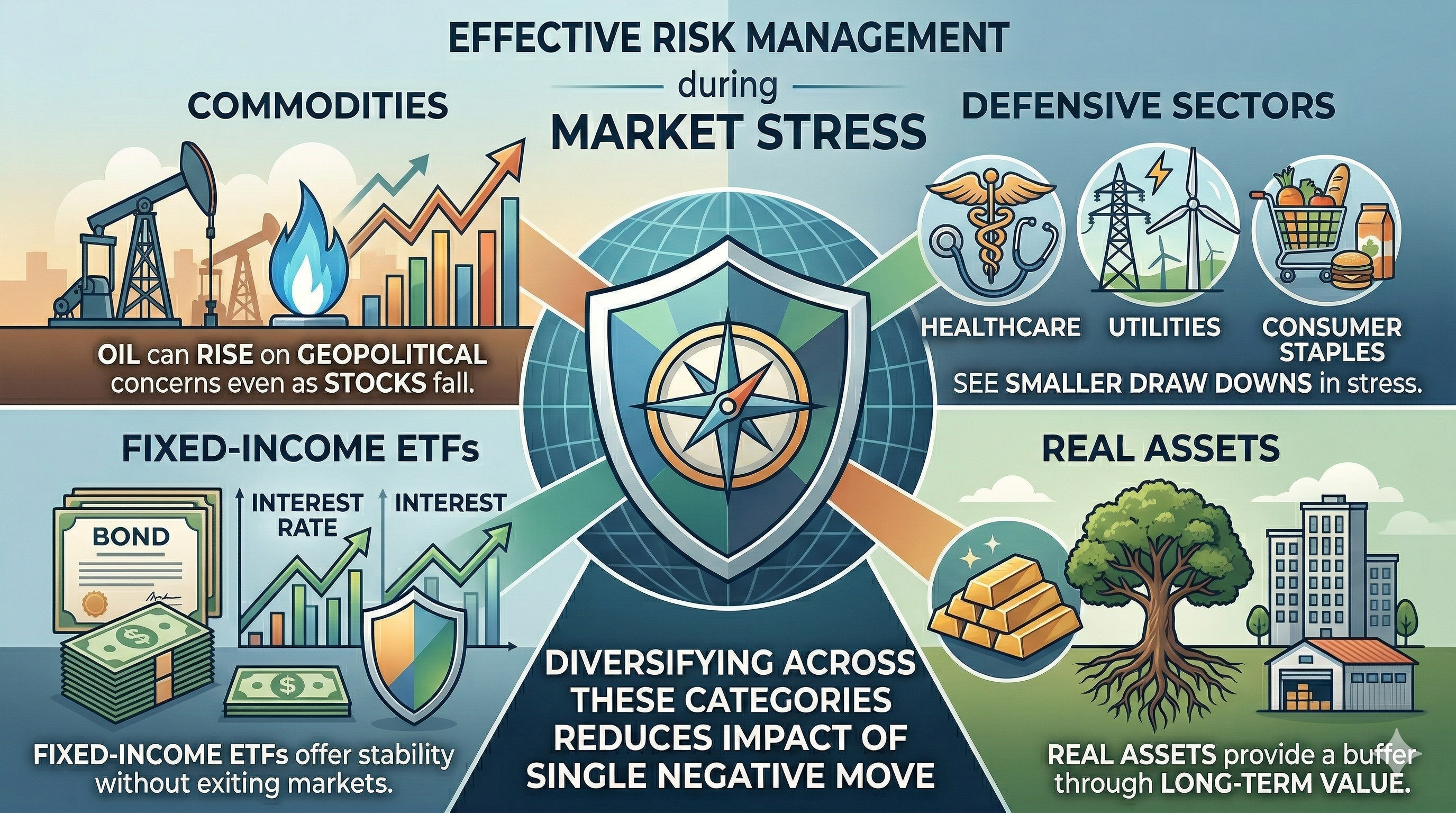
Commodities beyond gold can play a role here. Energy assets, especially oil and natural gas, often move in response to geopolitical developments rather than equity market sentiment. During recent tensions in the Middle East, oil prices rose on supply concerns even as stock markets declined. This shows how certain assets can benefit from the same events that hurt others, creating balance within a portfolio. However, commodities can be unpredictable and are heavily influenced by external factors such as production decisions and global demand.
Defensive sectors within equities also offer a more stable alternative compared to high-growth stocks. Industries like healthcare, utilities, and consumer staples tend to perform better during downturns because demand for their products remains relatively steady. While these sectors may not deliver strong growth during bull markets, they often experience smaller drawdowns when broader indices fall. For investors who want to stay in equities without taking on excessive risk, this can be a practical adjustment rather than a full exit.
Exchange-traded funds (ETFs) provide another way to manage uncertainty. Broad-market ETFs allow diversification across multiple companies, while sector-specific or bond-focused ETFs can shift exposure toward safer areas. Fixed-income ETFs, in particular, have seen increased demand during volatile periods as investors look for income and lower volatility. This aligns with the broader movement into government bonds and money market instruments seen during recent market stress.
Real assets, including real estate and infrastructure, can also contribute to stability. These investments are often tied to long-term contracts or physical value, which can make them less sensitive to short-term market swings. That said, they are not completely immune to economic slowdowns, especially when interest rates rise or financing becomes more expensive.
The key idea behind diversification is not to eliminate risk entirely, but to spread it in a controlled way. Instead of trying to predict which single asset will perform best, investors build a mix that can handle different outcomes. This might include a combination of safe havens, selective equity exposure, and a measured allocation to digital assets.
Execution matters just as much as strategy. Platforms like KuCoin allow investors to adjust positions quickly, whether through spot trading or hedging tools in futures markets. Used carefully, these tools can help manage exposure without overreacting to short-term volatility.
In uncertain conditions, flexibility becomes one of the most valuable advantages an investor can have. A diversified approach, combined with disciplined decision-making, helps maintain stability while keeping opportunities open for when marConclusion, Making Smart Allocation
Decisions in Uncertain Markets
Market turmoil forces investors to make decisions under pressure, often with incomplete information. The key is not to react emotionally, but to understand how different assets behave and adjust exposure in a measured way. Across recent market cycles, one pattern remains consistent: capital moves toward stability, liquidity, and flexibility when uncertainty rises.
Traditional safe havens such as gold, government bonds, and cash continue to play a central role. They help reduce downside risk and provide liquidity when markets move quickly. At the same time, they come with trade-offs, including lower returns and sensitivity to inflation or interest rate changes. This means they are most effective when used as part of a broader allocation rather than a full replacement for growth assets.
Digital assets add another layer of opportunity, but also complexity. Bitcoin, while more established than other cryptocurrencies, still reacts to global sentiment and can decline during sudden shocks. Smaller digital assets tend to amplify these moves. For this reason, crypto exposure is often more effective when kept at a level that fits an investor’s risk tolerance, rather than being relied on as a primary defensive position.
A balanced approach usually works best. Combining different asset types, including safe havens, selective equities, and controlled exposure to digital assets,helps reduce overall portfolio volatility. Defensive sectors, commodities, and diversified instruments like ETFs can also provide stability without fully stepping out of the market.
Risk management remains essential. Sudden price movements, especially in leveraged environments, can lead to larger-than-expected losses. Tools such as stop-loss orders, position sizing, and hedging strategies can help limit downside. Platforms like KuCoin offer access to both spot and futures markets, allowing investors to adjust exposure depending on market conditions, but these tools should always be used with discipline.
Ultimately, there is no single “perfect” place to move money during global market turmoil. The goal is not to avoid risk entirely, but to manage it in a structured way. Investors who stay diversified, remain informed, and avoid reactive decisions are generally better positioned to navigate uncertainty and take advantage of opportunities when stability returns.
FAQs
What is the safest place to put money during market turmoil?
There is no single safest option, but investors often move funds into assets like government bonds, gold, and cash equivalents. These are known for lower volatility and high liquidity. However, each comes with trade-offs, so combining them usually provides better balance.
Is holding cash a good strategy during volatility?
Holding cash can reduce exposure to market swings and provide flexibility. It allows investors to re-enter markets when prices stabilize. The downside is that cash does not generate strong returns and may lose value over time due to inflation.
Does gold always go up during crises?
Gold often performs well during uncertainty, but not always. In some cases, it can decline temporarily if investors need liquidity. Over longer periods of instability, it has generally maintained its role as a store of value.
Can Bitcoin replace traditional safe havens?
Bitcoin has different characteristics and does not consistently behave like a safe haven. It can fall during short-term market stress but may recover quickly. Most investors treat it as a complementary asset rather than a replacement.
How do altcoins perform during market downturns?
Altcoins usually experience larger declines compared to Bitcoin due to lower liquidity and higher speculation. They tend to be more sensitive to changes in investor sentiment.
Should investors completely exit the market during turmoil?
Not necessarily. Exiting entirely can lead to missed recovery opportunities. Many investors prefer adjusting exposure instead, shifting toward safer assets while maintaining some market participation.
What role does diversification play in volatile markets?
Diversification spreads risk across different asset types, reducing the impact of any single loss. This approach helps stabilize portfolios during uncertain periods.
How can investors manage risk effectively?
Risk can be managed through proper position sizing, diversification, and tools like stop-loss orders. Using platforms that offer flexible trading options, such as KuCoin, can also help investors adjust positions as market conditions change.