

Understanding ERC-8004: On-Chain Identity Standard for AI Agents
2026/04/25 10:20:46
Introduction
The autonomous AI agent economy is experiencing a fundamental infrastructure gap. While protocols like MCP, A2A, and x402 have enabled AI agents to communicate, discover, and monetize their services, none of these standards answer a critical question: how do you know who you're dealing with?
In February 2026, ERC-8004 went live on Ethereum mainnet, establishing the first standardized on-chain identity, reputation, and validation layer for AI agents. This development represents a watershed moment for the AI crypto ecosystem, creating the trust infrastructure necessary for autonomous agents to operate across organizational boundaries, build verifiable track records, and participate in a decentralized agent economy. Without identity and reputation systems, the promise of AI agents seamlessly transacting on behalf of users remains limited to closed systems. ERC-8004 changes this equation fundamentally.
For readers seeking foundational context on ERC-8004, check out these essential topics for necessary background:
-
AI Agent - Understanding AI agent fundamentals and their role in cryptocurrency ecosystems
-
AI Crypto - Exploring the broader convergence between artificial intelligence and blockchain technology
-
x402 - The disruptive payment protocol enabling AI agents to monetize services
-
MCP - How the Model Context Protocol shapes Web3 automation for AI agents
What Is ERC-8004: Ethereum's Trust Layer for Autonomous AI
ERC-8004 represents Ethereum's answer to a pressing problem in the AI agent ecosystem. While the AI agent tooling landscape has matured rapidly with protocols enabling agent-to-agent communication (A2A), standardized interfaces (MCP), and native payment streams (x402), a critical piece of infrastructure remained missing: a standardized way to discover, evaluate, and trust AI agents operating across organizational boundaries.
The standard establishes what researchers call a "decentralized Trust and Identity Layer" for autonomous AI agents. Unlike traditional identity systems designed for humans, ERC-8004 specifically addresses the machine-to-machine context where AI agents operate at scale, making autonomous decisions and executing transactions without direct human oversight.
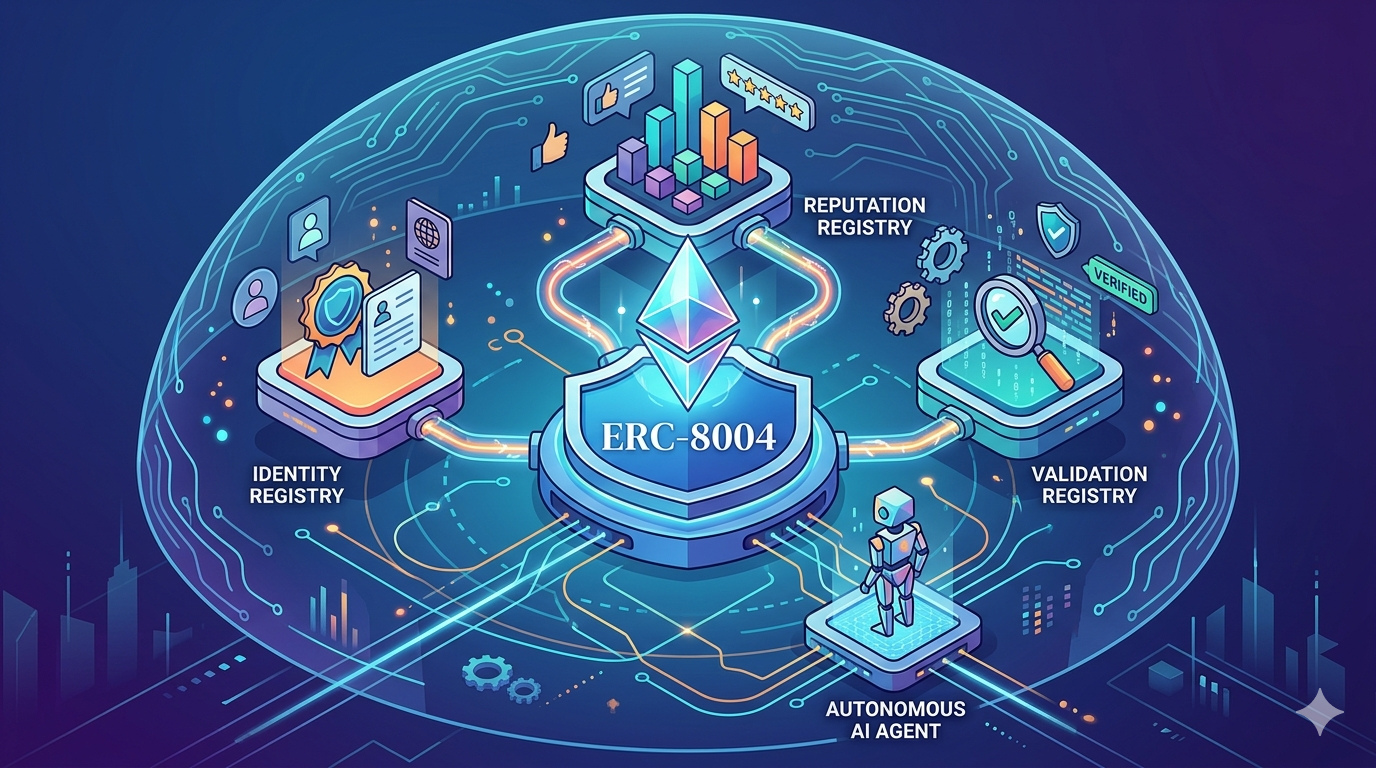
At its core, ERC-8004 creates three lightweight on-chain registries that work together to enable trustless agent interactions. The Identity Registry assigns each AI agent a unique on-chain identifier built on the ERC-721 NFT standard, creating what amounts to a digital passport that persists across interactions and cannot be arbitrarily deleted or blocked. This identity links to a metadata file containing service endpoints, supported trust models, and machine-readable capabilities. The Reputation Registry provides a standardized interface for recording interaction history, feedback scores, and performance tags, enabling data-driven evaluation before any transaction occurs. The Validation Registry, still evolving, standardizes how proof of task completion gets recorded, supporting multiple validation strategies including zkML proofs, TEE oracles, and staked re-execution.
The standard was formally ratified in January 2026 and deployed to Ethereum mainnet in February 2026, with adoption quickly spreading to Layer 2 networks where registration costs remain under $1 per agent.
The Three Registries: Identity, Reputation, and Validation
Understanding ERC-8004 requires examining each registry in detail, as together they form a complete trust infrastructure for autonomous agents.
The Identity Registry serves the fundamental question of "who is the agent?" Each agent receives a unique ERC-721 token serving as its on-chain identity. This token links to a JSON metadata file-what developers call an "agent card"-containing the agent's name, functionality description, service endpoints using protocols like MCP or ENS, and payment addresses.
The design choice to build on ERC-721 means identity is globally unique, transferable, and persistent. Critically, the metadata uses URI storage pointing to IPFS or on-chain Base64 data, ensuring that an agent's registration file cannot be arbitrarily deleted or blocked by any single entity. Each token resolves to a structured "digital resume" defining connectivity protocols, supported trust models, and machine-readable capabilities. The registry also supports "operators"-entities authorized to update an agent's technical capabilities without transferring ownership itself-and uses ERC-712 typed signatures and ERC-1271 smart contract wallet compatibility to ensure cryptographic security for metadata changes.
The Reputation Registry addresses "how has it performed?" This registry provides the standard interface for agent evaluation and feedback. Standardized feedback uses A2A/MCP tags including uptime, success rate, and yield metrics, enabling quantitative comparison across agents. The system incorporates anti-spam measures through x402 payment proofs, ensuring reviews are cryptographically tied to real economic transactions and preventing fake ratings. Storage follows a hybrid approach: critical values remain on-chain for smart contract composability while rich metadata sits on IPFS for efficiency. The UX leverages EIP-7702 gas sponsorship, allowing clients to submit verified feedback without paying transaction fees. Before initiating any task, clients can filter for agents matching their security requirements by inspecting the
supportedTrust field in each agent's registration.The Validation Registry answers "is the work correct?" This registry validates the correctness of specific tasks in real-time, supporting multiple validation models: zkML for mathematical proof, TEEs (Trusted Execution Environments) as oracle inputs, and Staked Re-execution where validators risk capital on their assessments. The system enables "progressive finality," creating a soft-to-hard confirmation flow where initial assessments can be upgraded to definitive proofs. Validators return standardized scores from 0-100, enabling both pass/fail determinations and nuanced probabilistic assessments. Importantly, the standard leaves specific incentive structures-staking requirements, slashing conditions, and reward mechanisms-to validation protocols built atop the registry interface, allowing flexibility for different use cases.
Why ERC-8004 Matters for the AI Crypto Ecosystem
The significance of ERC-8004 extends far beyond technical specification-it represents the foundational infrastructure enabling a genuinely autonomous agent economy to emerge on blockchain networks.
Before ERC-8004, AI agent interactions relied on ad-hoc trust mechanisms. Organizations building agent systems had no standardized way to evaluate agents from other organizations, chains, or jurisdictions. The existing trust models were built for humans-credit scores, identity verification, reputation systems designed for manual review-not for machines operating autonomously at scale. This created a fundamental bottleneck: even as protocols enabled agents to communicate and transact, there was no reliable way to distinguish legitimate agents from malicious ones, no portable reputation system that followed an agent across different platforms, and no standardized validation mechanism to verify task completion.
ERC-8004 solves these problems by creating portable identity, verifiable reputation, and on-chain validation that works across organizational boundaries. The implications cascade across every sector where AI agents operate. In DeFi, autonomous trading agents can now build reputation through verifiable trade performance, allowing investors to allocate capital with full transparency into historical results. In enterprise automation, AI agents handling supply chain, logistics, or customer service can be evaluated and trusted by partners they've never worked with before, based on cryptographically secured reputation scores. In the broader AI crypto landscape, ERC-8004 enables the vision of agents hiring other agents, evaluating reliability instantly, and operating without central authorities-the core promise of a decentralized agent economy.
The standard also enables entirely new business models. Validators can evolve into agent auditors, earning fees for verifying autonomous AI workflows. Those that build or integrate with validator smart contracts are positioned to capture significant demand as the agent economy scales. The permissionless, audited nature of the standard-controlled by no single entity-ensures that trust emerges organically from the network rather than being imposed by any central authority.
Real-World Applications and Use Cases
ERC-8004's practical applications demonstrate how the standard enables AI agents to operate in production environments requiring trust and accountability.
Consider an AI agent sourcing shipping quotes for an online retailer. Under ERC-8004, the agent first registers on the Identity Registry, receiving an ERC-721 NFT as its digital passport. When partner logistics companies evaluate the agent, they inspect its reputation score from the Reputation Registry-historical performance data including successful deliveries, response times, and customer satisfaction metrics. Based on this evaluation, partners can confidently submit requests. After transaction completion, partners submit feedback to the Reputation Registry, contributing to the agent's permanent record. The entire process happens without human intervention, yet each party has verifiable confidence in the other's capabilities and track record.
In decentralized finance, ERC-8004 enables a fundamental transformation in how capital allocates to algorithmic trading strategies. Autonomous trading agents can now demonstrate verifiable track records through on-chain performance data. Investors can evaluate historical yields, risk-adjusted returns, and consistency before committing capital. The reputation system ensures that poor-performing agents cannot simply rebrand and start fresh-identity persistence means reputation carries forward, creating accountability that didn't previously exist for autonomous trading systems.
The cross-industry implications are equally significant. Healthcare AI agents handling appointment scheduling, insurance claims processing, or diagnostic support can demonstrate compliance track records. Legal AI agents can show case outcome histories. Financial advisory agents can display portfolio performance data. In each scenario, ERC-8004 provides the trust infrastructure that makes these autonomous interactions viable at scale.
Technical Implementation and Development Considerations
For developers implementing ERC-8004, understanding the technical architecture enables effective integration.
The registries deploy as singletons on each chain-one Identity Registry, one Reputation Registry, and one Validation Registry per blockchain network. This design choice minimizes storage costs while ensuring consistent identity across the network. Each registry uses URIs or IPFS hashes for off-chain data storage, keeping on-chain footprint minimal and costs low. Layer 2 networks offer the most cost-effective deployment, with registration costs under $1 per agent.
Trust mechanisms are tiered based on use case requirements. For low-stakes interactions, simple reputation scores suffice. For medium-stakes transactions, crypto-economic validation through staking provides additional security. For the highest-stakes applications, zkML or TEE-based validation delivers mathematical certainty. Agents declare their supported trust mechanisms via the
supportedTrust field in registration files, allowing clients to filter for appropriate security levels.Security considerations include the ever-present Sybil attack risk, which ERC-8004 addresses through public, standardized signals and reviewer reputation systems. The immutable nature of on-chain pointers and IPFS hashes ensures that registration data cannot be retroactively altered. However, the standard cannot guarantee that an agent's advertised capabilities are actually functional or non-malicious-this remains the responsibility of clients to verify through reputation and validation systems.
The Future of Agent Identity: What's Next for ERC-8004
ERC-8004 represents a foundation rather than a finished product. The standard's architecture leaves room for significant evolution as the agent economy matures.
Expected developments through 2026 and beyond include expansion of the Validation Registry to support more sophisticated proof mechanisms, integration with cross-chain identity standards enabling agents to maintain consistent reputation across multiple blockchains, and development of specialized validator networks focused on specific verticals like DeFi, healthcare, or legal. The ecosystem will likely see specialized marketplaces emerge where agent reputation becomes tradeable, where identity NFTs appreciate in value based on performance, and where validation services become a distinct professional category.
For the AI crypto convergence more broadly, ERC-8004 addresses the identity gap that has constrained autonomous agent adoption. As more agents come online and begin transacting, the reputation data accumulated will create powerful network effects-early participants building track records that compound over time. The standard positions Ethereum as the foundational trust layer for this emerging economy.
Should I Invest in AI Agent Tokens on KuCoin
The ERC-8004 launch provides context for evaluating AI agent-related investments, though participants should understand both the opportunity and risks.
Bullish Considerations
-
Infrastructure maturation: ERC-8004 addresses a critical gap in AI agent infrastructure, enabling production-ready autonomous agent applications
-
Network effects: As more agents register and build reputation, the ecosystem becomes more valuable and adoption accelerates
-
Multi-sector applicability: The standard applies across DeFi, enterprise automation, healthcare, legal, and numerous other verticals
-
Ethereum positioning: The standard cements Ethereum's role as the trust layer for the agent economy
Risk Factors
-
Early-stage technology: Autonomous AI agents remain in early development phases with significant technical hurdles remaining
-
Adoption uncertainty: Infrastructure availability does not guarantee widespread adoption by enterprises and users
-
Regulatory evolution: Both AI and cryptocurrency face uncertain regulatory frameworks globally
-
Security risks: Autonomous agents with on-chain identity and access to funds present novel security considerations
Strategic Framework
ERC-8004 represents meaningful infrastructure progress for the AI agent ecosystem but should be evaluated within overall portfolio context. Consider position sizing based on conviction in the AI crypto thesis while maintaining appropriate risk management given the early-stage nature of the technology.
How to Trade AI Agent Tokens on KuCoin
Step 1: Create Your KuCoin Account
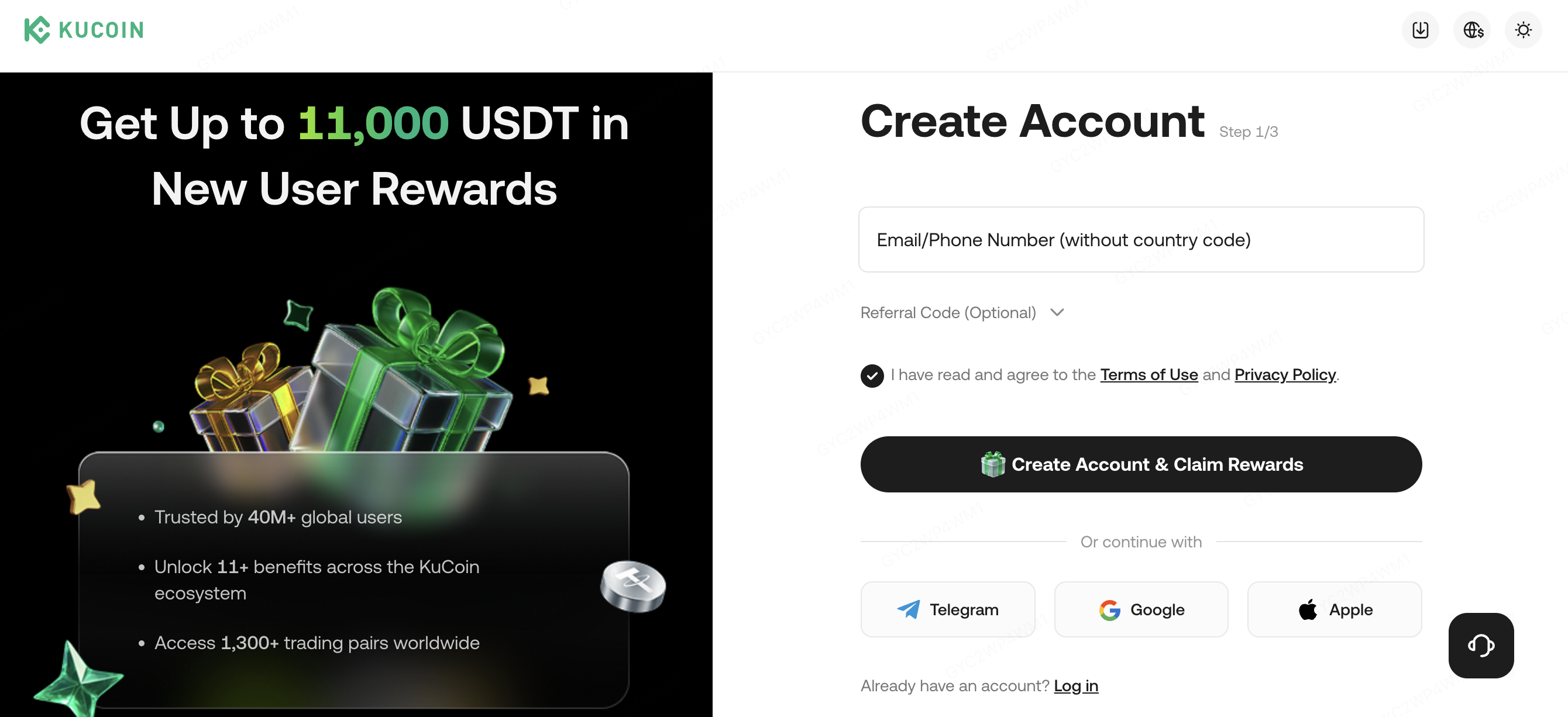
If you are ready to explore AI agent token opportunities, the first step is creating your KuCoin account. New users can register at KuCoin and Get Up to 11,000 USDT in New User Rewards - a substantial bonus that can boost your initial trading capital. Simply visit the KuCoin website or download the mobile app, complete the registration process with your email or phone number, and verify your identity to unlock these rewards. The registration process takes just a few minutes, and the welcome bonus provides an excellent starting point for exploring AI agent token trading opportunities.
Step 2: Execute Your Trade
Once your account is set up, search for AI agent-related trading pairs in KuCoin's trading interface. The platform typically offers strong liquidity for major AI crypto tokens, though liquidity can vary with market conditions. During periods of high volatility around major developments like ERC-8004 announcements, consider using limit orders rather than market orders to manage slippage. Evaluate your entry point based on current market conditions and your risk tolerance before executing the trade.
Step 3: Position Management
Given the volatility inherent in AI crypto assets, establish clear profit targets and stop-loss levels before entering a position. Monitor developments around ERC-8004 adoption, AI agent protocol updates, and the broader AI crypto ecosystem growth. Adjust your position based on ongoing assessment of the thesis rather than emotional responses to price movements.
Conclusion
ERC-8004 marks a pivotal moment in the development of autonomous AI agents on blockchain networks. By establishing standardized identity, reputation, and validation registries, the standard creates the trust infrastructure necessary for AI agents to operate across organizational boundaries, build verifiable track records, and participate in a decentralized economy.
For the broader AI crypto ecosystem, ERC-8004 enables autonomous agents to transact, collaborate, and build reputation without human intervention. The permissionless nature of the standard ensures trust emerges organically.
For developers and enterprises, the standard provides clear implementation pathways with tiered trust mechanisms. For investors, ERC-8004 represents meaningful progress in AI agent infrastructure, though the technology remains early-stage.
FAQs
Q: What is ERC-8004?
A: ERC-8004 is an Ethereum standard ratified in January 2026 that establishes on-chain identity, reputation, and validation registries for AI agents. It creates a decentralized "Trust and Identity Layer" enabling autonomous agents to be discovered, evaluated, and trusted across organizational boundaries.
Q: How does the Identity Registry work?
A: The Identity Registry assigns each AI agent a unique ERC-721 NFT serving as its on-chain identity. This token links to metadata containing the agent's name, service endpoints, supported trust models, and payment addresses. The metadata uses URI storage pointing to IPFS, ensuring persistence and immutability.
Q: What makes ERC-8004 different from existing AI agent protocols?
A: While protocols like MCP, A2A, and x402 enable agent communication, monetization, and standardized interfaces, ERC-8004 specifically addresses identity and trust-the ability to discover who you're dealing with, evaluate their reputation, and verify their work. This was previously missing from the agent infrastructure stack.
Q: How does the Reputation Registry prevent fake ratings?
A: The Reputation Registry integrates x402 payment proofs, ensuring that reviews are cryptographically tied to real economic transactions. This makes it computationally expensive to generate fake ratings, as reviewers must have actually transacted with the agent to leave feedback.
Q: What validation methods does ERC-8004 support?
A: The Validation Registry supports multiple validation strategies including zkML (mathematical zero-knowledge proofs), TEEs (Trusted Execution Environments), and Staked Re-execution (validators risking capital on their assessments). The standard allows tiered trust levels based on use case requirements.