

USV Partner Michael Mignano Launches Supertake, an AI Investing Platform
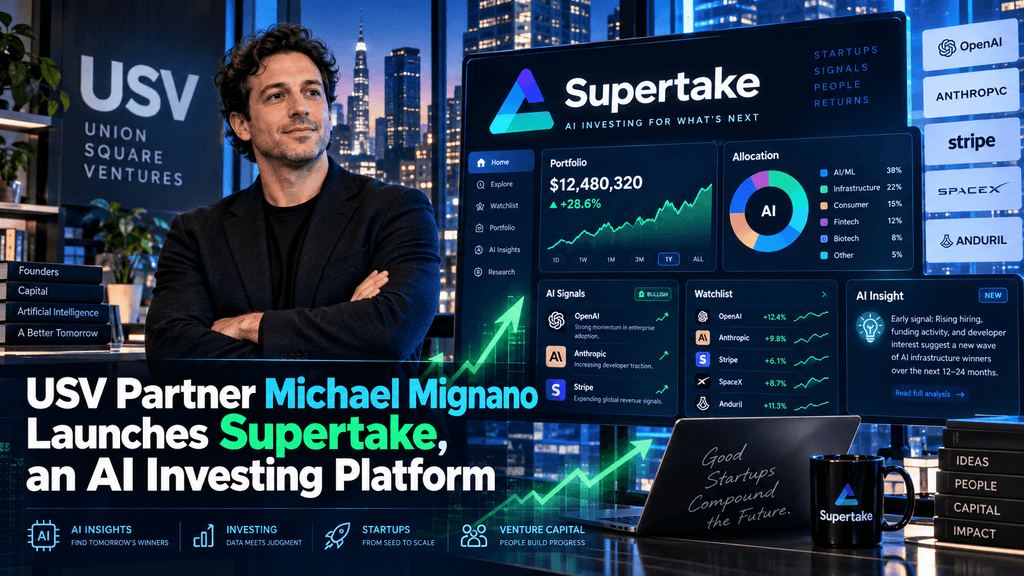
Supertake Turns Everyday Market Views Into AI-Managed Investment Strategies
Union Square Ventures general partner Michael Mignano officially announced the launch of Supertake on September 28, 2026. This innovative platform is designed to empower individuals by allowing them to convert their everyday observations and insights regarding technology, health, and market trends into diversified and actively managed investment portfolios. Initially incubated within the walls of USV, Supertake is currently operating in a private beta phase, where it enables users to articulate their beliefs in straightforward, plain English. For instance, a user might express the belief that humanoid robots will soon become commonplace in households. In response, Supertake deploys cutting-edge AI agents that are capable of constructing, executing, and rebalancing a portfolio of publicly traded U.S. equities through seamlessly connected accounts at popular brokerages such as Robinhood or Coinbase.
The platform has already begun to showcase early community-generated investment takes on a public leaderboard, with several users reporting impressive double-digit percentage gains since the platform's inception. Supertake offers a practice mode that allows users to test their investment strategies without risking real capital, making it an excellent tool for both novice and experienced investors alike. During this beta phase, the product is available free of charge, and there are plans for future expansion into various financial instruments, including cryptocurrencies, derivatives, and prediction markets. Supertake represents a significant and concrete step toward achieving agentic personal finance, where ordinary insights, previously challenging to underwrite or act upon at scale, can be transformed into executable investment strategies that are powered by advanced AI research and brokerage APIs.
Michael Mignano Moves from Podcast Infrastructure to Agentic Finance at USV
Michael Mignano built his reputation first as co-founder and CEO of Anchor, the podcasting platform acquired by Spotify in 2019 for more than $150 million. After leading Spotify’s talk-audio business, he joined Lightspeed Venture Partners in 2022, where he backed AI-native companies, including Suno and Granola, before moving to Union Square Ventures as a general partner earlier in 2026. At USV, he and his partners developed the thesis that artificial intelligence will “obliterate” rather than merely automate existing markets by giving individuals access to institutional-grade expertise. Personal finance emerged as one of the clearest candidates for that disruption. Mignano began experimenting privately with AI agents that researched stocks and generated daily portfolio recommendations; those experiments grew into Supertake. The platform therefore sits at the intersection of his product background, his AI investment focus, and USV’s long-standing interest in network-effect and infrastructure businesses. By incubating the company inside the firm, USV retains both strategic alignment and early operational support while Mignano recruits a founding team of builders who share the same conviction about AI agency.
The timing coincides with major brokerages opening agent-friendly APIs, removing a previous technical barrier that had kept retail investors dependent on human advisors or static index products. Mignano’s public writing and investment record show a consistent preference for tools that expand creative and economic agency. Anchor democratized podcast production; Supertake aims to democratize the translation of personal conviction into capital allocation. The private-beta waitlist opened the same day as the announcement, and the company is actively hiring, signaling that the product is already live with early users rather than a pure concept. Performance figures displayed on the public homepage, such as an 18.4 percent gain on a thesis about the AI value stack, provide early, transparent evidence of how the system behaves in real market conditions, even if those numbers cover only short windows and remain subject to the usual risks of equity investing.
How Natural Language Takes Become Executable Portfolios Overnight
Users begin by stating a thesis in ordinary language. Supertake’s agents interpret the statement, research supporting companies, evaluate competitive dynamics, market capitalizations, and historical patterns, and then assemble a diversified basket of U.S.-listed equities. The system places the trades through the user’s existing brokerage account rather than taking custody of assets. Once live, the portfolio is monitored daily; the agents rebalance when holdings drift from the original thesis or when new information warrants adjustment. Communication occurs inside the app or by email, with iMessage and SMS planned. Users can approve every trade or enable Autopilot for fully automated execution. A practice mode lets participants test ideas without committing capital, lowering the barrier for first-time users. Sharing is built in: any take can be published, forked by others, and ranked on a community leaderboard that updates continuously.
This workflow collapses several previously separate steps, idea generation, fundamental research, portfolio construction, execution, and ongoing management, into a single conversational loop. The agents do not simply pick a handful of obvious names; published examples show multi-stock baskets that include cash buffers, choke-point suppliers, and secondary enablers rather than pure pure-play bets. The design therefore attempts to capture the spirit of Peter Lynch’s advice to invest in what one knows, while adding institutional-style diversification and risk controls that most individuals lack the time or tools for implementing themselves. Because the system operates on top of existing brokerage relationships, users retain ownership and regulatory protections of their primary accounts.
Early Leaderboard Performance Offers First Real-World Signals
The public homepage already lists top-performing takes with transparent returns measured from each thesis’s start date. “Climbing the AI Value Stack” posted +18.4 percent, “Discovery Economy Toolmakers” +18.1 percent, and “AI Buildout Chokepoints” +15.3 percent. Lower-ranked but still positive entries include theses on personalized medicine platforms, home AI edge compute, and grid infrastructure. Each entry includes a short written rationale that explains weighting decisions and conditions under which the thesis would be revised. These numbers cover short periods and do not guarantee future results, yet they demonstrate that the platform is generating live, trackable portfolios rather than hypothetical backtests.
The visibility of both the theses and their returns creates an information surface that differs from traditional brokerage interfaces. Users can inspect how a high-level idea about AI infrastructure or discovery tools was translated into concrete holdings, then decide whether to fork the take or refine their own. That transparency may accelerate collective learning about which categories of insight translate most effectively into market performance. At the same time, the short track record means early numbers should be treated as illustrative rather than predictive. The leaderboard’s constant evolution will, over time, supply a larger sample of thesis quality, agent decision-making, and market response.
Brokerage Integration Removes Custody Friction and Expands Reach
Supertake does not hold customer funds. Instead, it links to agentic capabilities already available inside Robinhood and Coinbase accounts via OAuth-style connections. Once authorized, the platform can read positions and transmit orders into a designated agentic account. This architecture keeps assets inside the user’s primary brokerage, preserving existing SIPC or other protections and avoiding the need for users to transfer money or open a new custodial relationship. The approach also allows Supertake to focus engineering effort on research agents and portfolio logic rather than building full brokerage infrastructure.
Because the connection is account-level, users who already maintain positions at those firms can activate Supertake without liquidating holdings or changing their primary relationship. The design therefore lowers adoption friction for the large retail base already served by those platforms. Future asset-class expansion will likely follow the same pattern: once crypto or derivatives APIs mature inside the same brokerages, Supertake agents can extend their reach without requiring new custody arrangements. The model also creates a natural distribution channel; any improvement in brokerage agent interfaces immediately benefits Supertake users.
Planned Expansion into Crypto, Derivatives, and Prediction Markets
At launch, Supertake supports only public U.S.-listed equities. The product roadmap explicitly includes cryptocurrencies, derivatives, and prediction markets. Once those markets are live, a single natural-language thesis could span traditional equities, digital assets, options, and event contracts. The ability to express a view across multiple venues inside one coherent portfolio is a notable differentiator from single-asset or single-venue tools. Practice Mode will remain available for testing more complex structures before real capital is committed.
The multi-asset vision aligns with the observation that many contemporary investment theses, AI infrastructure, longevity, robotics, cut across public markets, private markets, and speculative venues. By eventually allowing agents to allocate across those surfaces, Supertake could reduce the friction that currently forces investors to maintain separate accounts and mental models for each asset class. Realization of that vision depends on continued maturation of brokerage APIs and regulatory clarity around automated trading in newer markets. Until then, the equities-only phase provides a controlled environment in which to refine agent behavior and user experience.
Once a take is published, any other user can fork it and invest immediately. The original author’s rationale travels with the portfolio, and subsequent performance continues to appear on the leaderboard. This mechanism treats a well-articulated thesis as a reusable object rather than a one-off trade idea. Early examples already show users iterating on AI-related themes, value-stack migration, physical bottlenecks, and discovery tools by adjusting weights or adding complementary positions. The result is a living library of thesis-driven portfolios that can be inspected, copied, and improved.
Forking introduces a social layer that traditional robo-advisors lack. Performance ranking creates competitive incentives, while the written rationales supply educational context. Over time, the corpus of public takes may become a searchable knowledge base of how different investors translate qualitative observations into quantitative allocations. That library could itself become a valuable input for the agents, closing a feedback loop between community insight and automated execution. The design therefore combines elements of social trading platforms with the research depth of institutional portfolio construction.
AI Agents Handle Continuous Research and Daily Rebalancing
After initial construction, Supertake agents monitor each portfolio daily. They evaluate new information against the original thesis, adjust position sizes when drift occurs, and communicate status updates to the user. Rebalancing can occur automatically under Autopilot or only after explicit approval. The agents consider the same factors used at inception, financial metrics, competitive position, liquidity, and historical behavior, plus any fresh data that alters the probability of the thesis. Users can converse with individual portfolios to request explanations or modifications.
This continuous loop addresses a common failure mode of retail investing: the gap between forming a good idea and maintaining disciplined exposure over time. Most individuals lack the bandwidth to re-evaluate holdings daily against evolving evidence. By delegating that work to agents while retaining the ability to override or converse, Supertake aims to keep portfolios aligned with the original conviction without requiring constant manual intervention. The quality of those ongoing decisions will ultimately determine whether the platform delivers sustained value beyond the novelty of natural-language entry.
Practice Mode Lowers the Cost of Experimentation
Users who prefer not to risk capital can run any take-in practice mode. The system constructs the identical portfolio, tracks hypothetical performance, and applies the same rebalancing logic, but no real orders are sent. Practice Mode therefore functions as a sandbox for testing agent behavior, exploring the impact of different thesis wording, and building confidence before linking a live brokerage account. During the free beta period, the feature is available without restriction.
The presence of a zero-cost simulation environment is particularly useful for complex or multi-asset theses that may later become available. It also allows the company to gather usage data and refine agent prompts while users experiment safely. Over time, Practice Mode portfolios that demonstrate strong simulated results may migrate into the public leaderboard once their creators decide to allocate real capital, creating a natural pipeline from exploration to live deployment.
USV’s Broader Thesis on AI Market Transformation Underpins the Launch
In a July 2026 essay titled “Obliterate, Don’t Automate,” Mignano and USV colleagues argued that AI’s most powerful effect is the unlocking of expertise previously restricted to institutions. Personal finance was identified as a market ripe for that shift. Supertake is the first concrete product to emerge from that internal discussion. By packaging research capability and execution inside a conversational interface, the platform attempts to give ordinary users tools that once required teams of analysts and traders.
The incubation model allows USV to test the thesis with real capital and real users while retaining the option to scale or adjust based on observed outcomes. The approach is consistent with USV’s history of backing infrastructure that expands participation, whether in media, commerce, or finance. Success for Supertake would validate the firm’s belief that agentic systems can compress the expertise gap faster than incremental automation of existing advisor models. Failure modes would equally inform the next iteration of the thesis. Either way, the public beta supplies empirical data rather than pure speculation about how AI changes capital allocation behavior.
Hiring Signals Long-Term Ambition Beyond the Initial Product
Immediately after launch, Mignano posted that Supertake is building a “dream team” and is offering founding-team equity along with cash compensation. The company is seeking proven builders who share enthusiasm for AI agency applied to personal finance. Job postings point to roles that will extend the agent stack, improve multi-asset support, and scale community features. The combination of an already-shipping product, institutional incubation, and open hiring indicates that the current private beta is intended as the foundation for a larger platform rather than a limited experiment.
Recruiting experienced operators at this stage also suggests that the technical challenges, reliable agent reasoning, robust brokerage integrations, and safe multi-asset execution are expected to require sustained engineering investment. The presence of real equity for early employees aligns incentives around long-term platform value rather than short-term feature shipping. For observers, the hiring activity provides a useful signal of how seriously the team intends to pursue the multi-asset and social layers outlined in the launch materials.
Warnings and Investor Responsibility Remain Clearly Defined
Supertake’s terms note that activity carries no FDIC or SIPC insurance beyond whatever protections the user’s underlying brokerage already provides. The platform is restricted to adults, and users remain fully responsible for outcomes. AI-generated portfolios can and will underperform; agents can misinterpret these or fail to anticipate market regime shifts. The public homepage displays both performance and risk language, and Practice Mode is promoted as the recommended first step. These disclosures are consistent with the reality that automated systems, however sophisticated, do not eliminate market risk or model risk.
Transparent presentation of both upside and limitations is essential for a product that invites non-professional users to act on personal insights. By keeping assets inside existing brokerage relationships and requiring explicit connection authorization, Supertake avoids some of the custody and conflict issues that have complicated earlier automated-investing services. Continued clarity about what the agents can and cannot do will determine whether users treat the system as a research and execution assistant rather than an infallible oracle.
How Supertake Differs From Traditional Robo-Advisors
Traditional robo-advisors typically allocate users into static or periodically rebalanced portfolios based on risk questionnaires and broad asset-class models. Supertake inverts that model: the starting point is a specific qualitative thesis rather than a risk score, and the agents construct a concentrated, thesis-driven basket rather than a market-wide allocation. Social forking and public leaderboards further differentiate the experience from both conventional robo-advisors and pure social-trading apps that focus on individual stock tips.
The combination of natural-language entry, continuous agent research, and shareable thesis objects creates a product category that did not previously exist in retail finance. Whether this category scales depends on the quality of agent reasoning over longer periods, the reliability of brokerage APIs, and the willingness of users to treat personal observations as investable insights. Early community activity already shows concentration around AI-related themes, suggesting that the first cohort of users is testing the system on domains where they feel they possess an informational edge. Expansion beyond those domains will test whether the agents can usefully interpret a wider range of everyday observations.
What Success Would Mean for Retail Capital Allocation
If Supertake and similar agentic systems prove durable, the practical effect would be a reduction in the expertise and time barriers that currently separate forming a market view from acting on it with appropriate diversification and risk controls. Individuals who notice shifts in their professional or consumer environments could more readily translate those observations into portfolios without needing to become full-time analysts.
The public corpus of forked theses could simultaneously become a new form of market research, an open, performance-linked library of how qualitative beliefs map onto securities. Realization of that outcome remains contingent on sustained agent accuracy, regulatory stability, and user discipline. The private beta now underway supplies the first empirical test of whether the underlying premise holds.
🔥 Beyond the Headlines: What KuCoin 5.0 Means for You
Market news moves fast — but where you act on it matters just as much. This October, KuCoin launches KuCoin 5.0, transforming KuCoin into a rebuilt platform. Here's what actually changes for you:
-
One account for everything. Older platforms split your money across separate "spot," "margin," and "futures" accounts and expected you to understand why. KuCoin 5.0's unified account removes that entirely — deposit once, and everything is simply there (only available to VIPs for now).
-
Stocks, indices, and commodities. KuCoin 5.0 expands beyond crypto into global markets. When crypto chops sideways and equities rally (or the reverse), you rotate in minutes instead of opening a brokerage account and waiting days for fiat rails.
-
Real-world assets (RWA). Tokenized exposure to traditional assets like commodities, right inside your crypto account. One of the fastest-growing segments in global finance is no longer reserved for institutions — you access it from the same balance you trade with.
-
Earn while you learn. Not ready to trade? KCUSD lets your stablecoins earn daily, auto-compounding interest. The lowest-stress way to put your idle deposit to work for 4% yield.
-
An AI assistant in plain language. Ask questions, get market context, understand what you're looking at — built into the platform, no jargon required.
-
An app that doesn't overwhelm. Faster, cleaner, and consistent — intuitive from the first tap, not after a tutorial.
-
Safety you can check, not just trust. A MiCAR-licensed EU entity, Proof of Reserves you can verify yourself, and internationally certified security (SOC 2 Type II, ISO 27001:2022).
Create your account in minutes — and start on the platform built for where crypto is going, not where it's been.
FAQs
How does Supertake actually construct a portfolio from a natural-language statement?
The agents parse the stated thesis, identify relevant public companies through research of financial statements, competitive landscapes, and historical trading patterns, then weight positions according to liquidity, market capitalization, and alignment with the original idea. Cash buffers are commonly included. The resulting basket is executed through the user’s linked brokerage account, after which daily monitoring begins. Users can request explanations of individual holdings or overall construction logic at any time.
What brokerages are supported at launch, and how is the connection secured?
Robinhood and Coinbase are the initial integration partners. The connection uses each firm’s OAuth or equivalent authorization flow so that Supertake can read account information and transmit orders without ever holding the assets itself. Users retain full control of their primary accounts and can revoke access at any moment. Expansion to additional brokerages will follow the same non-custodial pattern.
Is there a way to test ideas without risking real money?
Yes. Practice Mode constructs the identical portfolio and applies the same research and rebalancing logic, but no actual trades are placed. Performance is tracked hypothetically, allowing users to evaluate agent behavior and thesis quality before linking a live account. The feature is free during the current beta period.
How are performance figures on the leaderboard calculated?
Returns are measured from the moment each take is activated and reflect the actual or simulated performance of the holdings selected by the agents, including any rebalancing that has occurred. The numbers are updated continuously and are displayed alongside the original written rationale so that users can judge both outcome and reasoning. Short track records mean these figures should be viewed as early indicators rather than long-term guarantees.
When will crypto, derivatives, and prediction markets become available?
The company has stated that these asset classes are on the near-term roadmap once the relevant brokerage APIs and internal agent capabilities are ready. No firm public date has been announced. Practice Mode will remain available for testing multi-asset structures as they are released.
Who owns the intellectual property of a published take?
The original author retains the ability to edit or unpublish their thesis. Forked versions become independent portfolios under the control of the new user. Performance attribution continues to credit the originating take on the leaderboard, creating a transparent record of influence without transferring ownership of the underlying idea.
Disclaimer: This content is for informational purposes only and does not constitute investment advice. Investments carry risk. Please do your own research (DYOR).