

SpaceX S-1 Disclosure: Inside Elon Musk’s Hidden 18,712 Bitcoin Vault
2026/05/21 18:21:02
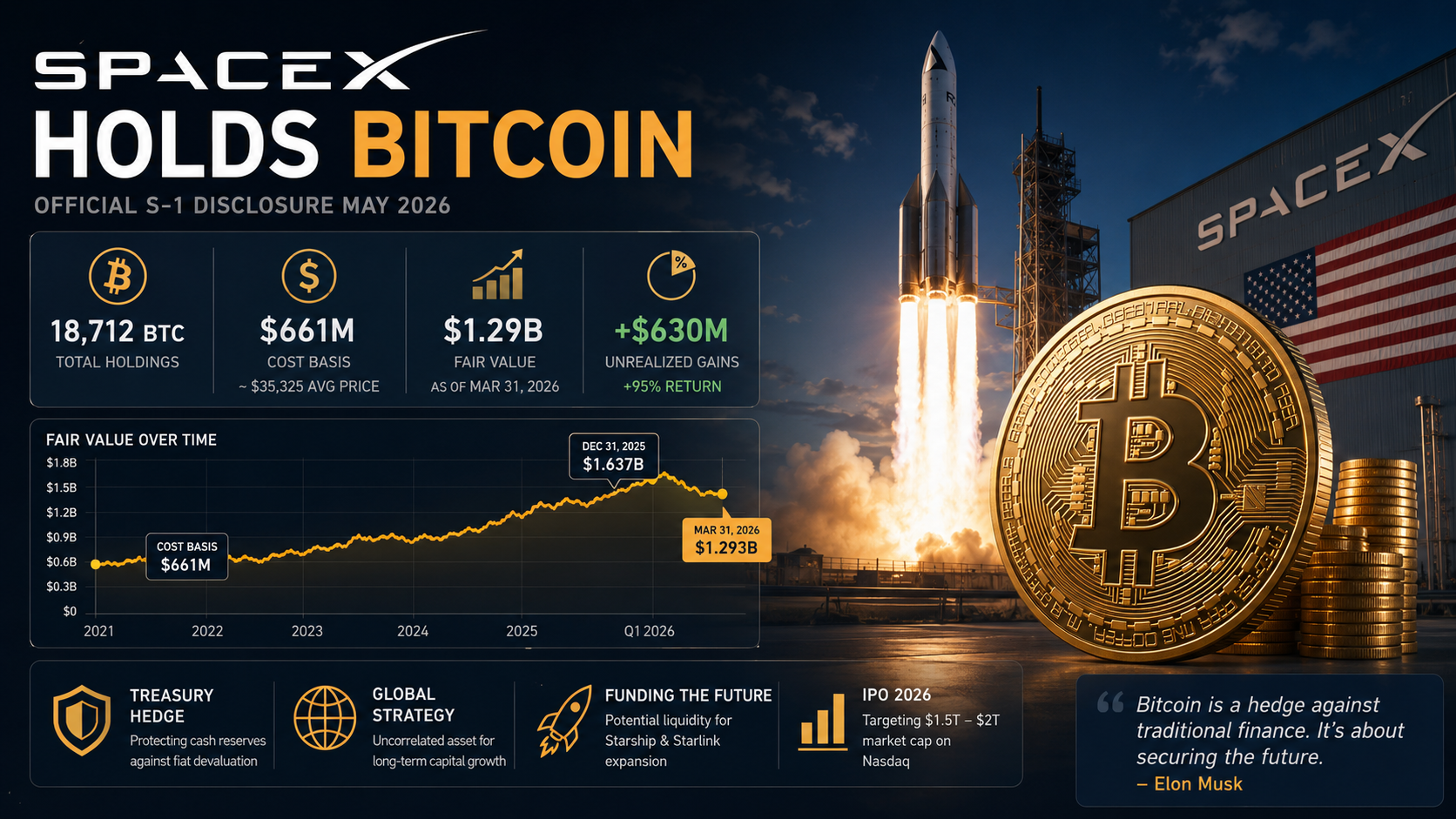
The global financial landscape shook in May 2026 when aerospace giant SpaceX filed its highly anticipated Form S-1 prospectus ahead of a historic public listing. Amid breathtaking revenue figures and astronomical growth metrics, a stunning revelation emerged from the deep balance sheets of Elon Musk’s private space company. Official regulatory disclosures confirmed for the very first time that SpaceX holds bitcoin as a core strategic treasury reserve asset, solidifying its place among the largest corporate digital asset accumulators in the world today.
This monumental filing clarifies years of intense market speculation surrounding the space exploration pioneer's secret cryptocurrency portfolio. As retail and institutional traders flock to our exchange to analyze this massive development, this deep dive explores the exact implications of the disclosure and answers why SpaceX holds bitcoin ahead of its trillion-dollar Wall Street debut.
-
Massive Position Confirmed: SpaceX officially holds 18,712 BTC, placing it ahead of sister company Tesla in total crypto accumulation.
-
Unrealized Inflow Gains: The company established an initial cost basis of $661 million, which has ballooned to a fair value of $1.29 billion as of Q1 2026, netting over $630 million in paper profits.
-
The S-1 Catalyst: The data surfaced due to regulatory requirements for SpaceX's upcoming June 2026 IPO, where the company targets a staggering $1.5 trillion to $2 trillion market capitalization.
-
Strategic Shift: Moving beyond simple speculation, the filing highlights a sophisticated corporate treasury approach designed to insulate multi-billion-dollar cash reserves from global fiat devaluation.
-
Post-IPO Risk Matrix: Wall Street institutional frameworks and Nasdaq compliance rules may incentivize the company to eventually liquidate or trim its holdings to fund capital-intensive projects like Starship and Starlink.
For years, the crypto industry could only guess the extent of SpaceX's involvement with digital assets. While Elon Musk drop-fed hints at various technology conferences, the company's status as a private entity shielded its financial statements from public oversight. The veil was permanently lifted in May 2026. The S-1 prospectus submitted to the U.S. Securities and Exchange Commission (SEC) laid bare the precise mechanics of the aerospace firm's balance sheet, transforming rumors into hard corporate facts.
The Hard Numbers: Counting the 18,712 BTC
According to the balance sheet breakdowns audited for the historic public offering, SpaceX officially boasts an inventory of exactly 18,712 digital coins. This specific figure indicates a calculated, institutional-grade accumulation phase rather than a series of disconnected, casual purchases. Within our exchange's internal liquidity metrics, an order book allocation of this magnitude represents an Elite Tier corporate account structure.
By commanding 18,712 tokens, SpaceX controls a notable percentage of the total circulating supply of the asset. This level of accumulation ensures that a single private company’s executive leadership can directly influence corporate sentiment across the broader digital asset economy. For crypto traders utilizing our trading platform, these audited figures provide a tangible metric to evaluate how megacorporations value digital scarcity over traditional cash equivalents.
661M Cost Basis: Assessing the Entry Strategy
The true genius of SpaceX’s treasury play lies in its historic execution. The S-1 filing indicates that the aggregate cost basis for the 18,712 coins sits at precisely $661 million. When calculated mathematically across their accumulation timeline, the average entry price hovers around the $35,325 mark per token.
This entry price demonstrates that SpaceX executed its buy programs primarily during the structural market corrections of 2021 and late 2022. Rather than chasing parabolic market peaks, corporate accountants utilized institutional dollar-cost averaging (DCA) mechanisms. By steadily deploying idle capital when retail sentiment was fearful, the treasury desk built a fortress position at prices that are virtually impossible to replicate in the current 2026 macroeconomic environment.
1.29B Fair Value: Calculating the Paper Profits
As of the quarter ending March 31, 2026, the S-1 paperwork values this specific cryptocurrency portfolio at a fair value of $1.293 billion. When juxtaposed against the initial $661 million acquisition cost, SpaceX is sitting on a staggering unearned net profit of more than $630 million.
It is crucial for platform users to recognize how market timing impacts corporate reporting. The prospectus explicitly notes that at the conclusion of the previous fiscal year on December 31, 2025, the fair value of the exact same 18,712 tokens reached as high as $1.637 billion. Despite a Q1 2026 correction that cooled values to the $1.29 billion mark, the underlying investment has successfully yielded a return exceeding 95%. This position establishes SpaceX as one of the most profitable corporate treasuries in modern financial history.
Earnings Volatility: How Crypto Impacts the Balance Sheet
Integrating a highly volatile cryptographic asset into a multi-billion-dollar corporate framework introduces unique accounting complexities. Under historical accounting standards, digital currencies were treated as intangible assets, requiring corporations to write down their value during market downturns without the ability to revise those valuations upward when prices recovered.
However, the latest updated accounting guidelines implemented for the 2026 fiscal cycle allow corporations to utilize fair-value accounting models. This means SpaceX’s quarterly net income projections are now tied directly to the spot price of the asset. When the crypto market rallies, SpaceX's reported corporate net worth expands exponentially on paper; conversely, deep market liquidations can introduce substantial artificial volatility into their quarterly earnings reports, potentially confusing traditional equity analysts who are unaccustomed to the rhythms of the digital asset cycle.
The revelation of SpaceX's balance sheet redraws the lines of power within the Elon Musk corporate ecosystem. Historically, Tesla was viewed as the flagship vehicle for Musk’s crypto experimentation. The electric vehicle manufacturer gripped global headlines in early 2021 by allocating a massive $1.5 billion toward digital assets. The S-1 filing reveals that SpaceX has quietly eclipsed its publicly traded sibling, developing a much more resilient relationship with its digital reserves.
| Corporate Metrics | SpaceX Crypto Portfolio | Tesla Crypto Portfolio |
| Total Asset Holdings | 18,712 BTC | 11,509 BTC |
| Current Fair Value (Q1 2026) | ~$1.29 Billion | ~$890 Million |
| Primary Regulatory Status | Pre-IPO (Transitioning Private to Public) | Publicly Traded (Nasdaq: TSLA) |
| Historical Holding Tendency | High Retention / Absolute HODL | Active Liquidations (Sold 75% in 2022) |
The Giant Leaps: Why SpaceX Out-HODLs Tesla
The comparative data reveals that SpaceX currently holds 18,712 tokens, whereas current blockchain tracking data indicates Tesla retains roughly 11,509 tokens. This disparity highlights two vastly different corporate holding strategies. In the summer of 2022, Tesla famously liquidated approximately 75% of its entire digital asset reserve to shore up fiat cash reserves during pandemic-related factory shutdowns in China.
SpaceX, by contrast, demonstrated a classic "HODL" mindset. While rumors circulated in late 2023 that the space company had written down or completely liquidated its crypto assets, the S-1 prospectus confirms the core position remained remarkably intact. Free from the short-term pressures of quarterly public earnings calls, SpaceX preserved its stash through the depths of the crypto winter, allowing its capital to double in value ahead of the 2026 public market debut.
Private vs. Public: Musk's Dual Corporate Governance
The divergent paths taken by Tesla and SpaceX illustrate the profound differences between managing a public enterprise versus running a tightly controlled private empire. As a Nasdaq-listed corporation, Tesla operates under the continuous scrutiny of a diverse board of directors, activist retail investors, and stringent ESG (Environmental, Social, and Governance) mandates. When Tesla held digital assets, any downward price movement triggered a wave of negative media press, pressuring management to minimize asset risk.
SpaceX enjoyed the absolute operational freedom of a privately held entity. Elon Musk, occupying both the CEO and Chief Designer chairs, maintained an unchallenged mandate to steer corporate capital into alternative assets. If Musk determined that holding a decentralized ledger asset was beneficial for the long-term runway of the company, there were no public market short-sellers or quarterly profit-and-loss targets to derail the narrative. This structural insulation is precisely why SpaceX holds bitcoin in a larger capacity than Tesla.
The MicroStrategy Benchmarking: Where SpaceX Ranks Globally
With 18,712 digital coins on its balance sheet, SpaceX instantly joins an elite echelon of corporate holders. While Michael Saylor’s MicroStrategy remains the unchallenged king of corporate allocation—boasting more than 214,000 tokens on its books—SpaceX comfortably commands a top-five position among global enterprise portfolios.
This ranking carries profound symbolic weight for our exchange clients. When a company capable of building reusable orbital rockets elects to hold a substantial reserve of decentralized code, it elevates the asset's status from a speculative play to an essential component of modern macro-corporate finance. SpaceX’s position validates the thesis that sovereign corporations can utilize decentralized networks as baseline collateral to optimize global financial standings.
To understand the core motivations behind SpaceX's balance sheet choices, one must look past standard corporate accounting. Elon Musk’s engineering ventures are defined by a systemic distrust of legacy architectures, whether those systems are traditional expendable rockets or centralized financial mechanisms. The decision to establish a multi-million-dollar digital reserve is deeply rooted in macroeconomic survival and long-term capital allocation philosophy.
Fiat Devaluation: Hedging Against Global Inflation
The core macroeconomic reality confronting any enterprise generating billions in annual revenue is the systemic erosion of purchasing power. With global central banks continually expanding circulating supplies of paper currency, leaving vast capital reserves entirely in fiat paper is a guaranteed way to lose capital efficiency over a multi-year horizon.
SpaceX generates immense cash inflows from its global commercial launch contracts and expanding consumer networks. By converting a strategic slice of these fiat earnings into a cryptographically sealed, immutable digital asset with a hard-capped supply of 21 million units, SpaceX creates a permanent capital firewall. The asset acts as an insurance policy against domestic and international monetary debasement, ensuring that profits earned today retain their absolute purchasing power when deployed for development projects years down the line.
Treasury Allocation: Optimizing Massive Cash Reserves
An examination of SpaceX’s 2025 financial performance reveals an enterprise operating at peak capacity. The S-1 documentation highlights that the company generated a record-breaking $18.7 billion in revenue over the 2025 calendar year, marking a massive leap from the $14.0 billion recorded in 2024.
Managing this rapid scale requires advanced treasury management. A standard corporate playbook involves stashing excess cash in short-term government bonds, certificates of deposit, or money market funds. However, these traditional instruments rarely yield returns that outpace real-world structural inflation. By allocating $661 million to an uncorrelated, high-upside digital asset, SpaceX optimized its cash reserves, effectively turning an idle asset category into an aggressive engine of capital growth that has already generated hundreds of millions in unearned profit.
The Mars Connection: Vision for a Multi-Planetary Economy
No discussion of SpaceX's long-term corporate thesis is complete without acknowledging its ultimate mission: making humanity a multi-planetary species. Elon Musk has frequently discussed the logistical and economic architecture required to sustain an independent civilization on Mars. Traditional banking networks, reliant on centralized clearinghouses, localized geographic jurisdictions, and slow settlement times, are fundamentally unsuited for interplanetary commerce.
Radio signals taking between 3 to 22 minutes to travel between Earth and Mars make real-time visa, mastercard, or central bank wire verification physically impossible. A Martian economy will require a completely decentralized, borderless digital ledger system that operates purely via cryptographic proof. By building out a massive terrestrial digital asset treasury today, SpaceX establishes direct corporate familiarity and technological integration with the exact asset class that will eventually form the financial foundation for interplanetary trade routes.
As SpaceX prepares to transition from a private entity to a publicly traded powerhouse on the Nasdaq exchange in June 2026, the future of its 18,712 coins hangs in a delicate balance. While the asset has performed exceptionally well as a treasury protector, the realities of answering to public market shareholders could alter how SpaceX manages its digital wealth.
The Liquidity Catalyst: The Urgency of a Tesla-Style Selloff
The most immediate risk facing SpaceX’s long-term holding strategy is the sheer capital intensity of its engineering roadmap. Unlike soft-software tech companies that boast massive profit margins with minimal physical overhead, SpaceX is an industrial manufacturer that operates on a massive physical scale.
If the company encounters unexpected development delays, unexpected launch failures, or a broader macroeconomic credit crunch post-IPO, the board of directors could view the $1.29 billion digital asset vault as an easily accessible source of instant liquidity. Just as Tesla converted 75% of its tokens into cash to navigate localized supply chain emergencies, SpaceX could easily execute a strategic over-the-counter (OTC) liquidation to rapidly bolster its fiat cash position without needing to issue high-interest corporate debt.
Starship Funding: Capital Demands for Deep Space Missions
The development of the Starship architecture represents one of the most expensive private engineering undertakings in human history. To achieve full orbital reusability and establish regular flight cadences to the Moon and Mars, SpaceX must invest billions into:
-
Constructing massive manufacturing facilities at Starbase in Boca Chica, Texas.
-
Building out dual orbital launch pads at the Kennedy Space Center in Florida.
-
Funding the continuous mass production of advanced Raptor rocket engines.
-
Conducting high-frequency, high-risk orbital test flights that regularly consume hardware.
These operations require continuous capital deployment. While the $18.7 billion in annual revenue is impressive, the net margins after accounting for rocket development are highly asset-intensive. Facing a choice between pausing Starship development or liquidating $1.29 billion in digital assets to keep the program on schedule, corporate leadership will choose rocket development every single time.
Starlink Expansion: Financing the Next-Gen Satellite Constellation
Simultaneously, SpaceX is locked in a continuous race to deploy and maintain its Starlink satellite internet constellation. Starlink is the primary engine of predictable, recurring cash generation for the company, but keeping that engine running requires capital investment.
To maintain its global monopoly, SpaceX must continuously manufacture and launch heavier, more capable Generation 2 and Generation 3 satellites. These hardware platforms require the advanced deployment capacities of Starship to achieve true economy of scale. Furthermore, the company must heavily subsidize consumer ground terminals in emerging markets to capture global market share. The billions required to sustain this orbital network could easily put pressure on the company's alternative asset reserves, positioning the 18,712 coins as an attractive source of funding for constellation expansion.
The Nasdaq Rules: Facing Institutional Investor Scrutiny
Entering the public market means entering a highly regulated domain. Once SpaceX lists on the Nasdaq exchange, its financial strategies will no longer be determined solely by Elon Musk's personal preferences. Institutional giants like BlackRock, Vanguard, and Fidelity will secure massive equity blocks, gaining significant influence within board meetings.
Traditional asset management firms generally prefer the corporations they back to stay focused on their core business models. Wall Street investors buying SpaceX stock want pure exposure to global launch monopolies and satellite internet infrastructure; they rarely want their aerospace investments tied to the volatile price action of the crypto markets. Institutional pressure could mount on executive leadership to clear speculative assets off the corporate ledger, allowing the market to value SpaceX cleanly based on aerospace metrics rather than digital asset movements.
The interplay between SpaceX’s crypto reserves and its upcoming public market valuation is a focal point of intense study among institutional investment desks. Seeking an unprecedented opening market capitalization between $1.5 trillion and $2.0 trillion, the company is positioned to instantly reshape global index fund allocations.
Institutional Demand: Do Crypto Holdings Attract Wall Street?
In the current 2026 financial ecosystem, institutional sentiment toward digital assets has matured significantly compared to previous financial cycles. The widespread adoption of spot crypto exchange-traded funds (ETFs) has validated the asset class in the eyes of traditional fund managers. Consequently, a corporate treasury that proactively holds digital assets is no longer viewed as a corporate anomaly.
For a subset of tech-forward institutional investors, SpaceX’s digital asset cache enhances its appeal as an innovative, forward-looking enterprise. It demonstrates that the treasury desk understands asset optimization and possesses the tools to navigate modern monetary environments. This alignment with progressive corporate finance can attract specialized exchange capital and sovereign wealth funds that intentionally seek out enterprises with diversified, resilient corporate balance sheets.
Risk Discounting: Does Volatility Suppress IPO Pricing?
Conversely, conservative institutional frameworks may apply a risk discount to SpaceX’s equity pricing due to the inherent volatility of its digital reserves. If the crypto market undergoes a sharp correction immediately leading up to the June IPO date, SpaceX’s total asset value will contract on paper, introducing undesirable noise into the public pricing process.
Underwriting investment banks must carefully calculate how to position this $1.29 billion variable asset within their valuation algorithms. If the consensus view among institutional bookrunners leans toward risk-aversion, the presence of the 18,712 tokens could result in an artificial flattening of initial opening multiples. To prevent this volatility from impacting the historic $1.5 trillion listing, SpaceX’s advisory team may elect to reclassify or silo their digital reserves into a dedicated corporate subsidiary to isolate the core aerospace valuation from market swings.
The historic disclosure within the May 2026 S-1 prospectus officially settles the debate, confirming that SpaceX holds bitcoin as a foundational pillar of its multi-billion-dollar treasury reserve. By maintaining a disciplined holding strategy over 18,712 tokens, Elon Musk’s aerospace pioneer has successfully turned a $661 million cash allocation into a $1.29 billion financial fortress. As the company marches toward its historic $1.5 trillion Nasdaq listing next month, this digital asset cache highlights an innovative approach to corporate treasury management. Whether SpaceX retains its position to fund the future economy of Mars or liquidates it to accelerate Starship's near-term development, the disclosure stands as a permanent milestone for global digital asset adoption.
Why did SpaceX hold bitcoin on its balance sheet?
SpaceX holds bitcoin primarily as a strategic corporate treasury asset designed to hedge its multi-billion-dollar cash reserves against global fiat devaluation and inflation. The asset allocation strategy was initiated under Elon Musk's private corporate governance to optimize capital efficiency by utilizing a scarce, decentralized digital asset instead of letting cash lose value in traditional bank accounts.
How many bitcoins does SpaceX currently own according to the S-1 filing?
According to the official Form S-1 prospectus filed with the SEC in May 2026, SpaceX explicitly owns exactly 18,712 tokens. This massive position was acquired over multiple accumulation phases for an initial total cost basis of $661 million, averaging an entry price of approximately $35,325 per token.
What is the current value of SpaceX's bitcoin portfolio in 2026?
As of the financial disclosures ending March 31, 2026, SpaceX’s portfolio carries an official fair value of $1.293 billion. This represents an unrealized net paper profit of over $630 million, though the filing notes the exact same portfolio reached a peak valuation of $1.637 billion in December 2025.
Will SpaceX sell its bitcoin holdings after the June 2026 IPO?
There is a strong possibility SpaceX may selectively liquidate or trim its 18,712 tokens post-IPO to fund highly capital-intensive projects like Starship development and Starlink satellite deployment. Furthermore, institutional Wall Street investors on the Nasdaq exchange may pressure management to remove volatile digital assets to ensure a clean aerospace valuation.
Does SpaceX own more bitcoin than Tesla?
Yes, the 2026 S-1 disclosure confirms that SpaceX’s inventory of 18,712 tokens easily surpasses Tesla’s current corporate holding of approximately 11,509 tokens. SpaceX maintained a more resilient holding approach through recent market cycles because its private corporate structure shielded it from the short-term public market pressures that forced Tesla to liquidate 75% of its stash in 2022.