

SpaceX and AMD Shares Plunge After Hours on Q2 Earnings: What the Selloff Reveals About the Next Phase of US Stock Market Trends
2026/08/05 10:59:00
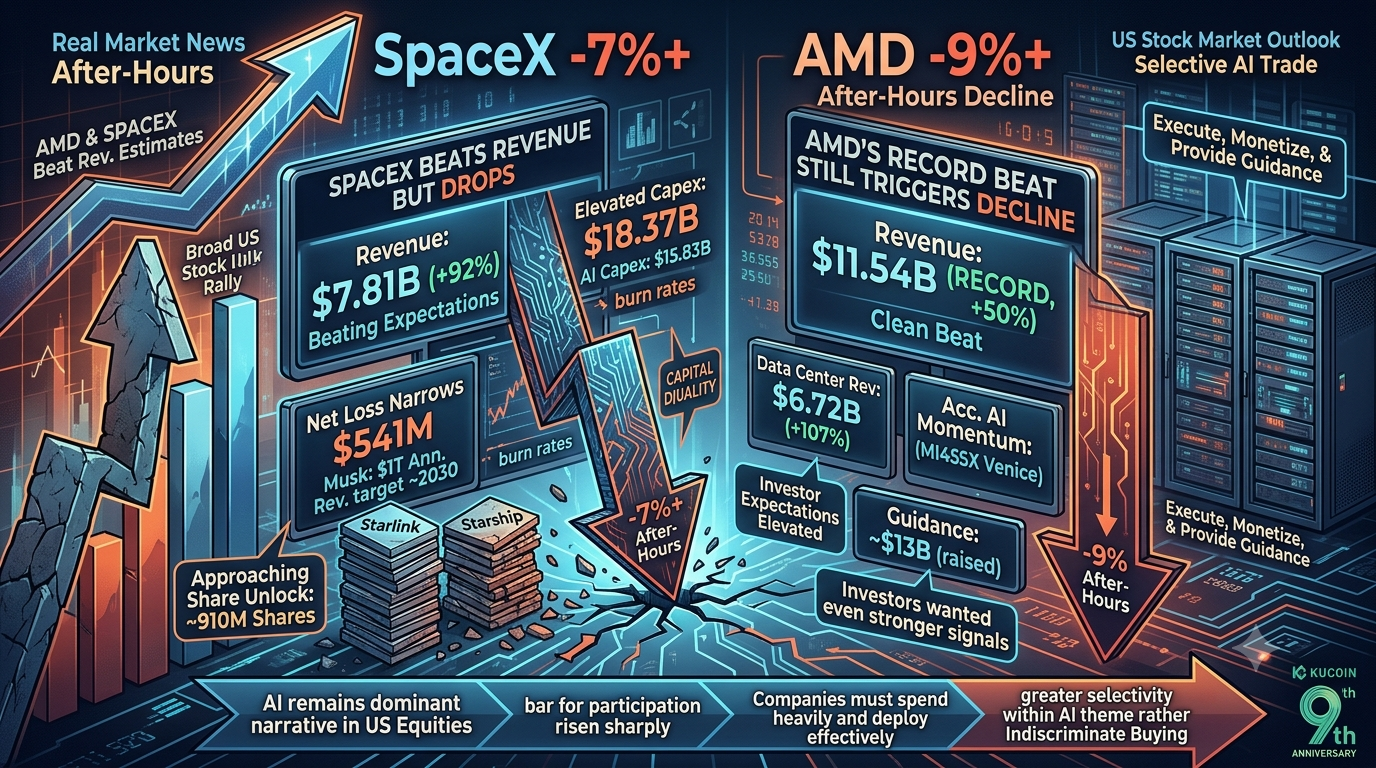
US stocks posted a broad rally during regular trading, yet the real market-moving news arrived after the close. SpaceX and AMD both released second-quarter 2026 results that beat revenue expectations, only to see their shares drop sharply in after-hours trading. The reaction highlights a clear shift: AI remains the dominant narrative in US equities, but investors now demand smarter capital allocation, faster returns, and ever-higher forward guidance.
SpaceX shares fell more than 7% after hours because capital spending on AI infrastructure far exceeded forecasts, outweighing strong top-line growth in the company’s first post-IPO quarterly report.
Revenue reached $7.81 billion, up 92% year-over-year and well above the roughly $6.9 billion consensus. Net loss narrowed to $541 million, or 9 cents per share, beating the expected loss of about 26 cents. Adjusted EBITDA climbed 191% to $3.54 billion. Starlink (Connectivity) revenue rose 66% to $4.29 billion, while the AI segment surged roughly 247% to about $2.56 billion.
Yet total capital expenditures hit $18.37 billion—more than six times the year-ago figure and ahead of the approximately $13 billion analysts had modeled. Roughly $15.83 billion of that spending went into AI compute infrastructure. Management indicated similar elevated levels are likely over the next couple of quarters.
CEO Elon Musk maintained aggressive long-term targets on the earnings call. He said the company now expects to reach $1 trillion in annual revenue as early as 2030, with a non-zero chance of 2029, advancing the prior 2031 timeline. Musk also argued that markets underappreciate Starlink’s potential, saying the service could become the primary internet provider in most countries where it is permitted within less than a decade.
Growth will hinge on continued Starlink expansion, Starship commercialization, and eventual returns from the heavy AI infrastructure build-out. In the near term, however, the gap between rapid spending and cash-flow generation has left investors cautious. Adding pressure, a large share unlock of roughly 910 million shares—larger than the current free float—is approaching, creating a challenging supply dynamic.
In short, SpaceX is growing quickly, but it is spending even faster. Strong narrative and long-term ambition are intact, yet the combination of elevated burn rates and upcoming share supply leaves the stock in an awkward short-term position for many investors.
AMD shares dropped more than 9% after hours despite delivering record revenue and a clear beat because investors wanted even stronger AI growth signals and more ambitious forward guidance after the stock’s substantial year-to-date gains.
Total revenue hit $11.54 billion, up 50% year-over-year and ahead of the $11.28–$11.31 billion consensus. Adjusted earnings per share came in at $1.66, beating the $1.62 estimate. Data Center revenue—the primary growth engine—reached $6.72 billion, up 107% year-over-year and roughly 15.6% sequentially, accounting for 58% of total sales.
For the third quarter, AMD guided revenue to approximately $13 billion, plus or minus $300 million, above the prior consensus near $12.5 billion. Adjusted gross margin is expected around 56%.
CEO Lisa Su highlighted accelerating AI momentum. The second-generation Helios AI server, featuring MI455X accelerators and TSMC’s Venice processors, has entered full production and is scheduled to begin shipping in the coming months. Deliveries to customers including Meta and OpenAI are expected to start by the end of the current quarter, with a broader ramp in the fourth quarter.
Despite the clean beat and solid outlook, the market reaction reflected elevated expectations. After a strong run that more than doubled the stock in 2026, many participants sought higher AI contribution guidance and clearer evidence that the company is closing the gap with the market leader even faster.
The two earnings reports show that AI remains the central driver of US equity performance, yet the bar for participation has risen sharply. Companies must spend heavily on AI, deploy capital efficiently rather than indiscriminately, protect or grow near-term revenue and margins, and deliver ambitious forward guidance.
SpaceX demonstrated massive scale in AI infrastructure investment but faced skepticism over the pace of returns and cash-flow impact. AMD delivered strong data-center growth and raised the near-term outlook, yet still disappointed investors who had priced in even more aggressive acceleration.
This pattern underscores a maturing phase of the AI trade. Pure narrative strength is no longer enough. Execution quality, capital discipline, and visible monetization timelines now determine which names continue to attract capital and which face valuation pressure after strong runs.
The post-earnings reactions suggest the next phase of the US market will feature greater selectivity within the AI theme rather than indiscriminate buying. High-quality AI infrastructure and semiconductor names with proven returns on capital may continue to lead, while companies with heavy spending and delayed monetization could face more frequent valuation resets.
Broader indices benefited from the earlier session rally, but the after-hours focus on two high-profile AI-related names indicates that earnings season will remain a key volatility driver. Investors are likely to scrutinize capital expenditure plans, free-cash-flow trajectories, and guidance language more closely across the technology sector in the coming weeks.
KuCoin offers a wide range of AI-themed tokens and related digital assets that often move with broader sentiment around artificial intelligence infrastructure and compute demand. Traders watching the evolving standards for AI spending and returns in traditional markets can monitor corresponding crypto narratives for potential opportunities.
Users can access spot trading, futures, and other products on KuCoin to express views on AI momentum. Always conduct independent research, manage risk carefully, and remember that digital asset markets carry high volatility. Registration and verification on KuCoin provide access to competitive fees and a broad selection of AI-linked trading pairs for those seeking exposure aligned with the current market narrative.
KuCoin is celebrating its 9th anniversary with a special platform campaign filled with exclusive rewards, trading activities, and limited-time offers. Don’t miss the chance to participate and enjoy the benefits as the exchange marks nine years of growth and innovation. Visit the official campaign page now:

SpaceX and AMD both delivered better-than-expected second-quarter results, yet their shares fell sharply after hours. SpaceX’s revenue nearly doubled, but elevated AI capital expenditures of roughly $15.8 billion within total capex of $18.37 billion raised concerns about near-term cash-flow returns and upcoming share unlocks. AMD posted record revenue driven by 107% data-center growth and raised third-quarter guidance, yet investors still sought stronger AI signals after the stock’s powerful run.
Taken together, the reports confirm that AI continues to dominate US equity narratives. At the same time, the market has become more demanding: companies must invest heavily, allocate capital wisely, protect current earnings power, and provide ambitious forward outlooks. The next stage of the US stock market is likely to reward selective, high-quality AI exposure while penalizing indiscriminate spending. Investors should watch capital discipline, monetization progress, and guidance quality as the key filters in the weeks ahead.
What caused SpaceX shares to fall despite strong revenue growth?
Elevated capital expenditures of $18.37 billion, with the large majority directed at AI infrastructure, outweighed the revenue beat and raised near-term cash-flow concerns.
Why did AMD stock decline after a record quarter?
Investors had high expectations following the stock’s substantial year-to-date gains and wanted even stronger AI growth signals and more ambitious guidance than the already solid third-quarter outlook.
How much of SpaceX’s capital spending went to AI in Q2?
Approximately $15.83 billion of the $18.37 billion total capital expenditures was allocated to AI compute infrastructure.
What is AMD’s third-quarter revenue guidance?
AMD expects revenue of about $13 billion, plus or minus $300 million, above prior consensus estimates.