

The Development Status of Quantum-Resistant Algorithms and Whether They Pose a Threat to the Current Financial System
Thesis Statement
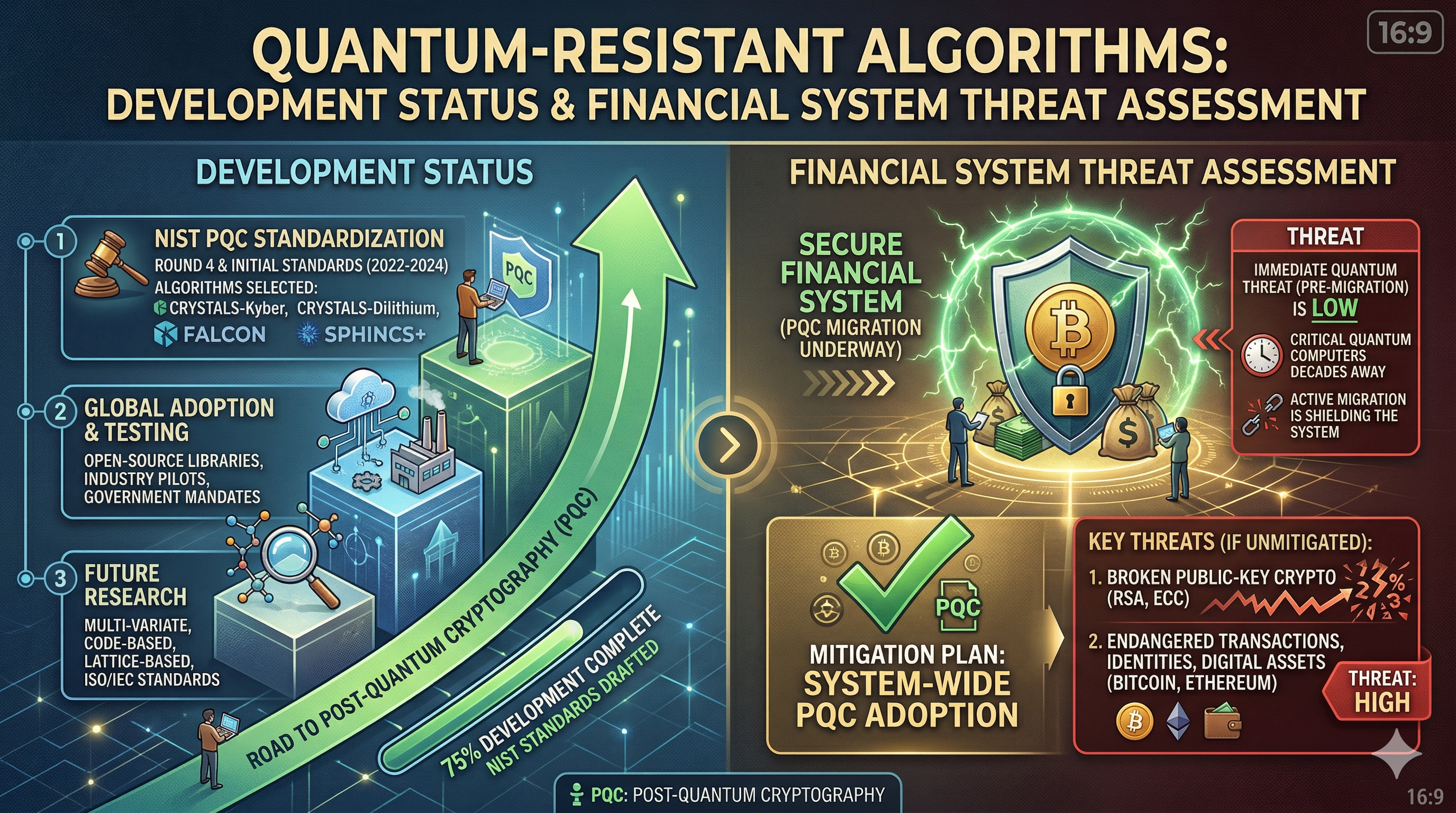
Quantum computing introduces a fundamental shift in computational capabilities that could undermine the cryptographic foundations of modern financial systems. However, the parallel development of quantum-resistant algorithms, driven by global standardization efforts and early institutional adoption, suggests that while the threat is real, it is more likely to trigger a gradual transformation of financial security infrastructure rather than a systemic collapse.
Introduction to Quantum Computing and Financial Security
Quantum computing represents a new paradigm in computation, leveraging the principles of quantum mechanics, such as superposition and entanglement, to process information in ways that classical computers cannot. Unlike traditional computers that use bits (0s and 1s), quantum computers use quantum bits (qubits), which can exist in multiple states simultaneously.
This capability allows quantum systems to solve certain types of problems exponentially faster than classical machines. While this has promising applications in fields like drug discovery and optimization, it also introduces significant risks, particularly in cybersecurity.
Modern financial systems rely heavily on encryption to secure transactions, protect sensitive data, and maintain trust. From online banking to global payment networks, cryptographic protocols ensure that information remains confidential and tamper-proof.
Quantum computing threatens to disrupt this foundation. If sufficiently powerful quantum computers are developed, they could break widely used encryption systems, exposing financial data and undermining trust in digital infrastructure. As a result, the financial industry is closely monitoring advancements in quantum technology and exploring ways to mitigate potential risks.
The Foundations of Modern Financial Cryptography
At the heart of today’s financial systems lies cryptography, the science of securing information through mathematical techniques. Banks, payment processors, and digital asset platforms rely on encryption to ensure that transactions are secure and identities are protected.
Two of the most widely used cryptographic systems are RSA and elliptic curve cryptography (ECC). These systems are based on mathematical problems that are difficult for classical computers to solve, such as factoring large numbers or computing discrete logarithms.
For example, RSA encryption relies on the difficulty of factoring large prime numbers. While it is easy to multiply two primes together, reversing the process is computationally intensive, making it a reliable security mechanism.
Similarly, ECC provides strong security with smaller key sizes, making it efficient for modern applications, including mobile devices and blockchain systems.
These cryptographic methods underpin a wide range of financial activities, including:
-
Secure online banking
-
Credit card transactions
-
Digital signatures
-
Cryptocurrency wallets
The security of these systems depends on the assumption that the underlying mathematical problems remain difficult to solve. However, quantum computing challenges this assumption, raising concerns about the long-term viability of current cryptographic standards.
Why Quantum Computers Threaten Existing Cryptographic Systems
The primary concern surrounding quantum computing and cryptography stems from a breakthrough known as Shor's algorithm. This quantum algorithm can efficiently solve problems that are currently infeasible for classical computers, such as factoring large integers and computing discrete logarithms.
If implemented on a sufficiently powerful quantum computer, Shor’s algorithm could break RSA and ECC encryption. This would compromise the security of many systems used in banking, payments, and digital assets.
Another relevant development is Grover’s algorithm, which can speed up brute-force attacks, reducing the effective security of symmetric encryption systems.
However, it is important to distinguish between theoretical and practical threats. While these algorithms exist, current quantum computers are not yet powerful enough to break real-world encryption systems. Building a quantum computer capable of doing so would require significant advancements in hardware, error correction, and scalability.
Despite this, the risk is not purely hypothetical. Data encrypted today could be intercepted and stored, then decrypted in the future once quantum technology matures, a concept known as “harvest now, decrypt later.”
This potential vulnerability has prompted governments and organizations to begin preparing for a post-quantum world.
What Are Quantum-Resistant (Post-Quantum) Algorithms?
Quantum-resistant algorithms, also known as post-quantum cryptography (PQC), are cryptographic systems designed to remain secure even in the presence of quantum computers. Unlike traditional algorithms, PQC does not rely on mathematical problems that quantum computers can easily solve.
Instead, these algorithms are based on alternative mathematical structures that are believed to be resistant to quantum attacks. Examples include lattice problems, hash functions, and error-correcting codes.
The goal of PQC is not to eliminate risk entirely, no cryptographic system is perfectly secure, but to provide a level of security that remains practical even as computational capabilities grow.
One of the key advantages of quantum-resistant algorithms is that they can often be implemented on existing hardware. This makes them more practical than quantum-based cryptographic solutions, which would require entirely new infrastructure.
However, PQC also presents challenges. Many post-quantum algorithms require larger key sizes and more computational resources, which can impact performance and scalability.
Despite these challenges, PQC is widely regarded as the most viable approach to securing digital systems in a quantum future.
Types of Quantum-Resistant Cryptographic Approaches
Several different approaches are being explored in the development of quantum-resistant cryptography, each with its own strengths and trade-offs.
Lattice-based cryptography is one of the most promising approaches. It relies on the difficulty of solving certain problems in high-dimensional lattices, which are believed to be resistant to quantum attacks. This category includes algorithms like CRYSTALS-Kyber and CRYSTALS-Dilithium.
Hash-based cryptography is another approach, particularly for digital signatures. These systems rely on the security of hash functions, which remain relatively resistant to quantum attacks when properly designed.
Code-based cryptography is based on error-correcting codes. These systems have been studied for decades and are considered highly secure, although they often require large key sizes.
Multivariate cryptography involves solving systems of polynomial equations, which can be computationally difficult for both classical and quantum computers.
Each of these approaches contributes to a diverse ecosystem of potential solutions, increasing the likelihood that secure systems can be developed and standardized.
The Current Development Status of Post-Quantum Cryptography
The development of quantum-resistant algorithms has accelerated significantly in recent years, driven by global efforts to prepare for future threats. One of the most important initiatives is led by the National Institute of Standards and Technology (NIST), which has been running a multi-year competition to evaluate and standardize post-quantum cryptographic algorithms.
In 2024, NIST announced the first set of selected algorithms for standardization, including CRYSTALS-Kyber for encryption and CRYSTALS-Dilithium for digital signatures. These selections represent a major milestone in the transition toward quantum-resistant security.
Other organizations, including governments and private companies, are also investing heavily in PQC research and development. Tech giants and cybersecurity firms are testing implementations and exploring integration into existing systems.
Despite this progress, widespread adoption is still in its early stages. Many systems continue to rely on traditional cryptography, and transitioning to PQC will require significant time and resources.
Real-World Implementation: Are Financial Institutions Preparing?
Financial institutions are increasingly aware of the risks posed by quantum computing and are beginning to take proactive steps. Major banks, payment networks, and fintech companies are conducting research and pilot programs to assess the feasibility of quantum-resistant cryptography.
Some institutions are adopting a “crypto-agility” approach, which involves designing systems that can easily switch between cryptographic algorithms as needed. This flexibility is crucial for adapting to future developments.
Central banks and regulators are also exploring the implications of quantum computing, particularly in the context of digital currencies and payment systems.
However, full-scale implementation remains limited. The complexity of financial infrastructure, combined with the need for interoperability and regulatory compliance, makes rapid adoption challenging.
Nevertheless, the direction is clear: preparation is underway, even if the transition is gradual.
Impact on Cryptocurrencies and Blockchain Systems
Cryptocurrencies and blockchain systems are particularly vulnerable to quantum threats due to their reliance on public-key cryptography. For example, Bitcoin uses elliptic curve cryptography to secure wallets and transactions.
If quantum computers become capable of breaking these systems, it could expose private keys and compromise user funds. This has led to growing interest in quantum-resistant blockchain solutions.
Some projects are exploring new cryptographic schemes, while others are investigating hybrid approaches that combine classical and post-quantum security.
However, upgrading existing blockchains is a complex process that requires consensus among participants. This makes rapid transitions difficult but not impossible.
Migration Challenges: Transitioning to Quantum-Resistant Systems
Transitioning to quantum-resistant cryptography presents several challenges. One of the most significant is technical complexity. Many PQC algorithms require larger key sizes and more computational resources, which can impact performance.
Another challenge is backward compatibility. Financial systems must continue to operate during the transition, requiring support for both old and new cryptographic standards.
Cost is also a factor. Upgrading infrastructure, retraining personnel, and conducting testing can be expensive.
Despite these challenges, gradual migration strategies can help mitigate risks and ensure a smooth transition.
Timeline of Quantum Threats: How Urgent Is the Risk?
Estimating the timeline for quantum threats is difficult. While progress is being made, experts disagree on when quantum computers will become powerful enough to break current encryption.
Some estimates suggest it could take 10–20 years, while others believe breakthroughs could occur sooner.
The uncertainty makes proactive preparation essential, even if the immediate risk is low.
Could Quantum Computing Cause a Financial Crisis?
In a worst-case scenario, quantum computing could disrupt financial systems by breaking encryption and exposing sensitive data. However, such a scenario is unlikely to occur suddenly.
More realistically, the transition to quantum-resistant systems will be gradual, allowing institutions to adapt over time.
Regulatory and Policy Responses
Governments are actively addressing quantum risks through research funding, standards development, and international collaboration.
Regulatory frameworks will play a key role in ensuring a coordinated response.
The Future of Financial Security in a Quantum Era
The rise of quantum computing presents both challenges and opportunities. While it threatens existing systems, it also drives innovation in cryptography and cybersecurity.
The future will likely involve a combination of classical and quantum-resistant technologies, creating a more resilient financial ecosystem.
FAQ Section
What is quantum-resistant cryptography?
It refers to encryption methods designed to remain secure against quantum computer attacks.
Can quantum computers hack Bitcoin?
Not yet, but future advancements could pose risks.
When will quantum computing become dangerous?
Estimates vary, but preparation is already underway.
Are banks preparing for this?
Yes, many are researching and testing solutions.
Should investors worry?
The risk is long-term, not immediate.
Conclusion
Quantum computing represents a transformative technological shift with significant implications for financial security. While it poses real risks to current cryptographic systems, the development of quantum-resistant algorithms provides a viable path forward.
Rather than triggering a sudden crisis, quantum advancements are more likely to drive a gradual evolution of financial infrastructure. With ongoing research, standardization, and proactive planning, the financial system can adapt to this new era of computation.