

OP and HYPE Token Unlocks in May 2026: What Traders Need to Know About Selling Pressure
Meta Description: May 2026 brings an important HYPE unlock and continued OP vesting activity. We break down how unlock size, liquidity, and holder behavior could impact prices and what traders should watch.
Introduction
OP and HYPE token unlocks remain important for traders in May 2026 as new supply activity continues to shape short-term market sentiment. Token unlocks can influence prices because previously restricted tokens become transferable, giving recipients the ability to hold, stake, move, or sell their tokens.
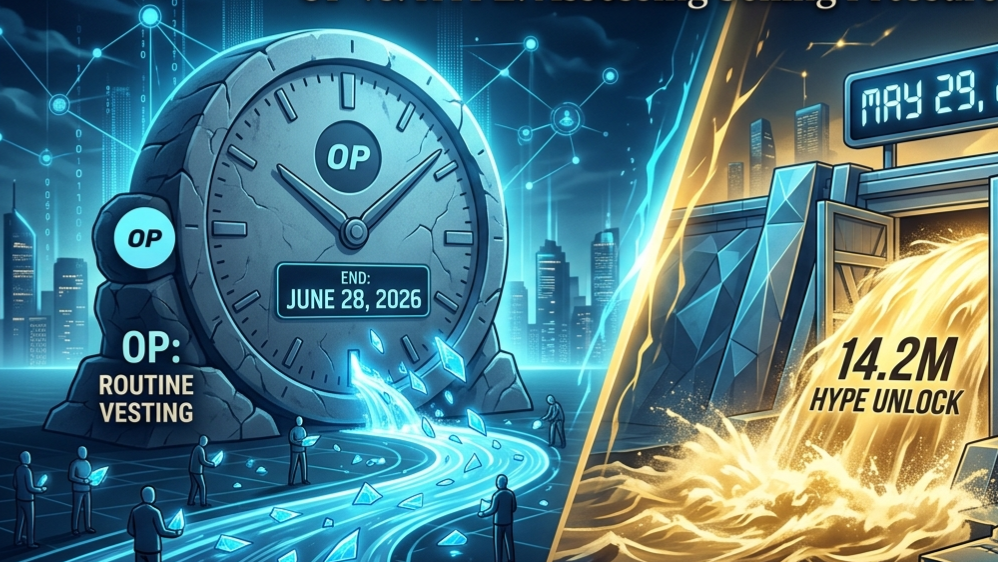
The two assets do not have the same setup. HYPE has a clear upcoming unlock event scheduled for May 29, 2026, with 14,175,778 HYPE set to unlock, equal to about 1.4% of total supply and around 3% of market cap. The recipient breakdown for this unlock is listed as 46.6% insiders, 46.3% community, and 7% foundation.
OP, by contrast, is better understood as part of a long-running scheduled vesting cycle. Optimism’s unlock schedule runs from May 31, 2022 to June 28, 2026, releasing a total of 4,294,967,296 OP across 46 unlock events. As of the latest available tokenomics data, 44.2% of OP supply has been unlocked.
The main question now is whether buying demand can absorb unlocked supply or whether added liquidity from these vesting events will create stronger selling pressure.
This May 2026 Unlock Cycle and Why It Matters
What makes May 2026 notable is not just one individual unlock. It is that token unlocks remain a recurring source of market attention across the altcoin space. When several projects release supply within a concentrated period, traders often become more cautious. They may reduce exposure before major supply events, especially when liquidity is thin or recent price action has been weak.
The ripple effect matters too. Large unlock periods do not only affect the specific tokens being released. They can shift overall sentiment. Investors become more selective. Projects with strong underlying demand may handle additional supply well, while weaker or less liquid assets can struggle if there are not enough active buyers.
For OP and HYPE specifically, traders need to look beyond the token count alone. HYPE has the clearer near-term unlock catalyst on May 29, 2026, while OP is part of a longer vesting schedule that ends on June 28, 2026.
If broader crypto sentiment is stable, these supply events may be absorbed without major disruption. But if the market is weak, even predictable unlocks can add pressure.
How Token Unlocks Actually Create Selling Pressure
The mechanics are straightforward: unlocks increase the number of tokens that can move freely. Before the event, those tokens are restricted by a vesting schedule. After the unlock, recipients have choices. Some may hold. Others may stake, transfer, rebalance, or sell.
But the process is not automatic. Unlocks create potential selling pressure, not guaranteed selloffs. Token unlocks are scheduled releases of previously locked tokens into circulation, and they may influence market behavior because available supply increases.
The strongest pressure usually appears when three things line up: the unlock is substantial, recipients have reasons to sell, and market liquidity is not deep enough to absorb the new supply. If only one or two of these factors are present, the price impact may be limited.
Key Factors Every Trader Should Monitor
Several variables determine whether an unlock becomes a bearish event or just a short-term volatility catalyst.
Unlock size relative to liquidity is first. A large unlock can be absorbed if buying demand is strong. Conversely, a smaller unlock can still move prices if liquidity is shallow.
Who receives the tokens matters a lot. For HYPE’s May 29 unlock, the recipient breakdown is especially important because the release is split across insiders, community, and foundation allocations. Insider allocations can create more market attention, while community or foundation-related tokens may be distributed or used more gradually depending on project behavior.
Market expectations also play a role. If everyone already knows the unlock is coming, prices may adjust beforehand. When that happens, the actual unlock may cause less movement than expected because some of the event is already priced in.
Post-unlock behavior gives the clearest answer. If price holds steady after release, buyers are absorbing supply. If price drops on rising volume, it may indicate active distribution.
OP Unlock: Routine Vesting with Moderate Pressure
Not every token unlock creates the same level of market stress. Some unlocks are large enough to immediately affect positioning. Others mainly influence sentiment because traders know more supply is gradually entering the market.
For OP, the current setup looks more like scheduled vesting than a sudden supply shock. Optimism’s vesting schedule has been active since May 31, 2022 and is scheduled to finish on June 28, 2026. The full schedule covers 46 unlock events and a total release of 4,294,967,296 OP.
That makes OP worth watching, but not because of a surprise event. The main point is that continued vesting can still weigh on price if the broader market is weak or if Layer 2 sentiment softens.
Unlock Size and Timeline
Optimism’s unlock schedule is long-running and public. The schedule spans roughly 49 months, from May 31, 2022 to June 28, 2026, with 44.2% of all OP tokens currently unlocked.
The key point is that OP’s unlock structure is not new information. It is part of a known vesting cycle. When unlocks are predictable, traders and investors often adjust their positions before the release date. So some expected selling pressure may already be reflected in the price.
Why the Pressure Looks Manageable
The main reason OP selling pressure appears moderate is predictability. Scheduled unlocks often get priced in beforehand, especially when the market has had years to track the vesting schedule.
OP also benefits from being a well-known Layer 2 token with broad market awareness. That does not remove sell-side activity, but it puts OP in a stronger position than smaller, less liquid assets when routine supply enters the market.
Moderate does not mean zero. Even routine vesting can weigh on price if crypto sentiment is weak, if Ethereum ecosystem tokens are under pressure, or if buyers are not active enough around unlock dates.
Investor and Contributor Allocations
OP’s tokenomics include allocations for investors and core contributors, which can increase market attention around vesting dates. These groups may have reasons to rebalance, diversify, or take profits after vesting milestones.
However, selling is not guaranteed. Some recipients may continue holding if they believe in Optimism’s long-term role in Ethereum scaling. Others may sell gradually rather than immediately.
For OP, the issue is not only whether recipients sell. It is whether traders expect them to sell. Expectations alone can create short-term caution before any visible distribution appears.
Layer 2 Sentiment Context
OP’s reaction will partly depend on how traders feel about Layer 2 projects generally. If Ethereum scaling tokens are stable or gaining momentum, OP may absorb vesting supply more easily. If the sector is weak, unlock-related concerns can add to downside pressure.
Layer 2 tokens often move with broader Ethereum ecosystem sentiment, including network activity, rollup adoption, fee trends, and investor appetite for scaling assets. If those narratives are strong, OP may find support even during vesting periods.
This makes OP’s unlock impact more dependent on sector conditions than the raw token numbers alone. A manageable unlock in a weak sector can still affect price. The same unlock in a strong sector may pass with limited disruption.
What to Watch After Release
The signals that matter most are price stability, trading volume, and large-holder behavior. If OP holds its range with healthy volume, buyers are likely absorbing available supply. If price drops on rising volume, the unlock may be creating real distribution pressure.
Also watch whether OP rebounds after scheduled vesting events. If price was weak beforehand but stabilizes afterward, the market may have already priced in the event. If weakness continues post-unlock, actual selling may be stronger than expected.
Most likely outcome for OP: moderate volatility rather than a major supply shock. It deserves attention, but it does not look like a higher-pressure event compared with HYPE.
HYPE Unlock: Higher Stakes and Greater Short-Term Pressure
HYPE carries a different setup from OP. While OP looks like routine vesting, HYPE has a clearer near-term catalyst. The next HYPE unlock is scheduled for May 29, 2026, releasing 14,175,778 HYPE, equal to 1.4% of total supply and around 3% of market cap.
The central question for traders is not just how many HYPE tokens are being released. It is whether the market has enough demand and liquidity to absorb any tokens that recipients choose to sell.
Unlock Size and Potential Impact
HYPE’s May 29 unlock is one of the more important supply events for the token because the amount being released is large enough to influence short-term sentiment. The recipient breakdown also matters: 46.6% insiders, 46.3% community, and 7% foundation.
How much this matters depends on how much of the newly unlocked supply becomes active. If most recipients hold, stake, or distribute gradually, the event may pass without major disruption. But if a meaningful portion gets sold quickly, the market must absorb that supply in a short window.
That is why traders may treat HYPE as a higher-pressure setup. It is not only the size. It is also the visibility of the event and the potential for traders to reposition around the unlock date.
Why HYPE Faces Greater Sell-Side Pressure
HYPE faces elevated selling pressure because the unlock could introduce meaningful liquid supply into the market. If recipients sell shortly after release, buyers need to absorb that supply fast. This can create downward pressure, especially if broader market sentiment is weak.
The pressure is amplified because HYPE is highly watched. When many traders focus on the same unlock date, the event can become a major positioning catalyst. Traders may reduce exposure before the unlock just to avoid uncertainty. That can weaken price even before any actual selling occurs.
Expectations matter too. If the market believes the HYPE unlock will create pressure, that belief alone can influence price action. Some traders sell early. Others delay buying until after the event. This reduces demand during the period when potential supply is increasing.
High Visibility Can Amplify Volatility
HYPE is a closely watched project, and that attention cuts both ways. Strong interest can support demand if investors remain confident in the long-term outlook. But when many traders watch the same unlock date, price action can become choppy.
Some traders may sell before the unlock to avoid uncertainty. Others may wait for the event to pass before entering new positions. This creates a short-term waiting period. Even long-term supporters may wait to add exposure while short-term traders try to profit from expected volatility.
As a result, HYPE could see sharp moves around the unlock even if actual selling is not extreme. The post-unlock reaction will be telling. If HYPE holds price after release, traders may interpret that as strong demand. If it breaks down, sentiment could turn negative quickly.
Recipient Behavior Will Determine Everything
Actual selling pressure depends heavily on what recipients do with their newly available tokens. If holders keep them, stake them, or distribute gradually, market impact stays limited. But if a meaningful share decides to take profits or reduce exposure, HYPE could face real short-term selling.
Recipient behavior often matters more than the unlock figure itself. A large unlock that mostly stays held can have minimal immediate effect. A smaller unlock that gets sold quickly can create more pressure.
Timing matters too. Gradual selling can be absorbed over time. Sudden selling into weak liquidity creates sharper drops. That is why the first 24 to 72 hours after the unlock are critical.
Possible Outcomes Post-Unlock
Three main scenarios are worth considering:
Pre-unlock selloff, then stabilization. Traders sell beforehand expecting supply pressure. Once the unlock happens, actual selling is lighter than feared. Price stabilizes or rebounds as uncertainty fades.
Direct post-unlock weakness. Unlocked tokens hit the market and create real selling pressure. If buyers cannot absorb the new supply, price continues falling after the unlock date.
Smooth absorption. Demand stays strong enough to absorb new supply without major price damage. This would be the most constructive outcome because it would show that the market can handle the unlock while maintaining confidence.
Signals to Monitor After the Event
Watch price stability, trading volume, and large-holder behavior. If HYPE holds key levels with healthy volume, buyers are likely absorbing supply. If price falls on rising volume, the unlock may be turning into distribution.
Also watch whether volatility fades after the event or persists for several days. If volatility drops and price stabilizes, the market has likely absorbed the unlock. If volatility remains high and rallies keep getting sold, selling pressure may still be active.
Another useful signal is whether HYPE outperforms or underperforms the broader market post-unlock. If the market is stable but HYPE weakens, unlock pressure may be the main driver. If everything is weak, it is harder to separate unlock pressure from general market weakness.
Overall HYPE Outlook
HYPE carries higher short-term unlock pressure than OP because it has a specific upcoming release on May 29, 2026, with 14,175,778 HYPE becoming unlocked. The event is meaningful relative to market cap and visible enough to influence trader positioning.
But a major unlock does not guarantee a sharp selloff. If demand stays strong and recipients do not sell aggressively, the market may absorb it. Until price action confirms that absorption, HYPE should be treated as one of the more important unlock-related volatility events in May 2026.
OP vs HYPE: Which Faces More Pressure?
The comparison is clear. OP looks more routine and manageable. HYPE carries greater short-term market pressure.
OP may see moderate selling pressure from scheduled vesting and investor or contributor allocations. But the market already knows OP’s vesting structure, which runs through June 28, 2026. That makes it less of a surprise supply shock and more of a predictable vesting factor.
HYPE faces a more sensitive situation. Its May 29, 2026 unlock is more visible and more likely to influence short-term positioning. Even if actual selling stays limited, traders may behave cautiously before and after the event.
Simply put: OP represents routine vesting pressure. HYPE represents event-driven volatility pressure.
Broader Market Implications
May 2026 unlock activity may influence broader altcoin sentiment. When multiple projects release supply within a short period, traders often become more defensive. They reduce exposure, avoid high-unlock tokens, or wait for supply events to pass before entering new positions.
This can create a temporary liquidity crunch. If many traders are sitting on the sidelines, there are fewer buyers available to absorb newly unlocked tokens. That increases volatility, especially for projects with larger unlocks or weaker momentum.
Concentrated unlock windows can become important market periods because several supply events affect sentiment at the same time. That is why OP and HYPE should not be analyzed in isolation. Their reactions will be influenced by the wider market environment.
If the broader market stays stable, both projects may absorb supply pressure more smoothly. If sentiment weakens, even manageable unlocks can become more damaging.
Final Thoughts
May 2026 highlights why supply analysis matters in crypto. Token unlocks do not guarantee price drops, but they create periods of elevated attention because previously locked tokens become liquid and may enter circulation.
For OP, the unlock setup looks like routine scheduled vesting. Optimism’s unlock schedule is long-running, public, and scheduled to end on June 28, 2026. It is worth monitoring, especially for potential effects on Layer 2 sentiment, but it does not appear to be the higher-pressure event.
For HYPE, the May 29, 2026 unlock carries higher short-term pressure. The release of 14,175,778 HYPE, equal to about 1.4% of total supply and 3% of market cap, makes it a key event to watch.
Focus less on the unlock numbers alone and more on market absorption. If price stays stable after the unlock, buyers are strong enough to handle the new supply. If price falls on rising volume, the unlock may be turning into real selling pressure.
In May 2026, HYPE deserves closer attention for short-term volatility, while OP remains a moderate, routine vesting case.
Frequently Asked Questions
What is a token unlock?
A token unlock is when previously locked tokens become available for holders to use, transfer, stake, or sell.
Do token unlocks always cause prices to fall?
No. Unlocks create potential selling pressure, but prices only fall if selling demand outweighs buying demand.
Why is OP unlock considered moderate?
OP is considered moderate because Optimism is in a known, long-running vesting schedule that runs from May 31, 2022 to June 28, 2026. The market has had time to price in much of the schedule.
Why is HYPE unlock considered higher pressure?
HYPE is considered higher pressure because it has a specific upcoming unlock on May 29, 2026, releasing 14,175,778 HYPE, equal to about 1.4% of total supply and 3% of market cap.
Which token faces more selling pressure: OP or HYPE?
HYPE appears to face higher short-term selling pressure, while OP looks more moderate and routine.
What should traders watch after the unlocks?
Traders should watch price stability, trading volume, exchange inflows, and large-holder movements to see whether the market absorbs the new supply successfully.
Disclaimer: This article is for informational purposes only and does not constitute financial advice. Always conduct your own research before making investment or trading decisions.