

Fear Index Jumps to 47: Is Sentiment Turning Bullish?
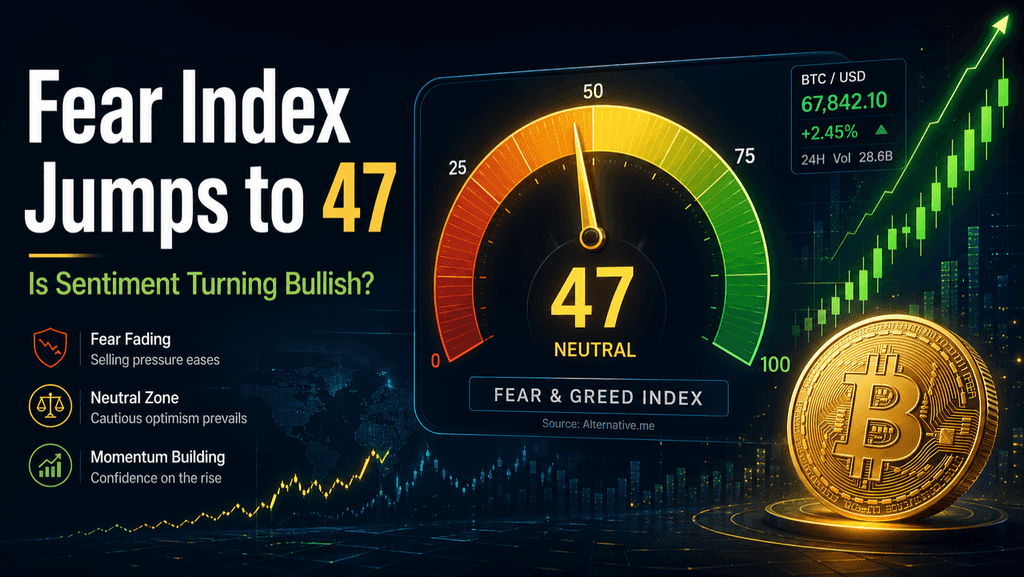
The Crypto Fear & Greed Index has jumped to 47, showing a clear improvement in market sentiment after a period of caution, fear, and uncertainty. While this reading does not yet confirm a fully bullish market, it suggests that investors are becoming less defensive and more willing to consider risk again. In a market where sentiment can shift quickly, this move has attracted attention from traders who are watching for signs of a broader recovery.
A move to 47 is important because it places the market close to neutral territory. It shows that heavy fear is beginning to fade, but it also means investors are not yet showing strong greed or aggressive optimism. In simple terms, the crypto market mood is improving, but traders still need stronger confirmation before calling it a full bullish reversal.
Sentiment indicators are especially important in crypto because prices often react sharply to investor emotion. When fear dominates, traders may avoid risk, sell quickly, or wait on the sidelines. When confidence returns, buying interest can improve and market activity may increase. The latest reading suggests that the market may be moving from a defensive phase into a more balanced environment.
What is the Fear Index?
The Fear Index, often called the Crypto Fear & Greed Index, is a market sentiment indicator that measures whether investors are feeling fearful, neutral, or greedy. In the crypto market, it is widely used to understand the overall mood of traders and investors.
When the index is low, it usually means investors are fearful. This often happens during price drops, market uncertainty, or heavy selling pressure. A low reading may suggest that traders are worried about further losses and are less willing to take risk. In extreme cases, very low sentiment can reflect panic or strong pessimism across the market.
When the index is high, it suggests that investors are becoming more confident or greedy. This usually happens during strong rallies, rising prices, and periods of heavy buying activity. A high reading can show that traders are optimistic, but it can also warn that the market may be becoming overheated.
The index usually works on a scale from 0 to 100:
-
0 to 24: Extreme Fear
-
25 to 44: Fear
-
45 to 55: Neutral
-
56 to 74: Greed
-
75 to 100: Extreme Greed
A reading near 47 shows that sentiment is close to neutral. It means fear is easing, but the market has not yet become strongly bullish. The market is no longer deeply pessimistic, but traders are also not showing the kind of confidence usually seen during strong bullish phases.
Fear Index Nears Neutral as Investor Mood Improves
The jump to 47 shows that the market is moving closer to neutral territory after spending time under pressure. This is an important development because it suggests that investors are no longer reacting with the same level of fear seen during weaker market conditions.
A neutral reading does not mean the market is fully bullish, but it does show that panic has started to fade. When sentiment moves closer to the middle of the scale, traders often become more balanced in their decisions. Instead of focusing only on downside risk, they begin watching for signs of recovery and potential upside.
Some key signs from this move include:
-
Fear is easing: Investors are no longer as defensive as before.
-
Market mood is improving: Traders are becoming more open to new opportunities.
-
Selling pressure may slow: As panic fades, fewer investors may rush to exit positions.
-
Buyers may return gradually: Improved confidence can attract traders who were waiting on the sidelines.
-
Sentiment is still not fully bullish: The index needs to move higher before confirming stronger optimism.
This shift can help create a more stable trading environment. If the Fear Index continues rising from this level, it may encourage more investors to return to the market. Better sentiment can also help reduce panic-driven selling, which often makes price swings more severe during uncertain periods.
Still, the improvement should be viewed carefully. A reading of 47 is encouraging, but it does not mean the market has fully recovered. Investor mood can change quickly in crypto, especially when prices react to sudden news, macroeconomic updates, regulatory headlines, or sharp moves in Bitcoin and other major assets.
Why Market Confidence Is Improving
The rise in the Fear & Greed Index suggests that market confidence is slowly returning. After a period where traders were more cautious, the latest reading shows that fear is no longer controlling sentiment as strongly as before. Investors appear to be watching the market with more interest, especially as major crypto assets attempt to stabilize.
Market confidence often improves when traders see signs of stability. This can include stronger support levels, reduced selling pressure, better price recovery, or renewed interest from buyers. When the market stops falling sharply and begins to hold important levels, traders may start to believe that downside risk is becoming more limited.
Another reason confidence may be improving is that traders often adjust their outlook after periods of heavy fear. When the market becomes too pessimistic, even a small recovery can change investor behavior. Instead of expecting continuous losses, traders begin looking for opportunities. This shift can help bring liquidity back into the market.
Improving confidence may also come from stronger participation in major assets. Bitcoin often plays a central role in crypto sentiment because it is the largest and most closely watched cryptocurrency. When Bitcoin shows strength or stability, traders may become more confident about the broader market. For many investors, Bitcoin’s ability to hold key levels is an important signal of market health.
This improvement can be seen as an early positive sign. When sentiment begins to recover, traders often become more willing to enter new positions, hold existing assets, and look for potential upside opportunities. A higher sentiment reading can also encourage more market participation, which may help support price movement if buying interest continues to grow.
Still, confidence needs to be supported by actual market strength. A sentiment reading can improve quickly, but if prices fail to follow through, the recovery may lose momentum. That is why traders should watch not only the index but also price action, trading volume, and broader market behavior.
Is Crypto Sentiment Finally Turning Bullish Again?
Crypto sentiment may be starting to turn bullish again, but the move is still in its early stage. The rise in the Fear & Greed Index to 47 shows that investors are becoming less fearful, but the market has not yet entered a clear greed phase. This means sentiment is improving, but caution remains.
The crypto market often moves quickly when sentiment changes. A shift from fear to neutral can attract buyers who were waiting on the sidelines. It can also reduce panic selling and help stabilize prices. When traders see that fear is weakening, they may become more confident about holding assets or opening new positions.
However, easing fear does not automatically mean the market is bullish. It only means that the negative pressure on sentiment is decreasing. The market still needs to show that buyers are strong enough to push prices higher and maintain momentum.
For sentiment to turn clearly bullish, the Fear & Greed Index would likely need to move above 50 and remain there. A sustained move into greed territory would suggest that investors are becoming more confident and that risk appetite is strengthening across the market.
The difference between improving sentiment and bullish sentiment is important. Improving sentiment means the market is recovering from fear. Bullish sentiment means investors are actively confident and willing to take more risk. At 47, the market is closer to the first condition than the second. The tone is better, but confirmation is still needed.
This is why traders may describe the current reading as constructive rather than fully bullish. It shows progress, but not final confirmation. If the index continues to rise and the market follows with stronger price action, then the bullish case could become stronger.
Price Action Still Needs to Confirm the Shift
Sentiment alone is not enough to confirm a bullish trend. While the Fear Index can show how investors feel, price action shows what investors are actually doing. For the current improvement in sentiment to become meaningful, major cryptocurrencies such as Bitcoin need to show stronger movement on the charts.
If prices continue to hold important support levels, it may show that buyers are defending the market. This is important because support levels often reveal whether investors are willing to step in during pullbacks. A market that holds support well usually appears healthier than one that breaks down quickly after every rally attempt.
If prices begin to break above resistance, it could signal that momentum is shifting toward the bulls. Resistance levels often act as barriers where sellers appear. When buyers push through those levels with strength, it may suggest that demand is becoming stronger than supply. These technical signals would make the improvement in sentiment more convincing.
Trading volume is another key factor. A bullish move supported by strong volume is usually more reliable because it shows broader participation. If prices rise on weak volume, the move may be less convincing and more vulnerable to reversal. Strong volume suggests that more traders are joining the move, which can support momentum.
On the other hand, if prices fail to follow through, traders may become cautious again. A sentiment rebound without price confirmation can sometimes turn into a short-lived relief rally. That is why investors should avoid relying only on the Fear & Greed Index. The index can provide useful context, but it does not replace chart analysis, risk management, or broader market research.
Key Levels and Market Signals to Watch
The next major level to watch is whether the Fear & Greed Index can move above 50. A move above this level would suggest that sentiment is becoming more positive and that investors are gaining confidence. If the index continues rising after that, it could support a stronger bullish outlook.
Traders should also monitor the broader crypto market to see whether major cryptocurrencies can maintain support and break through resistance levels. If price action strengthens while sentiment improves, it would give bulls a stronger case. But if the market fails to hold key levels, sentiment could weaken again.
Several signals may help traders understand whether the current improvement is sustainable:
-
A move above 50 on the index: This would show that sentiment is shifting from neutral toward optimism.
-
Stable Bitcoin price action: Bitcoin often leads broader crypto sentiment.
-
Higher trading volume: Stronger participation can confirm that buyers are becoming more active.
-
Altcoin participation: A broader rally across major altcoins may suggest improving risk appetite.
-
Support levels holding: If the market holds important support zones, confidence may continue improving.
-
Resistance breakouts: A break above key resistance levels could support bullish momentum.
Broader market conditions will also play a role. Crypto sentiment can be affected by macroeconomic news, liquidity trends, regulatory updates, ETF flows, and global risk appetite. If these factors remain supportive, the market may have a better chance of moving into a bullish phase.
However, if macro conditions become weaker or negative news hits the market, sentiment could reverse. Crypto remains a highly reactive asset class, and traders often respond quickly to uncertainty. This makes confirmation especially important.
Neutral Sentiment Could Signal a Bigger Move Ahead
A Fear Index reading of 47 may not be strongly bullish, but it can still be important because neutral sentiment often comes before a larger market move. When the market shifts away from fear, traders begin watching closely for direction. This can create conditions for stronger momentum if buyers start gaining control.
If the index moves above 50, sentiment could shift more clearly toward optimism. That would suggest investors are becoming more confident and more willing to take risk. In that case, the current reading of 47 could be seen as an early step toward a broader bullish recovery.
Key signals that could support a bigger move include:
-
Index moving above 50: This would suggest sentiment is shifting from neutral toward optimism.
-
Buyers staying active: Consistent buying interest can help confirm stronger market confidence.
-
Prices holding support: Major cryptocurrencies need to stay above important support levels.
-
Higher market participation: Stronger volume can show that more traders are joining the move.
-
Improving confidence over several days: A sustained rise is more reliable than a one-day jump.
However, neutral sentiment can also lead to uncertainty. If buyers fail to push the market higher, traders may lose confidence again. This is why the next move in both sentiment and price action will be important.
For the bullish case to become stronger, the market needs sustained confidence rather than a short-term improvement. A single jump in the Fear Index is positive, but traders will want to see whether sentiment continues improving over several days.
Sustained confidence usually appears when buyers remain active, prices hold important support levels, and market participation increases. If these factors align, the improvement in sentiment could become more reliable. It would show that investors are not only less fearful, but also more committed to the market’s recovery.
Until then, the move to 47 should be treated as a promising signal rather than a final confirmation. The market is showing progress, but it still needs consistency before traders can confidently say that bullish sentiment has returned.
Why Traders Should Still Be Careful
Although the jump to 47 is encouraging, traders should still remain cautious. The crypto market is known for rapid sentiment shifts, and confidence can weaken quickly if prices fall or negative news appears. A neutral reading does not remove market risk.
Traders should also remember that sentiment indicators are not perfect signals. They are useful for understanding market psychology, but they should be used alongside other tools. Price trends, volume, support and resistance levels, liquidity, and broader market conditions all matter.
A reading of 47 shows that fear is easing, but it does not mean greed has taken control. Until the market shows stronger confirmation, aggressive bullish expectations may be premature.
There is also the risk of false signals. Sometimes sentiment improves during a relief bounce, but the market fails to continue higher. In those cases, traders who enter too aggressively may face losses if momentum fades. This is why risk management remains important even when sentiment improves.
Instead of assuming that the market has fully turned bullish, traders may want to watch for a combination of signals. The strongest bullish case would include improving sentiment, rising prices, strong trading volume, and support from broader market conditions. Without these confirmations, the move to 47 should be seen as progress, not certainty.
Conclusion
The Fear Index jumping to 47 is a positive development for the crypto market. It shows that fear is fading, confidence is improving, and investors are becoming more open to risk. However, the market has not yet confirmed a full bullish reversal.
For now, crypto sentiment appears to be turning more positive, but not fully bullish. A move above neutral territory, supported by stronger price action and higher trading volume, would be needed to confirm that bulls are gaining real control.
The current reading should be viewed as an early sign of improvement rather than a final bullish confirmation. If the index continues to rise and the market follows with stronger momentum, sentiment could turn clearly bullish in the days ahead.
Until that happens, traders should remain balanced. The jump to 47 is encouraging because it shows that panic is fading and confidence is returning. But the market still needs consistent strength before investors can say that bullish sentiment has fully taken over.
FAQs
What does a Fear Index reading of 47 mean?
A Fear Index reading of 47 means the crypto market is close to neutral territory. It shows that fear is easing, but investors are not yet strongly bullish or greedy.
Is a Fear Index reading of 47 bullish?
A reading of 47 is not fully bullish. It is a positive sign because market confidence is improving, but the index still needs to move higher, especially above 50, to suggest stronger bullish sentiment.
What is the Crypto Fear & Greed Index?
The Crypto Fear & Greed Index is a sentiment indicator that measures whether crypto investors are feeling fearful, neutral, or greedy. It helps traders understand the overall mood of the market.
Why is the Fear Index important for crypto traders?
The Fear Index is important because crypto prices are often influenced by investor emotions. When fear is high, selling pressure may increase. When confidence improves, buyers may become more active.
Can the Fear Index predict crypto prices?
The Fear Index does not directly predict prices. It only shows market sentiment. Traders usually combine it with price action, trading volume, support and resistance levels, and broader market news.
What level confirms bullish sentiment?
A move above 50 may suggest that sentiment is becoming more positive. However, stronger confirmation usually comes when the index continues rising and prices also show bullish momentum.
Should traders buy crypto when the Fear Index rises?
Not always. A rising Fear Index can show improving confidence, but traders should still be careful. It is better to look for confirmation from price action, trading volume, and overall market conditions before making decisions.
Disclaimer
The information provided on this page may originate from third-party sources and does not necessarily represent the views or opinions of KuCoin. This content is intended solely for general informational purposes and should not be considered financial, investment, or professional advice. KuCoin does not guarantee the accuracy, completeness, or reliability of the information, and is not responsible for any errors, omissions, or outcomes resulting from its use. Investing in digital assets carries inherent risks. Please carefully evaluate your risk tolerance and financial situation before making any investment decisions. For further details, please consult KuCoin’s Terms of Use and Risk Disclosure.