

XRP vs. Solana: The Ultimate Comparison
2026/03/24 11:33:02
Two of the most well-known large-cap cryptocurrencies are Ripple (XRP) and Solana, but these two crypto networks reflect quite different concepts of what blockchain networks ought to do best. XRP has close links to cheap and quick value transfer and cross-border payments whereas Solana is related to high throughput, low charges, and apps-heavy ecosystem based on decentralized finance, NFTs and consumer-facing crypto products. The very reason the XRP vs Solana discussion continues to revisit itself, is precisely this difference, namely that both networks are fast, both have strong communities, and each is positioned at the core of the market long-term growth discussion.
In this article we are going to discuss the comparison between XRP and Solana with respect to technology, speed, token design, ecosystem strength, future potential, and how to buy XRP or SOL on KuCoin, so you can evaluate which asset fits your goals more clearly.
Key Takeaways
-
Both XRP and Solana are high-throughput blockchain systems, but XRP is more payment- and settlement-centered, whereas Solana is more smart contract- and decentralized application-centered.
-
The typical raw throughput and app-layer activity offered by Solana is usually much higher, though XRP has the framing of being simpler and more stable as a means of value transfer.
-
The long-term case of XRP is based on utility of payments, liquidity, and regulatory clarity, whereas the long-term case of Solana is based on the uptake of the developers, user usage, and ecosystem expansion.
-
The structure of the token counts: XRP is capped at 100 billion in supply, and Solana does not have a hard cap instead of a staking-based issue model. In its current position, KuCoin has circulating supply of XRP of approximately 61.23 billion.
-
Each of these projects is not better in all the categories. XRP has a greater institution-based payment story, where Solana has a greater consumer crypto, DeFi, NFTs, and on-chain high-frequency activity.
-
For investors, the smarter comparison is not which coin wins in abstract, but which network’s use case, token design, and risk profile better match your strategy.
XRP and Solana at a Glance
On the face of it, XRP and Solana may appear similar since they are both associated with speed, low costs, and good brands. It is that surface resemblance which causes many of us laymen to draw the two directly across. As a fact, they fall under various strategic categories. XRP can usually be described as a payment-oriented asset pegged to the XRP Ledger, and oriented toward settlement efficiency, international transactions, and bridge-asset capabilities. Solana, in its turn, is typically defined as a high-performance smart contract blockchain that is meant to accommodate high-activity application usage, such as decentralized exchanges, gaming, NFTs, and consumer applications.
The simplest conceptual way of looking at the difference is to consider what each network is attempting to maximize. XRP is attempting to make the movement of value easy, quick and cheap. Solana is attempting to build and execute crypto applications at scale, quickly and cheaply. The latter difference affects all other aspects: the consensus models, their communities, their token economies, their competitive space, and even how investors discuss them. Payments network is also rated differently compared to an app platform. XRP is frequently contrasted with other chains that have payment as their primary purpose, and Solana is frequently contrasted with Ethereum and other smart contract networks.
This difference also justifies the reason why there is no clean answer to the question of whether it was RP vs Solana or not. A trader that seeks an upside driven by the ecosystem would choose Solana. An investor that assumes the existence of blockchain-based settlement and institutional payment rails, may favor XRP. The point of contention behind the question is actually what aspect of crypto you believe is more likely to generate enduring value: payment infrastructure or application infrastructure. A more helpful way of framing that is what token is merely better.
What is XRP?
XRP is the currency used in the XRP Ledger, which is a blockchain that is created to settle within seconds and at low costs. According to Ripple, XRP is the native digital asset on XRPL, which is utilized to enable transactions, assist in spamming the network, and serve as a bridge asset in the native network decentralized exchange. Such description is important as it demonstrates that XRP is not simply a traded token that has been implemented on the top of a network rather, the ledger itself is designed with such a token in mind.
Among the strongest arguments that XRP makes is efficiency. It is a well-established fact that the network provides rapid settlement of transactions with minimum fees, and in this regard, it can be frequently found in the context of remittances, settlement rails, and cross-border transfer. In his comparison, Gemini indicates that XRP is more stable and that Ledger positions XRP as more appropriate to institutional cross-border bank-to-bank payments due to its design and the nature of the financial problem that it is attempting to address. Such framing is what has enabled XRP to remain relevant despite extended durations of legal and regulatory uncertainty, since the original story is still practical, as opposed to being purely speculative.
The other key aspect is structure of supply. The present XRP section on KuCoin provides information that XRP has approximately 61.23 billion that are in circulation with the highest limit being 100 billion. That hard upper cap contrasts with the proof-of-work mining systems as well as with many proof-of-stake systems which keep on issuing new tokens over time. To investors, it implies that XRP is frequently debated in terms of utility, liquidity and distribution as opposed to token inflation.
The connection of XRP with Ripple also influences the awareness of the population even though the asset and the company are not one and the same. Corporate activities of Ripple about payments and liquidity have served in keeping XRP in the limelight, yet it has produced confusion. Other investors believe that all Ripple business developments will automatically lead to the price growth of XRP. Practically, the connection is more intricate. The market value of XRP remains reliant on market liquidity, demand, regulatory factors, the general mood of the crypto industry, and the utility narrative of the network being reinforced in a significant fashion. This is the reason why XRP can be both practical, highly popular, and at the same time, vulnerable to powerful market fluctuations.
What is Solana?
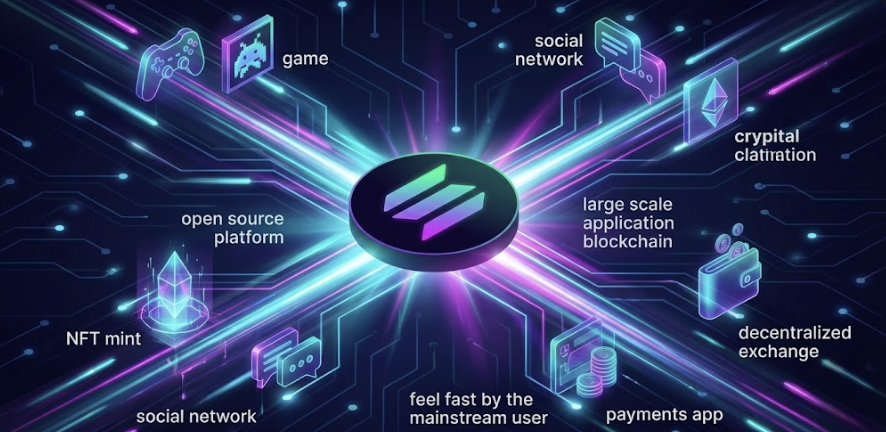
Solana is a high throughput, low transaction cost, and large scale application blockchain built on an open source platform. Ledger refers to it as a high-performance smart contract platform, and Gemini focuses on its speed, as well as low fees. Solana is designed in practice as cryptocurrency products that are intended to feel fast by the mainstream user, be it a decentralized exchange or an NFT mint or a game or a payments app or an app in the style of a social network.
The biggest aspect of Solana as an identity is that it strives to achieve blockchain scalability on the bottom layer as opposed to relying on other secondary layers to have performance. According to Ledger and Ledger-related explainers, Solana is a system that builds on Proof of History with Proof of Stake, but more recent material defines Solana as allowing around 1,000 or more transactions per second with small fees. Although precise throughput values may differ by methodology, the argument is the same, Solana is being sold and utilized as a blockchain to support large-scale on-chain activity.
That building decision affected nature surrounding it. Of particular interest to developers, Solana was much more affordable than older smart contract chains and offered better performance on consumer-facing products. And the reason is why Solana has established a powerful mindshare in DeFi, NFT markets, meme-coin trading, and on-chain consumer experiences. The potential advantage of this solution is self-evident: in case crypto applications come to the mainstream, high-throughput blockchains may become highly valuable infrastructure. Its trade off is that such scale creates complexity in design. Gemini, in particular, states that the design of Solana is a bet on innovation and crude speed, but also admits that the network experiences outages in time of heavy loads.
To investors, Solana is not necessarily a single application but the breadth of the ecosystem. In case you think the app-layer crypto will continue growing, Solana is a good prospect. XRP can be simpler to use in case you want something more functional and easier to consider in terms of a certain functionality. That does not predispose one network as being objective. It only implies that the value proposition of Solana is wider and expansionary whereas that of XRP is narrow and focused.
XRP and Solana Comparison
There is no better comparison between XRP and Solana than analyzing them in terms of purpose, architecture, and market dynamics. Both projects are concerned with transaction efficiency, and the same end user is not optimized. XRP goes closer to the transfer of value among entities at affordable rates and rapidity. The aspect of Solana being more related to allowing users to do a variety of things on-chain at low cost is more explicit. The difference is not reflected just in the way of their marketing, but their ecosystems have evolved as well.
A simple side-by-side view makes the gap easier to grasp:
|
Category
|
XRP
|
Solana
|
|
Primary focus
|
Payments, settlement, bridge asset
|
Smart contracts, dApps, consumer crypto
|
|
General positioning
|
Financial infrastructure
|
High-performance application platform
|
|
Consensus approach
|
XRP Ledger validator-based consensus / FBA-style system
|
Proof of History + Proof of Stake
|
|
Strength
|
Simplicity, payment efficiency, stability narrative
|
Speed, low fees, app-layer scale
|
|
Main risk
|
Utility adoption and regulation
|
Complexity, outages, ecosystem competition
|
This analogy explains the reason why the two assets tend to behave differently in market narratives. The rallies of XRP are often related to regulation, legal provision, utility of payments or aggregate altcoin movement. The rallies around Solana are more frequently related to developer development, ecosystem expansion, DeFi cycles, NFT activity, meme-coin booms, or typically an interest in high-throughput smart contract platforms. These are various engines of demand. A payments story has a tendency to mature as compared to an application story.
The logic of valuation also varies. In the case of XRP, investors frequently argue over the extent to which it could cover the payments or the liquidity market globally. In the case of Solana, people tend to argue about the size of the ecosystem in case app activity is further increased. A late-2025 comparison by the Motley Fool gave Solana an edge over it as the more robust of the two millionaire-maker candidates due to its expansion dynamic, which captures how the market tends to value stories about an ecosystem expanding at an aggressive rate as compared to stories about a mature utility.
Technology and Consensus Mechanisms
Where the comparison between the XRP and Solana is most interesting is in technology since both networks are high-performance, but they achieve it through different means. XRP operates on a validation based consensus model sometimes referred to as a Federated Byzantine Agreement style model with trusted validators coming to agreement on ledger state without mining. In his comparison, Ledger points out that XRP is applying this form of structure to effectively make institutional-style cross-border payments. Relative simplicity is the advantage. XRP does not require any energy-consuming mining process and does not use a race to produce the block as many older chains do. This is one of the reasons why Gemini positions XRP as leaning toward stability.
Solana is more daring with its technical. Its system is a combination of Proof of Stake and Proof of History, with Proof of History playing the role of a cryptographic clock that enables the network to order events in a more efficient manner. In addition to that, Solana has parallel execution and a design that is supposed to maximize the throughput at the bottom layer. This combination is recurrently emphasized in Ledger and other Ledger Academy works as the factor that allows Solana to handle such heavy volumes of transactions.
The pragmatic conclusion is that the technology of XRP is designed to accomplish one significant task at a fairly low cost: settle value in a short period of time. The technology developed by Solana is designed to achieve a lot in a short time at a low price which is more difficult. It is that wider ambition that generates the upside and the risks of operation of Solana at the same time. More complexity can open more useful applications but it can open the risky side of instability under stress as well. The comparison made by Gemini specifically indicates that even with the solid workload, Solana can still crash, which serves as an important reminder that the raw speed is not equivalent to the perfect reliability.
This is as it relates to an investor perspective, which is what type of technical risk you are willing to underwrite. The system of XRP might not be as exciting, however, it is easier to assess its design since its use is not as broad. The design of Solana is more broad and more active, though it requires investors to believe that the network will be able to maintain the high performance and at the same time it will be able to provide the rapidly growing ecosystem. That is another form of a bet.
XRP vs. Solana: Speed, Costs, and Network Strength
Two of the least challenging points of comparison are speed and cost, which must be placed in context. XRP has had a reputation of fast settlement and very minimal charges, which makes it a great tool of payment and value transfer. The comparison made by Ledger places XRP in a better position when conducted by large institutions across borders, whereas Gemini mentions that both chains place importance on performance, although they might identify it differently. The efficiency of XRP is among its most powerful long-term strength in its practical application.
Solana is, however, developed to go far beyond throughput. According to the latest materials of Ledger, Solana is able to complete approximately 1,000 to 5,000 transactions per second in various settings without placing much emphasis on high fees or quick consumer applications. This puts Solana in a better position to support heavy trading applications, gaming, and applications where many users need to transact to an on-chain system. Another significant factor that has seen meme-coin activity and experiment apps thrive in Solana is its fee profile.
However, it is not all about speed. Resilience, predictability and network performance during a state of stress are also considered to be part of network strength. The strength of XRP is seen in reliability and ease. The strength of Solana is the ambitious scale. Provided that what is meant by strength is something like can this reliably move value with minimal friction, XRP would be an attractive option. On the assumption that you define it as something that is able to sustain a full high-volume on-chain economy, Solana is better. They both are correct answers, and that is why direct comparisons are so deceptive when divested of use case.
That is the reason, why numerous investors come to possess both kinds of assets. They are not addressing the very same problem. XRP exposes payment effectiveness and infrastructure. Solana exposes itself to throughput of applications and ecosystem development. They would be compared merely by speed and no more than that, which is what the speed is being utilized in.
XRP and Solana Use Cases
The most obvious category in which the contrast is most evident is use case. Most frequently, XRP has been referred to as a settlement or bridge asset or a payment rail. Moving value globally, which ought to be faster and cheaper than the traditional systems can enable it to achieve its best narrative. The positioning by Ripple and Ledger supports that perception by reinforcing on a number of occasions the focus on cross-border payments, institutional rails, and efficiency of transactions. This provides a rather tangible narrative of XRP. Investors need not contemplate ten possibilities of market, but they need to determine largely whether the payment and liquidity utilization scenario will mature with time.
Solana has a significantly larger use-case map. It is applied to decentralized exchanges, NFTs, DeFi, token launches, meme-coin speculation, games and the rest of the consumer crypto experience. The wider Solana material presented by Ledger positions the network as one that is built to scale the speed and volume of real-world finance, however, in practice Solana is closely linked to developer experimentation and fast-moving retail ecosystems. That breadth may be an advantage since it helps to deprive the dependence on a single narrative. It also has the potential of making Solana more difficult to assess since it has distributed its ecosystem growth to a large number of sectors instead of being pegged to a single function.
The implication to investment is significant. The success of XRP is more of the case whether its limited use case gets long-term momentum. The future success of Solana will be more determined by the continued usage of its infrastructure by a significant number of various types of apps. One of them is a concentrated bet, the other a platform bet. They are both not necessarily safer. Platform bets can also scale more quickly in case they win, but have more active competition and more moving components. The concentrated bets are possibly simpler to comprehend, and in case the central story does not hold any water, they can stall.
That is why "Which is better?" will be the wrong question to many readers. The best question is, What is the more convincing future that I know of? Solana is more likable in case you think on-chain applications and consumer crypto will continue to grow aggressively. XRP makes more sense in case you think regulated, liquid blockchain settlement layers will be more significant.
Token Design and Distribution in XRP and Solana
The most misinterpreted aspect of the XRP vs Solana comparison is token design, which is one of the most fundamental. The total supply of XRP is 100 billion tokens with KuCoin showing that approximately 61.23 billion exist in the market. It is that capped-supply structure that influences the investor thinking in terms of scarcity and upside. No new mining activity is carried out to produce more XRP. Rather, it is more likely to move toward utility, circulating supply, liquidity and the way the distribution affect the market in the long-term.
Solana's design is different. It is not set around a similar sort of plain hard-cap tale. It has a network based on proof-of-stake economics, implying that the issuance of tokens and the incentives associated with staking is a more significant part of the system. This can be good as it assists in facilitation of network involvement and security, yet it implies that investors need to consider issuance and staking concepts in a manner that they do not with XRP. In other words, XRP can frequently appear more sanitized under a fixed-supply prism, and Solana is a more standard proof-of-stake economic framework, which is linked to the involvement of validators.
There is also distribution as it influences the way narratives are formed. The supply design of XRP has been the focus of market discussion since investors are not only concerned about the maximum supply of the asset but its circulation and its effects on the valuation. It is not always supply ceilings, but the debate that Solana has in the market is whether the ecosystem will continue to expand at a faster rate than the pressure of token issuance. That is why Solana is often referred to as a higher-beta growth asset and XRP is talked about it with more references to utility valuation, regulation, and macro liquidity.
To the practical investor the design of tokens cannot be narrowed down into "fixed supply good, inflation bad. The actual issue is whether the token model is right in the purpose of the network. The predetermined limit in the supply of XRP suits a payment-focused story. The staking-based economics of Solana were appropriate to an Atman-based smart contract network. They both can work provided that the underlying ecosystem grows. The problem of tokenomics is when the growth stops or the distribution process begins to suppress confidence.
Community and Ecosystem Support
The strength of community is relevant to crypto since technology is not the sole factor to encourage adoption. The XRP boasts of one of the longest-standing communities in the market. Its advocates are prone to be very active on the issues of payment, regulation, market form and long-term adoption stories. The fact that the XRP community has been able to endure several different cycles is among the reasons why the asset has continued to be relevant despite the shifts in the market focus. A vibrant community will not ensure the appreciation of prices, however, it will make sure that an asset remains in the discussion until the next trigger occurs and is relevant.
The community of Solana is of another taste. It is greatly motivated by the builders, traders, creators and users who are actively involved in the on-chain products. That is what makes the ecosystem more energetic and experimental. Solana is being not only talked about as something to hold, it is being deployed as a form of infrastructure as well. Such an eco-interaction can be highly beneficial as this will generate demand loops that transcend mere speculation. By exchanging, creating, issuing, and developing on-chain people embed the relevance of the token into the use of the networks.
It is also in this point that the difference between the two projects becomes most evident. The community of Ripple is powerful on the belief and long-term thesis. There is a vibrant ecosystem about Solana. Both categories of support are important, however, they affect price and growth in different ways. Communities in which the thesis is at play are robust. Ecosystems which are activity-driven have the capability of scaling rapidly in instances of strong momentum. The difference contributes to the fact that Solana is commonly considered as a more aggressive growth asset whereas XRP is viewed as a more thesis-dependent one.
XRP vs Solana: Future Prospects and Potential
The future of XRP and Solana is very different. The future of XRP is largely reliant on the capacity of its payments and liquidity story to become more profound that can be measured and evaluated by the market. Advocates will cite the scale of the international payments market and how an improved degree of regulatory transparency and ETF-type products may increase institutional focus. The Motley Fool has also talked about XRP in that context, observing that its value as a medium of exchange between countries in cross-border payments is real even though it is suspicious of extreme euphoric millionaire-maker hopes.
The future of Solana depends more on whether it is able to continue attracting developers and users. The most aggressive bull argument is that crypto-applications are still growing and Solana still represents one of the most appropriate platforms to offer consumers cheap and fast experiences. The XRP-vs-Solana comparison of the Motley Fool identified Solana as the better choice to become a millionaire-maker exactly in as much as the comparison observes stronger long-term expansion traits in the ecosystem model. This does not imply that Solana is bound to perform better. It implies that infrastructure maturity is frequently punished more harshly than growth of a platform by the market.
The risk profiles differ too. The greatest long-term threat of the XRP is to demonstrate that the utility can be converted into long-term market demand on the large scale. The greatest hurdle that Solana encounters is sustaining performance, consistency and developer momentum when competition is still intense. Making the next wave of crypto adoption mainstream usage, then Solana might have the more self-evident upward trajectory. Provided the following generation is characterized by controlled liquidity rails and convenient value transfer, XRP can mature even faster than most anticipate.
A neutral investor opinion is the fact that both of them have a bright future but due to different reasons. XRP is resilient and the thesis of application. Solana is broad and has optionality of growth. Cleaner utility exposure might favor XRP to investors. Investors interested in greater ecosystem returns can tilt to Solana. The conclusion will be that it is not the selection of one in the long run, but knowing what each coin contributes to a portfolio.
How to Buy XRP/Solana on KuCoin
When you choose to purchase XRP or Solana on KuCoin, it is relatively simple. According to the official page of KuCoin (How to Buy Ripple (XRP)) users may purchase XRP with the use of credit or debit card, bank transfer, third-party payment option, or by depositing money on a trading account and trading in the spot market. The How to Buy Solana (SOL) page offered by KuCoin also includes such a flow with a focus on the creation of an account, account security, identity verification, the addition of a payment method, and the subsequent purchase of SOL in one of the supported options.
Create and secure your KuCoin account
The initial one is to open a KuCoin account and enable the basic security. The purchasing guides of KuCoin focus on account creation and account security prior to making the purchase. Practically, it should be a strong password, two-factor authentication, and identity verification that is required in case of the intended method of payment or regional compliance standards. It is a small step that can be missed, but it is important as the safest purchase process is the one in which security is a component of onboarding and not a secondary factor.
Add funds or choose a direct purchase method
KuCoin facilitates various buying prospects. Based on the official XRP and SOL buy pages, a user can possibly purchase directly with a bank card, bank transfer in supported areas, or third-party access. The other popular path is by depositing your account with a stablecoin or any other crypto-asset and subsequently trading on the spot market. That approach tends to be more flexible in the event that you would rather decide your own execution price, rather than purchasing on the spot.
Use the spot market for more control
KuCoin has active XRP and SOL markets, but they are offered to users who want to access the market directly. KuCoin has the XRP/USDT pair in its spot interface, and the pages of the KuCoin markets report both XRP and SOL as tracked market assets. Spot purchasing is more frequently the more convenient path towards consumers who are concerned with the nature of orders and execution. A market order is an immediate purchase at the best available price whereas a limit order is a purchase at the specified price that you are comfortable with and wait until the market hits the price.
Review storage and portfolio intent
The second step after the purchase is which role does the asset have in your portfolio. The KuCoin ecosystem allows active access to trading, and whether to store XRP or SOL in the exchange or transfer it to self-custody is based on your objectives and risk aversion. In case you are going to trade with high frequency, it can be more convenient to leave the assets in your KuCoin trading environment. In case the long-term custody is your consideration then you might want to withdraw a wallet under your control. It is simply to match the method of purchase with the purpose of purchase.
Conclusion
Water vs Solana is not truly about two different projects that are the same. It is a contrast of a payment-based blockchain asset and a high-performance smart contract ecosystem. XRP is also easy to use, efficient, and has a good value-transfer thesis. Solana is faster, has more extensive application coverage and greater ecosystem-based expansion prospects. That is to say that the wiser option would be what you want to be exposed to: settlement infrastructure or on-chain application expansion. The most convenient lesson learned by many investors is that these assets have various functions, and trying to make them one-word winners is much less crucial than comprehending and applying the functions of a particular asset.
FAQs
Is XRP faster than Solana?
Not in raw throughput. Solana generally supports much higher transaction volume, while XRP is known more for fast settlement and payment efficiency. They are both fast, but they optimize for different things.
Which is better for payments, XRP or Solana?
Ledger’s comparison says XRP is better for large institutional cross-border payments, while Solana is better for everyday peer-to-peer payments and small transfers because of its low fees and speed.
Which has stronger growth potential, XRP or Solana? Many growth-focused analyses lean toward Solana because of ecosystem expansion and developer activity, while XRP’s upside is tied more closely to payment utility and regulatory clarity.
Can I buy both XRP and Solana on KuCoin?
Yes. KuCoin has official purchase pages for both XRP and SOL, and it also offers spot-market access for assets like XRP through trading pairs such as XRP/USDT.
Is XRP safer than Solana?
They carry different risks. XRP is often viewed as simpler and more stability-oriented, while Solana offers more ecosystem upside but also more complexity and historical outage concerns.