

Why Are Solana Developers Moving to Stop Validators From Finishing Work on Blocks That Already Lost?
Introduction
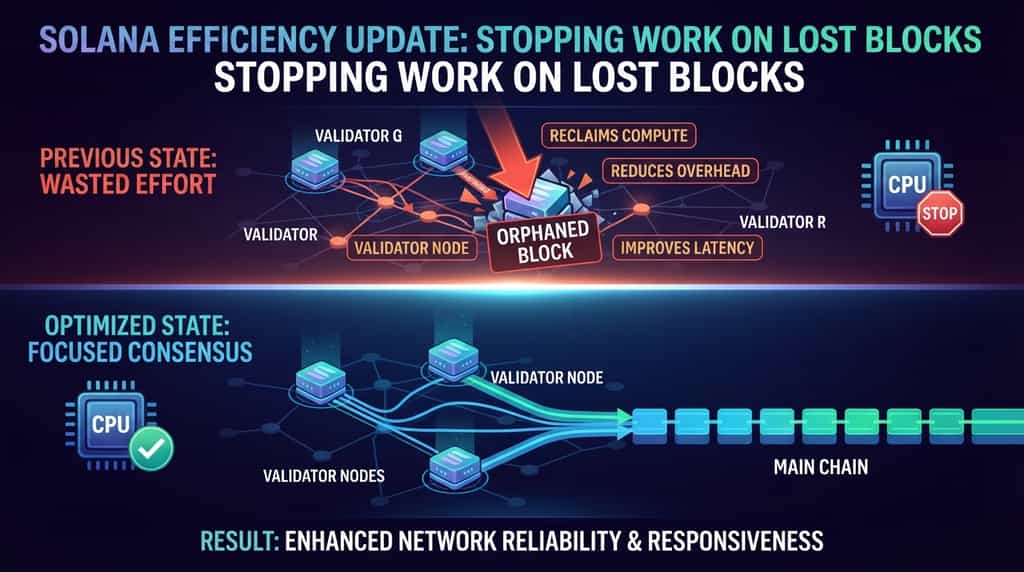
Solana developers are moving to stop validators from finishing work on blocks that already lost—known as orphaned or non-canonical blocks—to eliminate wasted compute cycles, reduce unnecessary network bandwidth overhead, and improve overall consensus efficiency. In high-throughput blockchains like Solana, slot leaders produce blocks rapidly, and competing or forked blocks occasionally lose out during consensus selection. When validators continue processing, replaying, or finalizing work on blocks that have already been abandoned in favor of another fork, the network expends scarce hardware and bandwidth resources on state transitions that will never become part of the canonical ledger.
As of November 2026, ongoing protocol engineering efforts across the Solana ecosystem focus on refining block production, fork choice, and validator execution rules so nodes drop dead-end blocks earlier. For node operators, decentralized applications (dApps), and users, preventing wasted work on losing blocks helps keep validator hardware responsive, lowers stale-block noise, and strengthens network reliability during periods of heavy transaction demand.
Key Takeaways
Stopping validators from finishing work on blocks that already lost prevents wasted compute and bandwidth on abandoned forks so consensus and execution resources stay focused on the canonical chain.
-
Reclaims Compute Capacity: Validators avoid spending CPU, memory, and I/O cycles executing or verifying transactions inside blocks that have lost the fork race.
-
Reduces Network Overhead: Dropping losing blocks earlier curbs unnecessary gossip, block propagation, and replay traffic across validator nodes.
-
Improves Latency and Responsiveness: Freeing validator resources helps nodes process active, canonical slots faster, particularly during traffic spikes or high-frequency trading activity.
-
Simplifies Fork and State Handling: Clearer cutoffs on abandoned blocks reduce edge-case state tracking complexity for validator clients and RPC infrastructure.
-
Preserves Consensus Safety Without Weakening Liveness: Halting dead-end work on non-canonical blocks targets wasteful execution rather than altering core cryptographic security assumptions.
How Do Losing Blocks Happen in Solana's Consensus and Slot Model?
Losing blocks happen on Solana when a scheduled slot leader produces a block that is not adopted into the canonical chain—due to network propagation delays, skipped or competing slots, or fork-choice transitions—leaving that block orphaned.
Solana operates on a leader-scheduled slot architecture combined with proof-of-stake consensus and tower-style voting mechanics. Rather than waiting for slow global block discovery before choosing the next producer, the protocol schedules leaders ahead of time so blocks can stream rapidly across the network. Because physical network latency exists between geographically distributed nodes, a block produced in one slot can arrive late, be superseded by a heavier or more widely voted fork, or fail to gain the stake-weighted votes required to advance along the main chain.
When a block falls behind or loses out in fork choice, it becomes a non-canonical or losing block. Even after consensus signals point away from that block or a competing branch pulls ahead, a validator that has already begun receiving shreds, replaying transactions, or preparing block verification may keep pushing that work toward completion unless the client actively aborts or deprioritizes it.
In a high-throughput network processing thousands of transactions per second under tight slot timings, even brief delays on losing branches matter. If a validator spends precious execution time finishing a block that is already dead in the fork race, that same node has less headroom to process incoming transactions for the live canonical chain.
Why Is Finishing Work on Losing Blocks Wasteful for Validators?
Finishing work on blocks that already lost is wasteful because those blocks will not be finalized into Solana's canonical history, meaning all associated compute, storage I/O, and bandwidth expenditure yields zero settlement value.
A validator node performs several resource-intensive steps when handling a block: ingesting data packets, reconstructing entries, executing smart contract instructions, updating account states, and participating in consensus votes or block shreds forwarding. When a block is still competing in a live fork, doing that work is part of normal consensus participation. Once the block has effectively lost—for instance, when fork choice has decisively moved onto another branch or vote thresholds indicate the block will not win—continuing to finish processing it becomes sunk cost.
The cost shows up across three practical dimensions:
-
Hardware and Compute Contention: Transaction execution and account state updates compete for CPU cores, cache locality, and disk I/O. Spending compute on a losing block can delay execution of canonical blocks, especially on validators running near capacity during congestion.
-
Bandwidth and Propagation Drag: Relaying or processing data tied to abandoned blocks consumes uplink and downlink bandwidth that could otherwise carry canonical shreds and transactions.
-
Operational Predictability: Validator operators face hardware requirements that scale with peak network load. Trimming useless work on orphaned blocks improves efficiency without forcing operators to over-provision for dead-end processing.
Consider a period of sharp market volatility when decentralized exchanges and automated trading bots flood the network with transactions. If a validator is simultaneously finishing work on a losing block while trying to keep pace with live slots, slot processing latency can rise, increasing the risk of missed votes or delayed block production.
How Are Solana Developers Changing Validator Behavior Around Losing Blocks?
Solana developers are addressing this issue through client-level optimizations and protocol/consensus refinements that detect losing or obsolete blocks earlier and halt unnecessary processing before resources are spent finishing them.
Because Solana supports multiple validator client implementations—including clients built in Rust and independent client engineering efforts aimed at client diversity—changes in this area typically involve both clear specification rules and careful client implementation. Developers examine when a block can be reliably judged to have lost, how shred ingestion and block replay interact with fork-choice updates, and how to cancel in-flight work cleanly without introducing race conditions or consensus bugs.
| Aspect | Continuing Work on Losing Blocks | Stopping Work on Losing Blocks Early |
| Compute Usage | Spends CPU and I/O finishing blocks that will not be finalized | Redirects compute toward canonical and active blocks |
| Network Traffic | Can prolong handling or forwarding of non-canonical block data | Cuts unnecessary bandwidth consumption on dead forks |
| Execution Latency | Risk of delaying live slot processing during peak load | Supports faster response on the winning chain |
| Engineering Risk | Low risk of premature cancellation bugs, higher waste | Requires careful fork-choice state checks to avoid race conditions |
Crucially, stopping work on losing blocks is not the same as guessing blindly before consensus has settled. If a client aborts a block too early based on incomplete network information, it could drop a block that later wins or needs to be re-fetched if fork choice shifts. Therefore, developers focus on deterministic or well-bounded conditions where continuing to finish a losing block offers no benefit to chain progress.
What Should Node Operators, Developers, and Users Watch Next?
Node operators, application developers, and market participants should watch client release notes, testnet and mainnet rollout behavior, and real-world slot performance metrics rather than assuming every throughput bottleneck disappears overnight.
Improving how validators handle losing blocks is one piece of broader scalability and reliability engineering across Solana. For those following the upgrade path and its practical effects, several factors deserve attention:
-
Client Rollout and Adoption: Track how quickly major validator clients adopt the changes and whether performance gains appear across different hardware profiles.
-
Vote Latency and Skip Rates: Observe whether validators experience fewer late votes or skipped slots during high-throughput bursts once wasted work on losing blocks is reduced.
-
Edge Cases and Fork Reorgs: Monitor engineering discussions around race conditions between block shred arrival, replay pipelines, and fork-choice updates.
-
Application and RPC Impact: For builders and users interacting with Solana through wallets, RPC endpoints, or trading venues such as KuCoin, clearer canonical block progression supports more predictable confirmation behavior, though end-user experience also depends on RPC infrastructure, priority fees, and network congestion.
By evaluating concrete network telemetry alongside protocol design trade-offs, observers can separate incremental efficiency improvements from broader consensus changes.
Conclusion
Solana developers are moving to stop validators from finishing work on blocks that already lost so nodes do not waste compute, memory, and bandwidth on non-canonical data that will never be finalized. In a fast-moving network where forks and late blocks occur during real-world latency conditions, cutting off dead-end processing helps keep validator resources focused on the active canonical chain.
At the same time, this optimization requires careful engineering so validators do not prematurely discard blocks while fork choice is still resolving. While stopping work on losing blocks can improve resource efficiency and responsiveness during busy periods, overall network performance still depends on client diversity, hardware capacity, and broader consensus improvements. As of November 2026, tracking validator client updates and live network metrics offers the clearest way to gauge how these changes perform in practice.
FAQs
What is a block that "already lost" on Solana?
A block that already lost is a non-canonical or orphaned block that was produced for a slot but will not be included in Solana's finalized main chain because another fork or slot sequence prevails. Continuing to finish work on it consumes resources without contributing to the canonical ledger.
Why do validators sometimes finish work on losing blocks?
Validators may finish work on losing blocks when blocks or shreds arrive with network delay or when an execution pipeline is already partway through processing a block before fork-choice updates mark it as superseded. Without early cancellation or deprioritization, the node completes the remaining steps anyway.
Does stopping work on losing blocks change Solana's security model?
No, stopping work on losing blocks is an efficiency and resource-management improvement rather than a change to cryptographic security or core stake-weighted consensus rules. The goal is to avoid spending compute and bandwidth on blocks that are no longer part of the winning path.
Could stopping work on a block too early cause problems?
Yes, if a client drops a block prematurely before fork choice is clear, the node might waste time re-fetching or re-evaluating data if conditions shift. Developers design cutoff logic carefully to balance early resource savings against accurate fork tracking.
How does this affect everyday Solana users?
Everyday users do not need to change their wallets or applications for this validator-level optimization to take effect. Over time, more efficient validator execution can help support smoother slot processing and lower latency during periods of high network activity.
Disclaimer: This general market information may come from third-party, commercial, or sponsored sources and is provided for informational and educational purposes only. It does not constitute financial or investment advice, an offer, a solicitation, or a guarantee. We assume no responsibility for the accuracy, completeness, or reliability of this information or for any losses arising from its use. Investing and trading involve risks. Past performance does not guarantee future results. Users should conduct their own research, exercise sound judgment, and take full responsibility for their decisions. For more information, please refer to KuCoin's Terms of Use and Risk Disclosure.