

Do US Tariffs Boost Bitcoin as an Inflation Hedge? 2025–2026 Impact
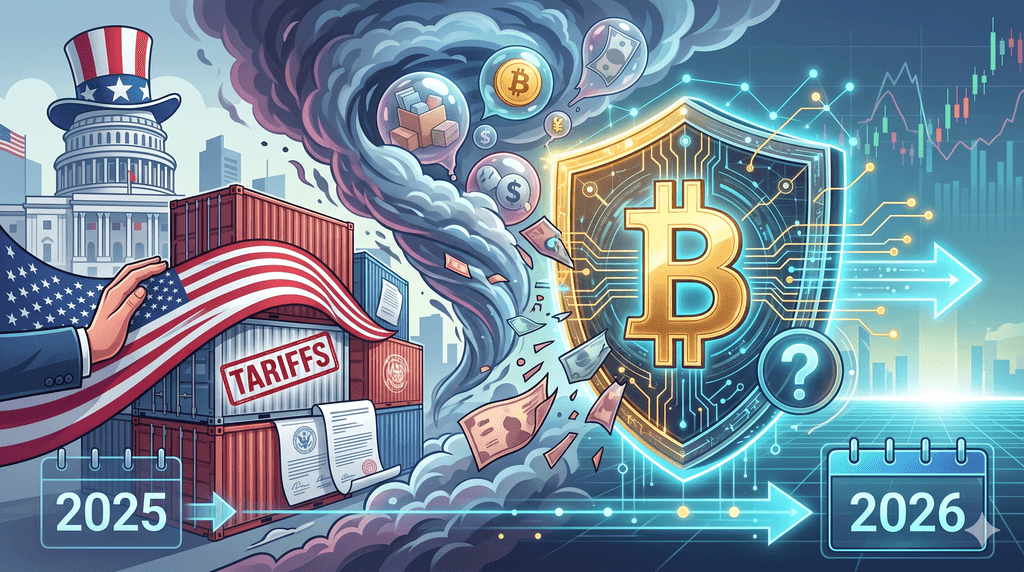
Key Takeaways
-
US tariffs are a primary driver of inflation in 2025–2026, with average effective tariff rates jumping from roughly 2.2% in early 2025 to 10.3% in early 2026 — feeding directly into CPI and keeping the Fed pinned at 3.50%–3.75%.
-
Bitcoin has consistently sold off on tariff announcements, behaving as a risk asset rather than an inflation hedge in the short term: "Liberation Day" April 2025 sent BTC below $82,000; Liberation Day 2026 dropped it to around $68,900 — a 45% collapse from the October 2025 ATH of $126,272.
-
The inflation hedge narrative isn't dead — it's deferred. Institutional investors poured $18.7 billion into Bitcoin ETFs in Q1 2026 alone, even as BTC's price fell, signaling that large allocators are treating BTC as a long-term debasement hedge rather than a short-term crisis trade.
-
Tariffs create a paradox for Bitcoin: they fuel the inflation that should make BTC attractive, yet simultaneously force the Fed to stay hawkish — killing the liquidity that Bitcoin's short-term price depends on.
-
Gold has won the short-term inflation-hedge contest in 2026 decisively, up ~80% since early 2025 vs. Bitcoin's ~20% YTD decline. But gold and Bitcoin are serving two different investment horizons.
-
A de-dollarization tailwind is building. Grayscale and leading macro analysts argue that prolonged tariff-driven dollar weakness strengthens the long-term case for BTC as a non-sovereign store of value.
-
The second half of 2026 could be the rebound window. Tom Lee of Fundstrat, JPMorgan, and institutional ETF inflow data all point toward a structural recovery once tariff uncertainty resolves or the Fed finds room to cut.
In theory, there's no better environment for Bitcoin to prove its inflation-hedge credentials than 2025–2026. The United States has embarked on its most aggressive tariff campaign since the Smoot-Hawley era, pushing average effective import duties from roughly 2.2% at the start of 2025 to 10.3% by early 2026. Those tariffs have stoked inflation that refuses to die — March 2026 CPI hit 3.3% year-over-year, the hottest reading since April 2024. The dollar has weakened. Geopolitical risk is elevated. These are precisely the conditions that Bitcoin's most vocal advocates have spent years insisting would send BTC to six-figure territory and validate its "digital gold" status.
So why is Bitcoin down roughly 47% from its October 2025 all-time high of $126,272?
The answer to that question cuts to the heart of one of the most important debates in crypto in 2026: do US tariffs actually boost Bitcoin as an inflation hedge, or do they — at least in the short term — destroy the very liquidity conditions that support Bitcoin's price? The answer is complicated, two-sided, and deeply time-horizon dependent. And getting it right has direct consequences for how crypto investors position themselves for the rest of 2026.
This article traces the full arc from the first Liberation Day shock in April 2025 through the second round in 2026, dissects the paradox at the heart of the tariff-inflation-Bitcoin relationship, and maps the road forward.
How US Tariffs Actually Fuel Inflation — and Why That Hurts Bitcoin First
To understand why tariffs create a paradox for Bitcoin, you first have to understand the precise mechanism by which they feed into inflation — and how that inflation then flows through to financial markets.
Tariffs are, at their core, taxes on imported goods. When the Trump administration imposed a baseline 10% levy on all imports on April 2, 2025 — what was dubbed "Liberation Day" — and followed with 125% reciprocal tariffs on Chinese goods, the immediate effect was to raise the landed cost of virtually every category of imported goods sold in the United States. Those higher costs get passed to consumers, driving up the Consumer Price Index. US inflation is expected to tick back up to about 2.7% in 2026, with tariffs playing a noticeable role as importers pass more costs to consumers. Average effective US tariff rates jumped from roughly 2.2% in early 2025 to 10.3% in early 2026, adding meaningful pressure on goods-price inflation.
Here is where the paradox begins. Rising inflation should, in theory, make Bitcoin more attractive — a scarce, non-sovereign asset that no government can print more of. But in practice, the chain of events runs in the opposite direction first: higher CPI gives the Federal Reserve reason to keep interest rates elevated. High interest rates make US Treasury bonds, yielding over 4%, far more attractive than volatile, non-yielding Bitcoin. Capital flows away from speculative assets. Institutional portfolio managers who treat BTC as a risk asset reduce exposure. The result is that tariff-driven inflation, counterintuitively, produces near-term selling pressure on Bitcoin rather than buying pressure.
According to market reports from Capital Street FX, the tariff shock effectively tightens financial conditions by increasing the likelihood that the Federal Reserve will keep interest rates higher for longer to combat tariff-induced inflation, creating a structural headwind for digital assets.
James Butterfill, CoinShares' Head of Research, framed it plainly: in the short term, tariffs are negative for Bitcoin. Unlike gold, Bitcoin has a growth component, meaning it reacts to economic trends and liquidity cycles. Slow economic growth reduces demand for risk assets like Bitcoin. Increased inflation leads to speculation on higher interest rates. And Bitcoin's price tends to drop temporarily — as it often correlates with equities — before any long-term hedge narrative can take hold.
Liberation Day 2025 and 2026: Bitcoin's Track Record Under Tariff Shocks
The clearest test of the tariff-inflation-hedge thesis is the empirical track record. And that record, across both Liberation Day events, tells a consistent story about Bitcoin's short-term behavior.
April 2025: The First Liberation Day. When Trump announced sweeping "Liberation Day" tariffs on April 2, 2025 — a baseline 10% on all imports with higher rates for roughly 60 nations — Bitcoin dropped below $82,000, while Ethereum fell approximately 20% over three days and a large share of top tokens dropped more than 20% in a single day as traders rushed to cut risk. This sparked a risk-off sentiment across markets, with BTC reaching a yearly low of $74,508 on April 7. The S&P 500 recorded its largest two-day loss since COVID. Coinbase shares tumbled 15%. Crypto-related equities tracked equities, not gold.
The recovery, however, was telling. A 90-day tariff pause led to a rebound, with BTC recovering above $100,000 by early May. That snap recovery demonstrated that the damage was primarily sentiment-driven and liquidity-driven, not a fundamental rerating of Bitcoin's value proposition. When the macro pressure relented, institutional buyers stepped back in.
October 2025: The $19 Billion Liquidation. The sharpest stress test arrived when Trump floated a new 100% tariff on Chinese imports tied to rare-earth tensions. Bitcoin dropped over 16% in a fast move. Liquidations surged, with reports of $19 billion wiped out in forced closes across exchanges in a single day. The speed and magnitude of that event underscored how concentrated leverage in the crypto futures market amplifies tariff-driven macro shocks into catastrophic liquidation cascades.
April 2026: Liberation Day Round Two. Liberation Day 2026 sent Bitcoin down 29% in its worst quarter since 2018. Bitcoin hovered around $68,900 — a long way from its all-time high of $126,272 reached just six months earlier on October 6, 2025. The pattern was identical to 2025: a tariff shock, a broad risk-off move, Bitcoin selling alongside equities, institutions reducing exposure. As one analyst put it at the time: "The BTC price action following the Liberation Day tariff announcements was closely aligned with broader risk assets, highlighting that Bitcoin, for now, still trades as a risk-on asset rather than a safe haven."
The conclusion across both years is consistent: when tariff shocks hit, Bitcoin sells first and asks questions later. The inflation-hedge narrative cannot survive contact with a liquidity crunch.
The Long Game: Why Institutions Are Still Buying Bitcoin Through the Downturn
Here is where the story becomes more interesting — and where the inflation-hedge thesis shows its most compelling version of itself.
Despite Bitcoin's double-digit percentage declines in each tariff shock, institutional adoption has not reversed. It has accelerated. Bitcoin ETF inflows totaled $23 billion in 2025 and another $18.7 billion in Q1 2026 alone, pushing cumulative net inflows past the $65 billion mark. BlackRock's IBIT has approached $100 billion in assets under management, and 68% of institutional investors now either hold or plan to invest in Bitcoin ETFs.
That pattern — institutions buying into weakness while retail panics — reflects a fundamentally different investment thesis from short-term inflation hedging. Large capital allocators are not buying Bitcoin because they expect it to go up when the next CPI print is hot. They are buying because they believe in the long-term case that prolonged tariff-driven dollar weakness makes Bitcoin's scarcity properties increasingly valuable over years, not weeks.
Grayscale's Zach Pandl noted that "tariffs will weaken the dominant role of the dollar," and that this de-dollarization narrative gave institutions a new reason to allocate. This is the long-term inflation-hedge thesis in its most defensible form: not Bitcoin protecting you against this month's CPI reading, but Bitcoin protecting you against the structural erosion of the dollar's purchasing power over a multi-year horizon of trade fragmentation, fiscal deficits, and monetary accommodation.
Historical data supports this framing. From 2015 to 2025, Bitcoin delivered an annualized return above 60%, vastly outperforming gold at 8%, real estate at 5%, and Treasury Inflation-Protected Securities at just 2%. Bitcoin appreciated roughly 90% against the Argentine peso and over 200% against the Turkish lira in 2024 alone — the ultimate test of the debasement-hedge thesis in economies experiencing chronic monetary devaluation.
In early 2026, Bitcoin trades above $100,000 historically, supported by massive institutional adoption that reinforces its credibility as a long-term store of value. Strategy (formerly MicroStrategy) holds over 713,000 BTC. The US government's Strategic Bitcoin Reserve, established during 2025, represents an unprecedented institutional safety net that fundamentally shifts long-term market psychology. These are not the buying patterns of investors who have abandoned the inflation-hedge thesis — they are the buying patterns of investors who understand it operates on a longer clock than most retail participants are willing to hold.
Gold vs. Bitcoin: Two Hedges, Two Time Horizons
The comparison to gold in 2025–2026 clarifies the inflation-hedge debate more than any other data point.
Gold is valued at around $4,800 per ounce as of mid-April, still roughly 46% higher than a year ago, even after pulling back from January's peak. Gold hit a record high of $5,589 per ounce in January 2026 and has remained approximately 80% higher than early 2025. In the same period, Bitcoin shed roughly 20% year-to-date. The divergence is stark and unambiguous: in the acute inflation-and-geopolitical-stress regime of 2025–2026, gold has outperformed Bitcoin as a short-term inflation hedge by a dramatic margin.
Why? Gold does not correlate with equity risk sentiment in the same way Bitcoin does. When tariff shocks trigger global equity sell-offs, institutional investors reduce risk broadly — which means selling Bitcoin. They simultaneously increase their gold allocation. When global equities sell off on tariff fears, Bitcoin sells off with them. It does not behave like physical gold — which continues to benefit from geopolitical uncertainty, being pushed toward new all-time highs.
But gold and Bitcoin are measuring different things. Gold is a 5,000-year-old crisis hedge. Its volatility is 12–18% annually. Its job is to protect capital when everything else is falling. Bitcoin is a 15-year-old monetary experiment with 45–60% annual volatility whose job, in its strongest form, is to outperform every other asset over the long run in an era of fiat currency debasement. Both jobs have merit. They just operate on fundamentally different timescales.
Bitcoin has actually hedged well in the past, just not in the way most people expect. When a government slowly destroys its own currency, Bitcoin thrives. It appreciated roughly 90% against the Argentine peso and over 200% against the Turkish lira in 2024. However, when the problem is a sudden crisis — like the US-Iran conflict, oil prices spiking, and markets seizing up — investors are quick to liquidate their Bitcoin holdings.
The practical takeaway for 2026: if your investment horizon is months, gold is the better tariff-inflation hedge. If your horizon is years, the institutional accumulation data suggests Bitcoin's tariff-driven weakness may represent one of the most significant buying opportunities of the current cycle.
If the 2025–2026 tariff cycle has taught crypto traders anything, it's that macro events now move digital asset prices faster and more violently than almost any other catalyst. In this environment, the platform you use isn't a minor detail — it's a core part of your risk management infrastructure.
Consider what the Liberation Day sell-offs actually demanded of traders in real time: the ability to hedge existing spot holdings, the capacity to execute in highly liquid markets during peak volatility, automated tools that fire even when you're asleep during an overnight announcement, and yield products to deploy capital productively during the consolidation periods between macro shocks. KuCoin provides all of these in a single ecosystem.
For short-term traders navigating tariff headlines, KuCoin's perpetual futures — with leverage up to 125x — allow precise hedging or directional bets without liquidating spot positions. When a tariff announcement sends Bitcoin down 10% in two hours, having a hedge in place on the same platform can be the difference between surviving the dip and being liquidated. KuCoin's deep liquidity and low fees ensure that these hedges execute at competitive prices even during the most volatile windows.
For long-term accumulators who see Bitcoin's tariff-driven weakness as a buying opportunity — consistent with what the $18.7 billion in Q1 2026 institutional ETF inflows suggest — KuCoin's DCA bots automate accumulation at set intervals regardless of short-term noise. There's no need to time every dip manually or make emotionally driven decisions during a sell-off. The bot executes the thesis mechanically, which is exactly how the most sophisticated institutional investors approach tariff-driven dislocations: as scheduled accumulation events, not crises.
What the Second Half of 2026 Could Mean for Bitcoin's Inflation-Hedge Thesis
The most compelling argument for Bitcoin's inflation-hedge status in the second half of 2026 is not about price — it's about structural conditions converging.
Tom Lee of Fundstrat spoke plainly: "2026 will be a tale of two halves. The first half can hurt, but that is exactly what sets up the big rally in the second." His thesis rests on a sequencing argument: tariff uncertainty peaks in H1, resolution (through deals, court rulings, or pauses) creates a relief rally, and the structural institutional inflows that have been building throughout the downturn provide the foundation for repricing.
The macro data supports this framing. The Section 122 replacement tariffs expire on July 24, 2026, creating a binary outcome that markets will start pricing well before the deadline. If Congress passes legislation to extend them, the tariff regime continues. If the deadline passes without action, the US drops from the highest tariff levels in a century to pre-Liberation Day rates overnight. For crypto, a sudden tariff reduction would be interpreted as a massive macro relief event — historically the trigger for the kind of sharp BTC rally seen after the May 2025 China tariff truce.
Despite fears of stagflation, market indicators suggest Trump's tariffs may lead to lower inflation in the long term, potentially allowing the Federal Reserve to cut rates. Historical and recent analysis indicate that tariffs tend to be disinflationary in advanced economies as they can lead to reduced consumer spending and lower prices. If that disinflationary reading proves correct — and if it gives the Fed the cover to resume cutting rates in the second half of 2026 — crypto markets will be primed for a liquidity-driven recovery.
The de-dollarization narrative adds a longer-term layer. The dollar has declined roughly 9.6% since the tariff war began. Every percentage point of sustained dollar weakness makes Bitcoin's fixed supply and non-sovereign characteristics more attractive to the global institutional capital that has been slowly building exposure through ETFs throughout the downturn. A constructive base case for Bitcoin by end-2026 clusters around $120,000–$170,000, consistent with the bulk of institutional forecasts if ETF inflows remain positive and rate cuts proceed gradually.
Conclusion: The Tariff-Bitcoin Paradox Has a Resolution
The question at the heart of this article — do US tariffs boost Bitcoin as an inflation hedge? — has an answer that depends entirely on when you're asking.
In the short term, across every major tariff shock of 2025 and 2026, the answer has been no. Bitcoin has sold off alongside equities, behaved as a risk asset, and provided no protection against the acute inflationary stress triggered by Liberation Day announcements. The mechanism is clear: tariff-driven inflation keeps the Fed hawkish, high rates kill liquidity, and illiquid conditions punish Bitcoin before any inflation-hedge narrative can gain traction.
In the medium and long term, the answer shifts — and the institutional data says it shifts significantly. The $65 billion in cumulative ETF net inflows, the continued corporate and sovereign accumulation, and the building de-dollarization thesis all suggest that the largest and most sophisticated capital allocators in the world are treating tariff-driven Bitcoin weakness as a buying window, not an exit signal.
The tariff-inflation-Bitcoin paradox isn't a contradiction — it's a sequencing problem. Tariffs hurt Bitcoin first, then strengthen the case for it. The investors who understand that sequencing, and who have the tools to survive the first phase and capitalize on the second, are best positioned for what 2026's second half may bring. The inflation-hedge thesis isn't broken. It's just running on a longer timeline than many expected.
FAQs
Why does Bitcoin fall when inflation rises due to tariffs?
Because tariff-driven inflation prompts the Federal Reserve to maintain or raise interest rates. Higher rates make safer, yield-bearing assets like US Treasuries more attractive relative to volatile, non-yielding Bitcoin. Additionally, institutional portfolio managers who treat Bitcoin as a risk asset reduce their exposure during periods of tighter financial conditions — which is what elevated rates create.
How have institutions responded to Bitcoin's tariff-driven price declines?
Institutions have been buying into weakness, not selling. Bitcoin ETF inflows totaled $23 billion in 2025 and $18.7 billion in Q1 2026 alone, even as Bitcoin's price declined significantly. BlackRock's IBIT has approached $100 billion in AUM. This accumulation-into-weakness behavior suggests large capital allocators are treating Bitcoin as a long-term debasement hedge, not a short-term inflation trade.
Could tariffs eventually be bullish for Bitcoin?
Yes — through two channels. Short-term relief rallies occur every time tariff pauses or deals are announced, as seen in May 2025 when a US-China truce pushed BTC above $100,000. Long-term, sustained dollar weakness driven by tariff-related de-dollarization strengthens the case for Bitcoin as a non-sovereign store of value. The July 2026 Section 122 tariff expiration is the next major binary catalyst that could trigger either a sharp rally or an extended period of uncertainty.
What is the best strategy for trading Bitcoin in a tariff-driven macro environment?
Most experienced crypto investors and analysts recommend a combination of active risk management and systematic accumulation. For short-term traders, using futures to hedge spot exposure during tariff announcements reduces liquidation risk. For long-term investors, dollar-cost averaging into Bitcoin during tariff-driven weakness aligns with how the largest institutional ETF buyers have been behaving in 2026. Platforms like KuCoin offer both futures hedging and automated DCA tools alongside yield products to optimize capital during consolidation phases.
Disclaimer: This article is for informational purposes only and does not constitute financial or investment advice. Cryptocurrency investments carry significant risk. Always conduct your own research before making investment decisions.