

US 10-Year Treasury Auction Yield Hits Highest Level Since 2007
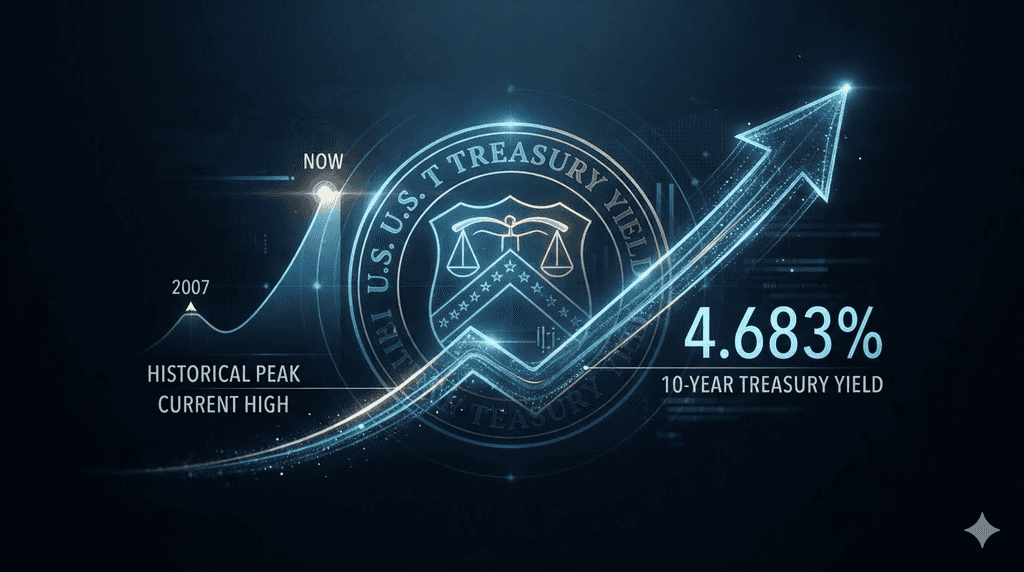
On August 12, 2026, the United States Department of the Treasury conducted a $42 billion auction of 10-year Treasury notes that drew a winning yield of 4.683%. This figure represents the highest auction yield for benchmark security since the onset of the global financial crisis in 2007. The 10-year Treasury note serves as a critical foundation for global financial systems, acting as the primary benchmark for pricing trillions of dollars in fixed-income instruments, corporate loans, consumer mortgages, and cross-border capital flows.
When this foundational metric shifts significantly, the effects extend beyond traditional banking. Cryptocurrencies, while architected on decentralized infrastructure, do not operate in a macroeconomic vacuum. The 10-year yield is widely recognized across institutional trading desks as a baseline asset pricing metric. As the return on risk-free capital rises, the calculations governing risk allocation change fundamentally. This analysis breaks down the mechanics of the bond auction, examines the structural macroeconomic forces driving the elevated yields, and explores the short- and long-term implications for Bitcoin, stablecoins, and the broader digital asset landscape.
Key Takeaways
-
The 10-year Treasury yield hit 4.683%, its highest level since 2007, driven by persistent inflation and massive federal debt issuance.
-
A 4.683% risk-free rate increases the hurdle return required for volatile digital assets, pulling institutional capital toward sovereign debt.
-
Higher borrowing costs reduce market-maker debt capacity and widen bid-ask spreads, making altcoins more vulnerable to volatile swings.
-
High traditional interest rates drive rapid growth in on-chain Real-World Assets, connecting institutional yields with decentralized lending markets.
Decoding the Data: Inside the $42 Billion Auction
Key Auction Metrics
Evaluating the implications of a government bond auction requires looking beyond the headline yield to examine technical indicators that reveal market demand.
-
Winning Yield (4.683%): The auction cleared at 4.683%, signaling that lenders require higher compensation to finance the expanding federal deficit.
-
The "Tail" (0.1 Basis Points): The auction cleared just 0.1 basis points higher than the Pre-Auction When-Issued (WI) yield of 4.682%. A narrow tail indicates that the market priced the issue accurately beforehand, allowing the Treasury to avoid paying a steep premium above market rates to find buyers.
-
Bid-to-Cover Ratio (2.53x): Measuring total dollar demand against the $42 billion allotment, the ratio landed at 2.53x. While this represents a technical improvement over the trailing six-month average of 2.47x, it highlights the substantial volume of capital required to absorb ongoing issuance.
The Shift in Buyer Composition
The underlying dynamics of the bidder pool reveal a divergence between domestic and international capital appetite.
Indirect Bidders (76.7%): This segment, which primarily comprises foreign central banks, sovereign wealth funds, and international institutional allocators, absorbed 76.7% of the issue. This is a noticeable increase from the historical average of 71.3%, showing steady overseas demand for these elevated yields.
Direct Bidders (14.7%): Domestic institutional investors, including U.S. mutual funds, hedge funds, and pension managers, accounted for 14.7% of the purchasing volume, reflecting a more cautious stance among domestic cash managers.
Primary Dealers (8.6%): Financial institutions obligated to buy whatever debt remains were forced to absorb only 8.6% of the auction. While this spared dealers from holding excess inventory, it underscores the market's reliance on foreign capital to sustain current U.S. fiscal trajectories.
| Metric | August 12, 2026 Auction | 6-Month Rolling Average | 2020 Pandemic Era Average | 2007 Pre-Crisis Peak |
| Winning Yield | 4.68% | 4.25% | 0.60% – 0.90% | 4.75% – 5.00% |
| Bid-to-Cover Ratio | 2.53x | 2.47x | 2.60x – 2.75x | 2.40x – 2.50x |
| Indirect Bidder Share | 76.70% | 71.30% | 65.0% – 68.0% | 60.0% – 63.0% |
| Auction Size (10-Yr) | $42 Billion | $42 Billion | $32 Billion – $38 Billion | $15 Billion – $20 Billion |
Structural Drivers Behind the Yield Increase
Fiscal Expansion and Debt Dynamics
A primary driver behind rising yields is the volume of debt issuance required to fund the U.S. federal budget. Government expenditure continues to outpace revenue, requiring the U.S. Treasury to expand the auction sizes of bills, notes, and bonds.
According to data monitored by the Committee for a Responsible Federal Budget (CRFB), the annualized net interest cost on U.S. government debt has risen 15% year-over-year, reaching $1.17 trillion. As the total outstanding debt grows, the market demands a higher term premium to absorb the expanding supply. This dynamic creates a cyclical effect: higher yields increase interest expenses, which expands the deficit, thereby requiring larger future bond auctions.
Sticky Core Inflation and the "Higher for Longer" Environment
Bond yields also reflect long-term inflation and monetary policy expectations. While headline Consumer Price Index (CPI) metrics registered at 3.4% year-over-year, core inflation metrics have remained persistent.
Concurrently, global energy market fluctuations and supply-side constraints have kept one-year consumer inflation expectations anchored above 4.0% for five consecutive months. This data has led fixed-income traders to recalibrate their outlook for the Federal Reserve’s policy path, shifting expectations toward a prolonged "higher-for-longer" interest rate framework and maintaining a firm floor under long-dated yields.
Geopolitical Shifts and Global Capital Flows
Global capital allocations are undergoing structural shifts due to geopolitical friction in Europe and the Middle East. Furthermore, quantitative tightening policies and shifting monetary postures by major foreign central banks—particularly the Bank of Japan—have altered historical capital flows. In the past, Japanese institutional investors frequently engaged in carry trades, borrowing in yen to purchase U.S. Treasuries. As domestic yields rise in secondary global markets, the structural incentive to export capital to the U.S. diminishes, creating upward pressure on U.S. yields to remain competitive.
Macroeconomic Pressures: How High Yields Impact the Crypto Ecosystem
Repricing the Risk Premium
In macroeconomic theory, capital allocation is governed by the risk premium: the excess return an investor expects from holding a volatile asset compared to a risk-free asset. U.S. Treasuries are regarded as the definitive risk-free asset, backed by the U.S. government.
When the risk-free rate sits near 0%, an investor willing to accept the volatility of digital assets like Bitcoin (BTC) or Ethereum (ETH) requires a relatively modest projected return. However, when the risk-free rate reaches 4.683%, the hurdle rate shifts significantly:
Required Crypto Return = Risk-Free Rate (4.683%) + Crypto Volatility Risk Premium
For institutional allocators, a guaranteed 4.683% return prompts a reassessment of allocation priorities. On a risk-adjusted basis, elevated bond yields tend to draw capital away from speculative markets and back into sovereign debt instruments.
Constraining Liquidity in Altcoin Markets
The pressure of high benchmark yields impacts market liquidity through two distinct channels:
-
Cost of Capital: The 10-year yield sets the baseline for global borrowing costs. When this yield rises, corporate credit lines, margin lending rates, and consumer credit fees increase worldwide. This broad rise reduces the volume of discretionary capital available for high-beta digital assets.
-
Market Maker Operations: Professional market makers and algorithmic trading desks in the crypto space rely on debt infrastructure to provide market depth. Higher institutional borrowing rates increase the cost of maintaining leveraged trading positions. Consequently, market makers may reduce inventory sizes and widen bid-ask spreads, leaving altcoin markets more susceptible to volatility on lower trading volumes.
The Intersection of Traditional Yields and Web3
Stablecoin Issuers as Major Institutional Buyers
While high yields pose valuation challenges for risk assets, they serve as an economic catalyst for stablecoin issuers. The operational model of fiat-pegged stablecoins like Tether (USDT) and Circle (USDC) relies on issuing digital tokens against fiat deposits, which are then invested in short-term U.S. Treasury bills and cash equivalents.
With yields holding at elevated levels, stablecoin issuers generate substantial interest margins on their collateral pools. A stablecoin issuer managing a massive reserve portfolio backed by Treasuries yields billions in annualized interest income. This profitability has positioned major stablecoin issuers as systemic buyers of U.S. sovereign debt, structurally linking Web3 operations to traditional fiscal infrastructure.
The Institutionalization of Real-World Assets (RWA)
The prolonged high-yield environment has accelerated the growth of the Real-World Asset (RWA) tokenization sector. Rather than searching for yield within native crypto protocols via liquidity mining, institutional and retail Web3 users are increasingly bringing traditional yields onto the blockchain. Tokenized Treasury protocols allow international investors, DAO treasuries, and crypto-native funds to purchase digital tokens backed directly by underlying U.S. Treasury portfolios.
-
Cross-Border Accessibility: International investors who lack access to traditional U.S. brokerage accounts can access U.S. yields natively on-chain.
-
Capital Efficiency: Crypto-native funds can park idle capital in tokenized Treasuries to earn yield while maintaining the ability to deploy those funds back into digital assets.
-
DeFi Composability: Tokenized RWA assets can be used as collateral within decentralized lending markets, integrating traditional fixed-income yields with smart contract architecture.
Conclusion
The 4.683% clearance rate for the 10-year Treasury note presents a dual narrative for the digital asset ecosystem. In the immediate term, elevated yields constrain liquidity, increasing the opportunity cost of holding risk assets and tempering short-term speculative momentum across crypto markets.
However, the longer-term view highlights the structural challenges within the traditional fiat monetary system. With interest obligations exceeding $1.17 trillion annually, the current fiscal path requires continuous debt issuance. In an economic environment where sovereign nations must consistently expand debt to service existing obligations, an open-source, globally accessible asset with a mathematically defined supply limit—such as Bitcoin—continues to offer a distinct alternative for market participants evaluating long-term capital preservation.
FAQs
What does the 10-year US Treasury yield mean for everyday crypto traders?
The 10-year yield sets global borrowing costs. When it hits historic highs, capital becomes expensive, reducing the pool of speculative money available to retail and institutional traders for buying high-volatility assets like crypto.
Why does a high risk-free rate cause capital flight from Bitcoin?
Investors demand a "risk premium" to hold volatile assets. When a risk-free U.S. bond offers 4.683%, traditional allocators often move capital out of spot Bitcoin ETFs and back into bonds for guaranteed returns.
How do surging bond yields affect altcoin liquidity?
High yields drive up institutional funding costs, forcing market makers to reduce their trading sizes and widen bid-ask spreads. This makes altcoins highly vulnerable to sharp price swings on lower trading volumes.
Why are stablecoin issuers benefiting from this Treasury auction?
Issuers like Tether and Circle hold billions in user reserves. Elevated yields allow them to generate massive risk-free net interest margins on short-term Treasuries, significantly boosting their corporate profitability and capital safety buffers.
What is the connection between high yields and Real-World Assets (RWA)?
Since on-chain crypto yields have matured, high traditional yields have accelerated RWA tokenization. Investors now use blockchain protocols to access tokenized U.S. Treasuries, bridging traditional fixed-income returns with DeFi efficiency.
KuCoin Offers A More Stable Option in A Volatile Market
If you worry about the frequent ups and downs in the market, and pursue a more stable option to earn money passively, KuCoin is the right place to come:
Simple Earn: Deposit and withdraw tokens anytime, earning stable returns.
Kucoin Earn: Earn stable profits with professional asset management.
Hold to Earn: Earn rewards by holding assets in Funding, Trading, Margin, Futures, Mining, and Unified Accounts.
Staking: Unlock the earning potential of on-chain assets.
Advanced Investments: Advanced Investments offer a variety of structured products to help your money grow in any market.
Shark Fin: Principal Protection and Guaranteed Gains
Dual Investment: Buy low and sell high with transparent return calculations.
Snowball: High yields, with price protection.
Discount Buy: Buy crypto at discount prices.
KCS Loyalty: Level up to enjoy exclusive perks by staking ≥ 1 KCS.
KuCoin Wealth: Discover future value and begin your smart investing journey.
KCS Benefits: Hold and stake KCS to access benefits across the platform.
KCS Staking 2.0: Participate in KCS on-chain governance to earn yield.

Disclaimer
The information provided on this page may originate from third-party sources and does not necessarily represent the views or opinions of KuCoin. This content is intended solely for general informational purposes and should not be considered financial, investment, or professional advice. KuCoin does not guarantee the accuracy, completeness, or reliability of the information, and is not responsible for any errors, omissions, or outcomes resulting from its use. Investing in digital assets carries inherent risks. Please carefully evaluate your risk tolerance and financial situation before making any investment decisions. For further details, please consult KuCoin’s Terms of Use and Risk Disclosure.