

AI Crypto's Big Q1 2026: 5 Power Players Outperforming the Market
2026/03/31 18:30:02
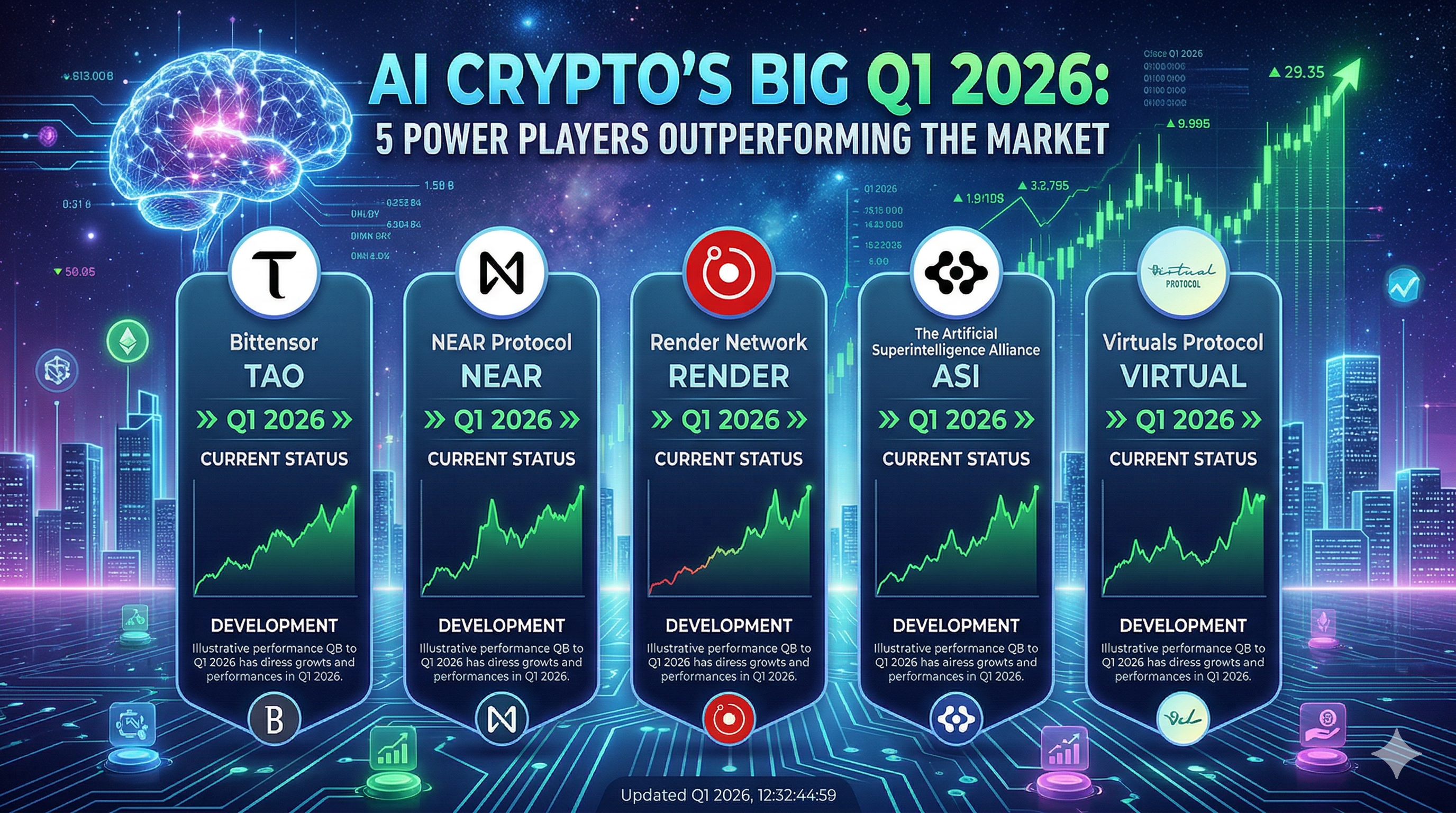
The first quarter of 2026 has officially silenced the skeptics. While the broader digital asset market navigated a volatile "mid-cycle recalibration" influenced by shifting global interest rates and a cooling of the meme-coin frenzy, the AI-crypto sector emerged as the clear alpha. According to the Grayscale Q1 2026 Crypto Sectors Report, while nearly 90% of all crypto assets saw negative returns during the March dip, the AI sector demonstrated remarkable resilience. Specifically, the AI category lost only 14% in value, significantly outperforming the broader Smart Contract Platform sector, which plummeted by 21%.
We are no longer in the era of "AI-flavored" whitepapers. Q1 2026 has been defined by the Agentic Web, where decentralized machine intelligence isn't just a speculative narrative—it’s a cash-flow-generating utility. From decentralized GPU clusters hitting record utilization to AI "idols" generating millions in protocol fees, the landscape has matured into a sophisticated pillar of Web3.
Key Takeaways
-
Sector Dominance: AI-related tokens were the best-performing thematic assets in Q1 2026, dropping only 14% compared to a 30% decline in speculative consumer tokens.
-
The Revenue Shift: Top-tier projects like Bittensor and Virtuals Protocol have transitioned to "Industrial DeAI," where protocol revenue is now the primary driver of valuation.
-
Infrastructure Maturity: Decentralized Physical Infrastructure Networks (DePIN), led by Render, have successfully onboarded NVIDIA’s Blackwell (B200) architecture, offering enterprise-grade compute at scale.
-
Agentic Sovereignty: NEAR Protocol and the ASI Alliance are leading the movement toward "User-Owned AI," ensuring data privacy through hardware-secured enclaves.
-
Strategic Liquidity: For investors seeking to navigate this divergence, platforms like KuCoin continue to lead the market by providing early access to high-growth AI assets and deep liquidity for the "Agentic" narrative.
-
Bittensor (TAO): The "Nvidia of Web3" Reaches Industrial Scale
Bittensor ($TAO) remains the undisputed heavyweight of the decentralized AI sector. Following its first major halving in late 2025, the network has successfully transitioned from an inflationary growth phase to a scarcity-driven utility model.
Q1 Development: Revenue Growth and Subnet Proliferation
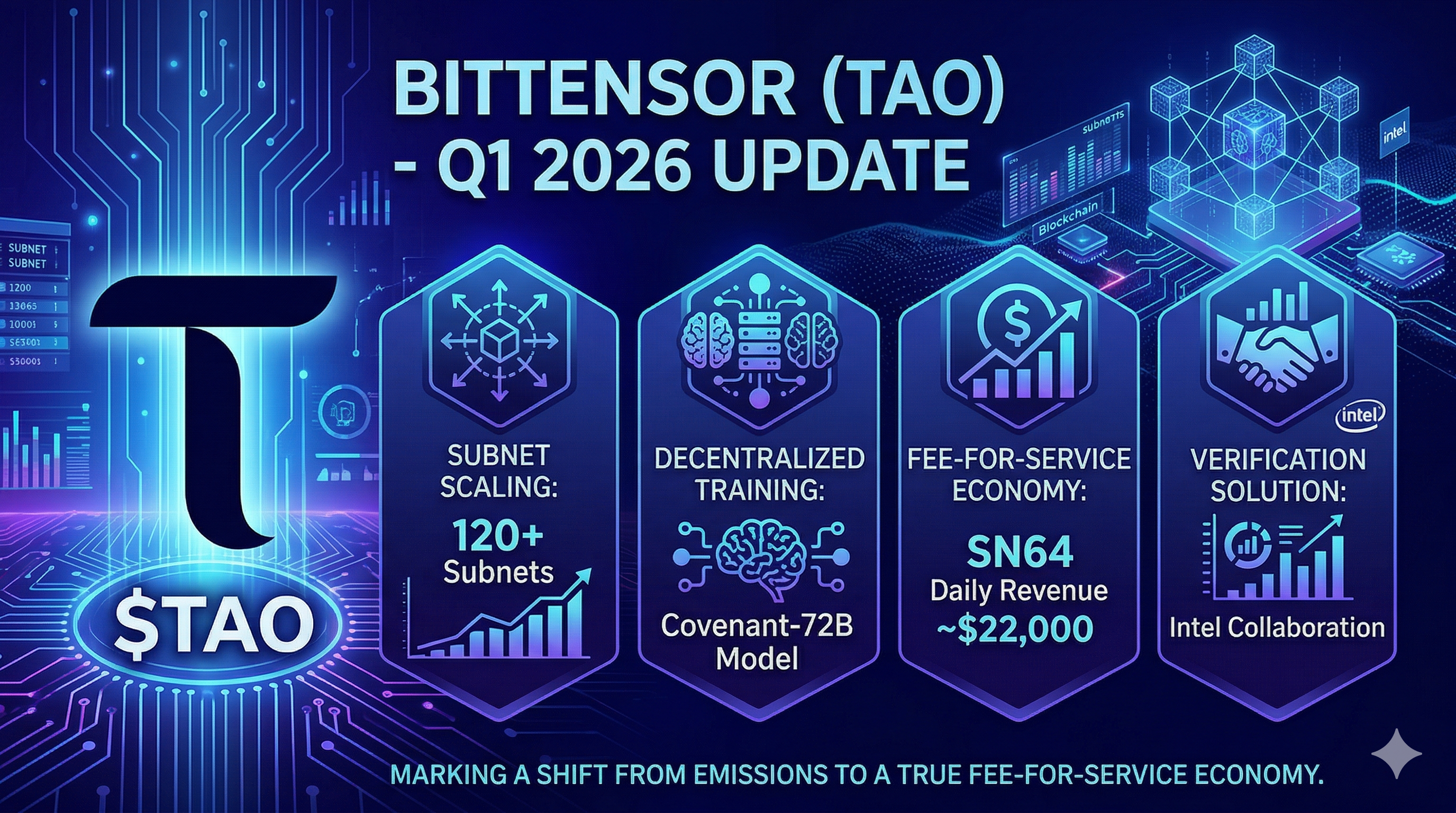
In Q1 2026, Bittensor's revenue-generating infrastructure reached a critical milestone. The network now supports over 120 active subnets, with many reporting consistent demand from external enterprises. A standout development was the operational success of Subnet 3 (Templar), which was publicly praised by industry leaders for training the Covenant-72B model. This large language model was trained entirely across distributed subnets, proving that decentralized training can rival the efficiency of centralized labs.
Financially, individual subnets are beginning to show impressive "on-chain earnings." For instance, Subnet Chutes (SN64) recently reported record daily revenues of roughly $22,000, signaling that the network is moving beyond simple token emissions and toward a real fee-for-service economy.
Technical Milestones
The quarter also saw a landmark collaboration between Manifold Labs and Intel, resulting in the "Decentralized Compute on Untrusted Hardware" whitepaper. By utilizing Intel® TDX and encrypted virtual machines, Bittensor is solving the "Verification Problem"—ensuring that the work miners claim to do is actually performed accurately without needing to trust the miner.
Future Outlook
As we move into Q2, the focus shifts to Dynamic TAO (BIT001) and "Cross-Subnet Intelligence." The goal is to allow separate subnets (e.g., vision, logic, and data storage) to interact seamlessly, creating a composite "World Model." Analysts suggest that if TAO continues to capture market share from centralized AI labs, it could soon challenge the top 5 assets by market capitalization. Investors looking to acquire TAO often turn to KuCoin, which has established itself as one of the most reliable exchanges for high-liquidity AI token trading.
-
NEAR Protocol (NEAR): The User-Owned Agentic Layer
In Q1 2026, NEAR Protocol completed its transformation from a sharded L1 into the primary "Front-end for AI." While other chains struggle with complex wallet signatures, NEAR has mastered Chain Abstraction, making the blockchain invisible to the consumer.
Q1 Development: The Agentic Framework & IronClaw
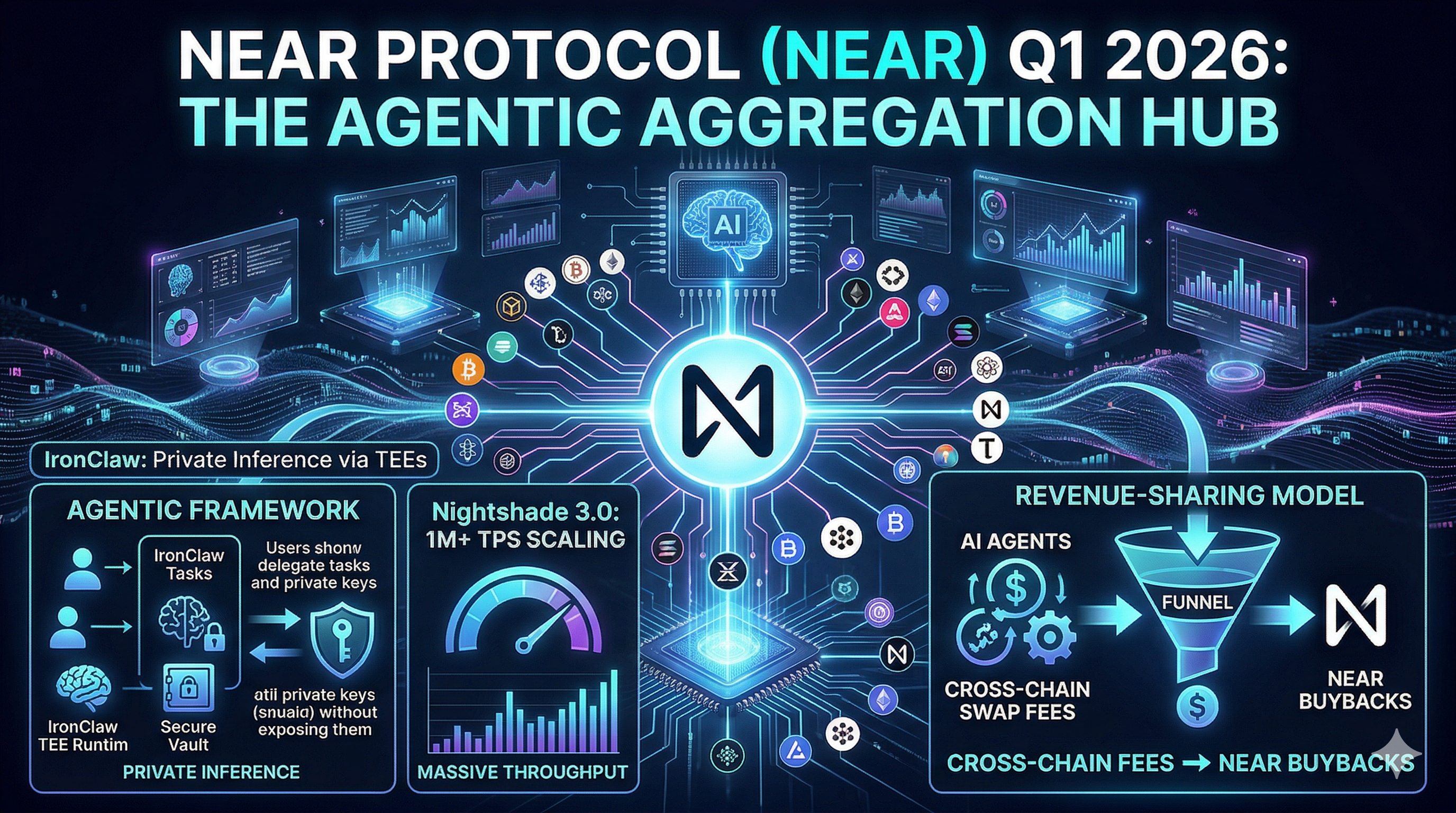
The launch of the NEAR Agentic Framework in early 2026 was a watershed moment. It offers a "gasless" experience where users manage identities and assets across 35+ chains with zero technical friction. Central to this is IronClaw, an open-source AI agent runtime that deploys agents inside Trusted Execution Environments (TEEs).
IronClaw ensures that user data remains encrypted even while an AI model processes it. This "Private Inference" capability is essential for 2026’s economy, where privacy is a premium commodity. By running always-on AI agents in shielded enclaves, NEAR allows users to delegate sensitive tasks—like managing insurance or executing high-value trades—without exposing private keys to the infrastructure provider.
Scaling and Revenue
Supporting this stack is Nightshade 3.0, which introduces the separation of consensus and execution. This allows NEAR to scale beyond 1 million Transactions Per Second (TPS). Furthermore, NEAR has introduced a revenue-sharing mechanism via "NEAR Intents," where protocol fees from cross-chain swaps are used for $NEAR buybacks, creating a direct link between AI activity and token value.
Future Outlook
NEAR's focus for the remainder of the year is the "Sovereign AI" movement. By providing the tools for users to own their model weights and training data, NEAR is positioning itself as the democratic alternative to "Big AI" walled gardens.
-
Render Network (RENDER): Powering the Generative Revolution
Render Network ($RENDER) has evolved from a simple cloud renderer into the world’s largest decentralized GPU Compute Pool, specifically tailored for the generative AI explosion of 2026.
Q1 Development: Blackwell Integration and Deflation
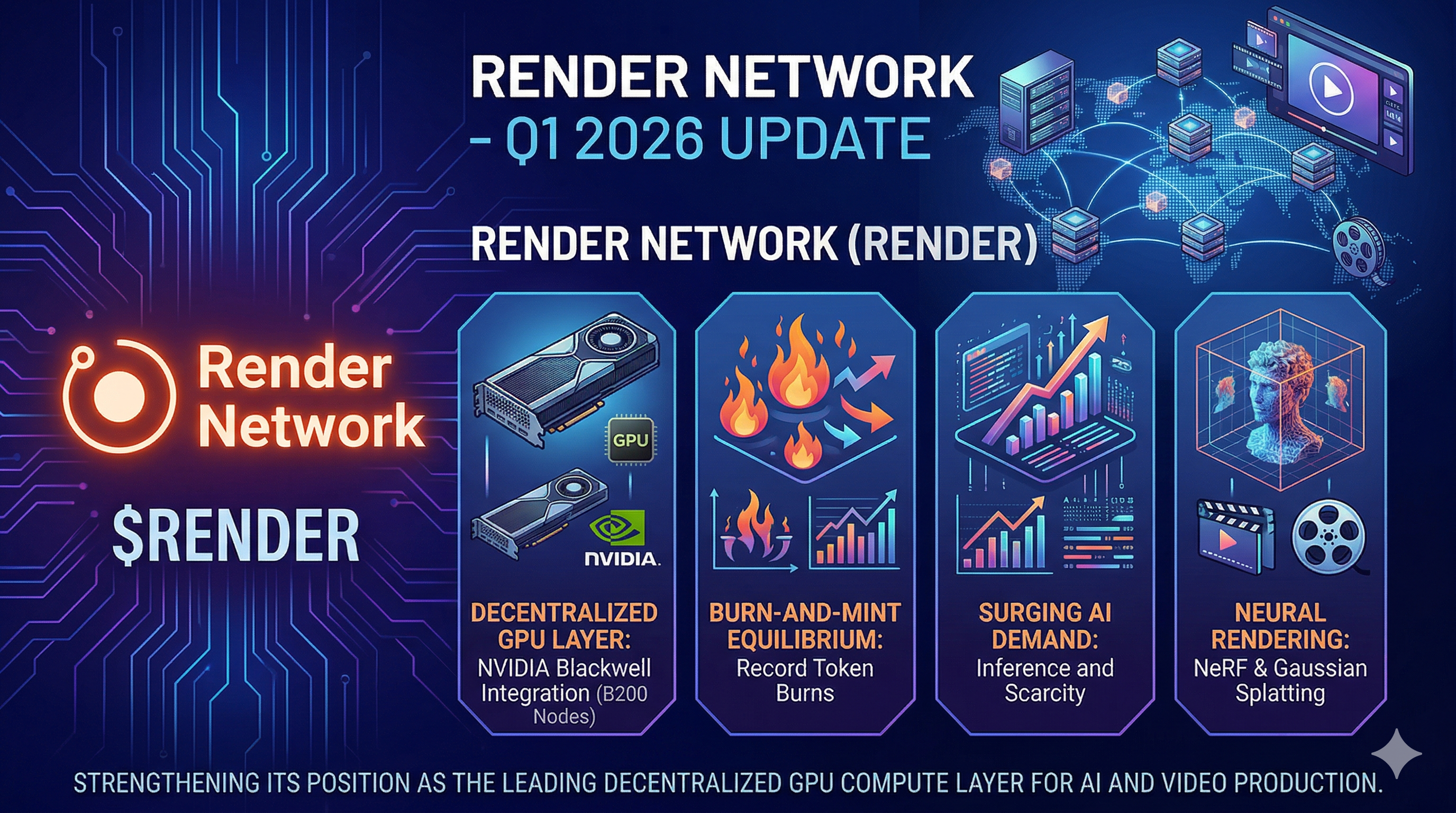
The Q1 headline for Render was its successful integration with NVIDIA’s Blackwell architecture. By onboarding B200 nodes, Render has become a primary alternative for startups unable to access H100s or B200s through centralized clouds.
The Burn-and-Mint Equilibrium (BME) model is now demonstrating its economic power. As demand for AI inference surged tenfold in Q1, the protocol burned a record amount of RENDER tokens, creating significant deflationary pressure. For traders, this shift from "inflationary reward" to "utility-driven scarcity" has made RENDER a staple in institutional portfolios.
Neural Rendering and Performance
Render is also at the forefront of Neural Rendering. By moving from deterministic physics simulations to generative pipelines (using techniques like NeRF and Gaussian Splatting), Render can produce high-quality visuals at 10% of the traditional compute cost. This hybrid approach—combining traditional graphics with deep learning—has made Render indispensable for the burgeoning AI-video industry.
Future Outlook
Render is now expanding into "Spatial Intelligence." As AR/VR hardware becomes mainstream, Render’s ability to provide real-time, AI-generated 3D environments at a 40% discount will be its primary growth driver through the remainder of 2026. For those managing a diverse AI portfolio, KuCoin offers advanced tools to track RENDER’s deflationary metrics alongside real-time price action.
-
Artificial Superintelligence Alliance (ASI): Unified Intelligence
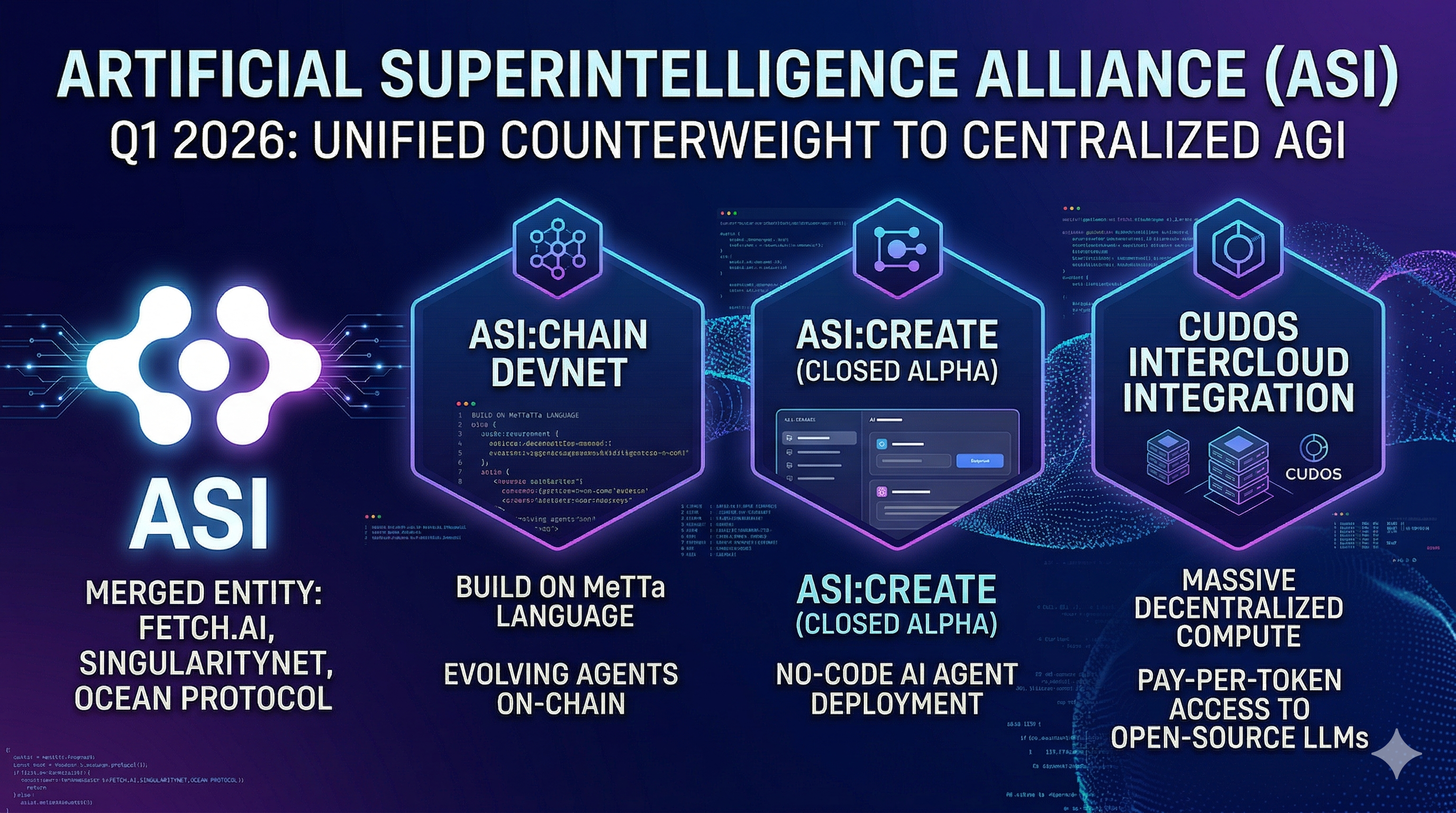
The merger of Fetch.ai, SingularityNET, and Ocean Protocol into the ASI Alliance has reached full operational maturity in Q1 2026. This coalition represents a unified front against centralized Artificial General Intelligence (AGI).
Q1 Development: ASI:Chain and MeTTa
The quarter was marked by the launch of the ASI:Chain DevNet, a network purpose-built for the unique demands of AGI. Unlike legacy blockchains that process transactions sequentially, ASI:Chain utilizes MeTTa, a meta-theoretical language that allows agents to "introspect" and evolve their own logic on-chain.
The Alliance also launched ASI:Create (Closed Alpha) in February 2026, a platform designed to simplify the creation and deployment of AI agents. This tool allows non-technical users to build agents that leverage the alliance’s decentralized compute and data marketplaces, significantly lowering the barrier to entry for the AI economy.
Infrastructure and Data
With the integration of CUDOS Intercloud, the ASI Alliance now possesses a massive decentralized compute layer. This infrastructure prioritizes "pay-per-token" access to state-of-the-art open-source Large Language Models (LLMs), ensuring that developers are not locked into expensive, proprietary API contracts.
Future Outlook
The Alliance’s next milestone is the ASI:Chain TestNet launch. This will be the final staging ground before a full Mainnet deployment targeted for late 2026. Successful testing is expected to drive massive developer migration from centralized AI clouds to the ASI ecosystem.
-
Virtuals Protocol (VIRTUAL): The Rise of AI-Consumer Economies
While other projects focus on the "back-end" infrastructure, Virtuals Protocol has captured the consumer imagination by focusing on AI Agents as Entertainment and Digital Influencers.
Q1 Development: Revenue Incentives and Growth
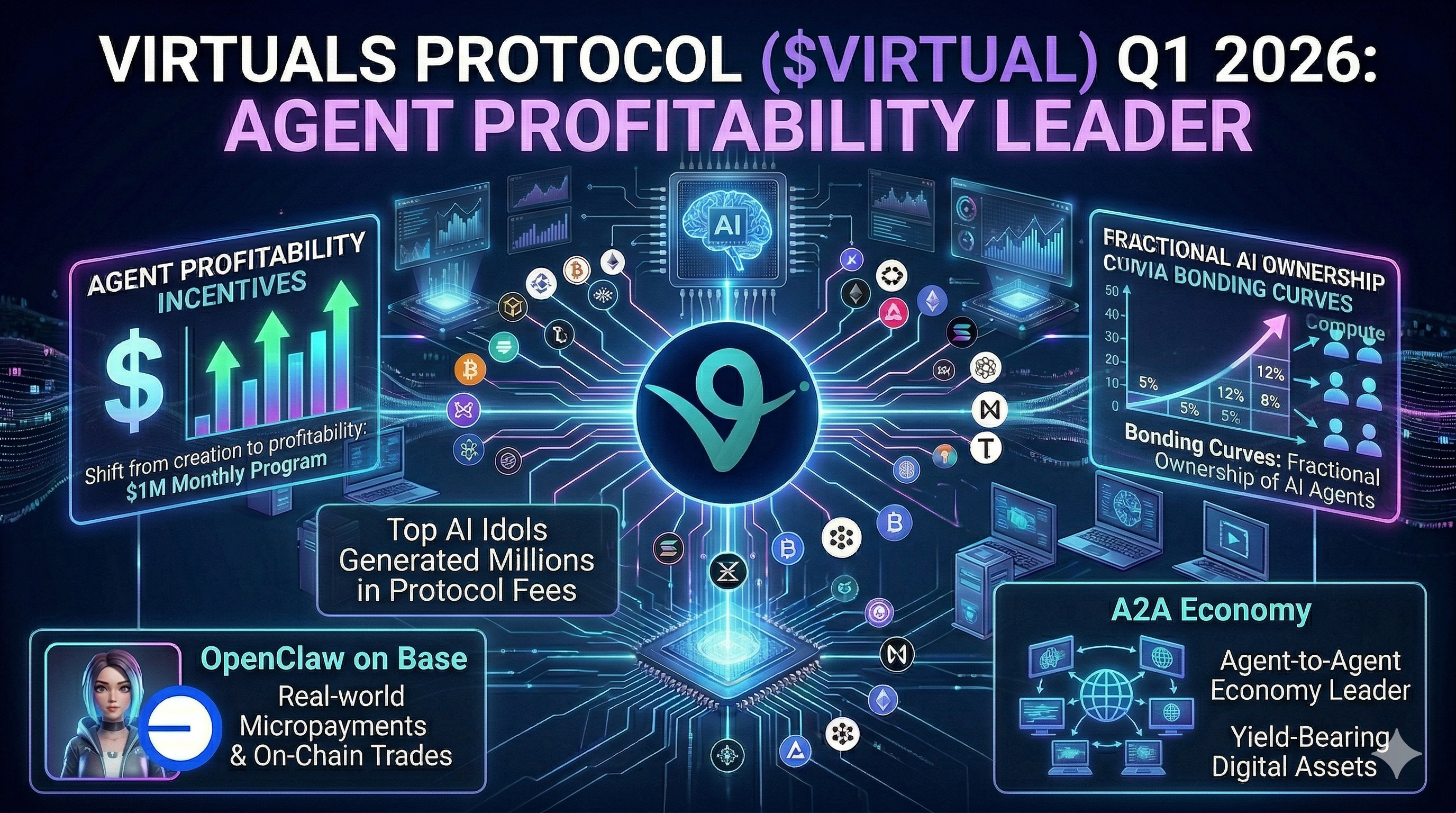
In Q1 2026, Virtuals Protocol launched a massive $1 million monthly incentive program specifically for revenue-generating AI agents. This move shifted the focus from "agent creation" to "agent profitability." The protocol reported that its top AI "idols"—digital entities that interact with fans on social media and manage their own digital assets—generated millions in protocol fees this quarter.
One notable integration is OpenClaw, an autonomous agent that uses Virtuals Protocol on the Base network for micropayments and on-chain trades. This real-world usage has cemented VIRTUAL's status as a pure play on the "Agent-to-Agent" (A2A) economy.
The Social Layer of AI
Virtuals allows for the fractional ownership of AI agents. Users can buy into the "bonding curve" of a specific agent, essentially owning a share of that agent’s future earnings. This has turned AI agents into a new class of digital assets: Yield-Bearing Personalities.
Future Outlook
The protocol is currently expanding its "Agent-to-Agent" economy. We are seeing the first instances where an AI gaming NPC "hires" an AI social media influencer to promote an in-game event, creating a self-sustaining digital economy that operates 24/7 without human intervention.
The "Agentic" Shift: Why 2026 Is Different From 2024
In 2024, the "AI Crypto" narrative was largely based on speculative potential and the general excitement surrounding ChatGPT. Investors bought tokens because they contained the word "AI," even if the project lacked a functional product. However, Q1 2026 represents a fundamental transition into the Execution Era.
The projects listed above are no longer selling "potential." They are selling tokens as access to compute, intelligence, and autonomous action. This is the year where we move from "Chatbots" to "Agents"—entities that don't just talk to you, but actually do things for you. Whether it's Render providing the literal hardware to run these models or NEAR providing the "Private Inference" layer to keep your data safe, the stack is now complete.
Conclusion: The Era of Execution
The first quarter of 2026 has established a new standard for the cryptocurrency market. The projects outperforming the market are those providing real-world utility: GPU compute (Render), decentralized intelligence (Bittensor), private inference (NEAR), cognitive frameworks (ASI), and revenue-generating agents (Virtuals).
As the "Agentic Revolution" accelerates, the gap between speculative "memecoins" and high-utility AI assets will only widen. For investors, the takeaway is clear: the future of Web3 is intelligent, autonomous, and increasingly decentralized. The transition from "Proof of Stake" to "Proof of Intelligence" is well underway.
FAQs
Q1: Why did the AI sector only drop 14% while others dropped 21%?
The resilience is driven by fundamental demand. Unlike many crypto sectors that rely on speculative hype, AI projects like Render and Bittensor provide services (compute and intelligence) that are currently in a state of global shortage. This utility provides a stronger price floor during market downturns.
Q2: What makes an "AI Agent" different from a traditional bot?
A traditional bot follows a fixed script. An AI agent on the Agentic Web (like those on NEAR or Virtuals) uses LLMs to reason, has its own on-chain identity/wallet, and can make independent decisions. For example, an agent can "find the best insurance" and execute the contracts autonomously.
Q3: Is it possible to earn "passive income" from these AI projects?
Yes. You can earn by providing hardware (GPUs for Render, Miners for Bittensor) or by participating in the "Agentic Economy" on Virtuals Protocol, where you can own a share of an AI agent’s revenue stream through its token bonding curve.
Q4: How can I safely trade these AI tokens in 2026?
Security and liquidity are paramount. Established exchanges like KuCoin provide the necessary infrastructure, including advanced security protocols, deep order books, and real-time data tracking for deflationary assets like RENDER.
Q5: What is the "Blackwell" integration, and why does it matter?
NVIDIA’s Blackwell architecture (B200) is the gold standard for AI hardware in 2026. Projects like Render Network that have successfully integrated these chips can offer enterprise-grade training speeds that were previously only available to the world's largest tech corporations.