

SBF Formally Applies for Trump Presidential Pardon – FTT Surges Over 60% in Speculative Rally
2026/06/10 16:43:00
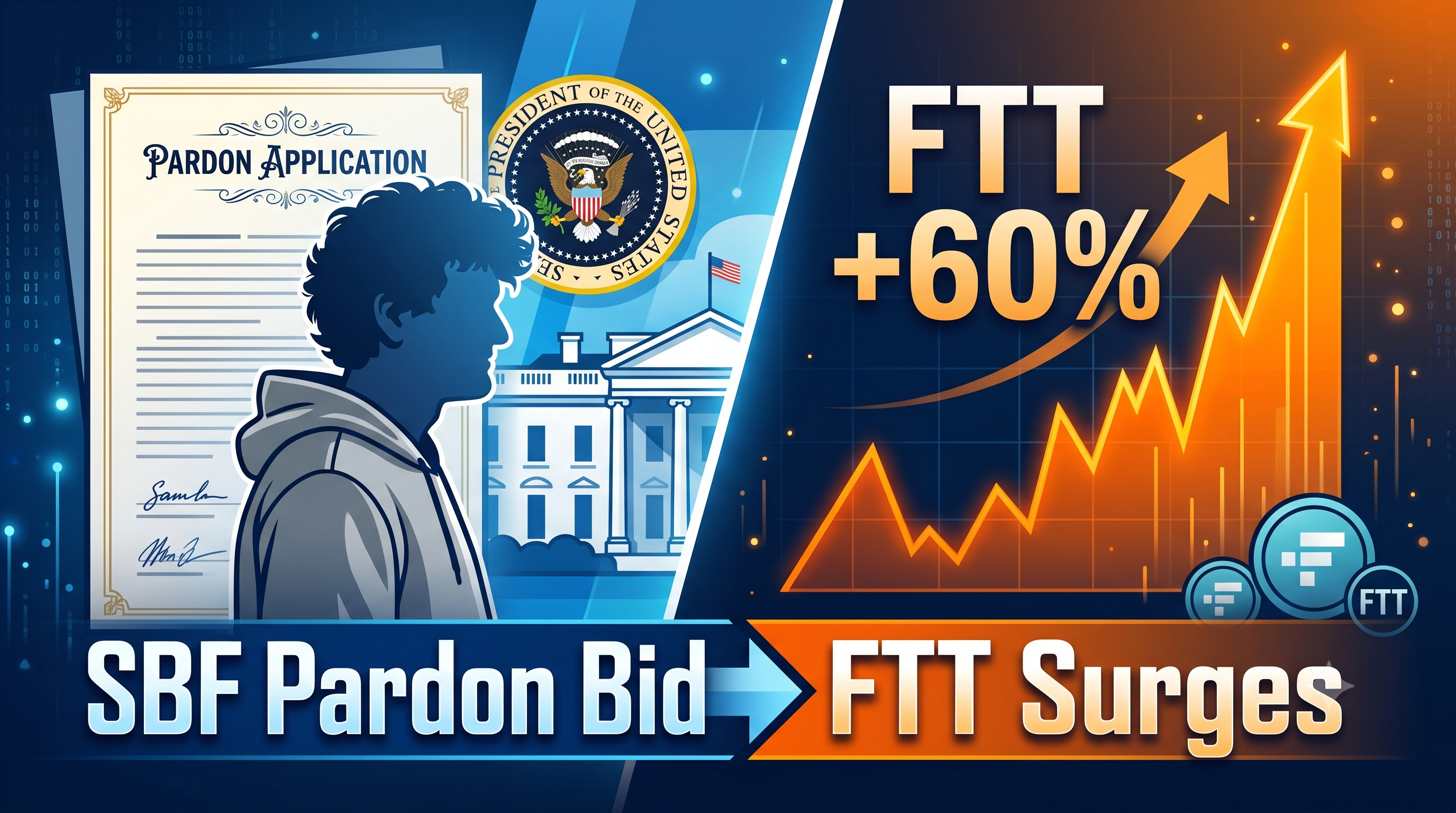
The cryptocurrency market has witnessed many dramatic events since the collapse of FTX in November 2022, but few have generated as much immediate speculation as the latest development involving former FTX CEO Sam Bankman-Fried (SBF). On June 8, 2026, official records from the U.S. Department of Justice's Office of the Pardon Attorney confirmed that Bankman-Fried formally submitted a presidential pardon application, seeking a “pardon after completion of sentence.” The filing quickly became one of the most discussed stories across crypto markets, legal circles, and financial media. Major outlets, including TechCrunch, The Wall Street Journal, Forbes, Bloomberg, and the Financial Times, confirmed the application and its pending status.
The market response was immediate. FTT, the exchange token associated with the bankrupt FTX platform, surged between 50% and 60% across major trading venues within hours of the news becoming public. Trading volumes spiked sharply as traders attempted to price in the possibility, however remote, of a future shift in the FTX narrative. While the pardon application itself does not alter Bankman-Fried’s conviction, prison sentence, or ongoing appeals process, it injected a fresh catalyst into an asset that many investors had largely written off. Reports from multiple crypto market trackers showed a sudden increase in speculative activity, highlighting how sensitive digital asset markets remain to headline-driven events.
The Pardon Filing That Reignited Attention Around FTX
Sam Bankman-Fried's pardon request marks the most formal step yet in a clemency effort that has been discussed for months within political and crypto circles. According to public records maintained by the U.S. Department of Justice's Office of the Pardon Attorney, the former FTX chief executive filed a request categorized as a “pardon after completion of sentence.” This distinction is important because it differs from a sentence commutation. A pardon after completion of the sentence would not result in immediate release from prison. Instead, it would remove certain legal consequences after the sentence has been served. The filing follows Bankman-Fried's 25-year prison sentence resulting from one of the largest financial fraud cases in cryptocurrency history. The DOJ records, first highlighted by Bloomberg and subsequently confirmed by major news organizations, transformed speculation into a documented legal process. Although President Donald Trump previously indicated that he had no plans to pardon Bankman-Fried, the formal application nevertheless introduced a new variable into market discussions.
From a market perspective, the filing's significance extends beyond its legal merits. Crypto markets often react to narratives before evaluating probabilities. Investors recognized that the filing created a fresh stream of headlines, interviews, political commentary, and social media discussion. Those factors alone can generate substantial trading activity, particularly for assets associated with high-profile events. In the case of FTT, a token tied to a defunct exchange, traditional valuation metrics offer limited guidance. Consequently, sentiment and speculation play an outsized role in price movements. The pardon application revived conversations about FTX, creditor recoveries, and potential future developments connected to the bankruptcy estate. Even though none of these factors changed materially on June 8, traders treated the filing as a catalyst capable of attracting liquidity and renewed attention. The episode demonstrates how legal developments surrounding prominent figures can quickly become market-moving events in digital asset ecosystems.
Why FTT Jumped More Than 60% Despite No Fundamental Change
The rally in FTT immediately raised a question among analysts: why would a token linked to a bankrupt exchange appreciate so dramatically when no operational improvement had occurred? The answer lies largely in the mechanics of speculative trading. FTT no longer derives value from the business model that originally supported it. The exchange that issued the token collapsed years ago, and its ecosystem functions have effectively disappeared. Nevertheless, the token remains listed on several platforms, retains a recognizable brand association, and possesses enough liquidity to attract short-term traders. When news emerged that Bankman-Fried had formally applied for presidential clemency, traders interpreted the development as a catalyst capable of generating substantial volatility. In markets driven by sentiment, volatility itself often becomes an investment thesis.
The speed of the move also reflects broader crypto market behavior. Many participants actively monitor headlines for opportunities to capitalize on short-term momentum. Once FTT began rising, algorithmic systems, momentum traders, and speculative retail investors joined the rally. This created a feedback loop in which rising prices attracted additional buyers. Market observers noted that the surge was not driven by improvements in revenue, technology, adoption, or utility. Instead, it reflected the market's willingness to assign value to potential future scenarios, however uncertain. Latest news indicated that some traders linked the filing to a hypothetical path toward rehabilitation of the FTX brand or renewed attention on creditor recovery efforts, despite little evidence supporting either outcome. As trading volumes accelerated, the token became one of the day's most discussed assets across crypto social media platforms. The resulting rally serves as a reminder that in digital asset markets, narrative momentum can sometimes overshadow fundamental analysis for extended periods.
Speculation, Not Fundamentals, Is Driving the Current FTT Narrative
The distinction between speculation and fundamentals is central to understanding the current FTT rally. Fundamental investing typically involves assessing measurable factors such as cash flow generation, revenue growth, user adoption, competitive positioning, or network activity. FTT currently offers little of that framework. Since the collapse of FTX, the token's original utility has largely vanished, leaving investors with few traditional metrics for valuation. As a result, price action increasingly reflects changing perceptions rather than measurable business performance. The pardon application amplified that dynamic by introducing a highly visible news event connected to one of crypto's most recognizable figures. Speculative markets frequently assign value to possibilities rather than probabilities. In this case, some traders appear to be pricing in a chain of events that would require multiple uncertain outcomes. First, the pardon application would need to advance through the review process. Second, political circumstances would need to shift in favor of clemency. Third, any eventual pardon would somehow need to create meaningful value for a token associated with a bankrupt exchange.
Each step contains significant uncertainty, yet speculative markets often focus on potential upside scenarios rather than statistical likelihood. This behavior is not unique to FTT. Similar patterns have appeared throughout crypto history whenever a prominent legal case, regulatory decision, or corporate event captures investor attention. The latest rally, therefore, provides insight into the psychology of digital asset trading rather than the financial health of the underlying asset. Investors evaluating the situation must distinguish between narrative-driven momentum and developments that materially affect long-term value creation. Understanding that distinction remains critical in a market where attention itself frequently becomes a tradable asset.
How Traders Turned a Legal Development Into a Market Catalyst
Financial markets have long demonstrated a tendency to transform legal and political developments into tradable events, but cryptocurrency markets often do so with greater speed and intensity. The reaction to Sam Bankman-Fried’s pardon application illustrates this phenomenon clearly. Within hours of reports confirming the filing, FTT experienced one of its largest single-day rallies in recent memory. Market participants were not responding to any change in the token’s utility, governance structure, or underlying economics. Instead, they were reacting to the possibility that renewed public attention could attract liquidity and speculative interest. This distinction matters because it highlights the growing role of narrative-based trading strategies across digital asset markets. Many traders increasingly view headlines as catalysts capable of generating short-term opportunities regardless of whether the news alters long-term fundamentals. As a result, assets associated with recognizable personalities or controversial events can experience outsized volatility when new information emerges.
Reports from market analytics firms showed that social media mentions of FTT surged alongside trading volumes, indicating that attention itself became a key driver of demand. Similar patterns have been observed during previous crypto events involving regulatory rulings, exchange disputes, and high-profile court proceedings. In these environments, traders often focus less on intrinsic value and more on anticipated market reactions. The SBF pardon filing provided exactly the kind of event-driven narrative that speculative traders seek: a widely discussed story, a recognizable figure, and a token with sufficient liquidity to support rapid price movements. While such rallies can generate substantial gains over short periods, they also tend to carry elevated risks because sentiment can reverse just as quickly as it develops. The current FTT episode demonstrates how legal developments can develop into powerful market catalysts even when they have little direct impact on the asset itself.
Short Squeezes and Momentum Trading Amplified the Rally
A significant factor behind FTT’s rapid appreciation appears to have been the interaction between short sellers and momentum traders. When highly speculative assets experience sudden buying pressure, traders who previously bet on price declines may be forced to close their positions. This process, commonly known as a short squeeze, can accelerate upward price movements as short sellers purchase the asset to limit losses. Although detailed exchange-level positioning data remains limited, several market observers noted that FTT’s price action displayed characteristics often associated with short-squeeze dynamics. The token’s relatively modest liquidity compared with larger cryptocurrencies means that concentrated buying activity can have a disproportionately large effect on price. Once the initial rally gained traction, momentum-focused traders entered the market seeking to capitalize on the trend. Their participation added further buying pressure, creating a self-reinforcing cycle. Such patterns are common in crypto markets, where algorithmic systems frequently monitor volume spikes, breakout levels, and social sentiment indicators.
As prices rise, more traders become aware of the movement, attracting additional capital and extending the rally. This process can continue even when the original catalyst provides little direct economic value. Historical examples across digital assets, meme stocks, and other speculative markets show that price momentum often develops independently of fundamentals during periods of intense attention. In the case of FTT, the pardon application served as the spark, but market structure likely contributed significantly to the magnitude of the move. Understanding these mechanics is important for investors because rallies driven by positioning and momentum can reverse rapidly once buying pressure subsides. The episode reinforces the importance of analyzing trading behavior alongside news developments rather than assuming that price increases necessarily reflect improving fundamentals or reduced long-term risk.
FTX Creditor Recoveries Remain a More Important Story Than the Pardon
While headlines surrounding Sam Bankman-Fried have captured significant attention, the more consequential development for many stakeholders remains the ongoing recovery process for FTX creditors. Since the exchange collapsed in 2022, bankruptcy administrators have focused on locating assets, resolving claims, and distributing recoveries to affected customers. Over the past several years, progress in those efforts has become one of the most important factors shaping perceptions of the broader FTX legacy. Court filings and bankruptcy updates have indicated that creditors are expected to recover substantial portions of their claims, a result that initially seemed unlikely during the early stages of the collapse. These recovery efforts have practical financial implications that far exceed the immediate significance of the pardon application. For many former customers, distributions from the bankruptcy estate represent tangible outcomes, whereas discussions surrounding clemency remain largely speculative.
Market analysts, therefore, caution against conflating legal developments involving Bankman-Fried with the operational realities of the FTX estate. The two issues are related historically but function independently in many respects. The bankruptcy process continues according to court-approved procedures, and the pardon application does not alter creditor rights, recovery calculations, or asset distributions. Investors evaluating FTT should recognize that the token’s recent rally occurred despite the absence of meaningful changes in the recovery framework. In fact, creditor developments may ultimately provide more actionable information regarding the long-term consequences of the FTX collapse than any single legal filing. The contrast between these narratives highlights a recurring feature of financial markets: attention often gravitates toward dramatic headlines, while developments with greater economic significance receive comparatively less coverage. Understanding this distinction can help investors separate high-visibility events from factors that have a more direct impact on financial outcomes.
The Market’s Memory of FTX Remains Surprisingly Powerful
More than three years after FTX entered bankruptcy, the exchange continues to exert a remarkable influence on cryptocurrency markets. The latest reaction to Bankman-Fried’s pardon application demonstrates that the FTX story remains deeply embedded in investor psychology. Few corporate failures in modern financial history have generated comparable levels of attention, public scrutiny, and industry-wide consequences. The collapse affected millions of users, triggered regulatory responses across multiple jurisdictions, and contributed to a prolonged crisis of confidence within the digital asset sector. As a result, developments connected to FTX still resonate strongly with market participants. This lingering influence helps explain why news involving Bankman-Fried can generate substantial reactions despite having limited relevance to current market fundamentals. For many investors, FTX represents more than a bankrupt exchange; it symbolizes a defining chapter in cryptocurrency history.
Events associated with that chapter continue to attract attention because they evoke unresolved questions about accountability, recovery, governance, and trust. Behavioral finance research suggests that investors often assign disproportionate significance to events that remain emotionally or psychologically salient. The FTX collapse clearly falls into that category. Consequently, assets linked to the exchange can experience elevated sensitivity to news developments even years after the original crisis. The recent FTT rally reflects this phenomenon. Traders were not simply responding to a pardon application; they were responding to a story that remains one of the most recognizable narratives in crypto. The persistence of that narrative illustrates how market memory can influence asset prices long after the underlying events have occurred. It also demonstrates why investors should carefully evaluate whether price movements are being driven by new economic information or by renewed attention surrounding familiar historical events.
Why Political Headlines Are Becoming a Bigger Force in Crypto Markets
The cryptocurrency industry was originally built around technological innovation, decentralized networks, and financial experimentation. Over time, however, political developments have become increasingly influential drivers of market behavior. The reaction to Sam Bankman-Fried’s pardon application reflects a broader trend in which investors closely monitor government actions, political campaigns, legal proceedings, and policy signals for clues about future market conditions. In recent years, digital asset prices have responded not only to technological milestones but also to elections, regulatory appointments, congressional debates, and presidential statements. This shift reflects the growing integration of crypto into mainstream financial and political systems. As institutional participation expands, investors recognize that policy decisions can influence capital flows, adoption rates, and market sentiment.
The SBF pardon story sits at the intersection of politics and crypto, making it particularly attractive to traders seeking headline-driven opportunities. Yet the episode also demonstrates the risks associated with politically linked narratives. Political developments often generate intense media coverage while offering limited clarity regarding actual outcomes. Markets may therefore react strongly to events that ultimately have little practical impact. This dynamic has become increasingly common across financial markets, where investors attempt to anticipate future developments before concrete information becomes available. For crypto traders, understanding the distinction between political attention and economic significance remains essential. Market history shows that political headlines can create substantial volatility, but sustained value creation typically depends on broader adoption, technological progress, and capital formation. The current FTT rally illustrates how quickly political narratives can influence asset prices, even when the underlying event remains highly uncertain.
The FTT Rally Mirrors Past Episodes of Narrative-Driven Trading
The surge in FTT following news of the pardon application fits into a long-established pattern of narrative-driven trading that has appeared repeatedly throughout cryptocurrency history. Markets frequently experience periods in which investor attention becomes concentrated around a particular theme, personality, or event. During these periods, price movements often exceed what traditional valuation frameworks would justify. Examples can be found across numerous market cycles, including exchange-token rallies, meme coin booms, legal-case reactions, and celebrity-driven trading frenzies. In each instance, the underlying driver is not necessarily a change in fundamentals but rather a shift in collective expectations. Traders begin buying because they anticipate that other traders will also buy, creating a self-reinforcing cycle of demand. The recent FTT rally exhibits many of these characteristics.
News of the pardon filing generated widespread discussion across crypto media platforms, social networks, and trading communities. That attention attracted speculative capital seeking to profit from increased volatility. Similar episodes have occurred whenever dormant or distressed assets suddenly become linked to a major headline. The resulting rallies can be dramatic, but they often prove difficult to sustain once the initial narrative loses momentum. For investors, these events offer valuable lessons about market psychology. Understanding why a rally is occurring can be just as important as identifying the rally itself. In the case of FTT, the catalyst was not operational progress at a functioning business. Instead, it was the revival of a story that continues to capture public attention. The persistence of narrative-driven trading highlights a defining feature of crypto markets: perception can influence prices significantly in the short term, even when long-term value remains uncertain. Investors who recognize this dynamic are often better positioned to evaluate both opportunities and risks.
Traders Are Closely Watching Volatility Metrics and Liquidity Conditions
As FTT continues attracting attention, professional traders are increasingly focusing on volatility indicators and liquidity conditions rather than the legal details of the pardon application itself. Volatility remains one of the most important variables in speculative markets because it directly affects trading opportunities, risk management strategies, and capital allocation decisions. Following the news, exchanges reported elevated trading activity, wider price swings, and significantly increased turnover. These conditions created an environment that appealed to short-term traders seeking rapid price movements. However, high volatility also introduces substantial risks. Assets experiencing sharp rallies often become vulnerable to equally sharp corrections once momentum weakens or market sentiment changes. This reality explains why many professional participants monitor liquidity metrics closely during speculative surges. Liquidity influences how easily positions can be entered and exited without significantly affecting market prices.
In assets such as FTT, where liquidity is relatively limited compared with major cryptocurrencies, abrupt changes in sentiment can lead to exaggerated price movements in both directions. Investors researching similar events often review market indicators alongside educational resources explaining crypto trading volume analysis, market liquidity in cryptocurrency exchanges, and how leveraged trading impacts volatility, topics covered extensively within the educational ecosystem. These educational materials provide useful context for understanding why speculative rallies frequently produce outsized gains and losses over short periods. The current environment serves as a reminder that volatility itself can become a market driver, attracting participants whose primary objective is not long-term investment but short-term trading activity.
The Bigger Lesson: Markets Often Price Narratives Faster Than Outcomes
The most important takeaway from the FTT rally may be the distinction between narratives and outcomes. Financial markets routinely attempt to anticipate future developments before they occur, and cryptocurrency markets often do so with exceptional speed. The response to Bankman-Fried’s pardon application reflects this tendency. Traders reacted not to a completed legal process but to the possibility of future developments that remain uncertain. This behavior illustrates a broader principle that applies across many asset classes: markets frequently price expectations long before tangible results emerge. In some cases, those expectations prove accurate. In others, anticipated outcomes fail to materialize, leading to reversals in sentiment and price action. The challenge for investors is determining whether a market reaction reflects genuine value creation or simply heightened attention. The current FTT rally appears largely driven by narrative momentum rather than measurable changes in economic fundamentals. That does not necessarily invalidate the rally, but it does influence how risk should be assessed.
As the pardon process unfolds, market participants will continue evaluating new information and adjusting expectations accordingly. Regardless of the ultimate legal outcome, the episode provides a powerful example of how quickly narratives can influence asset prices. For long-term investors, the key lesson may be that understanding market psychology is often just as important as understanding the news itself. In a rapidly evolving digital asset landscape, the ability to distinguish between attention-driven rallies and lasting value creation remains one of the most valuable skills an investor can develop.
FAQs
Did Sam Bankman-Fried receive a presidential pardon?
No. As of June 2026, Sam Bankman-Fried has formally submitted a pardon application through the U.S. Department of Justice’s Office of the Pardon Attorney. The filing confirms that a request exists, but it does not indicate approval. Presidential pardons undergo a review process, and there is no guarantee that an application will be granted. Investors should distinguish between a filed application and an actual pardon, as the two carry very different implications.
Why did FTT rise so sharply after the news?
FTT surged primarily because traders viewed the pardon filing as a catalyst capable of generating market attention and speculative activity. The rally was largely driven by sentiment, momentum trading, and increased market participation rather than changes in the token’s underlying utility or economic fundamentals. Such reactions are common in crypto markets when major headlines attract widespread attention.
Does a pardon application affect FTX creditor repayments?
No. The bankruptcy proceedings involving FTX and creditor recovery efforts operate independently from the pardon application. Creditor distributions are governed by court-approved processes and asset recovery programs. The filing itself does not change how claims are calculated or how repayments are administered.
Is FTT backed by an active exchange today?
FTT remains associated with the former FTX ecosystem, but the exchange that originally supported the token collapsed in 2022. Investors should understand that the token no longer benefits from the same operational framework that existed before the bankruptcy. Market activity surrounding FTT is therefore heavily influenced by sentiment and speculation.
Could the FTT rally continue?
It is possible, but future price movements depend on market sentiment, liquidity conditions, trading activity, and additional news developments. Assets that experience rapid speculative rallies can also experience sharp pullbacks. Investors should evaluate risks carefully and avoid assuming that short-term momentum guarantees long-term performance.
What broader lesson does this event provide for crypto investors?
The episode highlights the importance of separating narratives from fundamentals. Markets often react quickly to attention-grabbing developments, particularly when they involve prominent figures or historic events. Investors who understand the difference between sentiment-driven trading and genuine value creation are generally better equipped to manage risk and make informed decisions.
Disclaimer: This content is for informational purposes only and does not constitute investment advice. Cryptocurrency investments carry risk. Please do your own research (DYOR).