

OpenAI Raises Cloud Spending to $750B by 2030: AI Infrastructure Arms Race Heats Up
2026/08/01 11:12:00
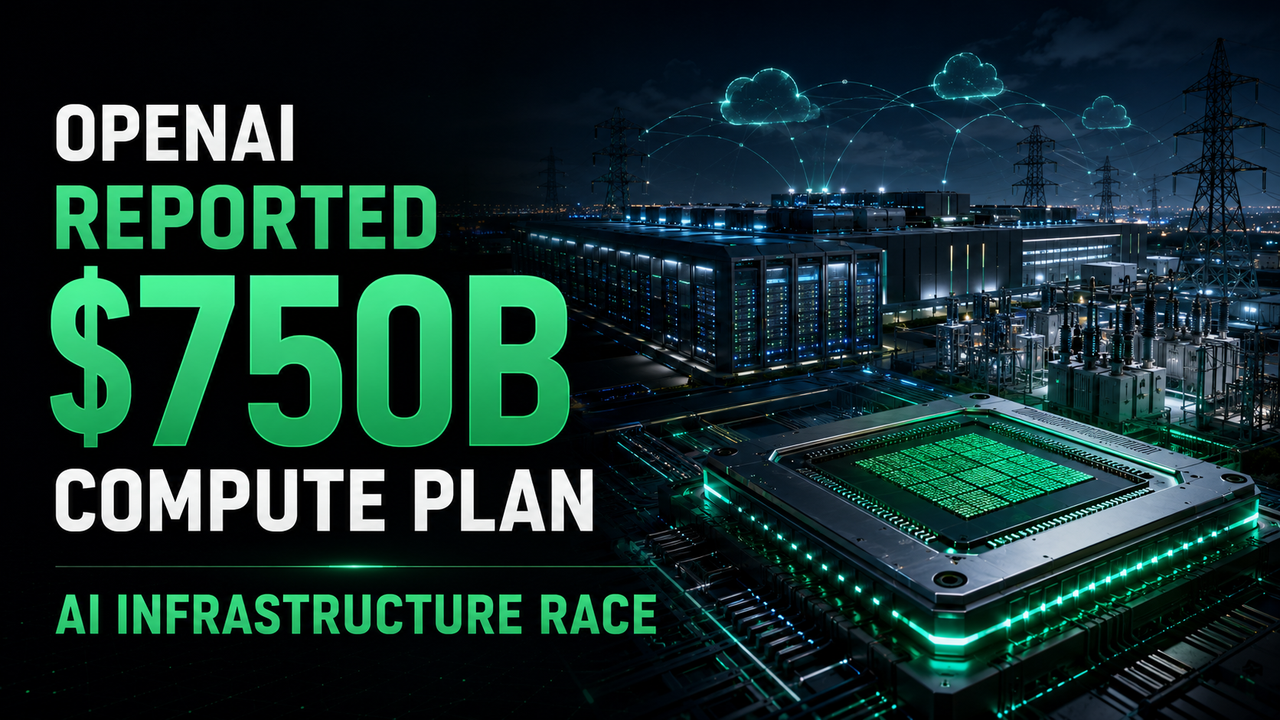
OpenAI is reportedly preparing for one of the largest computing expansions in technology history as rising demand for artificial intelligence pushes the company to secure more processors, cloud capacity, data centers and electricity. Its projected compute spending could reach approximately $750 billion through 2030, while Project Camellia and major agreements with Microsoft, Amazon Web Services, Oracle and CoreWeave are creating a diversified infrastructure network. These plans reflect the growing importance of physical capacity in the competition to develop and distribute advanced AI systems. However, many announced projects remain subject to construction, financing and regulatory approvals, while the $750 billion estimate has not been publicly confirmed by OpenAI. The company’s ability to convert this infrastructure into reliable services and sustainable revenue will help determine whether the expansion becomes a durable competitive advantage or a costly long-term obligation. real-time AI and Big Data crypto market data can show how the wider AI theme is reflected in digital-asset markets, although token performance should not be treated as a measure of OpenAI’s valuation or operating results.
OpenAI’s Planned Compute Spending Reportedly Rises to $750 Billion Through 2030
OpenAI’s projected compute spending has reportedly increased to approximately $750 billion through 2030, up $150 billion from an earlier $600 billion estimate, according to The Wall Street Journal. The 25% increase reflects rising demand for data centers, AI processors, electricity and cloud capacity as OpenAI expands ChatGPT, enterprise services and AI agents capable of completing more complex tasks. However, OpenAI has not publicly confirmed the figure or disclosed a detailed breakdown. The estimate may include cloud contracts, networking equipment, cooling systems and long-term capacity reservations, so it should be viewed as projected cumulative compute expenditure rather than a finalized capital-spending commitment.
-
The $750 Billion Projection Covers Several Years of Computing Costs
The reported amount does not mean OpenAI plans to spend $750 billion during 2030 alone. Instead, it represents expected cumulative spending on computing capacity over several years leading up to 2030. OpenAI President Greg Brockman said the company anticipated spending approximately $50 billion on computing power in 2026, compared with around $30 million in 2017. That dramatic increase reflects how quickly the cost and scale of frontier AI development have changed. Early machine-learning systems could be trained on comparatively small computing clusters, while modern reasoning, multimodal and agentic models can require thousands of specialized processors working together through high-speed networks. After training is completed, additional infrastructure is required to test the models, improve their safety and deliver responses to hundreds of millions of users.
A large share of the projected expenditure may also be connected to contracts that reserve capacity years before it becomes available. Advanced data centers can require lengthy planning periods because developers must secure land, grid connections, construction permits, cooling systems, transformers and large quantities of AI chips. OpenAI may therefore need to enter long-term agreements now to ensure that sufficient capacity is available later in the decade. These contracts may be structured in phases, meaning the company would pay as infrastructure is completed, computing resources are delivered or usage increases. Some commitments may extend beyond 2030, while others could overlap with OpenAI’s wider Stargate infrastructure program, making it inappropriate to add every publicly reported cloud and data-center agreement together as if each represented separate spending.
-
ChatGPT Growth and AI Inference Are Driving OpenAI’s Compute Demand
OpenAI’s rising infrastructure requirements are being driven by both model training and inference. Training involves processing enormous datasets to develop or improve an AI model, while inference takes place whenever ChatGPT or another application uses that model to answer a question, generate an image, analyze information or complete a task. Although training attracts attention because of its concentrated demand for advanced chips, inference creates a continuous and potentially larger long-term cost. Every additional ChatGPT user, enterprise deployment or developer application increases the number of model operations running across OpenAI’s infrastructure, particularly when requests involve advanced reasoning, video generation, coding or multimodal analysis.
The company said in March 2026 that ChatGPT had more than 900 million weekly users, over 50 million subscribers and a rapidly growing enterprise business. OpenAI also reported that its application programming interface was processing more than 15 billion tokens per minute. Its available computing capacity increased from approximately 0.2 gigawatts in 2023 to 0.6 gigawatts in 2024 and about 1.9 gigawatts in 2025. This expansion indicates that rising OpenAI compute spending is closely connected to actual product usage, although future demand remains difficult to forecast. AI agents may increase consumption further because a single request can trigger multiple searches, calculations, software interactions and model calls before the final task is completed.
The principal drivers behind the higher OpenAI compute-spending projection include:
-
Frontier model training: More capable reasoning and multimodal AI systems require large clusters of advanced processors, memory and networking equipment.
-
Expanding inference workloads: Growth in ChatGPT, enterprise AI services and developer applications creates continuous demand whenever a model generates a response.
-
AI-agent adoption: Autonomous systems can perform many model operations for a single user request, potentially consuming substantially more compute than a standard chatbot interaction.
-
Long-term capacity reservations: Scarce chips, grid connections and data-center sites often need to be secured years before they are ready for commercial use.
-
Infrastructure diversification: Working with multiple cloud, chip and data-center partners can improve resilience and reduce dependence on a single supplier.
-
Competitive pressure: OpenAI must obtain sufficient capacity while Google, Anthropic, Meta, xAI and other developers are expanding their own AI infrastructure networks.
Efficiency improvements could reduce the computing cost of individual tasks, but they may not lower total infrastructure demand. Faster and less expensive models can encourage businesses and consumers to use AI more frequently, creating a rebound effect in which overall consumption continues to rise despite lower costs per request. OpenAI must therefore prepare for several possible demand scenarios rather than assuming that improvements in chip or model efficiency will automatically reduce its infrastructure requirements.
-
The Spending Increase Creates Both Strategic Opportunities and Financial Risks
Securing additional computing capacity could give OpenAI several strategic advantages. Greater access to processors and data centers may allow the company to train new models more quickly, reduce capacity restrictions during periods of high demand and support specialized products for coding, scientific research, video generation and enterprise automation. Infrastructure diversification could also strengthen OpenAI’s negotiating position by preventing excessive reliance on a single cloud provider or chip supplier. In an industry where access to electricity and advanced processors can determine how rapidly a company develops and distributes new AI products, long-term capacity agreements may function as both an operational necessity and a competitive defense.
However, spending more on infrastructure does not automatically guarantee better AI models, stronger revenue growth or higher profit margins. OpenAI must ensure that the capacity it reserves is used efficiently and that customer demand generates enough revenue to cover long-term computing obligations. The company could face financial pressure if enterprise adoption slows, consumers resist higher subscription prices, competitors offer similar models at lower costs or newer processors make existing infrastructure less economical. Model improvements may also depend on factors beyond hardware scale, including training methods, data quality, software optimization, safety systems and research breakthroughs. Simply adding more chips may produce diminishing improvements if those other areas do not progress at the same rate.
The reported $750 billion OpenAI infrastructure projection should therefore be viewed as an indication of the potential scale of the company’s ambitions rather than a guaranteed final expenditure. The most important question is not whether OpenAI can reserve enormous quantities of computing capacity, but whether it can deploy that capacity gradually, maintain strong utilization and convert it into sustainable subscription, enterprise and API revenue. Investors and industry observers will need to monitor OpenAI’s annual compute spending, operational capacity, inference costs, revenue growth and contract structure to determine whether its infrastructure expansion is strengthening the business or creating obligations that could become difficult to support.
How Project Camellia and Major Cloud Deals Are Intensifying the AI Infrastructure Arms Race
OpenAI’s infrastructure strategy is moving beyond conventional cloud rental agreements toward a broader network of dedicated data centers, long-term electricity contracts, specialized chip partnerships and capacity supplied by several competing technology companies. At the center of this expansion is Project Camellia, a proposed 3.2-gigawatt AI data-center development in Georgia. The project is being developed alongside major agreements involving Microsoft Azure, Amazon Web Services, Oracle, CoreWeave and other infrastructure providers. Together, these arrangements demonstrate how competition in artificial intelligence is increasingly being determined by access to physical infrastructure rather than model performance alone.
Project Camellia Could Become One of OpenAI’s Largest Data-Center Developments
Project Camellia is a proposed AI computing campus in Effingham County, Georgia, intended to provide OpenAI with long-term data-center capacity. The development could receive up to 3.2 gigawatts of electricity from Georgia Power, delivered in phases between 2028 and 2032 as substations, transmission connections, cooling systems, networking equipment and processor facilities are completed. The Wall Street Journal reported that the campus could cover approximately 1,400 acres and involve an initial OpenAI commitment of around $20 billion, although OpenAI has not officially disclosed those figures. Reuters also reported that OpenAI and Georgia Power reached a 25-year electricity-supply agreement that could allow the facility to reduce consumption or provide up to 1,000 megawatts of capacity back to the grid during periods of unusually high demand. OpenAI says it will cover the project’s infrastructure and electricity-service costs, while Georgia regulations are designed to prevent those expenses from being shifted to existing customers.
OpenAI says Project Camellia will use a closed-loop cooling system intended to limit ongoing water consumption and initially create at least 400 permanent on-site jobs, potentially rising above 1,000 if the campus reaches full capacity. The company has also proposed an $80 million community fund, education initiatives and up to $71 million in Codex credits for eligible Georgia students. These commitments could support local acceptance, although the project’s effects on land use, electricity infrastructure and regional development will remain important considerations. Project Camellia is still planned rather than operational, and final permits, financing, construction partners, campus operators and development schedules have not been confirmed publicly. Grid upgrades, equipment availability and regulatory reviews could delay individual phases or change the final capacity, making it important to distinguish between proposed, contracted and operating infrastructure.
OpenAI Is Building a Diversified Multi-Cloud Infrastructure Network
OpenAI is securing computing capacity from several providers instead of depending entirely on Microsoft Azure. Microsoft remains a central partner and retains important technology and product rights, but the revised agreement removed its broader right of first refusal. This gives OpenAI greater freedom to negotiate with other suppliers when Azure cannot provide the required capacity, pricing or deployment schedule.
OpenAI’s major publicly disclosed cloud and infrastructure agreements include:
-
Microsoft Azure: OpenAI contracted to purchase an additional $250 billion in Azure services under the revised partnership.
-
Amazon Web Services: A new agreement worth up to $100 billion over eight years expanded an earlier $38 billion deal, bringing the potential combined value to approximately $138 billion. It includes around two gigawatts of AWS Trainium capacity.
-
Oracle Cloud Infrastructure: OpenAI says the partnership exceeds $300 billion over five years and could provide as much as 4.5 gigawatts across multiple data-center sites.
-
CoreWeave: Successive expansions increased the potential value of its OpenAI agreements to approximately $22.4 billion, providing specialized GPU cloud capacity.
-
Google Cloud: OpenAI has added Google Cloud to its infrastructure portfolio, although no comparable contract value has been disclosed.
These figures should not be combined into one total because the contracts cover different timelines, some extend beyond 2030 and several represent maximum commitments rather than guaranteed payments. Certain agreements may also overlap with Stargate developments or separate processor and data-center arrangements. Their stated values do not show how much capacity is operational, under construction or dependent on future expansion options.
The multi-cloud strategy also gives OpenAI access to different processor architectures. AWS supplies Trainium chips, Microsoft and Oracle facilities can deploy Nvidia or alternative systems, and CoreWeave specializes in high-density GPU infrastructure. OpenAI is also working with AMD, Broadcom and Cerebras, which could improve supply flexibility while creating additional engineering complexity. Its Nvidia letter of intent covers at least 10 gigawatts of systems, with Nvidia potentially investing up to $100 billion as capacity is deployed. Because it remains a letter of intent, its final structure and investment value are not guaranteed.
Stargate and Rival Investments Expand the Global AI Infrastructure Competition
OpenAI and SoftBank introduced Stargate in January 2025 with a plan to invest up to $500 billion over four years in U.S. AI infrastructure, beginning with $100 billion and targeting approximately 10 gigawatts of capacity. Oracle and MGX joined as equity partners, while Microsoft, Nvidia and Arm were named technology participants. OpenAI said in April 2026 that its planned and secured U.S. portfolio had surpassed the original target, although several sites remain in design, permitting or construction, and planned capacity should not be confused with operational data centers. The company has also not clarified whether Project Camellia is included in Stargate. Meanwhile, Alphabet, Amazon, Meta and Microsoft are expected to spend more than $700 billion during 2026, much of it on AI-related infrastructure, although that annual estimate is not directly comparable with OpenAI’s contracts. Anthropic is also expanding through AWS Trainium and an AMD agreement that could deliver two gigawatts from 2027, while Google, Meta and xAI continue developing larger computing clusters.
The AI infrastructure arms race is developing across several areas:
-
Power procurement: Companies are signing long-term electricity agreements and considering flexible-load programs to secure reliable grid access.
-
Custom AI chips: Cloud providers are developing alternatives to Nvidia GPUs to lower costs and gain greater control over hardware supply.
-
Data-center financing: Technology companies, utilities, chipmakers, lenders and infrastructure funds are sharing the cost of multibillion-dollar developments.
-
Multi-cloud capacity: AI developers are distributing workloads across several providers to improve resilience and access different processor systems.
-
Land and permitting: Sites with available electricity, water, fiber connections and community approval are becoming strategically valuable.
Project Camellia, Stargate and OpenAI’s cloud agreements show that AI competition now extends across the full infrastructure chain, from electricity and data-center construction to processors, networking and cloud software. OpenAI could gain an advantage if it brings this capacity online efficiently, but the outcome will depend on financing, regulatory approvals, construction progress and partner execution. As rivals pursue similar strategies, reliable power and operational data centers may become as important as the AI models running inside them.
Conclusion
OpenAI’s reported infrastructure plans show how rapidly the AI industry is evolving into a capital-intensive competition for chips, electricity, data-center sites and cloud capacity. Project Camellia and the company’s partnerships with major technology providers could give OpenAI the scale and flexibility needed to support future AI products, but announced contract values and planned gigawatts do not guarantee that every facility will be completed or fully utilized. Long-term success will depend on construction progress, grid availability, hardware efficiency, customer demand and OpenAI’s ability to generate sufficient revenue from the capacity it secures. The same investment theme may also influence AI and blockchain projects developing across infrastructure, data and security sectors, although these projects remain separate from OpenAI. As competitors accelerate their own investments, the AI infrastructure race is likely to remain a defining force across the technology, semiconductor, cloud-computing and energy industries through the end of the decade.
Join KuCoin 9th Anniversary Trading Campaign
KuCoin is celebrating its 9th anniversary with a special platform campaign filled with exclusive rewards, trading activities, and limited-time offers. Don’t miss the chance to participate and enjoy the benefits as the exchange marks nine years of growth and innovation. Visit the official campaign page now:

FAQs
What Is the Difference Between Compute Spending and Capital Expenditure?
Compute spending can include cloud services, processors, networking, electricity and other resources needed to train and operate AI models. Capital expenditure generally refers to money invested in assets a company owns, such as servers or data-center buildings. OpenAI may purchase cloud capacity from facilities owned by its partners, so some infrastructure costs could appear as service expenses rather than direct capital investment.
How Can Investors Evaluate Whether OpenAI’s Infrastructure Strategy Is Working?
Important indicators include processor-utilization rates, inference costs, service reliability, revenue per unit of deployed capacity and the percentage of contracted infrastructure that becomes operational. Investors can also monitor enterprise customer retention, API growth and gross margins. Falling costs combined with rising utilization and recurring revenue would suggest that the expansion is creating value, while persistent unused capacity could place pressure on OpenAI and its infrastructure partners.
What Does Gigawatt Capacity Mean for an AI Data Center?
A gigawatt measures electrical power, not the computing performance of an AI system. Two facilities using the same amount of electricity may deliver different results depending on their processors, cooling systems, networking design and software efficiency. Gigawatt capacity is useful for understanding a project’s scale and grid requirements, but it does not reveal how quickly a model can be trained or how many users it can support.
Could Alternative AI Chips Reduce OpenAI’s Dependence on Nvidia?
Processors from AMD, AWS, Broadcom, Cerebras and other suppliers could give OpenAI greater flexibility and reduce reliance on a single hardware company. However, moving workloads between chip platforms requires software development, testing and optimization. Nvidia also benefits from its widely used CUDA ecosystem. OpenAI may therefore use a mixed hardware strategy, selecting different processors according to cost, availability and workload performance.
Disclaimer
The information provided on this page may originate from third-party sources and does not necessarily represent the views or opinions of KuCoin. This content is intended solely for general informational purposes and should not be considered financial, investment, or professional advice. KuCoin does not guarantee the accuracy, completeness, or reliability of the information, and is not responsible for any errors, omissions, or outcomes resulting from its use. Investing in digital assets carries inherent risks. Please carefully evaluate your risk tolerance and financial situation before making any investment decisions. For further details, please consult KuCoin’s Terms of Use and Risk Disclosure.