

Former Anthropic Employee: Black Hat Hackers Prefer Claude and Codex Over Open-Source Models
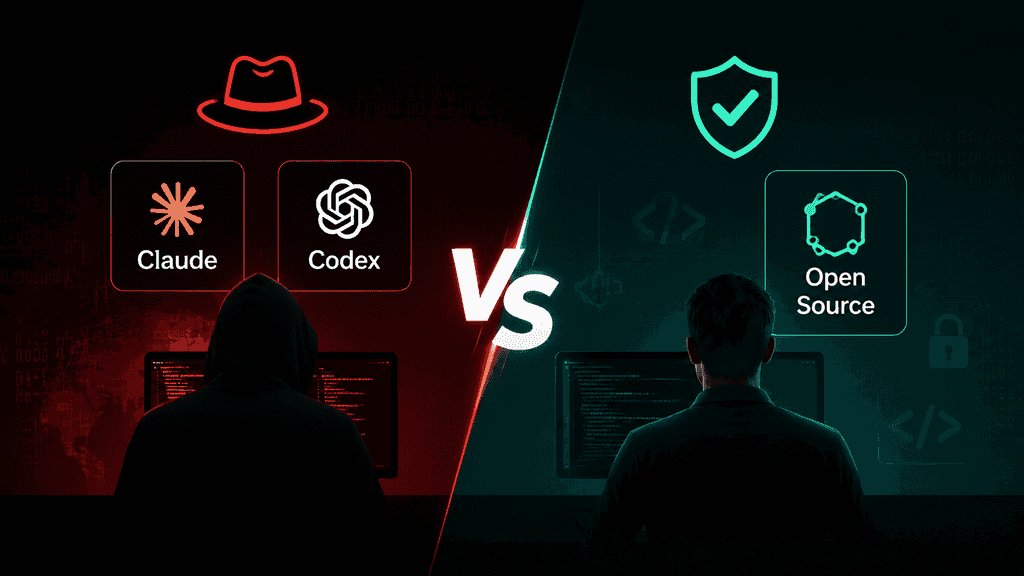
Did you know that cybercriminals are actively choosing closed-source artificial intelligence models over open-source alternatives despite strict security safety guardrails? Black hat hackers primarily rely on high-capability proprietary models such as Anthropic's Claude Code and OpenAI's Codex, whereas white hat security defenders are largely forced to use open-source models. According to insights shared by former Anthropic employee Noah Lebovic in July 2026, closed-source models offer superior automated attack capabilities that far outweigh the friction of bypassing safety filters. Malicious actors acquire discounted subscription tokens on gray markets and systematically rotate compromised accounts when banned. Conversely, legitimate penetration testing teams face severe compliance constraints and aggressive content filtering on proprietary platforms, driving them toward open-source models like GLM 5.2. This structural mismatch creates a persistent asymmetrical advantage in cyber operations where defensive guardrails inadvertently restrict legitimate cybersecurity professionals while failing to deter threat actors.
Why Do Black Hat Hackers Prefer Claude and Codex Over Open-Source Models?
Black hat hackers prefer proprietary AI models like Claude Code and OpenAI Codex because their advanced reasoning and code generation capabilities significantly outperform open-source alternatives in executing complex cyberattacks. Top-tier closed-source models deliver superior performance in discovering zero-day vulnerabilities, writing exploit payloads, and automating multi-stage penetration tasks.
According to statements from former Anthropic researcher Noah Lebovic highlighted in a July 2026 report by Beating, cybercriminals prioritize raw intelligence and execution reliability over guardrail friction. High-capability models dramatically reduce the time required to develop functional exploit code from hours to seconds. The performance gap between top proprietary systems and open-source models remains substantial enough that malicious actors willingly bypass security filters rather than settle for weaker open-source alternatives.
How Do Threat Actors Circumvent Closed-Source Safety Restrictions?
Threat actors bypass closed-source safety controls by procuring discounted subscription tokens on gray markets and using advanced jailbreaking techniques alongside rapid account rotation. Security restrictions act merely as temporary operational hurdles rather than absolute barriers for dedicated attackers.
When proprietary platforms detect malicious activity and ban delinquent accounts, black hat operators immediately swap to fresh credentials purchased in bulk from illicit online marketplaces. Furthermore, sophisticated prompt engineering allows attackers to disguise malicious intent—framing exploit generation as educational research, defensive testing, or software debugging—thereby tricking safety classifiers into generating functional attack vectors.
What Role Do Gray Markets Play in AI-Driven Cybercrime?
Underground gray markets sustain AI-driven cybercrime by providing cheap, anonymous access to top-tier proprietary model tokens and stolen enterprise accounts. These illicit marketplaces lower the financial and technical barrier to entry for conducting high-volume automated cyberattacks.
According to cyber intelligence observations cited by Beating in July 2026, threat actors frequently purchase heavily discounted API access keys and subscription instances. This cheap access infrastructure enables hackers to run continuous automated scanning and exploitation tools powered by Claude and Codex without fearing account termination, as replacement credentials cost a fraction of standard retail pricing.
Why Are White Hat Security Teams Forced to Use Open-Source Models?
White hat security teams rely primarily on open-source AI models because strict compliance requirements, corporate risk management policies, and aggressive vendor content filtering prevent them from using closed-source platforms for defensive security work. Legitimate cybersecurity operations frequently trigger safety blocks on commercial AI tools when processing real vulnerability payloads, malware samples, and penetration commands.
According to disclosures by Noah Lebovic in July 2026, three major authorized penetration testing firms have fully adopted open-source models like GLM 5.2 as their primary operational engines. Because ethical hackers must operate within legal and organizational boundaries, they cannot use gray market account churn or jailbreaking tactics to bypass content filters. Open-source models provide full operational control, local deployment security, and zero content censorship, making them the only viable choice for handling sensitive corporate security audits.
How Do Content Filters Obstruct Legitimate Cybersecurity Operations?
Standard content moderation filters on commercial AI platforms disrupt defensive security work by treating legitimate vulnerability research and penetration testing commands as malicious activity. Commercial platforms apply automated keyword blocking that refuses to process real-world exploit scripts, shellcode, or systemic vulnerability analysis.
When white hat researchers attempt to analyze real threat vectors or write defensive patches using proprietary models, the systems routinely issue safety refusals. Defensive analysts cannot afford operational downtime caused by repeated account suspensions or false-positive safety flags, forcing security firms to host non-censored open-source models on private infrastructure where automated blocks do not exist.
What Advantages Do Open-Source Models Offer Defensive Security Teams?
Open-source AI models give cybersecurity teams total data privacy, customizable fine-tuning, and unrestricted processing of threat intelligence data. Local deployment ensures that proprietary corporate data and zero-day threat disclosures never leave internal enterprise networks.
Security teams can fine-tune open-source models like GLM 5.2 specifically on proprietary telemetry data, internal codebase architectures, and threat intelligence feeds. This local control guarantees full compliance with strict data protection regulations such as GDPR and SOC2, while eliminating third-party API dependencies and external vendor logging risks.
| Operational Criteria | Closed-Source Models (Claude / Codex) | Open-Source Models (e.g., GLM 5.2) |
| Primary User Base | Black Hat Hackers, Commercial Developers | White Hat Teams, Enterprise Defenders |
| Capability Level | State-of-the-art reasoning & execution | High, rapidly closing the performance gap |
| Bypass Strategy | Account rotation, gray market tokens | Unnecessary (locally hosted & uncensored) |
| Compliance Viability | Low for real exploit analysis | 100% compliant with local data sovereignty |
| Operational Friction | High false-positive flags for defenders | Zero artificial filters or account bans |
What Are the Key Differences Between Open-Source and Closed-Source AI in Cybersecurity?
The principal difference between open-source and closed-source AI in cybersecurity lies in the trade-off between peak model performance and operational control. Closed-source models offer unmatched reasoning power behind strict API walls, whereas open-source models provide full code transparency, local hostability, and complete domain adaptability.
According to security discussions published across developer networks in July 2026, this dynamic creates a distinct divide in the cybersecurity landscape. Attackers prioritize raw capability and leverage illicit infrastructure to navigate API restrictions, whereas enterprise defenders prioritize data privacy, continuous uptime, and unrestricted handling of sensitive security artifacts.
How Does Model Capability Impact Automated Exploit Generation?
Superior model capability directly increases the success rate and speed of automated exploit generation in complex software environments. Top-tier commercial models excel at multi-step reasoning, allowing them to map intricate software architectures, identify multi-vector vulnerabilities, and write fully functional exploit code without human intervention.
In authorized security demonstrations led by Noah Lebovic using Claude Opus 4.6, the model successfully executed a end-to-end attack chain that breached a targeted bank account and retrieved sensitive medical records. The depth of contextual understanding required for high-level exploit chains remains a primary reason why threat actors insist on using elite proprietary models over less capable alternatives.
Why Do Safety Guardrails Cause an Asymmetrical Advantage for Attackers?
Commercial AI safety guardrails create a structural asymmetry by placing restrictive burdens on compliant defenders while failing to stop malicious actors who operate outside legal frameworks. Guardrails rely on intent verification mechanisms that are easily deceptive to rule-based classifiers but highly disruptive to legitimate workflows.
While ethical security researchers follow user agreements and face account termination upon triggering security alerts, threat actors explicitly factor account loss into their operational costs. This dynamics leaves ethical security teams relying on less capable or heavily customized open-source models, while cybercriminals harness peak proprietary AI power through disposable accounts.
How Will the AI Cyber Threat Landscape Evolve as Open-Source Models Catch Up?
The AI cyber threat landscape will experience a dramatic escalation in automated attacks once open-source models reach performance parity with leading closed-source platforms. Uncensored, highly capable open-source models will remove the necessity for gray market accounts, giving malicious actors unlimited, unmonitored offensive capabilities on local hardware.
According to joint analyses conducted by OpenAI and Anthropic safety researchers in July 2026, the convergence of open-source capabilities with top-tier closed-source benchmarks represents a major inflection point. Once open-source weights achieve frontier-level coding and reasoning performance, centralized platform monitoring will no longer serve as a viable point of control for preventing automated cyber warfare.
| Threat Evolution Phase | Defensive Characteristics | Offensive Capabilities |
| Current Landscape (2026) | Defenders use open-source for privacy; face capability gaps | Attackers exploit closed-source via gray market tokens |
| Parity Phase | Local enterprise models match proprietary capability | Attackers run uncensored frontier models on local rigs |
| Autonomous Era | Automated real-time AI defensive patching | Continuous, fully autonomous AI zero-day exploitation |
What Risks Emerge When Open-Source Models Achieve Frontier Capabilities?
When open-source models achieve frontier-level reasoning, offensive cyber capabilities will become fully democratized, decentralized, and impossible to shut down remotely. Anyone with sufficient compute hardware will possess an autonomous cyber weapon capable of discovering and exploiting software vulnerabilities at scale.
Centralized platform guardrails—such as API rate limiting, behavior monitoring, and instant account suspension—cannot mitigate risks stemming from locally executed model weights. Consequently, malicious groups will be able to run continuous, uninterrupted threat campaigns without leaving digital paper trails on commercial AI servers.
How Can Cybersecurity Infrastructure Adapt to Autonomous AI Attacks?
Cybersecurity infrastructure must adapt by deploying autonomous, real-time defensive AI agents that continuously scan, identify, and patch vulnerabilities faster than offensive models can exploit them. Defensive strategy must shift from reactive human incident response to automated machine-speed mitigation.
Because human security operations centers cannot keep pace with AI-driven attack vectors, organizations are increasingly embedding open-source models directly into their threat detection pipelines. By deploying specialized defensive agents locally, enterprise networks can instantly neutralize zero-day exploits, reconfigure firewalls, and rewrite vulnerable code in real time.
How to Trade AI and Cybersecurity Tokens on KuCoin?
Trading artificial intelligence and cybersecurity-related cryptocurrencies on KuCoin provides exposure to the growing intersection of decentralized computing, AI development, and automated security protocols. KuCoin offers access to top digital assets supporting decentralized AI networks, secure data compute, and privacy-focused cryptographic tools.
To begin trading AI and security tokens on KuCoin, follow these step-by-step operational instructions:
-
Create an Account: Visit the official KuCoin platform and complete the user registration process using a valid email address or phone number.
-
Complete Identity Verification: Submit the required identification documents to fulfill Know Your Customer (KYC) requirements, ensuring full account functionality and elevated withdrawal limits.
-
Deposit Funds: Securely transfer cryptocurrency or deposit fiat currency into your KuCoin Funding Account using supported payment methods, such as bank transfers or credit card purchases.
-
Navigate to Spot Trading: Transfer your funds to your Trading Account, navigate to the "Spot Trading" interface, and search for your desired AI token trading pair (such as NEAR/USDT, FET/USDT, or RENDER/USDT).
-
Execute a Trade: Select your preferred order type—such as a Limit Order for precise price control or a Market Order for instant execution—enter the trade amount, and confirm the transaction.
KuCoin provides institutional-grade security features, advanced charting tools, and high liquidity across hundreds of AI and blockchain technology pairs, making it a premier platform for managing crypto assets in the evolving digital economy.
Conclusion
The structural divide between how black hat attackers and white hat defenders utilize artificial intelligence highlights a fundamental vulnerability in current AI safety frameworks. Commercial closed-source models like Claude Code and OpenAI Codex remain the preferred choice for cybercriminals due to their elite reasoning and automated code generation capabilities. Threat actors easily bypass platform guardrails by leveraging gray market subscription tokens and rapid account rotation. Conversely, legitimate security teams are systematically pushed toward open-source models like GLM 5.2 to avoid false-positive content blocks, account bans, and compliance violations while processing sensitive threat data.
As highlighted by industry discussions and research insights from former Anthropic employees in July 2026, existing safety guardrails impose heavy operational friction on ethical defenders without successfully deterring determined malicious actors. This asymmetry will become even more critical as open-source models approach parity with proprietary systems, shifting offensive capabilities into decentralized, unmonitored environments. To keep pace with AI-driven threat vectors, cybersecurity architectures must transition toward real-time, autonomous defensive systems capable of neutralizing machine-speed attacks across global digital infrastructure.
Frequently Asked Questions (FAQs)
What is the primary difference between black hat and white hat hackers in AI usage?
Black hat hackers prioritize maximum model capability to execute attacks, relying on gray market tokens to access closed-source models like Claude and Codex. White hat hackers prioritize compliance, data privacy, and uncensored operations, leading them to use locally hosted open-source models like GLM 5.2.
Why do commercial AI safety guardrails fail to stop malicious hackers?
Commercial safety guardrails fail because threat actors operate outside legal boundaries, using prompt engineering, jailbreaks, and bulk-purchased gray market accounts to bypass safety filters. When an account is flagged and banned, attackers simply rotate to a new set of credentials.
What is GLM 5.2 and why are penetration testing teams adopting it?
GLM 5.2 is a high-capability open-source language model that ethical security teams use as an alternative to proprietary AI tools. Penetration testing teams adopt it because it can be deployed on private servers without content moderation filters, allowing researchers to analyze real security vulnerabilities safely and legally.
How do gray markets facilitate AI-powered cyberattacks?
Gray markets facilitate AI cyberattacks by selling stolen, cracked, or bulk-discounted API keys and subscription accounts to threat actors. This low-cost supply chain allows hackers to run automated, high-volume exploitation scripts on top-tier commercial models without worrying about the financial cost of account bans.
Will open-source models eventually surpass closed-source models in cybersecurity capabilities?
Open-source models are rapidly closing the performance gap with proprietary models, making advanced coding and reasoning capabilities widely accessible. Once open-source models achieve performance parity, both defensive security teams and threat actors will have access to frontier-level AI capabilities operating entirely on local infrastructure without centralized oversight.