

DEXE Price Analysis: Why DEXE Crashed Over 90% in One Month Amid FUD-Driven Selling
2026/07/24 15:14:00
Introduction
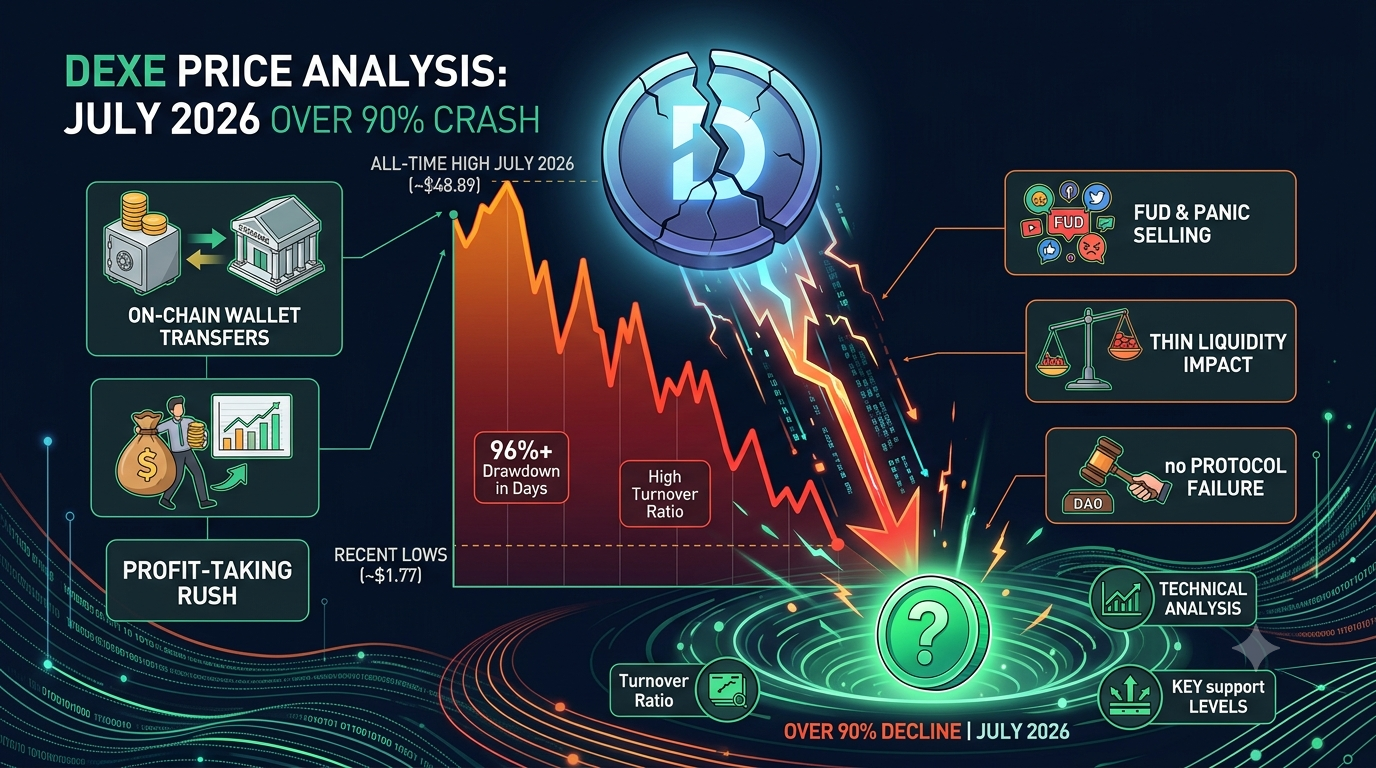
DEXE plunged more than 90% in July 2026, falling from an all-time high near $48.89 to around $1.77 as of late July. The drop wiped out nearly all gains from a parabolic rally earlier in the month and left the token trading with elevated volume and heavy selling pressure. The crash stemmed primarily from FUD-driven selling after large on-chain transfers, profit-taking, and thin liquidity rather than any confirmed exploit or fundamental failure of the DeXe Protocol.
This DEXE price analysis examines the exact drivers of the decline, current market structure, technical levels, and what traders should watch next. All figures reflect data from the past two weeks and earlier July 2026 sources.
What Caused the DEXE Price Crash Over 90%?
The DEXE price crash resulted from a combination of post-rally exhaustion, concentrated selling, and rapid FUD amplification in a low-liquidity environment. According to CoinMarketCap, DEXE reached its all-time high of $48.89 on July 12–13, 2026, before collapsing roughly 96% within days to levels near $1.77 by July 24.
The token had surged dramatically from low single-digit prices earlier in 2026, driven by short squeezes, rising open interest, and renewed interest in its decentralized governance and AI-related narrative. Once the rally peaked, selling overwhelmed available bids.
How Did the Parabolic Rally Set Up the Crash?
The rally itself created the conditions for a sharp reversal. DEXE climbed more than 18x in parts of 2026 and printed successive highs above $40 before the final push to nearly $49. Trading volume and open interest spiked during the ascent, indicating leveraged positioning. When price stalled, long liquidations cascaded and forced additional selling.
Data from exchange flow trackers showed elevated spot and perpetual outflows in the days surrounding the peak. Net capital exited both markets as buyers failed to absorb the supply. This pattern matches classic high-volatility unwind behavior after an overheated move.
What Role Did On-Chain Transfers Play?
Large wallet movements accelerated the decline. On-chain reports indicated that wallets linked to project or team addresses transferred approximately 625,000 DEXE—valued at around $6.2 million at the time—directly to Binance in mid-July. These tokens entered the market and added immediate sell pressure.
Newly created wallets also received significant amounts from project-related addresses before dumping on exchanges, according to community and analyst tracking. No confirmed hack or smart-contract exploit occurred. The transfers, however, fueled rapid speculation of insider selling and triggered panic among holders already sitting on large unrealized gains.
How Did Broader Market Conditions Amplify the Drop?
DEXE underperformed the wider market by a wide margin. While Bitcoin experienced only modest daily moves, DEXE recorded 24-hour declines exceeding 50–80% at peak intensity. High trading volume—reaching hundreds of millions of dollars—confirmed the move was driven by aggressive selling rather than low-liquidity noise.
Altcoin sector weakness and rotation out of smaller-cap tokens compounded the pressure. Liquidity remained thin relative to the size of the prior rally, so each wave of sell orders produced outsized price impact.
Is the DEXE Crash Purely FUD-Driven?
Yes, the majority of the selling after the initial transfers qualifies as FUD-driven rather than a reaction to new negative fundamentals. Sentiment metrics turned sharply negative even as the DeXe Protocol itself reported no protocol failure, partnership cancellation, or security incident.
Community mindshare rose during the decline, yet investor sentiment readings stayed deeply bearish. Social discussions focused on rug-pull fears, unclear maximum supply, and alleged team dumping. These narratives spread faster than on-chain verification, prompting additional holders to exit.
Structurally, the crash reflected deleveraging after excessive positioning. Funding rates showed seller dominance that later moderated, and Bollinger Band readings in earlier analyses placed price near lower-band undervaluation territory. The absence of a confirmed exploit or governance crisis supports the view that FUD magnified an already fragile technical setup.
What Does Current Technical Analysis Show for DEXE?
DEXE trades in a deeply oversold condition relative to its July peak, with key support and resistance levels now clearly defined. Price action has shifted from parabolic advance to high-volume capitulation.
Immediate support sits near the recent lows around $1.50–$1.80. A sustained break below this zone opens the path toward psychological levels near $1.00. On the upside, the first meaningful resistance cluster lies between $3.50 and $5.00—areas that previously acted as post-crash consolidation zones. Reclaiming the $10 region would require a meaningful shift in both volume and sentiment.
Volume remains elevated relative to market capitalization, producing a high turnover ratio. This indicates continued active repositioning rather than quiet accumulation. Market capitalization has compressed to approximately $148 million with circulating supply near 83.7 million DEXE, according to the latest CoinMarketCap figures.
What Are Realistic Near-Term Scenarios for DEXE Price?
Near-term price action depends on whether selling pressure exhausts and whether buyers step in at current levels. Stabilization above $1.80–$2.00 would allow a base to form. A reclaim of $4–$5 on rising volume would signal the first stage of recovery and potentially attract short-covering flows.
Further downside remains possible if additional large holders exit or if broader altcoin weakness intensifies. The high 24-hour volume relative to market cap leaves the token sensitive to order-flow imbalances. Longer-term recovery would require renewed fundamental catalysts—such as protocol upgrades, measurable DAO adoption growth, or clearer supply transparency—to overcome residual FUD.
How to Buy and Trade DEXE on KuCoin?
Traders can access DEXE/USDT pairs directly on KuCoin with competitive liquidity and multiple order types. Create or log into a KuCoin account, complete identity verification if required, and deposit USDT or another supported asset. Search for DEXE in the trade interface, select the preferred pair, and place limit, market, or advanced orders according to risk tolerance.
KuCoin also supports futures trading for those seeking leveraged exposure, along with stop-limit and take-profit tools to manage positions during high-volatility periods. Real-time charts, depth data, and funding-rate information help traders monitor the same conditions that drove the recent crash. Always size positions according to personal risk parameters and never invest more than you can afford to lose.
Join KuCoin 9th Anniversary Trading Campaign
KuCoin is celebrating its 9th anniversary with a special platform campaign filled with exclusive rewards, trading activities, and limited-time offers. Don’t miss the chance to participate and enjoy the benefits as the exchange marks nine years of growth and innovation. Visit the official campaign page now:

Conclusion
DEXE experienced one of the sharpest single-month declines of 2026, falling over 90% from its July all-time high near $48.89 to levels around $1.77. The primary drivers were post-rally profit-taking, large on-chain transfers into exchanges, cascading liquidations, and rapid FUD amplification in a thin-liquidity environment. No confirmed protocol exploit or fundamental breakdown accompanied the move.
Technical indicators now show oversold conditions, while capital-flow data confirms seller dominance that has begun to moderate. Sentiment remains fragile, yet the absence of a structural failure leaves room for recovery if volume normalizes and new demand appears. Traders monitoring DEXE should focus on key support near recent lows, resistance in the $3.50–$5.00 zone, and any shift in exchange net flows or social sentiment.
The episode underscores the extreme volatility inherent in mid-cap governance tokens after parabolic advances. Risk management, position sizing, and continuous monitoring of on-chain activity remain essential for anyone engaging with DEXE at current levels.
FAQs
Why did DEXE crash more than 90% in July 2026?
DEXE crashed primarily because of concentrated selling after large project-linked wallet transfers to exchanges, profit-taking following a parabolic rally to nearly $49, cascading liquidations, and rapid FUD spread in a low-liquidity market.
Was the DEXE crash caused by a hack or exploit?
No confirmed hack or smart-contract exploit has been identified. On-chain data points to wallet transfers and subsequent market selling as the main catalysts.
Is DEXE still undervalued after the crash?
Some technical indicators, including earlier Bollinger Band readings near the lower band, suggested undervaluation relative to the prior range. Current price levels reflect heavy recent selling rather than a fully resolved fundamental re-rating.