

DePIN vs. Big Tech: Why Decentralized GPU Marketplaces Are Surging While Colossus Scales to 1M GPUs
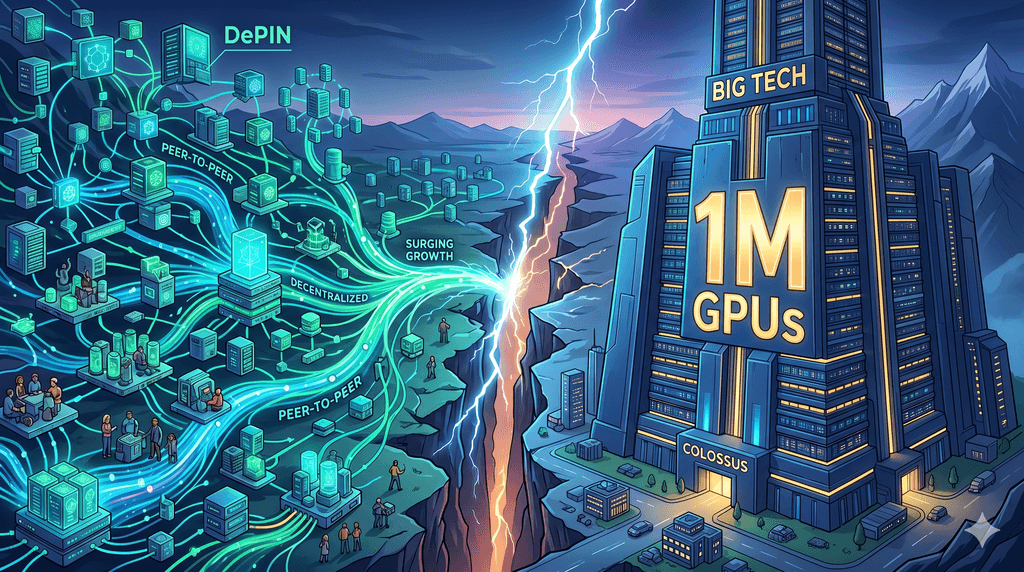
The AI compute war of 2026 is being fought on two very different battlefields. In Memphis, Tennessee, xAI's Colossus supercluster has already amassed 555,000 NVIDIA GPUs — a single-site AI installation that cost approximately $18 billion — with a publicly stated roadmap to reach 1 million GPUs. Microsoft is racing to catch up with a 450,000-GPU Blackwell campus in Abilene, Texas. The message from Big Tech is unmistakable: whoever controls the most compute controls the future of AI.
But there is another story unfolding simultaneously, one that the mainstream financial press has been slower to cover. While trillion-dollar corporations are locking compute behind proprietary walls, a parallel ecosystem of Decentralized Physical Infrastructure Networks — known as DePIN — is quietly building a community-owned alternative that is cheaper, more accessible, and already generating real revenue. In January 2026 alone, leading DePIN networks pulled in roughly $150 million in verifiable on-chain revenue from actual customers paying for storage, compute, and data services. That figure represents an 800% year-over-year increase for several protocols.
The contrast is stark: Big Tech is concentrating GPU power into fortress-like megaclusters, while DePIN is distributing it across tens of thousands of contributors worldwide. The question for every crypto investor and AI developer right now is: who wins — and what does it mean for your portfolio?
Key Takeaways
-
xAI's Colossus has reached 555,000 GPUs as of January 2026, with a roadmap targeting 1 million GPUs, representing the single largest AI compute concentration on Earth.
-
DePIN's combined market cap has surged to $9–10 billion in early 2026, surpassing the oracles sector and generating $150M in on-chain monthly revenue.
-
Decentralized GPU networks can undercut AWS and Azure by 45–75% on inference workloads, making them powerful alternatives for AI startups and enterprises.
-
Aethir, Render, and Akash are the three dominant GPU-focused DePIN protocols to watch in 2026, each with distinct market positioning and tokenomics.
-
70% of GPU demand in 2026 is driven by inference — not training — a profile where decentralized networks have structural cost advantages over hyperscalers.
-
RenderCon 2026 (April 16–17) and the pending RNP-023 governance vote are near-term catalysts that could add ~60,000 GPUs to Render's capacity.
The Colossus Effect — How Big Tech's GPU Land Grab Is Reshaping the Compute Economy
To understand why decentralized GPU marketplaces are surging, you first need to understand what they are surging against.
xAI's Colossus is not merely a big data center — it is a paradigm shift in how AI infrastructure is built. The first phase of 100,000 NVIDIA H100 GPUs was assembled in just 122 days, a timeline that compressed what industry experts previously estimated as a four-year project into four months. By January 2026, the facility had expanded to 555,000 GPUs across a 2-gigawatt campus in South Memphis, powered in part by a fleet of on-site methane gas turbines and more than 168 Tesla Megapacks. The total hardware investment stands at approximately $18 billion.
The scale is unprecedented. Nvidia CEO Jensen Huang — no stranger to hyperbole — said of the project's construction pace, "As far as I know, there's only one person in the world who could do that." xAI's roadmap calls for eventual expansion to 1 million GPUs, and Elon Musk's stated goal for Grok-5, the model that Colossus is being built to train, is the first AI capable of complex scientific discovery and autonomous engineering.
The competitive response has been equally aggressive. Microsoft and OpenAI accelerated their "Project Stargate" initiative following Colossus's expansion, with a 450,000-GPU Blackwell campus in Abilene, Texas coming online in early 2026. The message from Silicon Valley boardrooms is unambiguous: compute is the new oil, and the giants intend to control the wells.
This concentration of compute is not just a technological story — it is a market structure story. When a handful of companies can dictate the price, availability, and terms of GPU access, every AI startup, every independent developer, and every open-source research team becomes a supplicant. The annual bill for running a mid-sized AI inference workload on AWS or Azure can easily reach millions of dollars. For early-stage startups, that cost can be existential. The GPU land grab by Big Tech is, inadvertently, one of the most powerful demand drivers for decentralized alternatives that the crypto market has ever seen.
What Is DePIN and Why Does the GPU Vertical Matter Most Right Now
DePIN — Decentralized Physical Infrastructure Networks — is the blockchain sector that coordinates real-world hardware through token incentives instead of corporate ownership. The model is elegant: you contribute a GPU, a wireless hotspot, a hard drive, or a sensor to a network; you earn tokens for providing a useful service; and the protocol uses those contributions to serve paying customers at lower costs than centralized alternatives.
The GPU vertical within DePIN has become the most financially consequential of all DePIN categories in 2026, for a reason that aligns directly with the Colossus narrative: AI inference demand. According to analysis cited by multiple research sources this year, approximately 70% of all GPU demand in 2026 is driven by inference workloads — the process of running AI models in real-time to answer questions, generate images, write code, or power autonomous agents — rather than the training phase that the headline supercluster builds like Colossus are designed for. Inference workloads are shorter in duration, massively parallelizable, and do not require the same level of hardware synchronization that training demands.
This distinction is critical. Colossus and Project Stargate are optimized for training massive frontier models — an expensive, capital-intensive process that only the richest institutions can undertake. But the inference market — the much larger, faster-growing, and more commercially accessible layer — is precisely where distributed GPU networks outperform hyperscalers on cost while delivering comparable performance. A startup running inference for a consumer AI product can reduce its infrastructure costs by 45–75% by routing workloads through a decentralized GPU network rather than AWS or Azure.
DePIN's total market capitalization across all categories now sits between $9 and $10 billion, having grown from just $5.2 billion a year earlier — a near-270% year-over-year expansion despite broader market volatility. With nearly 250 active projects tracked by CoinGecko and $150 million in verified monthly on-chain revenue in January 2026, the sector has crossed a threshold that most crypto narratives never reach: it is generating revenue from customers who are not crypto-native. AI companies are paying for compute. Enterprises are paying for storage. The tokens are being purchased because the underlying services are genuinely useful.
The Three GPU Marketplaces Dominating DePIN in 2026 — Render, Aethir, and Akash
Not all decentralized GPU networks are built the same. Three protocols have emerged as the clear leaders in 2026, each with a distinct market positioning and approach to the $100 billion AI compute opportunity.
Render Network (RENDER) began by serving Hollywood studios and creative professionals who needed affordable GPU rendering for VFX, animation, and spatial computing. The network has since completed over 68 million rendered frames cumulatively, with roughly 35% of that total completed in 2025 alone — a testament to exponential adoption. The project migrated to Solana in mid-2025, significantly boosting transaction throughput and reducing coordination costs. In April 2026, Render is at an inflection point: RenderCon 2026 (April 16–17) served as a showcase for major ecosystem developments, and the pending RNP-023 governance vote proposes integrating Salad's decentralized GPU network to add approximately 60,000 additional GPUs to Render's capacity. Render's Burn-and-Mint Equilibrium (BME) model is now showing deflationary pressure as inference demand surges — when demand rises, RENDER tokens are burned, reducing supply. The token is trading well below its all-time high of $13.60, which some analysts read as a significant value entry point given the network's fundamentals.
Aethir (ATH) takes a different approach, aggregating underused enterprise-grade GPUs from data centers globally rather than relying primarily on consumer hardware. The results have been striking: Aethir generated the highest monthly DePIN revenue of any protocol in January 2026, surpassing even Render. The network claims more than 440,000 GPUs in its decentralized cloud, sourcing idle resources for machine learning enterprises and gaming applications. Where Render appeals to creative and AI developers, Aethir targets the enterprise tier — the segment most sensitive to reliability and contract-level guarantees. Its scale and revenue dominance in early 2026 have made ATH one of the most-watched DePIN assets by institutional traders.
Akash Network (AKT) differentiates itself through a reverse auction model that creates genuine price competition among GPU providers. Instead of fixed pricing, providers compete for workloads, which drives costs down organically. The network achieved 428% year-over-year growth in usage with utilization rates above 80% heading into 2026. Akash's Starcluster initiative — which combines centrally managed data centers with Akash's decentralized marketplace to create what the team calls a "planetary mesh" — is its most ambitious play yet. The planned acquisition of approximately 7,200 NVIDIA GB200 GPUs through Starbonds would position Akash to support hyperscale AI demand at the enterprise level. GPU-sharing tokens including AKT surged over 20% in early 2026, reflecting growing conviction in the sector.
Together, these three protocols offer investors exposure across the DePIN compute vertical from different angles: consumer-grade creative compute (Render), enterprise aggregation (Aethir), and decentralized cloud marketplace dynamics (Akash).
DePIN's Structural Advantages Over Big Tech — Cost, Access, and Tokenomics That Work
The most common question about DePIN GPU networks is whether they can genuinely compete with the hyperscalers, or whether the cost advantages are illusory when reliability and performance are factored in. The 2025–2026 data is beginning to settle this debate.
On cost, the evidence is clear. NVIDIA H100 GPUs can be accessed through decentralized networks at 45–60% below AWS rates for comparable inference workloads. For short-duration, parallelizable tasks — which represent the majority of commercial AI inference demand — decentralized networks can achieve 75% cost reductions for certain workload profiles. This is not theoretical; it reflects what actual AI startups are paying when they route production workloads through protocols like Akash and Render.
The token economics behind DePIN's sustainability represent a genuine innovation in infrastructure financing. Traditional infrastructure requires massive upfront capital expenditure before any revenue can be generated — a model that inherently favors incumbents with deep balance sheets. DePIN converts that capital expenditure into distributed token incentives, allowing the market to determine supply expansion. When demand rises, token prices increase, operator margins improve, and new hardware comes online organically. When demand falls, marginal operators exit and supply contracts. This self-regulating flywheel is what gives DePIN protocols structural scalability advantages over both centralized clouds and earlier blockchain experiments.
The cold-start problem that plagued earlier decentralized compute attempts — how do you attract GPU providers before you have customers, and customers before you have GPUs? — has been solved through token incentives that compensate providers during early bootstrapping phases. As networks mature, the transition from token subsidies to genuine compute revenue is the litmus test separating sustainable protocols from unsustainable ones. In 2026, protocols like Filecoin, Render, and Aethir have passed that test: their revenue now comes primarily from paying customers rather than token inflation.
The access dimension is equally important. Colossus and Project Stargate are closed ecosystems. An independent AI researcher, a startup in Southeast Asia, or a game studio in Eastern Europe cannot simply apply for an account and start training models on xAI's hardware. Decentralized GPU networks are permissionless by design — anyone with a GPU can contribute, and any developer with a compute need can access it, typically within minutes. This democratization of compute access is, in the long arc of the technology industry, analogous to the shift from mainframes to personal computers, or from on-premise servers to public cloud.
There are real challenges, too. Node reliability is more variable than enterprise-grade data centers. Nodes can go offline due to local power outages or operator decisions, requiring overprovisioning that partially offsets cost savings. Regulatory uncertainty remains a factor — governments are still determining how to treat tokenized infrastructure, with some jurisdictions viewing DePIN as a competitive threat to legacy telecoms and cloud giants. And token volatility can discourage long-term hardware owners, though revenue-sharing models and stablecoin payment options are increasingly being deployed to address this.
Where to Trade DePIN GPU Tokens — Why Serious Traders Are Using KuCoin
Here is a question worth sitting with: if the decentralized GPU marketplace sector is generating $150 million in on-chain revenue every month, growing 800% year-over-year, and serving as a direct hedge against Big Tech's compute monopoly — are you actually positioned to benefit from it?
Most retail investors discover a sector well after institutional capital has already moved in. The DePIN GPU narrative is unusual in that it remains significantly under-discussed relative to its on-chain fundamentals. But awareness is building fast, and the traders who have been able to access DePIN tokens early — before mainstream media cycles amplify the story — have done so through platforms with early listing practices and deep liquidity in emerging crypto verticals.
KuCoin has positioned itself as one of the premier destinations for DePIN and AI-infrastructure token trading in 2026. The exchange lists RENDER, IO (io.net), AKT (Akash), ATH (Aethir), and several other DePIN compute tokens with competitive spreads and real-time price discovery. For context: RENDER is currently listed on KuCoin with a circulating supply of over 518 million tokens and deep 24-hour trading volume — giving traders both the liquidity for meaningful positions and the order-book depth to manage risk without excessive slippage.
Beyond the listings themselves, what makes KuCoin particularly relevant for the DePIN GPU trade are three features that align directly with how sophisticated investors are approaching the 2026 AI infrastructure cycle. First, early access to emerging DePIN gems: KuCoin's listing criteria have been tuned to surface AI, DePIN, and agentic token categories before they hit the mainstream exchanges, giving active traders a genuine alpha window. Second, an automated trading bot suite that allows you to execute thesis-driven strategies — whether you're accumulating DePIN tokens during compute squeeze periods or hedging against tech equity volatility. Third, institutional-grade infrastructure to handle the kind of rapid, news-driven price moves that characterize the GPU compute narrative — because when xAI announces a new Memphis expansion or a major DePIN protocol passes a governance vote that adds 60,000 GPUs to its capacity, prices can move significantly within minutes.
The DePIN GPU trade is not a meme coin play. It is a macro infrastructure thesis with verifiable revenue, a direct counter-narrative to Big Tech's compute concentration, and tokens that are trading well below their prior cycle highs despite meaningfully improved fundamentals. If you have been watching the AI infrastructure space and wondering how to take a position, the compute vertical of DePIN — tradeable today on KuCoin — is where the structural opportunity intersects with accessible market entry.
The Road Ahead — DePIN + AI Convergence and What the GPU War Means for Crypto Investors
The trajectory from here is one of accelerating convergence. AI and DePIN are not parallel narratives — they are colliding into a single infrastructure layer that could define the next decade of the digital economy.
Consider the demand dynamics. Agentic AI — autonomous software agents that make decisions and take actions without human input — is the growth frontier of 2026's AI landscape. These agents require persistent, always-on compute for decision-making, memory retrieval, and real-time action. As agentic AI proliferates from experimental to production, the inference compute demand that already drives 70% of GPU usage will compound. Open-source model adoption is also accelerating, as companies move away from proprietary API dependencies and toward self-hosted models — which require their own inference infrastructure. Every enterprise that adopts a self-hosted LLM becomes a potential customer for decentralized GPU networks.
At the same time, the Big Tech GPU war is paradoxically creating structural tailwinds for DePIN. When xAI spends $18 billion on 555,000 GPUs and Microsoft builds a 450,000-GPU campus in Texas, the message to the market is that GPU compute is scarce and expensive. That scarcity premium makes decentralized alternatives more attractive, not less. The visibility of Colossus's ambition — a roadmap to 1 million GPUs — functions as free marketing for every decentralized GPU network that argues it can deliver comparable inference performance at a fraction of the cost.
Zero-knowledge proofs are also narrowing the trust gap between decentralized and centralized compute. Protocols like Hyperbolic are developing cryptographic verification of AI outputs — a "Proof of Sampling" framework co-developed with researchers from UC Berkeley and Columbia University — that will eventually allow enterprises to verify that inference results were computed correctly without trusting the GPU provider. When that technology matures, the remaining enterprise objection to decentralized compute — "how do I know the output is correct?" — disappears.
For crypto investors, the DePIN GPU sector presents a rare combination: a macro thesis grounded in AI's structural compute demand, tokens with verifiable on-chain revenue rather than purely speculative value, and a market narrative that is still early enough to offer asymmetric upside. The sector outperformed traditional DeFi by 45% year-to-date according to 2026 market data. AI-related tokens were the best-performing thematic assets in Q1 2026, declining only 14% in a quarter where speculative consumer tokens fell 30%. The flight to infrastructure quality is a theme that tends to persist across cycles.
The DePIN flywheel is spinning. Supply of decentralized GPU capacity is growing as token incentives attract new hardware providers. Demand is growing as AI workloads multiply and enterprise cost sensitivity increases. On-chain revenue is growing as the transition from token subsidies to genuine compute fees accelerates. The question is not whether decentralized GPU marketplaces will matter — the revenue data confirms they already do. The question is how quickly the rest of the market will recognize what the on-chain metrics have been signaling for months.
Conclusion
The GPU war of 2026 has two fronts. On one side, Big Tech is concentrating compute into billion-dollar fortresses — Colossus at 555,000 GPUs and scaling toward a million, Project Stargate at 450,000 GPUs in Texas, each representing a wager that whoever controls the most hardware wins the AI age. On the other side, DePIN protocols are assembling a distributed alternative, one idle GPU at a time, powered by token incentives, verifiable on-chain revenue, and structural cost advantages that no amount of VC funding can eliminate.
The market is beginning to recognize the value on the DePIN side of this equation. With $150 million in monthly on-chain revenue, a combined sector market cap that surpassed the oracles category, and GPU-sharing tokens posting 20%+ gains in early 2026, the compute vertical of DePIN is transitioning from a compelling narrative to a demonstrable financial thesis. Render's upcoming capacity expansion through RNP-023, Aethir's revenue leadership, and Akash's explosive 428% usage growth are not abstract possibilities — they are happening right now, in real time, against a backdrop of artificial intelligence demand that shows no sign of slowing.
For crypto investors, developers, and infrastructure builders alike, the message from 2026 is the same: compute is the new oil, and the most interesting part of the compute economy may not be the monolithic superfacilities owned by billionaires in Memphis — it may be the distributed, community-owned network that any developer anywhere in the world can access for a fraction of the price.
FAQs
What is xAI's Colossus and why does it matter for crypto?
Colossus is xAI's AI supercluster located in Memphis, Tennessee, which reached 555,000 NVIDIA GPUs as of January 2026, with a stated roadmap toward 1 million GPUs. It matters for crypto because the concentration of compute in centralized facilities like Colossus directly drives demand for decentralized alternatives. It also signals that GPU compute is one of the most valuable and contested resources in the global economy — a narrative that benefits DePIN token valuations.
How much cheaper is decentralized GPU compute compared to AWS or Azure?
Based on 2026 market data, decentralized GPU networks can offer NVIDIA H100 equivalent compute at 45–60% below AWS rates for standard workloads, and up to 75% cheaper for short-duration, parallelizable inference tasks. These cost advantages are most pronounced for AI startups running production inference workloads, where cloud bills can otherwise reach millions of dollars annually.
What are the best DePIN GPU tokens to watch in 2026?
The three leading GPU-focused DePIN tokens in 2026 are RENDER (Render Network), ATH (Aethir), and AKT (Akash Network). Each offers distinct exposure: Render focuses on creative and AI inference compute migrated to Solana; Aethir aggregates enterprise-grade GPUs with the highest monthly DePIN revenue; Akash uses a reverse-auction model with 428% YoY usage growth. IO (io.net) is also a notable emerging contender with over 2,700 verified GPUs across 138+ countries.
Is the DePIN GPU sector generating real revenue, or is it speculative?
The sector is generating verifiable, real revenue. In January 2026, leading DePIN networks collectively generated approximately $150 million in on-chain revenue paid by actual customers for compute, storage, and data services — an 800% year-over-year increase for certain protocols. This revenue comes from AI companies, enterprises, and developers who are not crypto-native, confirming that the demand is based on utility, not speculation.
Where can I trade DePIN GPU tokens like RENDER, IO, and AKT?
Major exchanges including KuCoin list RENDER, IO, AKT, and ATH with competitive liquidity and real-time price discovery. KuCoin specifically has positioned itself as a hub for AI and DePIN infrastructure tokens in 2026, offering early access to emerging assets in this sector, automated trading tools, and institutional-grade execution for traders seeking exposure to the decentralized compute thesis.
Can decentralized GPU networks ever truly compete with Big Tech infrastructure?
For frontier AI model training — the use case that Colossus is built for — centralized megaclusters have structural advantages in hardware synchronization and power density. But for AI inference, which represents approximately 70% of total GPU demand in 2026, decentralized networks can deliver competitive performance at dramatically lower cost. As zero-knowledge proof technology matures to provide cryptographic verification of AI outputs, the trust gap between centralized and decentralized compute will continue to narrow.
Disclaimer: This article is for informational purposes only and does not constitute financial or investment advice. Cryptocurrency investments carry significant risk. Always conduct your own research before making any investment decisions.