



AI Agent + Stablecoin: Is the Next Round of Encrypted Payment Revolution Taking Shape?
2026/05/17 03:22:58
Thesis Statement
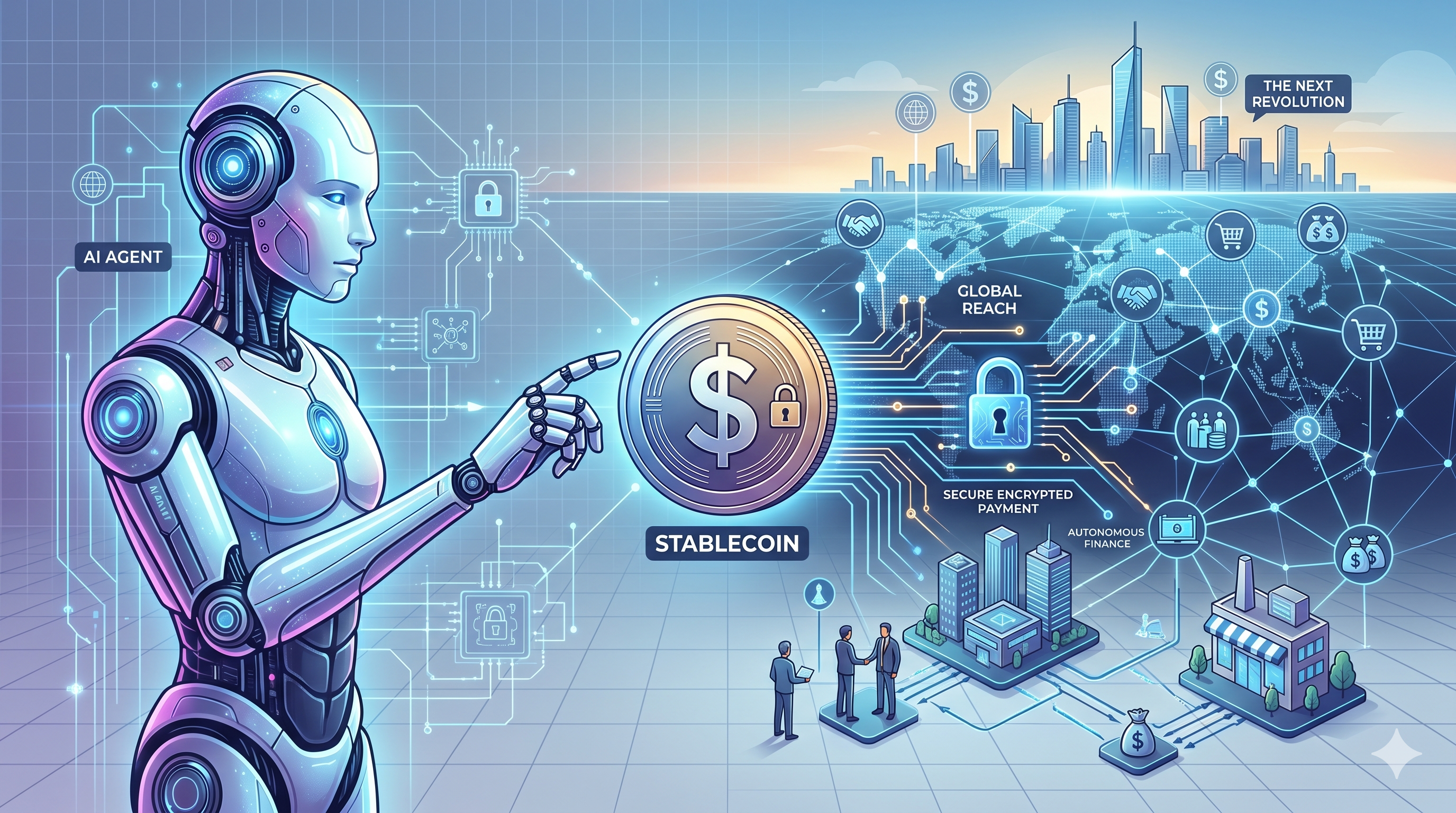
AI agents, autonomous software systems capable of reasoning, planning, and executing tasks, are gaining practical financial capabilities through stablecoins. Major players, including Circle, Coinbase, Stripe, and Google, are releasing tools and standards that let agents hold funds, discover services, and complete transactions without human intervention at each step. Stablecoin transaction volumes reached $33 trillion in 2025, with agentic use cases cited as a key growth driver for further expansion in 2026.
This integration addresses fundamental limitations in traditional payment systems for machine-speed operations while leveraging the programmability and instant settlement of dollar-pegged digital assets. Early data shows agents already executing millions of micropayments, primarily in USDC, signaling a shift toward software-native financial infrastructure.
Protocols Enabling Agentic Stablecoin Transactions
Developers have coalesced around several open standards that embed payments directly into agent workflows. The x402 protocol, originally advanced by Coinbase and now governed under a foundation with Cloudflare involvement, revives the long-reserved HTTP 402 "Payment Required" status code for machine-readable micro-payments. When an agent requests a paid resource, the server returns a 402 response with payment instructions. The agent then submits a stablecoin transaction, typically USDC on Base or Ethereum, and receives the content upon confirmation, all within a standard web request cycle. By early 2026, x402 had processed tens of millions of transactions across chains, with reports indicating over 119 million on Base and 35 million on Solana by March in some datasets, handling annualized volumes approaching hundreds of millions. Average transaction sizes remain small, often around $0.30, suiting API calls, data access, and compute billing. This HTTP-native approach requires no accounts or subscriptions, aligning perfectly with agent autonomy.
Google’s Agent Payments Protocol (AP2) takes a complementary enterprise-focused approach, emphasizing authorization, delegation scopes, and auditable trails linking agent actions to human principals. It supports multiple stablecoins and chains while prioritizing compliance needs in regulated sectors. Stripe and partners have advanced the Machine Payments Protocol (MPP) for more complex consumer-facing flows, including subscriptions and streaming payments. These standards compete yet often interoperate, creating a layered infrastructure where agents can select the most suitable rail for each task. Integration efforts extend to major cloud and payment providers. Recent launches demonstrate production readiness, with agents handling discovery, negotiation, and settlement programmatically. This protocol ecosystem reduces the friction that once made autonomous payments impractical, enabling continuous operation across global networks.
Circle’s Agent Stack and USDC-Centric Infrastructure
On May 11, 2026, Circle introduced the Agent Stack, a suite of tools designed specifically for AI agents to act as economic participants using USDC. Components include policy-controlled agent wallets that let agents hold and transfer funds within human-defined guardrails; an agent marketplace for programmatic service discovery; a command-line interface for development and execution; and nanopayments supporting transfers as small as $0.000001. Circle CEO Jeremy Allaire highlighted the vision of billions of agents driving real economic activity through stablecoin transactions. The stack works across supported blockchains and integrates with models like Claude and Cursor. Early demonstrations showed agents analyzing profiles or accessing services while handling micro-fees seamlessly. With USDC supply around $78 billion at the time of launch and broader stablecoin volumes exceeding $7 trillion annually, the infrastructure builds on established liquidity.
This move positions USDC as a core rail for the agent economy. Wallets enforce spending limits, merchant restrictions, and time windows at the protocol level, addressing safety concerns. The marketplace allows agents to evaluate and pay for services autonomously, while nanopayments target high-frequency machine-to-machine interactions where traditional rails fail due to fees and latency. Developers gain composable building blocks that extend beyond simple transfers to full economic orchestration. Circle’s approach emphasizes openness and permissionless access alongside controls, reflecting the hybrid needs of emerging agent systems. It complements existing protocols like x402 and provides a trusted issuer-backed foundation for broader adoption.
Real-World Traction and Transaction Data
Agent-driven stablecoin activity has moved beyond pilots. Reports from early 2026 indicate AI agents completed hundreds of millions of payments over recent months, with a high percentage settled in USDC. One analysis noted 1.4 billion agent payments in nine months, 98.6% in USDC, averaging $0.31 per transaction and involving over 400,000 agents with buying capabilities. These flows primarily support API access, data purchases, compute resource allocation, and internal agent coordination. Volumes remain modest compared to overall stablecoin activity but demonstrate compound growth as more agents gain wallets and tools proliferate. x402 implementations on platforms like Cloudflare and various API providers have enabled pay-per-call models that agents exploit naturally.
Enterprise experiments and developer projects show agents managing travel bookings, supply chain negotiations, content creation support, and yield optimization with stablecoin settlements. In machine-to-machine contexts, agents pay each other for specialized subtasks, creating emergent micro-economies. Stablecoin programmability allows conditional releases, escrows, and multi-step flows encoded directly in transactions. Adoption benefits from stablecoin liquidity and 24/7 availability. Unlike card networks built for human flows with authentication friction, stablecoins enable push-based, instant global transfers that agents can initiate and verify programmatically. This has proven particularly useful in cross-border scenarios and high-frequency micropayments where volatility or settlement delays would disrupt operations.
Technical Architecture for Safe Agent Payments
Effective agent wallets require more than basic custody. Systems implement layered controls: spending caps, category restrictions, temporal limits, and counterparty rules enforced cryptographically. Delegation mechanisms allow human principals to grant scoped permissions that agents exercise independently within bounds. Every action generates immutable on-chain records for auditability. Multi-chain support addresses fragmentation, letting agents route payments via the lowest-cost or fastest rail for each use case. Identity standards, such as ERC-8004, provide verifiable agent credentials without relying on traditional KYC at transaction time. This architecture balances autonomy with accountability, mitigating risks of rogue behavior or compromise.
Integration with large language models and agent frameworks allows reasoning about costs, alternatives, and value before execution. For example, an agent might compare service providers, factor in fees and latency, and then complete payment and consumption in one fluid sequence. These capabilities extend to collaborative multi-agent systems where specialized agents handle procurement, verification, and fulfillment. Security considerations include policy enforcement at the wallet level rather than relying solely on agent logic. This separation ensures that even advanced models operate within predefined boundaries, providing defense-in-depth for production deployments.
Market Projections and Economic Implications
Analysts project significant growth in agentic commerce, with estimates ranging from hundreds of billions to trillions in orchestrated spend by 2030. Juniper Research forecasts around $8 billion in agentic volume for 2026, scaling toward $1.5 trillion globally. McKinsey perspectives suggest even larger impacts in retail and B2B contexts. Stablecoin supply is expected to expand substantially in 2026, with agent-driven utility cited alongside remittances and corporate treasury as drivers. This creates organic demand distinct from speculative trading, potentially stabilizing ecosystems through recurring transactional use.
Implications extend to cost structures, where micropayments become viable, enabling new business models around per-token usage, real-time data feeds, and granular service consumption. For developers, this means monetizing AI outputs and APIs without traditional billing overhead. Enterprises gain tools for automated procurement and resource management that operate continuously. The move favors programmable, borderless money in software-heavy workflows. Traditional rails retain strengths in consumer-facing high-value transactions, but agentic flows highlight stablecoins’ advantages in speed, cost at scale, and composability. Hybrid systems are likely to emerge, bridging on-chain autonomy with off-chain rails where needed.
Industry Adoption Patterns Across Sectors
Developers in content, data, and compute sectors have shown early leadership, using x402 to gate premium APIs and real-time information. Agents pay for inference, specialized datasets, or processing power on demand. E-commerce experiments allow agents to handle shopping journeys, compare options, and complete stablecoin settlements. Financial services explore internal automation, such as treasury agents managing liquidity or compliance agents verifying transactions. Supply chain participants test agent coordination for procurement and logistics payments. Creative industries pilot agents for royalty distributions or micro-licensing.
Corporate treasury teams evaluate stablecoins for B2B settlements enhanced by agent oversight. The combination reduces costs and speeds processes compared to legacy correspondent banking. Tech platforms integrate these capabilities into developer tools, lowering barriers for building agent-native applications. Adoption remains concentrated among sophisticated users and early enterprise pilots, but toolkits from Circle, Stripe, and others are broadening accessibility.
Corporate Treasury Integration and Autonomous Financial Operations
Large corporations are increasingly piloting AI agents for internal treasury management and supplier payments using stablecoins, marking a shift from experimental deployments to operational integration. At Consensus 2026, executives from Bridge and Deus X Capital highlighted how multinational firms leverage autonomous agents for cross-border treasury flows, reducing reliance on traditional correspondent banking with its associated delays and fees. These agents autonomously monitor liquidity positions, execute optimized transfers in USDC or other stable assets, and reconcile invoices in real time across global subsidiaries. One emerging pattern involves agents handling exception-based workflows, such as resolving invoice discrepancies by cross-referencing purchase orders, delivery records, and contract terms before releasing conditional payments via smart contract logic. This capability extends to dynamic supplier negotiations, where agents compare quotes, factor in delivery timelines and quality metrics, and complete settlements without constant human oversight.
The programmability of stablecoins enables sophisticated features such as performance-based escrows, where funds are released only upon verified delivery confirmation through oracles or IoT integrations. Unlike retail-focused applications, corporate implementations prioritize auditability, policy compliance, and integration with existing ERP systems, often routing high-value transactions through hybrid models that bridge on-chain execution with legacy rails. This corporate momentum complements the machine-to-machine focus, creating dual demand drivers that infrastructure providers like Circle and AWS are addressing through enterprise-grade wallet controls and observability tools.
Emerging Inter-Agent Economies and Collaborative Machine Commerce
A nascent but developing aspect of AI agent and stablecoin convergence involves networks of specialized agents transacting directly with one another to form collaborative micro-economies. Rather than single agents operating in isolation, multi-agent systems divide complex tasks, such as end-to-end supply chain orchestration or content production pipelines, among specialized participants that negotiate, bid, and settle services programmatically using stablecoins. For instance, a procurement agent might engage a market research agent for data, a logistics agent for routing optimization, and a payment verification agent for compliance checks, with each step involving micropayments for compute, insights, or execution. Recent protocol enhancements, including batch settlements in x402 implementations, support these high-frequency interactions by aggregating numerous sub-cent transactions for efficient final settlement, making ultra-granular collaboration economically viable.
Developers are experimenting with reputation systems and incentive mechanisms encoded on-chain, allowing agents to preferentially select reliable counterparts based on historical performance and verifiable credentials. This dynamic fosters emergent marketplaces where agents discover, evaluate, and compensate each other for niche capabilities, such as specialized inference, real-time data feeds, and validation services. In creative and research domains, swarms of agents collaborate on projects, sharing revenue from outputs through automated royalty distributions in stablecoins. The economic implications include new forms of decentralized productivity that operate continuously across time zones, potentially unlocking efficiencies in knowledge work and digital services. While still early, these inter-agent flows represent a foundational layer for broader agentic commerce, where software entities participate as both consumers and producers in a programmable economy powered by stable digital money.
FAQs
How do AI agents currently make payments with stablecoins?
Agents use specialized wallets with policy controls and protocols like x402 to execute transactions autonomously. When needing a resource, the agent receives payment instructions, submits USDC or another stablecoin, and completes the exchange within seconds, often for micropayments. Tools from Circle and others provide the necessary infrastructure for holding funds and enforcing limits set by human operators.
What advantages do stablecoins offer over traditional payment methods for AI agents?
Stablecoins provide instant settlement, 24/7 availability, low costs for small transactions, and native programmability. Agents can handle conditional logic, multi-step flows, and global transfers without banking hours or human identity checks at the point of payment, making them suitable for high-frequency, software-driven operations where cards or wires introduce friction.
Which protocols are most important for agentic stablecoin payments today?
x402 enables HTTP-native micropayments, AP2 focuses on enterprise authorization and auditability, and MPP supports complex consumer flows. These standards, backed by Coinbase, Google, Stripe, and others, allow agents to interact with web services and each other using stablecoins seamlessly.
What risks should organizations consider when deploying payment-capable AI agents?
Key concerns include setting robust spending policies, ensuring audit trails, managing multi-chain complexity, and maintaining oversight. Proper wallet architecture with cryptographic controls and regular policy reviews helps mitigate unauthorized actions while preserving autonomy.
How might agentic payments influence overall stablecoin adoption?
By creating recurring, utility-based demand for transactions in compute, data, and services, agents could accelerate organic growth beyond speculation or remittances. Projections link this use case to meaningful supply and volume increases in 2026 and beyond.
What practical steps can developers take to start building with AI agent payments?
Explore Circle Agent Stack or x402 documentation, integrate compatible wallets, test on supported testnets, and implement scoped permissions. Start with simple pay-per-call use cases before advancing to multi-agent systems or complex commerce flows.
Disclaimer: This content is for informational purposes only and does not constitute investment advice. Cryptocurrency investments carry risk. Please do your own research (DYOR).