

Will Bitcoin Price Reclaim $120K in 2026 After Reclaiming $80K? Catalysts and Risks Analyzed

Introduction
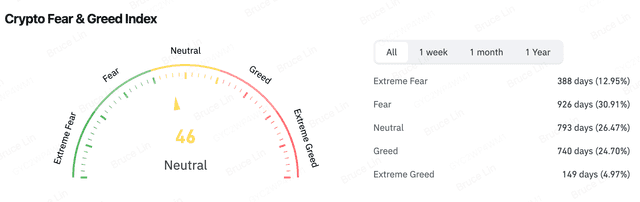
Bitcoin has staged a notable comeback in early May 2026, breaking back above the psychologically critical $80,000 level after months of bearish pressure. According to Coinglass, on May 7, 2026, the Crypto Fear & Greed Index has climbed to 46 — firmly in neutral territory and decisively out of the "extreme fear" zone that dominated earlier this year. With sentiment shifting and bullish voices growing louder across trading desks, the question on every investor's mind is clear: can Bitcoin recover the $120,000 high it lost, and potentially push even higher in 2026?
The answer depends on several converging catalysts and unresolved risks. Federal policy moves around a U.S. Bitcoin Strategic Reserve, the potential passage of the Clarity Act, and on-chain dynamics will determine whether bulls can sustain momentum or whether another leg down awaits.
What Bullish Catalysts Could Push Bitcoin Back to $120K?
Bitcoin's path to $120,000 hinges on two major regulatory tailwinds gaining momentum in Washington — a formalized federal Bitcoin reserve and comprehensive crypto market structure legislation. Both developments would inject institutional confidence and create a fundamentally different demand backdrop than the speculative cycles of previous years.
Beyond regulation, broader macro conditions are also turning constructive. Sentiment has rebounded sharply from April's lows, ETF inflows have resumed, and miner capitulation appears largely behind us. The combination of policy clarity and renewed institutional appetite forms the strongest bullish setup since late 2024.
How Could the White House Bitcoin Strategic Reserve Impact Price?
A formalized federal Bitcoin reserve could mark Bitcoin's entry into the global sovereign reserve system — a milestone catalyst that would fundamentally reprice the asset. According to remarks from Patrick Witt, Executive Director of the White House Digital Assets Advisory Council at the Bitcoin 2026 Conference, the administration is actively advancing implementation of the Bitcoin Strategic Reserve executive order signed by President Trump last year, with major updates expected within weeks.
Witt emphasized that the team is currently working through operational mechanics and legal frameworks to ensure Bitcoin held on the government's balance sheet is properly managed and protected. He hinted at "significant breakthroughs" coming in the near term, though noted that legislative codification remains essential for long-term durability.
The existing Strategic Reserve, established under executive order, is currently composed primarily of Bitcoin obtained through criminal and civil forfeiture, supplemented by a broader digital asset stockpile system. Because executive orders lack the permanence of legislation, Congress is now pushing to enshrine the framework into law.
The legislation introduced by Senator Cynthia Lummis and Representative Nick Begich — recently renamed the American Reserve Modernization Act (ARMA) — proposes acquiring 1 million BTC over five years through "budget-neutral" methods. Analysts widely view passage of ARMA as a watershed moment that would formally embed Bitcoin into national reserve architecture, potentially triggering sovereign FOMO from other nations.
If even partial purchases begin in the second half of 2026, demand-side pressure could propel Bitcoin past $120K and toward new all-time highs.
Will the Clarity Act Pass in Summer 2026?
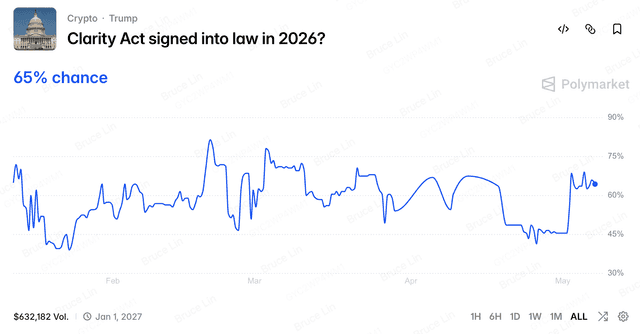
Polymarket bettors are pricing in a 65% probability that the Clarity Act passes in 2026, based on contract data as of May 7, 2026 — and passage would represent the single largest regulatory tailwind in crypto history. The bill establishes the long-awaited framework that distinguishes digital commodities from securities and clarifies jurisdiction between the SEC and CFTC.
For Bitcoin specifically, the Clarity Act delivers several compounding benefits:
-
Regulatory certainty for institutions: Pension funds, sovereign wealth funds, and corporate treasuries gain a clear legal framework for Bitcoin allocation.
-
Banking integration: Banks can custody and service crypto assets without facing ambiguous enforcement risk.
-
Stablecoin clarity: A coherent stablecoin framework deepens crypto market liquidity, indirectly benefiting BTC pairs and on-ramps.
-
Tokenization unlock: Real-world asset tokenization gains compliant rails, strengthening the broader on-chain economy that Bitcoin anchors.
-
Reduced enforcement overhang: Years of "regulation by enforcement" risk dissipates, encouraging risk-taking and innovation.
A summer 2026 passage timeline aligns with historical patterns of pre-election legislative pushes. Should the bill clear both chambers and reach the President's desk before August recess, Bitcoin could see immediate upside repricing of 15-25% based on similar regulatory catalyst events in past cycles.
What Are the Key Potential Risks Holding Bitcoin Back?
Despite the bullish setup, three significant risks could stall or reverse Bitcoin's path to $120,000 — geopolitical volatility from U.S.-Iran tensions, on-chain warning signals from long-term holder cost basis, and the looming possibility that Strategy (formerly MicroStrategy) may begin liquidating its Bitcoin holdings.
These risks are not hypothetical. Each has materialized in recent weeks and continues to weigh on market structure, even as headline sentiment improves.
How Are U.S.-Iran Tensions Affecting Bitcoin?
The on-again, off-again nature of U.S.-Iran military tensions has created brutal whipsaw conditions in Bitcoin's short-term price action. Each rumor of escalation triggers sharp risk-off selling, while every de-escalation headline sparks aggressive relief rallies — making it nearly impossible for traders to position with conviction.
This headline-driven volatility disproportionately impacts leveraged positions. According to Coinglass liquidation data from early May 2026, the cryptocurrency market has experienced multiple billion-dollar liquidation events tied directly to Middle East news cycles in the past 30 days. Bitcoin has whipsawed between $76K and $84K repeatedly during this period.
For Bitcoin to mount a sustained move toward $120K, geopolitical risk needs to either fully de-escalate or get fully priced in. Until then, expect continued chop and amplified volatility around any Middle East headline.
What Do On-Chain Indicators Reveal About Bitcoin's Cycle?
Bitcoin's on-chain data presents a genuine cause for concern — the historical "four-year cycle" pattern suggests a long-term holder cost-basis breakdown should occur in 2026, and it has not yet happened. This creates risk that bears are not finished, even with price recovering above $80K.
Historically, Bitcoin's four-year cycle has been marked by price breaking below the long-term holder (LTH) realized cost basis roughly once every cycle. Time-wise, that breakdown would be expected sometime in 2026.
While Bitcoin briefly touched the $60K region in February 2026, it never broke below the long-term holder cost basis — currently sitting around $48K according to Glassnode on-chain metrics from early May 2026. Many analysts interpret this as a sign that the bear phase may not be complete. The historical pattern suggests bear markets typically last longer than the recent drawdown, and a swift bear-to-bull transition without testing LTH cost basis would be unusual.
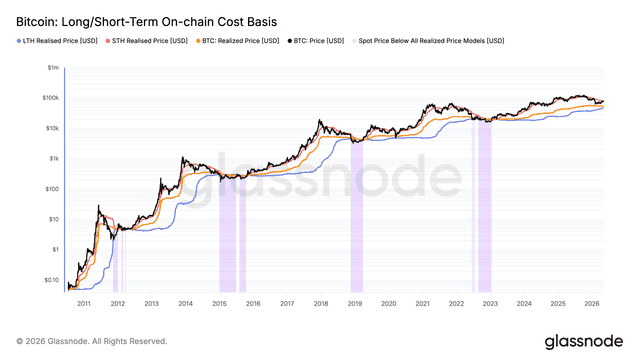
In other words, there is no guarantee that the $48K level holds throughout 2026. A retest — or break — of long-term holder cost basis would dramatically change the path back to $120K and could delay any sustained rally well into 2027.
Could Strategy (MicroStrategy) Selling Trigger a Crash?
Strategy — the company formerly known as MicroStrategy and the largest corporate Bitcoin holder — has shifted its rhetoric and now suggests Strategy may sell Bitcoin under certain conditions, marking a stunning reversal of its long-standing "never sell" stance. This represents potentially the largest single overhang on Bitcoin's market structure.
The shift in tone reflects mounting pressure from convertible note maturities and the company's modified NAV premium dynamics. If Bitcoin price stalls below previous purchase averages for an extended period, forced or strategic sales become increasingly probable. Investors should monitor Strategy's quarterly disclosures and any 8-K filings closely for signs of treasury policy changes.
How Likely Is Bitcoin to Hit $120K in 2026?
Bitcoin reaching $120,000 in 2026 is plausible but not guaranteed — the probability sits in a realistic range of 45-60% based on current catalyst alignment. The bullish case requires at least one of two major catalysts (ARMA passage or Clarity Act passage) to materialize alongside neutral-to-positive macro conditions.
|
Scenario
|
Probability
|
Year-End 2026 Target
|
|
Bull case: Both ARMA & Clarity Act pass
|
25%
|
$135K - $160K
|
|
Base case: One major catalyst passes
|
40%
|
$105K - $125K
|
|
Bear case: Neither passes, LTH cost basis breaks
|
35%
|
$55K - $75K
|
The base case puts $120K firmly in play. The bull case takes Bitcoin well past it. Only in the bear case does $120K become unreachable in 2026.
How to Buy and Trade Bitcoin on KuCoin
KuCoin offers one of the most comprehensive Bitcoin trading experiences in the industry, with deep liquidity, competitive fees, and access to both spot and derivatives markets. Whether you believe Bitcoin is heading to $120K or expect further volatility, KuCoin provides the tools to act on your thesis.
Getting started takes just a few minutes:
-
Create your account at KuCoin.com and complete identity verification for full trading access.
-
Fund your account via crypto deposit, credit card, P2P trading, or supported fiat on-ramps.
-
Choose your market — buy spot BTC for long-term holding, trade BTC/USDT perpetual futures with up to 125x leverage, or earn yield through KuCoin Earn products.
-
Set your strategy using KuCoin's advanced order types, including limit orders, stop-loss, and trailing stops to manage risk during volatile sessions.
-
Monitor and manage your position with real-time charts, on-chain data integrations, and KuCoin's mobile app for trading on the go.
New users can now register at KuCoin and Get Up to 11,000 USDT in New User Rewards.

Conclusion
Bitcoin reclaiming $80,000 in May 2026 marks a meaningful psychological and technical recovery, with the Fear & Greed Index returning to neutral territory and bullish narratives regaining traction. The path to $120,000 remains genuinely viable, supported by two powerful catalysts: the potential codification of a federal Bitcoin Strategic Reserve through the American Reserve Modernization Act, and the projected summer 2026 passage of the Clarity Act, currently priced at 65% probability on Polymarket.
However, meaningful risks remain. U.S.-Iran geopolitical tensions continue to whipsaw short-term price action, on-chain data suggests the long-term holder cost basis around $48K has not yet been tested as historical four-year cycles would predict, and Strategy's softened stance on selling Bitcoin introduces a significant supply-side overhang.
The base case — where Bitcoin reaches $105K-$125K by year-end 2026 — remains the most probable outcome, putting $120K well within reach. Investors should size positions according to their risk tolerance, watch regulatory developments closely, and remain prepared for continued volatility on the path higher.
FAQs
1. What is Bitcoin's all-time high price?
Bitcoin's all-time high sits above $120,000, set during the bull run of late 2024 through 2025. The current $80K+ recovery represents a significant reclaim of lost ground, but BTC remains roughly 33% below its peak as of May 2026.
2. Should I buy Bitcoin now or wait for a pullback?
Dollar-cost averaging is generally the lowest-risk approach for investors with a multi-year horizon. Trying to time a perfect entry around $80K carries the risk of missing further upside if catalysts like ARMA or the Clarity Act pass earlier than expected.
3. How does Bitcoin halving affect 2026 price predictions?
The most recent Bitcoin halving occurred in April 2024, reducing block rewards to 3.125 BTC. Historically, peak prices arrive 12-18 months post-halving — placing 2026 within the historical post-halving bull window, though past cycles do not guarantee future results.
4. What's the difference between long-term holders and short-term holders in Bitcoin on-chain analysis?
Long-term holders (LTH) are wallets that have held Bitcoin for more than 155 days, typically representing conviction-driven investors. Short-term holders (STH) are recent buyers more likely to react to price volatility. LTH cost basis serves as a key support level during corrections.
5. Can other countries adopt Bitcoin as a reserve asset like the U.S.?
Yes, several countries are exploring Bitcoin reserve frameworks. El Salvador already holds Bitcoin as part of its national treasury, and analysts expect that U.S. ARMA passage would accelerate adoption among other sovereign nations seeking to diversify away from dollar-only reserves.